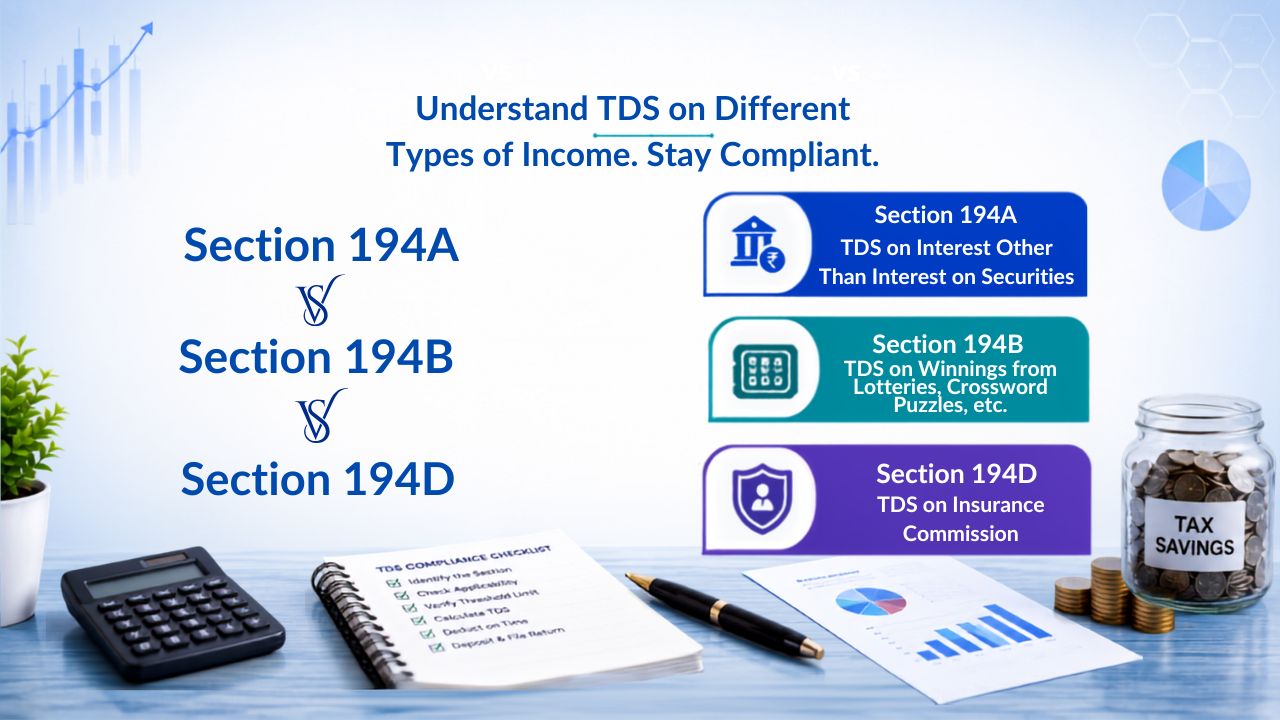
Section 194A vs Section 194B vs Section 194D: TDS on Different Incomes
Three different people. Three different tax deductions. Three different sections of the Income Tax Act.
Your bank quietly deducted Rs. 6,500 from your FD interest payout. A game show deducted Rs. 15,000 before handing you your prize money. Your friend who sells insurance got Rs. 1,000 cut from his commission cheque.
All three are TDS. But all three happen under completely different sections: Section 194A, Section 194B, and Section 194D , with different rates, different thresholds, and different rules on whether you can stop the deduction or claim it back.
In my seven years of working with salaried professionals, I have seen genuine confusion around these three sections. People assume all TDS works the same way. It does not. Understanding the Section 194A vs Section 194B vs Section 194D TDS comparison will help you know exactly what was deducted, why, and what you can do about it.
What is Section 194A: TDS on Interest Income
Section 194A deals with TDS on interest income other than interest on securities. This section covers the interest you earn on fixed deposits, recurring deposits, savings accounts, loans given to others, and any other interest income that does not come from government securities or bonds.
The key word here is “other than securities. Interest on government bonds and debentures is covered under a different section. Everything else , bank FD interest, NBFC interest, interest from cooperative societies, interest on loans , falls under Section 194A.
Who deducts TDS under Section 194A?
Any person paying interest income to you is responsible for deducting TDS, provided they meet the criteria. This includes banks, cooperative societies, post offices, NBFCs, companies, and even individuals in certain cases.
However, individuals and HUFs who are not subject to tax audit in the previous year are not required to deduct TDS on interest they pay. So if you lend money to a friend and they pay you interest, they are not required to deduct TDS.
Threshold limits under Section 194A
The threshold limit determines when TDS kicks in. If your interest income stays below the threshold, no TDS is deducted.
For banks, cooperative societies, and post offices, the threshold is Rs. 40,000 per financial year. If your total interest from a bank in a year stays below Rs. 40,000, the bank will not deduct TDS. For senior citizens aged 60 and above, this threshold has been raised to Rs. 1,00,000 per financial year from FY 2025-26 onwards, following the Budget 2025 announcement.
For all other deductors such as NBFCs, companies, individuals paying interest on business loans , the threshold is Rs. 5,000 per financial year. This lower threshold catches a wider range of interest payments.
TDS rate under Section 194A
The TDS rate under Section 194A is 10% on the interest amount exceeding the threshold. If you do not have a PAN, the rate goes up to 20%.
The TDS is deducted at the time of credit or payment, whichever is earlier. So if your bank credits FD interest to your account on March 31, the TDS is deducted on that date itself.
Can you stop TDS under Section 194A?
Yes. This is the one section among the three where you can prevent TDS deduction by submitting Form 15G or Form 15H if your total income is below the taxable limit. You can read the complete guide on Form 15G vs Form 15H vs Form 121 to understand who should submit which form.
Under the New Income Tax Act 2025, Section 194A is renumbered to Section 393. For FY 2025-26 filing in July 2026, old section numbers continue to apply since you are filing under Tab 1 of the Income Tax Portal.
Practical example: Section 194A
You have a fixed deposit of Rs. 8 lakh at 8% annual interest with your bank. Annual interest works out to Rs. 64,000. Since this exceeds the Rs. 40,000 threshold, your bank will deduct TDS at 10% on Rs. 64,000, which comes to Rs. 6,400. You receive Rs. 57,600 as net interest.
If you are a senior citizen with the same FD, no TDS is deducted since Rs. 64,000 is below the Rs. 1,00,000 threshold that applies to senior citizens.
What is Section 194B: TDS on Lottery and Game Winnings
Section 194B is a completely different category. It deals with TDS on winnings from lotteries, crossword puzzles, card games, gambling, betting, and any game of any sort , whether the prize is cash or kind.
The biggest difference from Section 194A is this: you cannot stop this TDS. No Form 15G, no Form 15H, no exemption based on your income level. If you win above the threshold, TDS is deducted regardless of your total annual income. Even if your income is zero otherwise, the TDS stands.
Who deducts TDS under Section 194B?
The person or organisation responsible for paying the winnings must deduct TDS before releasing the prize. This includes lottery organisers, TV game show producers, casinos, racecourses, and card game operators.
If the prize is in kind, such as a car, a holiday package, or jewellery, the organiser cannot simply hand over the prize without first ensuring tax is paid. The winner must deposit the tax amount with the organiser in cash, and only then can the prize be released.
Threshold and rate under Section 194B
The threshold under Section 194B is Rs. 10,000 per transaction. This is a per-transaction threshold, not an annual aggregate. So if you win Rs. 8,000 in one game and Rs. 9,000 in another, neither triggers TDS even though your total winnings are Rs. 17,000.
The TDS rate is a flat 30%. No deductions under Chapter VI-A (80C, 80D, etc.) can be claimed against this income. No basic exemption benefit applies. Tax at 30% plus 4% health and education cess makes the effective rate 31.2%.
These winnings are reported under “Income from Other Sources” in your ITR-2 or ITR-3.
Online gaming: Section 194BA
From April 1, 2023, online gaming winnings are covered under a separate provision: Section 194BA. This section has no threshold limit at all. Even Re. 1 of net winnings is subject to TDS at 30%. TDS is deducted at every withdrawal from the gaming platform and on any remaining balance at the end of the financial year.
Under the New Income Tax Act 2025, both Section 194B and Section 194BA are consolidated into Section 393. The rates and mechanism remain the same; only the section number changes from Tax Year 2026-27 onwards.
Can you get a refund on Section 194B TDS?
If your total income including winnings is below the taxable limit, you can claim the TDS as a refund when you file your ITR. However, this is a refund through ITR filing, not an exemption at source. The TDS will be deducted regardless.
Practical example: Section 194B
You win Rs. 50,000 in a television game show. Since Rs. 50,000 exceeds the Rs. 10,000 per-transaction threshold, TDS at 30% is deducted on the full Rs. 50,000. TDS amounts to Rs. 15,000. You receive Rs. 35,000 as the net prize. This Rs. 15,000 appears in your Form 26AS and can be adjusted against your final tax liability when you file ITR.
If the prize was a car worth Rs. 5 lakh, you would need to deposit Rs. 1,50,000 in cash as tax with the organiser before the car keys are handed over to you.
What is Section 194D: TDS on Insurance Commission
Section 194D is the most specific of the three. It deals only with TDS on commission or remuneration paid to insurance agents and insurance intermediaries for sourcing insurance business , both life and general insurance.
If you are an insurance agent who receives commission from an insurance company for policies you sell, TDS under Section 194D applies to your earnings.
Who deducts TDS under Section 194D?
The insurance company paying the commission deducts TDS before crediting the agent’s account. This applies to life insurance companies, general insurance companies, and reinsurance companies.
Threshold and rate under Section 194D
The threshold under Section 194D is Rs. 15,000 per financial year. If your total commission from a single insurer stays below Rs. 15,000 in the year, no TDS is deducted.
The rate depends on who is receiving the commission. For individuals and HUFs, the TDS rate is 5%. For companies and other non-individual entities, the rate is 10%. If PAN is not provided, the rate goes up to 20% for all categories.
Can you stop TDS under Section 194D?
Individual agents with income below the taxable limit can submit Form 15G to prevent TDS deduction. This works the same way as for FD interest under Section 194A. The commission income should be below the basic exemption limit and the estimated tax on total income should be NIL.
Practical example: Section 194D
An insurance agent earns Rs. 20,000 as commission from a life insurance company in FY 2025-26. Since Rs. 20,000 exceeds the Rs. 15,000 threshold, TDS at 5% applies on the full Rs. 20,000. TDS comes to Rs. 1,000. The agent receives Rs. 19,000. This Rs. 1,000 is credited to Form 26AS and can be claimed back in ITR if the agent’s total tax liability is lower.
If the same commission was earned by an insurance broking company, TDS would be at 10%, making it Rs. 2,000.
Section 194A vs Section 194B vs Section 194D: Comparison Table
| Parameter | Section 194A | Section 194B | Section 194D |
|---|---|---|---|
| Income type | Interest (FD, RD, savings, loans) | Lottery, game show, card game winnings | Insurance agent commission |
| Who deducts | Banks, NBFCs, co-op societies, others | Lottery/game organisers | Insurance companies |
| Threshold | Rs. 40,000 (banks); Rs. 5,000 (others) | Rs. 10,000 per transaction | Rs. 15,000 per year |
| Senior citizen threshold | Rs. 1,00,000 (banks) | Not applicable | Not applicable |
| TDS rate | 10% | 30% (flat, no deductions) | 5% (individual); 10% (company) |
| No PAN rate | 20% | 30% | 20% |
| Can NIL TDS be claimed? | Yes, via Form 15G or Form 15H | No | Yes, via Form 15G (individuals) |
| Deductions allowed against income | Yes (80C, 80D, slab benefit, etc.) | No (flat tax, no deductions allowed) | Yes (slab benefit applies) |
| Report in ITR under | Income from Other Sources | Income from Other Sources | Business or Professional Income |
| New Act 2025 section | Section 393 | Section 393 | To be confirmed |
Key Differences You Must Know
TDS rate difference is massive. Section 194A at 10% and Section 194D at 5% are manageable deductions. Section 194B at 30% is a far heavier hit and happens regardless of your tax slab or income level.
Threshold structure is different. Section 194A threshold is annual and per-deductor. Section 194B threshold is per transaction. Section 194D threshold is annual from a single insurer. This distinction matters a lot for planning.
Form 15G works for two but not for one. You can submit Form 15G or Form 15H to stop TDS under Section 194A and Section 194D. You cannot do so for Section 194B winnings under any circumstances.
Deductions against income work differently. If you earn FD interest, you can use deductions like 80C and 80D to reduce your overall tax liability. If you win a lottery, those deductions offer zero benefit against that specific income. The 30% applies on the gross winnings without any offset.
How All Three Sections Connect to Your ITR
Regardless of which section the TDS was deducted under, the credit always shows up in your Form 26AS on the Income Tax Portal and the Annual Information Statement. When you file your ITR, all three credits are available to offset your final tax liability.
The income itself is reported differently. FD interest and lottery winnings both go under “Income from Other Sources,” but lottery winnings have a special flat tax rate applied to them. Insurance commission is typically reported under “Business or Professional Income” by the agent.
You can read the complete picture of how TDS works across different payment types in the TDS vs TCS comparison guide and the broader overview in the income tax guide for India.
Section 194A, 194B, 194D Under the New Income Tax Act 2025
Under the New Income Tax Act 2025, which became effective from April 1, 2026, all the non-salary TDS provisions previously spread across the 194-series have been consolidated into Section 393. This includes Section 194A (interest), Section 194B (lottery winnings), and Section 194BA (online gaming). Section 194D is expected to follow a similar renumbering.
The rates and thresholds remain unchanged. Only the section numbers shift. For ITR filing in July 2026 covering FY 2025-26, you continue using old section numbers since you are filing under Tab 1 of the Income Tax Portal. New section references apply from Tax Year 2026-27 onwards under Tab 2. You can read the full transition guide in the New Income Tax Act 2025 vs Income Tax Act 1961 article.
Common Mistakes Taxpayers Make with These Three Sections
Assuming FD interest below Rs. 40,000 is tax-free. TDS is not deducted if interest is below Rs. 40,000, but the income is still taxable. You must declare it in your ITR and pay tax as per your slab rate. TDS threshold and taxability are two separate things.
Thinking lottery TDS can be avoided. No form, no declaration, and no income level can exempt you from TDS under Section 194B. If you win above Rs. 10,000 in a single transaction, TDS at 30% will be deducted.
Insurance agents not submitting Form 15G. Many individual insurance agents with low income do not know they can submit Form 15G to avoid TDS on commission. If your total income is below the basic exemption limit, submit Form 15G to your insurance company at the start of each financial year.
Missing TDS credit in ITR. All three sections result in TDS credits in Form 26AS. Always cross-check your Form 26AS before filing. If any TDS entry is missing, follow up with the deductor immediately. A missing entry means you lose the credit for that year.
Not declaring low-interest income. If your FD interest is Rs. 35,000 and the bank did not deduct TDS (below Rs. 40,000 threshold), many people assume it does not need to be declared. It does. All interest income must be reported in ITR regardless of whether TDS was deducted. You can check the TDS on salary and other income guide for more details on how different income types are handled.
Conclusion
Section 194A, Section 194B, and Section 194D cover three completely different types of income – yet all three work on the same principle: the government collects tax in advance before the money reaches you.
The most important takeaways:
Section 194A on FD interest is manageable. You can prevent it with Form 15G or Form 15H if your income is below the taxable limit, and all deductions apply normally when you file ITR.
Section 194B on lottery winnings is non-negotiable. No form, no exemption, no deduction can stop the 30% TDS at source. The only option is to claim a refund through ITR if your total tax liability is lower.
Section 194D on insurance commission is straightforward. Individual agents pay only 5%, and Form 15G works here too if income is below the exemption limit.
All three credits show up in your Form 26AS. Always verify before filing ITR so you do not miss a single rupee of credit you are entitled to.
Frequently Asked Questions
Can I claim a refund if TDS was deducted under Section 194B on my lottery winnings? Yes, if your total tax liability after including the winnings is lower than the TDS deducted, you can claim a refund by filing your ITR. However, the TDS will be deducted at source regardless. You cannot avoid it by submitting any declaration form.
My bank has multiple FDs. Is the Rs. 40,000 threshold per FD or total? The threshold is per bank branch, not per FD. Your bank aggregates the interest from all FDs at the same branch and applies TDS if the total exceeds Rs. 40,000. If you have FDs at different banks, each bank applies its own threshold independently.
I won Rs. 8,000 in a card game. Will TDS be deducted? No. The threshold under Section 194B is Rs. 10,000 per transaction. Since Rs. 8,000 is below this threshold, no TDS will be deducted. However, you must still declare this income in your ITR as income from other sources.
As an insurance agent earning Rs. 12,000 commission, will TDS be deducted? No. The threshold under Section 194D is Rs. 15,000 per financial year from a single insurer. Since Rs. 12,000 is below this threshold, no TDS will be deducted. Still declare it in ITR.
What if I have income from all three: FD interest, lottery winnings, and insurance commission in the same year? All three will appear separately in your Form 26AS as TDS credits under their respective sections. You add all three to your total income and compute final tax. All TDS credits are then deducted from the final tax liability, and the balance is either paid or refunded.
Under the New Income Tax Act 2025, do these section numbers change? Yes. Section 194A, Section 194B, and Section 194BA are all consolidated into Section 393 under the New Income Tax Act 2025. Section 194D is expected to be similarly renumbered. For FY 2025-26 ITR filing in July 2026, old section numbers still apply since you file under Tab 1 of the portal.