TDS vs TCS: Key Differences Every Taxpayer Must Know in 2026
You filed your ITR last year. You claimed your TDS credit. Done.
But then you bought a car and the dealer charged you Rs. 12,000 extra. Your bank deducted something called TCS on your foreign transfer. And suddenly you have no idea what is going on or whether you can get that money back.
TDS and TCS both reduce your final tax bill, both show up in your Form 26AS, but they work in completely opposite directions. Miss either one while filing and you leave money on the table.
This guide covers everything you need to know about TDS vs TCS difference in 2026, including updated rates for FY 2025-26, practical examples, and how these changes look under the New Income Tax Act 2025.
What is TDS (Tax Deducted at Source)?
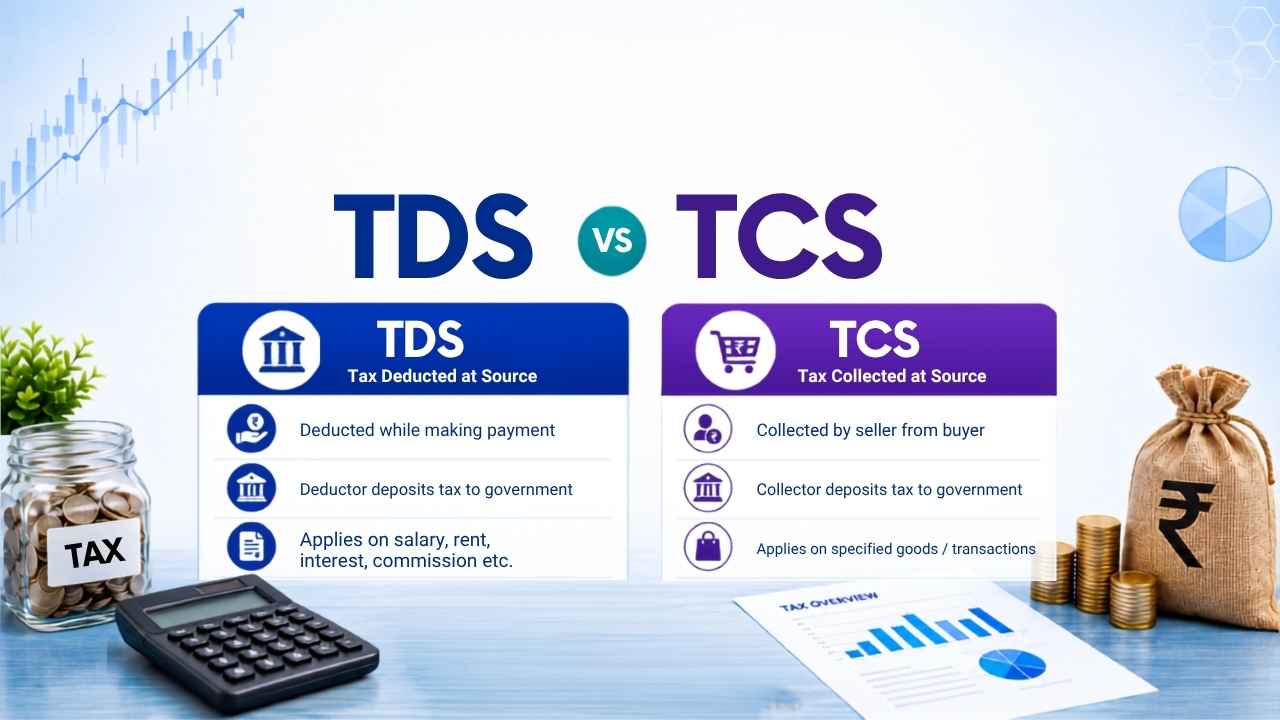
TDS stands for Tax Deducted at Source. Under this mechanism, the person making a payment deducts a percentage of tax before releasing the amount to the recipient. The deducted tax is then deposited with the government on behalf of the recipient.
Think of it this way: if your employer pays you Rs. 1,00,000 as salary and your applicable TDS rate works out to Rs. 8,000 for that month, you receive Rs. 92,000 in hand. The remaining Rs. 8,000 goes to the government as advance tax on your behalf.
TDS applies to a wide range of payments including salary, interest on fixed deposits, rent, professional fees, commission, and payment to contractors. Each type of payment has its own TDS section, threshold limit, and rate under the Income Tax Act 1961, or under the New Income Tax Act 2025 if you are filing from Tax Year 2026-27 onwards.
The person responsible for deducting TDS is called the deductor, and the person whose tax is deducted is the deductee.
What is TCS (Tax Collected at Source)?
TCS stands for Tax Collected at Source. Under this mechanism, the seller of certain specified goods or services collects a percentage of tax from the buyer at the time of sale and deposits it with the government on the buyer’s behalf.
The direction here is reversed compared to TDS. In TDS, the payer deducts before paying. In TCS, the seller collects over and above the sale price.
For example, if you buy a car priced at Rs. 12 lakh, the dealer collects Rs. 12,000 as TCS at 1% and deposits it with the government. You receive the car but pay Rs. 12,12,000 in total. That Rs. 12,000 is credited to your tax account and you can claim it when filing your ITR.
TCS was originally limited to a few commodities like timber and scrap. Over the years, the government expanded it significantly to cover foreign remittances, overseas travel packages, and high-value goods purchases.
TDS vs TCS: The Core Difference
The single most important distinction is this: TDS is deducted by the payer, while TCS is collected by the seller.
In TDS, the obligation to deduct and deposit lies with the person making the payment. In TCS, the obligation to collect and deposit lies with the seller. In both cases, the ultimate tax burden belongs to the income earner or the buyer, and both amounts are reflected in their Form 26AS.
TDS vs TCS: Detailed Comparison Table
| Parameter | TDS | TCS |
|---|---|---|
| Full form | Tax Deducted at Source | Tax Collected at Source |
| Who deducts/collects | Payer (employer, bank, tenant, buyer) | Seller of specified goods/services |
| From whom | Deducted from the payee/recipient | Collected from the buyer |
| When | At the time of payment or credit, whichever is earlier | At the time of receipt of payment or debiting buyer’s account |
| Governing section (Old Act) | Sections 192 to 206AA | Section 206C |
| Governing section (New Act 2025) | Sections 390 to 412 | Section 394 |
| Applicable on | Income payments (salary, interest, rent, fees, etc.) | Sale of specified goods and services |
| Certificate issued | Form 16 / Form 130 (salary), Form 16A (others) | Form 27D |
| Return filed by deductor/collector | Form 24Q, 26Q, 27Q | Form 27EQ |
| Credit in taxpayer’s account | Form 26AS / Form 168 | Form 26AS / Form 168 |
| Claim in ITR | Yes, reduces final tax payable or gives refund | Yes, reduces final tax payable or gives refund |
Key TDS Sections and Rates for FY 2025-26
TDS on Salary: Section 192 (Section 392 under New Act)
Your employer deducts TDS on salary based on your estimated annual income and applicable slab rate. There is no fixed percentage; it depends entirely on your total projected income for the year. You can read the complete breakdown in the TDS on salary under Section 192 guide.
Under the New Income Tax Act 2025, Section 192 has been renumbered to Section 392, but the mechanism remains identical for ITR filing in July 2026 since you are filing under Tab 1 (Act 1961) for FY 2025-26.
TDS on Fixed Deposit Interest: Section 194A
Banks deduct TDS at 10% on interest income if it exceeds Rs. 40,000 in a financial year. For senior citizens, the threshold has been raised to Rs. 1,00,000 from FY 2025-26 following the Budget 2025 announcement. If your interest income is below these thresholds, no TDS is deducted.
If you have submitted Form 15G (for individuals below 60 years with income below the taxable limit) or Form 15H (for senior citizens), the bank will not deduct TDS even if interest crosses the threshold. Under the New Income Tax Act 2025, these forms have been consolidated into Form 121.
TDS on Rent: Section 194I
If you pay rent exceeding Rs. 2,40,000 per year to a landlord, TDS at 10% applies on land and building rent, and 2% on plant and machinery rent.
TDS on Professional and Technical Fees: Section 194J
Professional fees (doctors, lawyers, consultants) attract TDS at 10%. Technical services attract a lower rate of 2%. The threshold is Rs. 30,000 per year per payee.
TDS on Property Sale: Section 194-IA
If you buy immovable property worth Rs. 50 lakh or more, you as the buyer must deduct TDS at 1% of the sale value and deposit it. This is one TDS section where the buyer is the deductor.
TDS on EPF Withdrawal: Section 192A
If you withdraw from your EPF before completing five years of continuous service and the withdrawal exceeds Rs. 50,000, TDS at 10% is deducted. No TDS applies if you submit Form 15G or Form 15H.
Key TCS Sections and Rates for FY 2025-26
TCS on Motor Vehicles: Section 206C(1F)
If you purchase a motor vehicle valued above Rs. 10 lakh, the dealer collects TCS at 1% of the sale value. On a Rs. 12 lakh car, TCS works out to Rs. 12,000.
TCS on Foreign Remittance Under LRS: Section 206C(1G)
This is the TCS provision that affects the most salaried professionals today. Under the Liberalised Remittance Scheme, if you send money abroad for investments, foreign education (self-funded), or other purposes, TCS at 20% applies on the amount exceeding Rs. 7 lakh in a financial year.
However, for education remittances made through an educational loan from a financial institution, the TCS rate is only 0.5%. For medical treatment abroad, the rate is 5% above Rs. 7 lakh.
TCS on Overseas Tour Packages: Section 206C(1G)
If you book an overseas tour package, the travel agent collects TCS at 20% on the entire package value regardless of the amount. If the package is booked through an authorized tour operator and the remittance is within Rs. 7 lakh, the rate is 5%.
TCS on Sale of Goods: Section 206C(1H)
Sellers with turnover above Rs. 10 crore in the previous year must collect TCS at 0.1% from buyers who purchase goods worth more than Rs. 50 lakh in a year. Importantly, if the buyer is already deducting TDS under Section 194Q on the same transaction, the seller is exempt from collecting TCS.
TCS on Specified Commodities: Section 206C(1)
Sellers of timber, tendu leaves, scrap, alcoholic liquor, and minerals collect TCS at rates ranging from 1% to 5% depending on the commodity.
Practical Examples: TDS vs TCS in Real Life
Example 1: Ramesh, Salary TDS
Ramesh is a software engineer earning Rs. 15 lakh annually. His employer calculates his estimated tax liability at Rs. 1,20,000 for the year and deducts Rs. 10,000 as TDS every month. By March, the full Rs. 1,20,000 is credited to the government. When Ramesh files his ITR, this entire amount reflects in his Form 26AS and gets adjusted against his final tax liability.
Example 2: Sunita, Car Purchase TCS
Sunita buys a car for Rs. 12 lakh. The dealer collects TCS at 1%, which comes to Rs. 12,000. Sunita pays Rs. 12,12,000 in total. The Rs. 12,000 TCS is deposited by the dealer and shows up in Sunita’s Form 26AS. When she files her ITR, she claims this Rs. 12,000 as a credit against her tax liability.
Example 3: Rohan, LRS Foreign Remittance TCS
Rohan sends Rs. 10 lakh abroad for overseas investment. His bank collects TCS at 20% on the amount exceeding Rs. 7 lakh. That means TCS applies on Rs. 3 lakh at 20%, which equals Rs. 60,000. Rohan pays Rs. 10,60,000 to the bank. The Rs. 60,000 TCS is credited to his Form 26AS and he can claim a refund if his total tax payable is lower than the TCS already collected.
Example 4: Priya, FD Interest Below TDS Threshold
Priya has a fixed deposit of Rs. 5 lakh at 7% annual interest, earning Rs. 35,000 in FY 2025-26. Since this is below the Rs. 40,000 threshold for banks, no TDS is deducted. However, Priya must still declare this Rs. 35,000 as income from other sources in her ITR and pay tax on it based on her slab rate.
How TDS and TCS Credit Works in ITR
Both TDS and TCS amounts are available as tax credits when you file your ITR. The deductor or collector deposits the amount with the government using Challan 281. The credit appears in your Form 26AS on the Income Tax Portal and the Annual Information Statement, now called Form 168 under the New Income Tax Act 2025. When you file your ITR, the system automatically picks up these credits. If your total TDS and TCS credits exceed your final tax liability, the excess is refunded to your bank account.
Always verify your Form 26AS before filing. If any TDS or TCS entry is missing, contact the deductor or collector to rectify it. A missing entry means the credit will not be available at the time of filing.
You can read the full guide on income tax basics for India if you want a comprehensive overview of how TDS and TCS fit into the larger tax filing picture.
TDS vs TCS: Who Bears the Tax Burden?
In both mechanisms, the ultimate tax burden is on the same person: the income earner (TDS) or the buyer (TCS). The deduction or collection is merely an advance tax collection mechanism to ensure that the government receives tax throughout the year rather than in a lump sum at the end.
This is also why both TDS and TCS are considered part of your advance tax payments. If you have already paid advance tax and also have TDS deducted, both amounts are credited and your final tax payable reduces accordingly. Read the advance tax payment guide to understand how all three interact.
Common Mistakes Taxpayers Make with TDS and TCS
Ignoring TCS on car purchase or foreign remittance. Many taxpayers forget to claim TCS credit in their ITR simply because they do not check Form 26AS carefully. Every TCS amount is a credit that reduces your tax outgo.
Not submitting Form 15G or Form 15H on time. If your income is below the taxable limit, submitting Form 15G (now Form 121 under New Act) at the start of the financial year prevents unnecessary TDS deductions and the hassle of claiming a refund.
Assuming TCS is an additional tax. TCS is not an extra tax. It is an advance collection that gets fully adjusted when you file your ITR. If your total income is below the taxable limit, the entire TCS amount comes back as a refund.
Confusing TDS deducted by employer with total tax liability. Your employer deducts TDS based on an estimate made at the start of the year. If your actual income changes due to a bonus, rental income, or capital gains, you may owe additional tax beyond what was deducted. In that case, you need to pay self-assessment tax before filing.
TDS vs TCS: Quick Reference Summary
| Situation | Type | Who Acts | Rate |
|---|---|---|---|
| Employer pays salary | TDS | Employer deducts | Slab rate |
| Bank pays FD interest above Rs. 40,000 | TDS | Bank deducts | 10% |
| You pay rent above Rs. 20,000/month | TDS | You (tenant) deduct | 10% |
| You buy property above Rs. 50 lakh | TDS | You (buyer) deduct | 1% |
| You buy car above Rs. 10 lakh | TCS | Dealer collects | 1% |
| You send money abroad above Rs. 7 lakh | TCS | Bank collects | 20% (0.5% for education loan) |
| You book overseas tour package | TCS | Travel agent collects | 20% |
| You buy goods above Rs. 50 lakh | TCS | Seller collects | 0.1% |
Frequently Asked Questions
Is TCS refundable? Yes. TCS is credited to your tax account just like TDS. If your total TCS and TDS credits exceed your final tax liability, the excess is refunded after you file your ITR.
Do I need to do anything to claim TDS or TCS credit? No separate claim is needed. When you file your ITR, the pre-filled return automatically includes TDS and TCS credits from your Form 26AS. Just verify the figures are correct before submitting.
What if my employer deducted excess TDS? Excess TDS is refunded by the Income Tax Department after processing your ITR. The refund comes directly to your bank account linked to your PAN.
Can TCS on LRS be avoided? No, TCS on foreign remittance above Rs. 7 lakh cannot be avoided if you are remitting from your own funds for investment. You can only get it back as a refund when filing ITR.
What happens if the deductor does not deposit TDS? The tax department can still hold you responsible for the shortfall if TDS was not deposited by your deductor. Always verify Form 26AS before filing. If TDS deducted by your employer or bank does not show in Form 26AS, follow up with them immediately.
Under the New Income Tax Act 2025, do TDS and TCS rules change? The mechanism stays identical. Section numbers change. TDS moves to Sections 390 to 412 and TCS moves to Section 394. For ITR filing in July 2026 for FY 2025-26, you are using Tab 1 (Act 1961), so old section numbers apply. New section numbers will matter from Tax Year 2026-27 filed in July 2027.