Gratuity vs Leave Encashment: Tax Exemption Comparison 2026
After 20 years at the same company, you finally retire.
Your employer hands you two cheques. One says gratuity: Rs. 7,00,000. The other says leave encashment: Rs. 6,00,000. Together that is Rs. 13,00,000 in your hands.
Now the question is: how much of this is actually tax-free?
The gratuity vs leave encashment tax exemption comparison is one of the most important things a salaried professional needs to understand before retirement or resignation. Both are part of your retirement benefits, but they are governed by completely different sections of the Income Tax Act, have different exemption limits, and use different formulas to calculate what is tax-free.
In my seven years of working with salaried employees, I have seen many people assume both are fully tax-free. They are often not. And the difference between knowing and not knowing can mean lakhs in unexpected tax liability.
What is Gratuity?
Gratuity is a lump sum payment made by your employer as a token of gratitude for your long service. It is governed by the Payment of Gratuity Act, 1972, and is payable when you complete at least five years of continuous service with the same employer.
The five-year condition is waived in two situations: if you die during service or if you become permanently disabled. In both cases, gratuity is paid even if service is less than five years.
Gratuity is payable at the time of retirement, resignation, termination, or death. It is a one-time payment and not a monthly benefit.
What is Leave Encashment?
Leave encashment is the payment you receive for the unused earned leave standing to your credit at the time of retirement or separation. Simply put, your employer pays you money in lieu of the leaves you accumulated but never took.
Unlike gratuity, leave encashment can also be received during service when your employer allows you to encash accumulated leaves periodically. However, the tax treatment changes depending on when you receive it.
Key Difference Before the Tax Rules
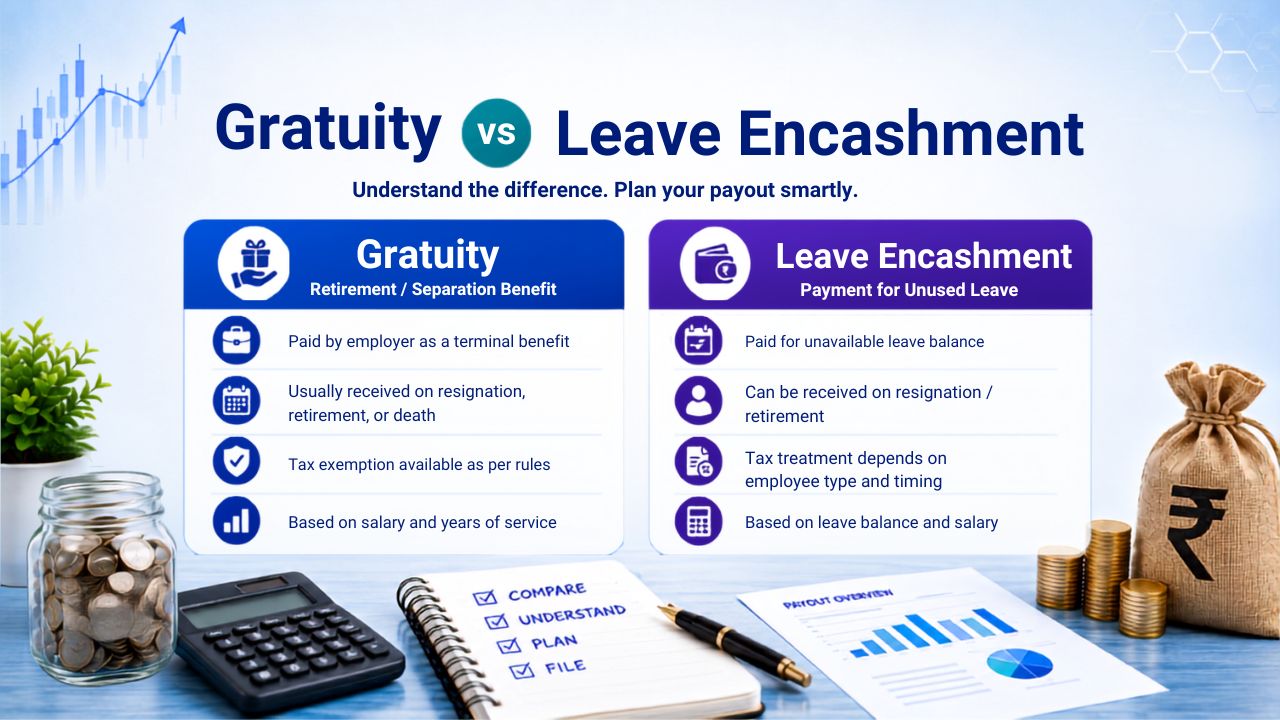
Both gratuity and leave encashment are part of salary income. Both have exemptions under the Income Tax Act. But the similarities end there.
Gratuity is paid only at the end of employment. Leave encashment can be received both during service and at the end. Gratuity has a specific formula linked to your last drawn salary and years of service. Leave encashment exemption is based on your average salary over the last ten months. And critically, the exemption limits are different , Rs. 20 lakh for gratuity and Rs. 25 lakh for leave encashment for private sector employees.
Tax Exemption on Gratuity: Section 10(10)
The tax treatment of gratuity under Section 10(10) depends on which category of employee you fall into.
Government Employees
If you are a Central Government employee, State Government employee, defence personnel, or employee of a local authority, your entire gratuity is fully exempt from tax. There is no upper limit. Whether you receive Rs. 10 lakh or Rs. 50 lakh as gratuity, not a single rupee is taxable.
Private Sector Employees Covered Under the Payment of Gratuity Act
Most private sector employees working in establishments with ten or more employees fall under the Payment of Gratuity Act, 1972. For these employees, the tax exemption on gratuity is the least of the following three amounts:
The actual gratuity received, or the amount calculated using the formula 15/26 multiplied by last drawn salary multiplied by completed years of service, or Rs. 20,00,000 (Rs. 20 lakh), whichever is the lowest.
For this formula, salary means basic salary plus dearness allowance only. Completed years of service rounds up if the remaining period is six months or more. So 20 years and 7 months counts as 21 years, but 20 years and 4 months counts as 20 years.
The exemption limit of Rs. 20 lakh was enhanced from Rs. 10 lakh in March 2018 and continues to apply for FY 2025-26.
Private Sector Employees Not Covered Under the Payment of Gratuity Act
Some employees work in organisations with fewer than ten employees or in sectors not covered under the Act. For these employees, the exemption is the least of:
The actual gratuity received, or half a month’s average salary multiplied by completed years of service (only full years, no rounding), or Rs. 20,00,000.
Here, average salary means the average of the last ten months’ salary, where salary includes basic, DA forming part of retirement benefits, and commission based on a percentage of turnover.
Gratuity Tax Exemption: Practical Examples
Example 1: Private Employee, Gratuity Act Covered
An employee retires after 20 years of service. Last drawn basic salary plus DA is Rs. 60,000 per month. The employer pays Rs. 7,00,000 as gratuity.
Exempt amount is the least of: Actual gratuity: Rs. 7,00,000 Formula: 15/26 x Rs. 60,000 x 20 = Rs. 6,92,308 Limit: Rs. 20,00,000
The least of the three is Rs. 6,92,308. So Rs. 6,92,308 is exempt and the balance Rs. 7,692 is taxable as salary income.
Example 2: High Salary Employee, Limit Hits
An employee retires after 25 years. Basic plus DA is Rs. 1,50,000 per month. Gratuity received is Rs. 25,00,000.
Exempt amount is the least of: Actual gratuity: Rs. 25,00,000 Formula: 15/26 x Rs. 1,50,000 x 25 = Rs. 21,63,462 Limit: Rs. 20,00,000
The least is Rs. 20,00,000. So Rs. 20,00,000 is exempt and Rs. 5,00,000 is taxable.
Example 3: Government Employee
A Central Government employee receives Rs. 30,00,000 as gratuity on retirement. The entire Rs. 30,00,000 is fully exempt. No tax, no formula calculation needed.
Tax Exemption on Leave Encashment: Section 10(10AA)
Leave encashment tax exemption depends on two things: when you receive it and which type of employee you are.
Leave Encashment During Service
If your employer allows you to encash accumulated leaves while you are still employed, the entire amount is fully taxable. No exemption is available for leave encashment received during service, regardless of your income level or the amount received.
This is a critical point many employees miss. When companies offer annual leave encashment as part of CTC or flexible benefit plans, that amount is added to your salary and taxed at your applicable slab rate. You can read how this impacts your TDS in the TDS on salary Section 192 guide.
Leave Encashment at Retirement or Resignation: Government Employees
For Central and State Government employees, leave encashment received at the time of retirement is completely exempt from tax with no upper limit. This is similar to the gratuity treatment for government employees.
Leave Encashment at Retirement or Resignation: Private Sector Employees
For private sector employees, the exemption on leave encashment received at retirement, resignation, or termination is the least of four amounts:
The actual leave encashment received, or ten months’ average salary based on the last ten months preceding retirement, or the cash equivalent of the earned leave standing to credit at the time of retirement (subject to a maximum of 30 days of earned leave per year of service), or Rs. 25,00,000 (Rs. 25 lakh).
The Rs. 25 lakh limit was significantly enhanced from the earlier Rs. 3 lakh limit with effect from April 1, 2023, following the Budget 2023 announcement. This was a major relief for private sector employees who were being taxed heavily on leave encashment under the old limit.
For this calculation, average salary means the average of the last ten months’ salary preceding retirement, where salary includes basic salary, DA forming part of retirement benefits, and commission as a percentage of turnover.
Leave Encashment Tax Exemption: Practical Example
An employee retires after 20 years of service. Average salary over the last ten months is Rs. 60,000 per month. The employee has a leave credit of 30 days per year of service (maximum allowed), which means 600 days total. The employer pays Rs. 6,00,000 as leave encashment.
Exempt amount is the least of: Actual encashment: Rs. 6,00,000 Ten months’ salary: Rs. 60,000 x 10 = Rs. 6,00,000 Cash equivalent of leave: (Rs. 60,000 / 30) x 600 = Rs. 12,00,000 Limit: Rs. 25,00,000
The least of the four is Rs. 6,00,000. So the entire Rs. 6,00,000 is exempt. Zero tax.
Gratuity vs Leave Encashment: Full Comparison Table
| Parameter | Gratuity | Leave Encashment |
|---|---|---|
| Governing section | Section 10(10) | Section 10(10AA) |
| Payment of Gratuity Act | Yes, applicable | Not applicable |
| Minimum service required | 5 years (waived on death/disability) | No minimum service required |
| When payable | Retirement, resignation, death, disablement | Retirement, resignation, or during service |
| During service | Not paid during service | Can be paid during service (fully taxable) |
| Government employee exemption | Fully exempt, no limit | Fully exempt at retirement, no limit |
| Private sector exemption limit | Rs. 20,00,000 | Rs. 25,00,000 |
| Formula for private sector | 15/26 x last salary x completed years | Least of 4 conditions |
| Salary definition | Basic + DA only | Average of last 10 months (Basic + DA + commission) |
| Years of service rounding | Half year and above rounds up (Gratuity Act covered) | No rounding, only full years |
| Taxability above limit | Taxable as salary | Taxable as salary |
| On death | Fully exempt for legal heirs | Fully exempt for legal heirs |
| New Act 2025 section | Section 10(10) continues | Section 10(10AA) continues |
Can Both Be Claimed in the Same Year?
Yes. If you retire and receive both gratuity and leave encashment in the same year, you can claim exemption on both separately. The Rs. 20 lakh gratuity limit and Rs. 25 lakh leave encashment limit are independent of each other. There is no combined cap.
Both exempt amounts are excluded from your total income. Only the taxable portion of each, if any, gets added to your salary income for the year. You can cross-check this in your Form 26AS to verify the TDS your employer has deducted after applying these exemptions.
How These Exemptions Work in Old vs New Tax Regime
Both gratuity and leave encashment exemptions under Section 10(10) and Section 10(10AA) are available under both the old and new tax regimes. These are not deductions that get blocked in the new regime like Section 80C or HRA exemption. They are exemptions on the nature of income itself, and they apply regardless of which regime you choose.
This means even if you opt for the new tax regime, your gratuity up to Rs. 20 lakh and your leave encashment up to Rs. 25 lakh at retirement remain fully tax-free. You can read more about which regime works better for your overall income in the old vs new tax regime comparison.
Lifetime Limit for Gratuity
One important point many employees overlook: the Rs. 20 lakh exemption limit for gratuity is a lifetime limit across all employers. If you changed jobs and received gratuity from a previous employer, that amount counts toward your lifetime limit.
For example, if you received Rs. 8,00,000 as gratuity from your previous employer and claimed exemption on it, only Rs. 12,00,000 of exemption remains available from future employers. This needs to be disclosed correctly while filing your income tax return.
Leave encashment also has a lifetime limit. The Rs. 25 lakh exemption under Section 10(10AA) is an aggregate limit across all employers throughout your career. If you received and claimed Rs. 8,00,000 as leave encashment from a previous employer, only Rs. 17,00,000 of exemption remains available from future employers.
What Happens to the Taxable Portion?
Any gratuity or leave encashment amount above the exempt limit is added to your income under the head “Salaries” for that financial year. It is taxed at your applicable slab rate.
If the taxable amount is significant, it could push you into a higher slab in that year. For example, if your regular salary is Rs. 8 lakh and you receive Rs. 6 lakh as taxable gratuity, your total income for that year becomes Rs. 14 lakh. You would want to check your income tax slabs for FY 2026-27 to calculate the liability.
In such cases, you may also want to check if any deductions under Section 89(1), which provides relief for salary arrears and past service income , are available to reduce the tax impact of receiving a large lump sum in a single year.
Leave Encashment on Death
If an employee passes away during service, the leave encashment paid to the legal heirs is fully exempt from tax in their hands. There is no upper limit, and the heirs do not need to pay any tax on this amount regardless of the quantum.
Similarly, gratuity received by legal heirs on the death of an employee is also fully exempt with no limit. Both exemptions under Section 10(10) and Section 10(10AA) extend this protection to the family of the deceased employee.
Common Mistakes to Avoid
Assuming leave encashment during service is tax-free. Many employees think all leave encashment is exempt. It is not. Only leave encashment received at the time of retirement, resignation, or termination qualifies for exemption. Leave encashment received while you are still employed is fully taxable.
Ignoring the lifetime limit on gratuity. If you received gratuity from a previous employer and did not account for it, you may have used up part of your Rs. 20 lakh lifetime limit. Always keep records of gratuity received from each employer.
Using the wrong salary figure in the gratuity formula. The formula uses only basic salary plus DA. HRA, special allowance, bonus, and other components do not form part of “salary” for the gratuity exemption formula.
Not checking TDS deducted by employer. Your employer calculates the exempt amount and deducts TDS only on the taxable portion. But errors happen. Always verify through your Section 10 exemptions and check your Form 26AS before filing ITR.
Not disclosing taxable gratuity or leave encashment in ITR. Even if TDS was deducted correctly, the taxable portion must be declared in your ITR under salary income. Omission can trigger a notice.
Conclusion
Gratuity and leave encashment are two of the most valuable tax-free retirement benefits available to salaried employees in India. For private sector employees, up to Rs. 20 lakh of gratuity and up to Rs. 25 lakh of leave encashment can be completely exempt from tax at the time of retirement.
The key things to remember: government employees get full exemption with no limit on both. Private sector employees need to apply the relevant formula and stay within the prescribed limits. Leave encashment during service is always taxable, no matter what. And both exemptions are available under both old and new tax regimes.
Knowing these rules before your retirement or resignation can help you plan better, avoid a surprise tax bill, and ensure you claim every rupee of exemption you are entitled to.
Frequently Asked Questions
Is gratuity taxable if I resign before 5 years? If you resign before completing five years of continuous service, you are generally not entitled to gratuity under the Payment of Gratuity Act. If your employer pays gratuity voluntarily, the amount is fully taxable since the statutory conditions for exemption are not met.
Is leave encashment during service taxable under both old and new tax regimes? Yes, leave encashment received during service is fully taxable under both regimes. No exemption is available regardless of the tax regime you choose.
My employer gave me gratuity from a trust. Is it still exempt? Yes. Whether the gratuity is paid directly by the employer or through an approved gratuity trust, the exemption under Section 10(10) applies in the same way.
What if I worked for 20 years and 8 months? How many years count for gratuity? For employees covered under the Payment of Gratuity Act, 8 months rounds up to a full year. So 20 years and 8 months counts as 21 years in the formula. For employees not covered under the Act, only complete years count, so it would be 20 years.
Do I need to file ITR if my only income is exempt gratuity and leave encashment? If your total income after exemptions is below the basic exemption limit, you may not be required to file ITR. However, if TDS was deducted on the taxable portion, filing ITR is the only way to claim a refund if you are not liable to pay that tax.