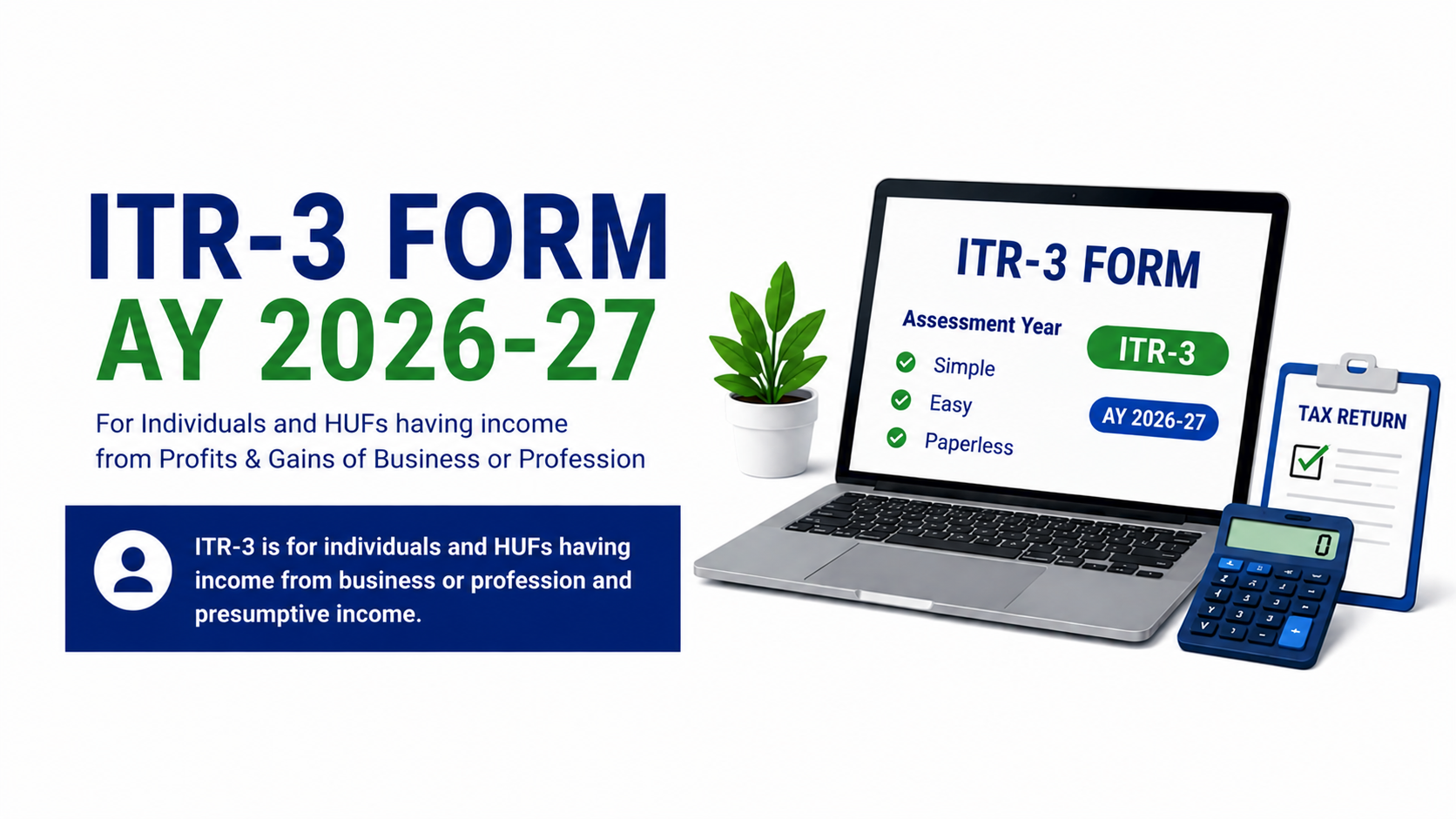
ITR-3 Form AY 2026-27: For Business & Profession Income
If you run a business, practice as a professional, or are a partner in a firm, ITR-1 and ITR-2 are not your forms. You need to file the ITR-3 form.
ITR-3 is the most comprehensive individual return form. It covers every type of income a business owner or professional can have, including profits from a firm, capital gains, salary, house property income, and other sources, all in one return.
This guide covers who must file ITR-3 for AY 2026-27, what schedules it includes, and how to file it correctly on the income tax portal.
What Is ITR-3?
ITR-3 is an income tax return form for individuals and Hindu Undivided Families (HUFs) who have income from a business or profession. If you are new to income tax filing, start with our complete income tax guide before choosing your form. that is not covered under the presumptive taxation scheme.
The key word here is “non-presumptive.” If you are maintaining books of accounts and computing your actual profit and loss, ITR-3 is your form. If you have opted for the presumptive scheme under Section 44AD or 44ADA, you would file ITR-4 instead.
For AY 2026-27, ITR-3 covers income earned during FY 2025-26 (April 1, 2025 to March 31, 2026). Since this period falls under the Income Tax Act 1961, you will use Tab 1 on the income tax portal.
Who Should File ITR-3 form AY 2026-27?
You must file the ITR 3 form if any of the following apply to you:
Business Owners with Books of Accounts
If you own a business and are not opting for presumptive taxation, ITR-3 is mandatory. This includes sole proprietors, traders, manufacturers, and any individual running a business under their own name or a trade name.
Examples:
- A retail shop owner in Delhi earning Rs. 18 lakh annually from trade
- A manufacturer of auto parts maintaining full books of accounts
- A digital marketing agency run by a sole proprietor with Rs. 35 lakh in turnover
Professionals Not Under Presumptive Scheme
Doctors, lawyers, chartered accountants, architects, engineers, and other notified professionals who maintain regular books of accounts and compute actual profits must file ITR-3.
If your professional gross receipts exceed Rs. 75 lakh (the 44ADA threshold), you cannot opt for the presumptive scheme at all. ITR-3 is compulsory.
Partners in a Partnership Firm
If you are a partner in any partnership firm or LLP, you must file ITR-3. This applies even if your only income from the firm is your share of profit, which is exempt from tax under Section 10(2A).
Why? Because as a partner, you have business income. Even if the profit share itself is tax-free, you must report it in ITR-3 and claim the exemption there.
Those with Both Business Income and Other Income
If you have business or professional income along with salary, capital gains, or rental income, ITR-3 covers all of it in a single return. You do not need to file separate returns.
Example: Priya is a salaried software engineer earning Rs. 12 lakh per year. She also runs a freelance consulting practice on the side earning Rs. 8 lakh annually. Since her consulting income is professional income (not covered under presumptive), she must file ITR-3, not ITR-1 or ITR-2.
Who Cannot File ITR-3?
| Situation | Correct Form |
|---|---|
| Only salary income, no business | ITR-1 or ITR-2 |
| Capital gains only, no business | ITR-2 |
| Business income under Section 44AD (presumptive) | ITR-4 |
| Professional income under Section 44ADA (presumptive) | ITR-4 |
| Company, LLP, or firm as an entity | ITR-5 or ITR-6 |
Note: If you previously opted for Section 44AD (business) and want to exit the scheme for AY 2026-27, you must file ITR-3 and you will be barred from re-entering Section 44AD for the next 5 years. This 5-year restriction applies only to business owners under 44AD, not to professionals under 44ADA.
For a detailed comparison of all ITR forms, see the Which ITR Form to File for FY 2025-26 guide.
ITR-3 vs ITR-4: Key Difference
This is the most common confusion point. Here is a straightforward comparison:
| Factor | ITR-3 | ITR-4 |
|---|---|---|
| Books of accounts | Maintained | Not required |
| Taxation basis | Actual profit and loss | Presumptive (flat % of turnover) |
| Audit applicability | Yes, if turnover exceeds threshold | Only if opting out of presumptive |
| Eligible for | All business/profession income | Only Section 44AD, 44ADA, 44AE |
| Turnover limit | No upper limit | Up to Rs. 2 crore (or Rs. 3 crore if 95% transactions are digital) under 44AD; Rs. 75 lakh under 44ADA |
| Complexity | Higher | Lower |
If your business turnover is above Rs. 3 crore or your professional receipts are above Rs. 75 lakh, ITR-3 is automatically your form. The presumptive limits do not apply to you.
Audit Requirement for ITR-3 Filers
Not every ITR-3 filer needs a tax audit. Here is when audit becomes mandatory:
For businesses (Section 44AB): If your total turnover or gross receipts exceed Rs. 1 crore in FY 2025-26, a tax audit by a chartered accountant is required before filing. This limit is Rs. 10 crore if at least 95% of your transactions are digital.
For professionals (Section 44AB): If gross receipts exceed Rs. 50 lakh, audit is required.
If opting out of presumptive scheme: If your declared profit is below the presumptive threshold (8% or 6% for business, 50% for professionals), audit is mandatory regardless of turnover.
Audit cases have a later filing deadline. For AY 2026-27, audit returns must be filed by October 31, 2026, not July 31.
Check the ITR Filing Last Date 2026 article for all applicable deadlines.
Key Schedules in ITR-3
ITR-3 is a detailed form. These are the most important schedules you will encounter:
Schedule BP (Business or Profession): The core schedule where you report gross receipts, expenses, and net profit from your business or profession. If you have a profit and loss statement, this is where it gets summarised.
Schedule P&L (Profit and Loss): A detailed income and expenditure statement if your accounts are audited.
Schedule BS (Balance Sheet): Required for audit cases, capturing your assets and liabilities as of March 31, 2026.
Schedule HP (House Property): For rental income and home loan interest deduction, if applicable.
Schedule CG (Capital Gains): For STCG and LTCG from shares, mutual funds, or property sold during FY 2025-26.
Schedule OS (Other Sources): For interest, dividends, and any other miscellaneous income.
Schedule CYLA and BFLA (Current Year and Brought Forward Loss Adjustment): For setting off current year losses against income and applying losses carried forward from earlier years.
Schedule EI (Exempt Income): For reporting your share of profit from a partnership firm, which is exempt under Section 10(2A).
Schedule AL (Assets and Liabilities): Mandatory if total income exceeds Rs. 50 lakh.
Schedule FA (Foreign Assets): For any foreign bank accounts, foreign equity, or overseas income.
How to File ITR-3 Online: Step by Step
Step 1: Gather Your Documents
Before you begin, keep the following ready:
- Profit and loss statement and balance sheet for FY 2025-26
- Bank statements for the business account
- Form 130 (earlier Form 16) if you also have salary income
- Capital gains statement from your broker, if applicable
- Tax audit report (Form 3CA/3CB and 3CD), if applicable
- Advance tax and self-assessment tax payment challans
Step 2: Log In and Select the Correct Tab
Go to incometax.gov.in and log in with your PAN. For AY 2026-27, select Tab 1 on the portal (Income Tax Act 1961 applies to FY 2025-26 income).
Navigate to: e-File > Income Tax Returns > File Income Tax Return > AY 2026-27 > ITR-3.
Step 3: Choose Online or Offline Mode
ITR-3 is available in both online and offline modes. For most business filers with audit requirements, the offline JSON utility is more practical. You fill the utility, upload the auditor’s report, and then submit the JSON file on the portal.
For non-audit cases with relatively simple income (professional income + salary, no complex P&L), the online mode works well.
Step 4: Fill Schedule BP
Enter your gross receipts or turnover, deductible business expenses, and net profit. The portal does the computation automatically once you enter these figures.
If you have a tax audit, your auditor will have already prepared Form 3CD, which contains a detailed breakdown. Use that as your reference.
Step 5: Report All Other Income
After Schedule BP, fill any additional schedules applicable to your situation: house property, capital gains, or other sources. ITR-3 allows you to consolidate everything in one return.
Step 6: Set Off Losses (If Any)
If you had a business loss in FY 2025-26, you can set it off against other income (except salary) using Schedule CYLA. Losses that cannot be fully set off in the current year can be carried forward for 8 years using Schedule BFLA.
A business loss can also be set off against capital gains in the same year.
Step 7: Claim Deductions and Select Tax Regime
Under the old regime, claim deductions under Chapter VI-A: Section 80C, 80D, 80E, and so on. Under the new regime, these deductions are not available, but tax rates are lower.
Note: Business owners cannot switch tax regimes every year like salaried individuals. After opting out of the new regime, they can switch back to the new regime only once. Once they return to the new regime, they cannot opt out again. This makes the choice more consequential for business owners compared to salaried professionals.
Step 8: Pay Any Balance Tax and Submit
If advance tax paid during the year falls short of your total liability, pay the balance via Challan 280 as self-assessment tax before submitting. Interest under Section 234B applies on any shortfall.
Step 9: Verify the Return
Submit and verify your return within 30 days using Aadhaar OTP, net banking, or sending a signed ITR-V to CPC Bengaluru. An unverified return is treated as not filed.
See the How to Verify ITR After Filing guide for all available options.
Deadlines for ITR-3 Filers: AY 2026-27
| Category | Deadline |
|---|---|
| Non-audit cases | July 31, 2026 |
| Audit cases (Section 44AB) | October 31, 2026 |
| Transfer pricing cases | November 30, 2026 |
| Belated return | December 31, 2026 |
| Revised return | March 31, 2027 |
| Updated return (ITR-U) | March 31, 2031 |
Missing the non-audit deadline means a late filing fee of Rs. 5,000 under Section 234F, along with the loss of the ability to carry forward business losses. Filing on time matters significantly for business owners.
Common Mistakes to Avoid in ITR-3
Not reporting exempt partner income: Partners often skip Schedule EI because their share of firm profit is tax-free. But it must be reported in ITR-3. Omitting it can trigger a notice.
Mixing personal and business expenses: Only expenses directly related to your business or profession are deductible in Schedule BP. Personal expenses claimed as business deductions are a common audit trigger.
Missing advance tax payment interest: If you did not pay advance tax in four instalments during FY 2025-26, interest under Sections 234B and 234C applies. The portal calculates this, but many filers are surprised by the amount.
Forgetting capital gains from investments: Business owners who also invest in stocks or mutual funds must fill Schedule CG in ITR-3. Many assume it is only required in ITR-2.
Wrong tax regime selection for business owners: Unlike salaried individuals, business owners cannot switch tax regimes every year. Once you opt out of the new regime, reverting is not allowed.
Frequently Asked Questions
Q1: I am a freelancer. Should I file ITR-3 or ITR-4?
It depends on whether you are opting for the presumptive scheme. If your gross receipts are up to Rs. 75 lakh and you opt for Section 44ADA (declaring 50% as profit without maintaining full books), file ITR-4. If your receipts exceed Rs. 75 lakh or you prefer to compute actual profit, file ITR-3. Read the Income Tax for Freelancers guide for a detailed breakdown.
Q2: I am a salaried employee but also earn consulting fees on the side. Which form do I file?
If your consulting income is professional income (not covered under presumptive), you must file ITR-3. Your salary income and consulting income are both reported in the same return.
Q3: My business made a loss this year. Should I still file ITR-3?
Yes, and it is important that you do. You can carry forward a business loss for up to 8 years, but only if you file the return on time. A belated return loses this benefit. See the Belated Return vs Revised Return guide for more.
Q4: As a partner in a firm, do I need to attach the firm’s balance sheet to my ITR-3?
No. You report your share of profit and any remuneration or interest received from the firm in your individual ITR-3. The firm files its own return (ITR-5) separately. You do not attach the firm’s accounts to your personal return.
Q5: Can I file ITR-3 in offline mode?
Yes. Download the ITR-3 utility from the income tax portal, complete it offline, and upload the JSON file. For audit cases, the offline mode is generally recommended because it gives you more control over entering audit report details.