Capital Gains Tax on Mutual Funds 2026
Capital gains tax on mutual funds changed significantly with Budget 2024, and FY 2025-26 is the first full year where all the new rates apply without transition. If you invest in equity funds, debt funds, hybrid funds, or SIPs, the tax treatment now depends not just on how long you held the investment but on the type of fund, when you bought the units, and whether Section 50AA applies.
In my seven years of working with salaried professionals on tax planning, mutual fund taxation is one area where investors consistently underestimate their liability. They assume a long holding period automatically means lower tax. For debt funds bought after April 1, 2023, that assumption ends up costing them at ITR time.
This guide covers all current capital gains tax rates on mutual funds for FY 2025-26, with worked examples for equity, debt, hybrid, and SIP investments.
Quick Reference: Mutual Fund Capital Gains Tax Rates FY 2025-26
| Fund Type | Holding Period | Tax Treatment | Rate |
|---|---|---|---|
| Equity-oriented (65%+ equity) | Up to 12 months | STCG | 20% |
| Equity-oriented (65%+ equity) | Above 12 months | LTCG above Rs.1.25L | 12.5% |
| Debt fund (Section 50AA, bought after Apr 1, 2023) | Any | Slab rate | Applicable slab |
| Debt fund (bought before Apr 1, 2023, sold after Jul 23, 2024) | Above 24 months | LTCG | 12.5% |
| Hybrid (35% to 65% equity) | Up to 24 months | STCG | Slab rate |
| Hybrid (35% to 65% equity) | Above 24 months | LTCG | 12.5% |
| Gold/International funds | Above 24 months | LTCG | 12.5% |
| Dividends (all fund types) | Not applicable | Slab rate | Applicable slab |
Health and Education Cess at 4% applies on top of all tax amounts.
For the official tax treatment across all mutual fund categories, refer to AMFI’s Tax Regime for Mutual Funds.
What Changed in Budget 2024 for Mutual Fund Investors
The Finance (No. 2) Act, 2024, effective July 23, 2024, made two significant changes affecting mutual fund investors:
Equity fund STCG rate raised from 15% to 20% under Section 111A. Any equity fund units sold within 12 months of purchase now attract 20% tax instead of the earlier 15%.
Equity fund LTCG rate raised from 10% to 12.5% under Section 112A. The annual exemption was simultaneously raised from Rs. 1 lakh to Rs. 1.25 lakh to partially offset the rate increase.
These changes apply to all redemptions made on or after July 23, 2024, regardless of when the units were purchased.
Equity Fund Taxation: STCG and LTCG with Examples
A mutual fund qualifies as equity-oriented if at least 65% of its assets are invested in domestic equity shares. This includes large-cap, mid-cap, small-cap, flexi-cap, focused, ELSS, and aggressive hybrid funds that meet this threshold.
Short-Term Capital Gains (STCG): Held Up to 12 Months
Example: Equity fund held 8 months
| Particulars | Amount |
|---|---|
| Purchase value | Rs. 5,00,000 |
| Sale value | Rs. 6,50,000 |
| STCG | Rs. 1,50,000 |
| Tax @ 20% (Section 111A) | Rs. 30,000 |
| Health and Education Cess @ 4% | Rs. 1,200 |
| Total tax payable | Rs. 31,200 |
Long-Term Capital Gains (LTCG): Held Above 12 Months
The first Rs. 1.25 lakh of LTCG across all equity shares and equity-oriented mutual funds in a financial year is exempt. Only the gain above this threshold is taxed at 12.5%.
Example: Equity fund held 18 months
| Particulars | Amount |
|---|---|
| Purchase value | Rs. 5,00,000 |
| Sale value | Rs. 7,50,000 |
| Total LTCG | Rs. 2,50,000 |
| Less: Annual exemption | Rs. 1,25,000 |
| Taxable LTCG | Rs. 1,25,000 |
| Tax @ 12.5% (Section 112A) | Rs. 15,625 |
| Health and Education Cess @ 4% | Rs. 625 |
| Total tax payable | Rs. 16,250 |
Practical note on the Rs. 1.25 lakh exemption: This exemption is per financial year and covers all equity LTCG combined, including direct shares and equity mutual funds. If you have already used part of the exemption on equity share gains, only the remaining balance applies to your mutual fund LTCG.
To understand how this LTCG gets reported alongside your salary income, refer to my guide on how to file ITR online.
Debt Fund Taxation: The Section 50AA Framework
This is the most misunderstood area of mutual fund taxation after Budget 2023 and Budget 2024.
For Units Bought On or After April 1, 2023
All debt-oriented mutual funds bought on or after April 1, 2023 fall under Section 50AA. Under this section, all gains are treated as short-term capital gains regardless of how long you hold the units. There is no LTCG benefit, no indexation, and no reduced rate. The gain is added to your total income and taxed at your applicable slab rate.
Example: Debt fund held 30 months (bought May 2023)
| Particulars | Amount |
|---|---|
| Purchase value | Rs. 3,00,000 |
| Sale value | Rs. 3,60,000 |
| Gain | Rs. 60,000 |
| Holding period | 30 months |
| Tax treatment | Slab rate (Section 50AA) |
| Tax @ 30% slab | Rs. 18,000 |
| Health and Education Cess @ 4% | Rs. 720 |
| Total tax payable | Rs. 18,720 |
Even though the investor held the fund for 30 months, which would have qualified as LTCG under old rules, Section 50AA treats the gain as short-term. A fund held for 10 years under Section 50AA produces the same tax outcome as one held for 10 months.
For investors in the 30% slab, this makes debt funds significantly less tax-efficient than they were before April 2023. To understand which slab applies to your income, refer to my guide on income tax slabs FY 2026-27.
For Units Bought Before April 1, 2023 and Sold After July 23, 2024
If you bought debt fund units before April 1, 2023 and sold them after July 23, 2024, and held them for more than 24 months, the gain qualifies as LTCG and is taxed at 12.5% without indexation. Note that the earlier 36-month holding threshold was reduced to 24 months by Budget 2024.
Hybrid Fund Taxation
Hybrid funds sit between equity and debt, and their tax treatment depends entirely on their equity allocation:
Aggressive hybrid / equity savings funds (65%+ equity): Treated exactly like equity funds. STCG at 20% within 12 months, LTCG at 12.5% above Rs. 1.25 lakh after 12 months.
Balanced hybrid funds (35% to 65% equity): These are not equity-oriented funds and are not covered by Section 50AA either. They follow a 24-month holding period for LTCG classification. STCG is taxed at slab rate, LTCG is taxed at 12.5% without the Rs. 1.25 lakh exemption.
Example: Balanced hybrid fund held 26 months
| Particulars | Amount |
|---|---|
| Purchase value | Rs. 4,00,000 |
| Sale value | Rs. 5,20,000 |
| LTCG (held above 24 months) | Rs. 1,20,000 |
| Tax @ 12.5% | Rs. 15,000 |
| Health and Education Cess @ 4% | Rs. 600 |
| Total tax payable | Rs. 15,600 |
Note: The Rs. 1.25 lakh annual exemption under Section 112A applies only to equity-oriented funds. It does not apply to balanced hybrid funds taxed under Section 112.
SIP Taxation: How FIFO Works
When you invest through a Systematic Investment Plan and redeem units, each monthly instalment has its own holding period. FIFO (First In, First Out) applies on redemption, meaning the units purchased first are treated as sold first.
Practical impact: A single redemption from a long-running SIP account can contain both STCG and LTCG components.
Example: SIP of Rs. 10,000 per month for 13 months, full redemption
- Instalment 1 (held 13 months): LTCG treatment at 12.5% above Rs. 1.25 lakh
- Instalments 2 to 12 (held 2 to 12 months): Some STCG, some may cross 12 months
- Instalment 13 (held 1 month): STCG at 20%
This means partial redemptions from SIPs require careful tracking of which units are being sold. Most mutual fund statements provide a cost and gain breakup that separates STCG and LTCG for ITR filing. Always use the statement from your fund house or platform rather than calculating manually.
ELSS Funds: Tax Saving with a Lock-In
Equity Linked Savings Schemes (ELSS) qualify for deduction under Section 80C of the Income Tax Act up to Rs. 1.5 lakh under the old tax regime. ELSS has a mandatory 3-year lock-in period, so redemptions always qualify as LTCG.
On redemption after 3 years, LTCG is taxed at 12.5% above the Rs. 1.25 lakh annual exemption, exactly like any other equity fund. Since STCG cannot arise on normal ELSS redemption (the lock-in prevents it), the taxation is straightforward.
Under the new tax regime, Section 80C deductions are not available, which means ELSS loses its primary tax advantage for investors who have opted out of the old regime. For a detailed comparison of which regime suits different income profiles, refer to my guide on the old vs new tax regime.
Capital Loss Set-Off and Carry Forward
Capital losses from mutual fund redemptions can be set off against capital gains, subject to these rules:
- Short-term capital loss (STCL) can be set off against both STCG and LTCG
- Long-term capital loss (LTCL) can only be set off against LTCG, not against STCG
- Neither STCL nor LTCL can be set off against salary, business income, or any other income head
- Losses carried forward are available for 8 assessment years from the year of loss, provided the ITR was filed on time
Example: STCL Rs. 70,000, STCG Rs. 1,00,000, LTCG Rs. 2,00,000
| Particulars | Amount |
|---|---|
| STCG | Rs. 1,00,000 |
| Less: STCL set off | Rs. 70,000 |
| Net STCG | Rs. 30,000 |
| Tax on STCG @ 20% | Rs. 6,000 |
| LTCG | Rs. 2,00,000 |
| Less: Annual exemption Rs. 1,25,000 | Rs. 1,25,000 |
| Taxable LTCG | Rs. 75,000 |
| Tax on LTCG @ 12.5% | Rs. 9,375 |
| Total tax before cess | Rs. 15,375 |
| Health and Education Cess @ 4% | Rs. 615 |
| Total tax payable | Rs. 15,990 |
To ensure you claim these losses correctly and carry them forward when needed, filing your ITR before the due date is essential. My guide on advance tax payment explains how capital gains affect your advance tax obligation during the year.
Dividend Taxation
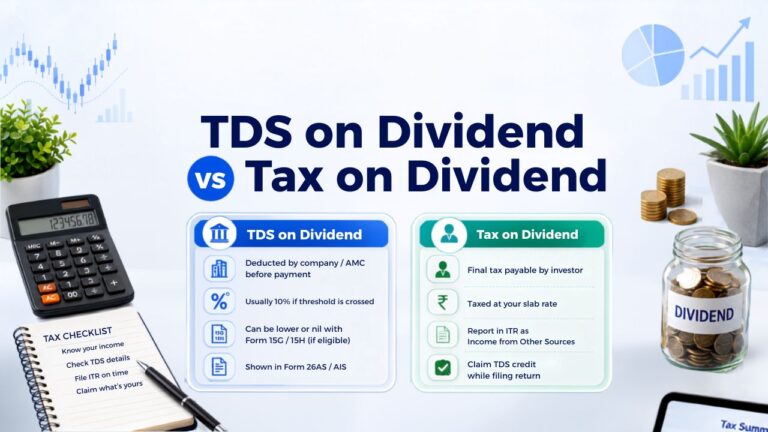
Since the Finance Act 2020, dividends from mutual funds are fully taxable in the hands of the investor. There is no Dividend Distribution Tax at the fund level. Dividends are added to your total income under “Income from Other Sources” and taxed at your applicable slab rate.
TDS at 10% is deducted under Section 194K if dividend income from a single AMC exceeds Rs. 5,000 in a financial year. The TDS is credited against your final tax liability when you file your ITR.
For investors choosing between the Growth option and the IDCW (Income Distribution cum Capital Withdrawal) option, the Growth option is generally more tax-efficient since gains are realised only at redemption and can be managed with the LTCG exemption.
Tax Planning with the Rs. 1.25 Lakh Annual LTCG Exemption
The Rs. 1.25 lakh annual exemption under Section 112A is one of the few straightforward tax planning tools available to equity mutual fund investors. Since it resets every financial year, salaried professionals with long-term SIP investments can harvest gains systematically.
How tax harvesting works: If your long-running equity SIP has accumulated significant LTCG, you can redeem units in April of each financial year up to the point where your LTCG stays within Rs. 1.25 lakh, and immediately reinvest the proceeds. This resets your cost of acquisition to the higher current NAV, reducing your future taxable gains without triggering any current tax. Done annually, this can substantially reduce your eventual tax liability on equity fund redemptions.
For tax saving strategies that complement this approach, my guide on tax saving tips for salaried employees covers options across both regimes. For those still maximising Section 80C under the old regime, my guide on Section 80C deductions covers ELSS and other eligible instruments.
Where to Report Mutual Fund Capital Gains in ITR
Mutual fund capital gains are reported in Schedule CG of the ITR form. For salaried professionals with mutual fund gains, ITR-2 is the applicable form (not ITR-1, which covers only salary and one house property).
Key points for ITR filing:
- LTCG from equity funds goes under Section 112A in Schedule CG
- STCG from equity funds goes under Section 111A in Schedule CG
- Debt fund gains (Section 50AA) go under normal STCG in Schedule CG
- Capital loss carried forward is reported in Schedule CFL
- Your mutual fund statement (annual tax statement from the fund house or platform) shows the breakup; use it directly rather than calculating manually
If your ITR refund is held up after filing, my guide on ITR refund status check explains how to track it.
Conclusion
Capital gains tax on mutual funds in FY 2025-26 follows a clear but layered framework. Equity funds attract 20% on STCG and 12.5% on LTCG above Rs. 1.25 lakh. Debt funds bought after April 1, 2023 are taxed at slab rate under Section 50AA regardless of holding period. Hybrid funds fall in between depending on their equity allocation and holding period.
The most practical action for salaried investors with equity SIPs is to track the Rs. 1.25 lakh annual LTCG exemption and harvest gains in April each year to reset the cost basis. For debt fund investors, the tax efficiency that existed before April 2023 is gone and debt funds now compete directly with FDs on an after-tax basis.
For all mutual fund gains, filing ITR-2 before July 31, 2026 is necessary to report capital gains correctly and to carry forward any losses for future set-off.
Frequently Asked Questions
Does the Rs. 1.25 lakh LTCG exemption apply per fund or per investor?
Per investor, per financial year. It covers all LTCG under Section 112A across all equity mutual funds and listed equity shares combined. If you have Rs. 80,000 LTCG from an equity fund and Rs. 60,000 LTCG from direct shares, the combined Rs. 1,40,000 exceeds the limit. Only Rs. 1,25,000 is exempt and Rs. 15,000 is taxable at 12.5%.
I bought a debt fund in March 2022 and plan to sell it now. What rate applies?
Since you bought before April 1, 2023, Section 50AA does not apply. If you have held for more than 24 months and sell after July 23, 2024, your gain qualifies as LTCG at 12.5% without indexation.
Does switching between mutual fund schemes trigger capital gains tax?
Yes. A switch from one fund to another is treated as a redemption of the original fund and a fresh purchase in the new fund on the switch date. Capital gains tax applies on the gain in the original fund as of the switch date. The new fund’s holding period starts from the switch date.
Is there TDS on mutual fund capital gains for resident investors?
Generally no. Resident investors do not have TDS deducted on mutual fund capital gains. You pay tax when filing your ITR. TDS under Section 194K applies only on dividend income above Rs. 5,000 per AMC per year, not on capital gains.
Can I claim Section 87A rebate on LTCG from equity funds?
No. From FY 2023-24 onwards, the Section 87A rebate is not available against special rate income including LTCG under Section 112A and STCG under Section 111A. The rebate applies only against income taxed at slab rates.
If I hold an equity fund for exactly 12 months, is it STCG or LTCG?
STCG. The holding period must be more than 12 months for LTCG classification. A unit purchased on June 1, 2025 and sold on June 1, 2026 (exactly 12 months) is STCG. It becomes LTCG only if sold on June 2, 2026 or later.