Income from House Property and Taxes
If you own a house in India, the Income Tax Department expects you to declare it under the head “Income from House Property” whether you live in it yourself, rent it out, or leave it vacant. Many salaried professionals either skip this section entirely or get confused about what counts as taxable income when they are not collecting any rent at all. For the complete framework of income tax rules in India, see our complete income tax guide.
This guide walks you through exactly how income from house property is calculated, what deductions you can legally claim, and how the tax treatment differs between a self-occupied home and a let-out property in FY 2025-26.
What Is Income from House Property?
Any income earned from a building or land attached to it through rent or lease is taxed under the head “Income from House Property.” This applies to both residential and commercial properties.
Three conditions must be satisfied for income to be taxed under this head:
- The property must be a building or part of a building, along with any attached land such as a parking space or garden.
- You must be the legal owner or deemed owner of the property.
- You must not be using the property for your own business or profession. If you do use it for business, the income is taxed under “Profits and Gains from Business or Profession” instead.
One important clarification: if you sublet a rented flat, that income is not treated as house property income. It falls under “Income from Other Sources.” Similarly, if you run a hostel or paying guest facility at commercial scale, that is treated as business income, not house property income.
Who Is a Deemed Owner?
Even if a property is not in your name legally, you may still be treated as the owner for tax purposes. This concept of deemed ownership was introduced under Section 27 to prevent tax evasion through property transfers to family members.
You are treated as the deemed owner in situations such as:
- You transferred a property to your spouse or minor child without receiving fair consideration in return
- You are allotted a flat under a cooperative housing society
- You hold a lease of more than 12 years on a property
- A property cannot be divided among heirs and you are the holder
In all these cases, income from the property is taxed in your hands, not in the hands of the person whose name appears on the document.
Types of House Property for Tax Purposes
1. Self-Occupied Property
A property you occupy for your own residential use is a self-occupied property. The Income Tax Act allows you to treat up to two properties as self-occupied. The annual value of such properties is taken as nil, which means there is no rental income to declare. However, you can still claim deductions on a home loan. As per the Income Tax Department, you can refer to the official Income Tax portal for complete ITR filing guidance on house property income.
2. Let-Out Property
A property you rent out, whether for the full year or part of the year, is a let-out property. The actual rent received or receivable is used as the starting point for computing income.
3. Deemed Let-Out Property
If you own more than two properties, any property beyond the second is treated as deemed let-out even if it is vacant and generating no rent. The notional market rent is used to compute taxable income, which can result in a tax liability with zero actual rental earnings.
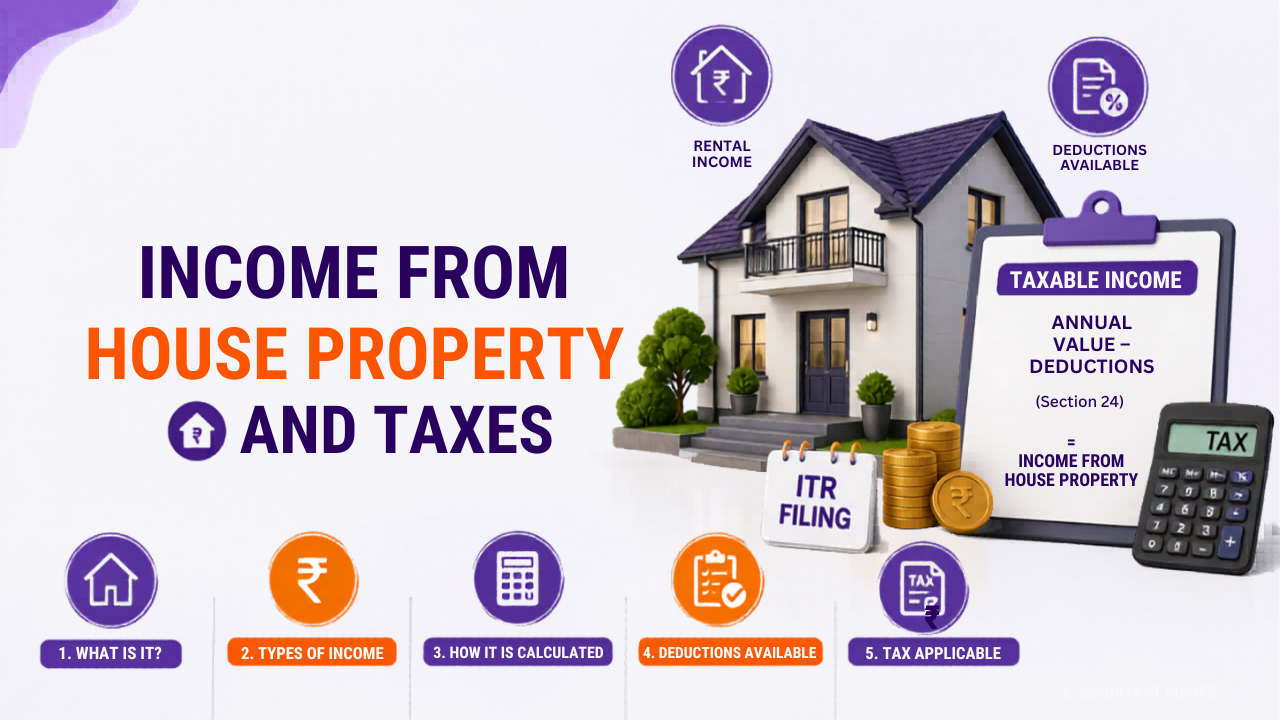
How to Calculate Income from House Property: Step by Step
The computation follows a standard format for let-out and deemed let-out properties. For self-occupied properties, the Gross Annual Value is simply zero, so the first three steps are not applicable.
Step 1: Determine Gross Annual Value (GAV)
The GAV is determined as follows:
First, calculate the Expected Rent. Take the higher of the Fair Rent and the Municipal Value, then cap that figure at the Standard Rent. The result is your Expected Rent.
Next, compare the Expected Rent with the actual rent received or receivable during the year. The higher of the two becomes the GAV.
Example: Ramesh owns a flat in Pune that he rents out.
- Municipal Value: Rs. 80,000
- Fair Rent: Rs. 90,000
- Standard Rent: Rs. 75,000
- Actual Rent Received: Rs. 72,000
Higher of Municipal Value (Rs. 80,000) and Fair Rent (Rs. 90,000) = Rs. 90,000. This is then capped at Standard Rent = Rs. 75,000. That is the Expected Rent. GAV = Higher of Expected Rent (Rs. 75,000) and Actual Rent (Rs. 72,000) = Rs. 75,000.
Step 2: Deduct Municipal Taxes (Property Tax)
Municipal taxes or property taxes paid by the owner during the financial year are deducted from the GAV. A few conditions apply:
- Only taxes actually paid during the year are deductible. Unpaid dues cannot be claimed.
- If the tenant pays the property tax, the owner cannot claim this deduction.
- Taxes relating to a prior year, if paid during this financial year, are still deductible in this year.
- This deduction is allowed even if the property is vacant for part of the year.
Step 3: Arrive at Net Annual Value (NAV)
NAV = GAV minus Municipal Taxes Paid
The NAV is the base on which all further deductions under Section 24 are calculated.
Step 4: Standard Deduction of 30% Under Section 24(a)
A flat 30% of the NAV is allowed as a standard deduction. This covers expenses like repairs, maintenance, and general upkeep. You get this deduction regardless of what you actually spent. No bills or proof are required. No other expenses beyond this 30% can be claimed separately.
Step 5: Deduct Home Loan Interest Under Section 24(b)
Interest paid on a home loan taken for purchase, construction, or renovation of the property is deductible under Section 24(b). The limits depend on your tax regime and property type, covered in detail in the next section.
Step 6: Final Income from House Property
After deducting the 30% standard deduction and home loan interest from the NAV, the remaining figure is your Income from House Property. This amount is added to your total income and taxed at the applicable slab rate. You can check the current rates in our Income Tax Slabs FY 2026-27 guide.
Full Calculation Example:
Priya owns a let-out flat in Bengaluru.
| Particulars | Amount |
|---|---|
| Gross Annual Value | Rs. 5,00,000 |
| Less: Municipal Taxes Paid | Rs. 20,000 |
| Net Annual Value (NAV) | Rs. 4,80,000 |
| Less: Standard Deduction 30% under Section 24(a) | Rs. 1,44,000 |
| Less: Home Loan Interest under Section 24(b) | Rs. 1,00,000 |
| Income from House Property | Rs. 2,36,000 |
This Rs. 2,36,000 is added to her salary income and taxed at her applicable slab rate.
Calculation for a Self-Occupied Property
For a property you live in, the GAV is zero. Since there is no value to compute, there is no rental income and no tax. But here is where many salaried professionals miss out: you can still claim a deduction on home loan interest, and that deduction will create a loss from house property, which can be set off against your salary income under the old tax regime.
Example:
Vikram owns a flat in Delhi where he lives with his family. He has a home loan with an annual interest component of Rs. 1,80,000.
| Particulars | Amount |
|---|---|
| Gross Annual Value | Rs. 0 |
| Net Annual Value (NAV) | Rs. 0 |
| Less: Home Loan Interest under Section 24(b) | Rs. 1,80,000 |
| Loss from House Property | Rs. 1,80,000 |
Under the old tax regime, this Rs. 1,80,000 loss can be set off against his salary income, reducing his total taxable income and lowering his tax outgo. To understand how TDS on salary is adjusted when you submit your home loan interest certificate to your employer, read our TDS on Salary guide.
Home Loan Interest Deduction: Section 24(b) Limits
Under the Old Tax Regime
For a self-occupied property, interest deduction is allowed up to Rs. 2 lakh per year, provided the loan was taken on or after 1 April 1999 and construction is completed within 5 years from the end of the financial year in which the loan was taken.
If any of the following conditions apply, the deduction is capped at Rs. 30,000 instead of Rs. 2 lakh:
- The loan was taken on or after 1 April 1999 but construction is not completed within 5 years from the end of the financial year in which the loan was availed. For example, if the loan was taken on 30 April 2024, construction must be completed by 31 March 2029. If it is not, the limit drops to Rs. 30,000.
- The loan was taken before 1 April 1999.
- The loan was taken on or after 1 April 1999 for repairs or renovation only, not for purchase or construction.
For a let-out property, there is no ceiling on interest deduction under the old regime. The entire interest paid during the year is deductible. However, the total loss from house property that can be set off against other income such as salary is capped at Rs. 2 lakh per year. Any excess loss is carried forward for up to 8 years and can only be set off against future house property income.
Under the New Tax Regime
For a self-occupied property, no interest deduction is allowed at all.
For a let-out property, interest is allowed as a deduction without any upper limit. However, if this results in a loss, that loss cannot be set off against salary or any other income. It also cannot be carried forward. The loss simply lapses.
| Property Type | Old Regime | New Regime |
|---|---|---|
| Self-Occupied | Up to Rs. 2 lakh deduction | No deduction |
| Let-Out | Full interest deductible | Full interest deductible |
| Loss Set-Off | Up to Rs. 2 lakh against other income | Not allowed |
| Loss Carry Forward | Yes, up to 8 years | Not allowed |
This difference is one of the key factors to weigh before choosing your tax regime. Our Old vs New Tax Regime article covers this comparison in full detail.
Pre-Construction Interest: What Happens Before the Property Is Ready?
If you took a home loan while the property was still under construction, you cannot claim the interest during the construction period. Once construction is complete, the total interest paid during the entire pre-construction period is aggregated and allowed as a deduction in five equal instalments starting from the year of completion.
Example: Sunita took a home loan on 30 April 2024. Construction was completed by 31 March 2029. The total pre-construction interest paid during this period was Rs. 5,00,000. Starting FY 2029-30, she can claim Rs. 1,00,000 per year for five years as a deduction, in addition to the regular annual interest for each of those years.
Principal Repayment Deduction Under Section 80C
The principal component of your home loan EMI qualifies for deduction under Section 80C, subject to the overall limit of Rs. 1.5 lakh per year. Stamp duty and registration charges paid for the property are also eligible under this same limit, but only in the year they are paid.
Two important conditions apply:
- The loan must be for purchase or construction of a new property, not for renovation.
- You must not sell the property within 5 years of taking possession. If you do, all the deductions claimed in previous years are reversed and added back to your income in the year of sale.
This deduction is not available under the new tax regime. If you have opted for the new regime, neither the principal repayment nor the stamp duty qualifies for any deduction.
For a full breakdown of Section 80C investment options and the Rs. 1.5 lakh limit, refer to our Section 80C Deductions guide.
Additional Deductions for First-Time Homebuyers
Section 80EE
Section 80EE provided an additional deduction of up to Rs. 50,000 on home loan interest for first-time homebuyers, over and above the Rs. 2 lakh limit under Section 24(b). However, this deduction was available only if the home loan was sanctioned between 1 April 2016 and 31 March 2017. Since that window is now closed, no new claims can be made under Section 80EE for FY 2025-26.
Section 80EEA
Section 80EEA extended similar benefits for affordable housing loans, allowing an additional deduction of up to Rs. 1.5 lakh on home loan interest. This was available for loans sanctioned between 1 April 2019 and 31 March 2022. That window is also now closed. If your loan was sanctioned before 31 March 2022 and you have been claiming this deduction in previous years, you may continue to claim it as long as you remain otherwise eligible.
Both sections apply only under the old tax regime and are not available under the new regime.
Tax on Rental Income: Which ITR Form to Use?
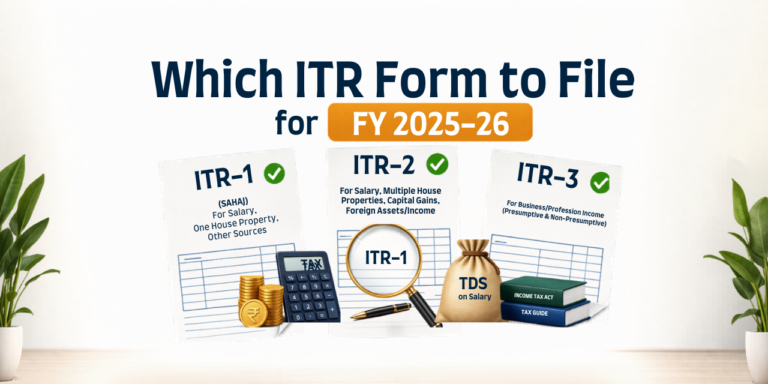
If you have income from a let-out house property along with salary, you cannot file ITR-1. You will need to file ITR-2, which has a dedicated schedule for house property income. If you own more than one property, ITR-2 is mandatory regardless of whether the second property is let out or self-occupied.
Make sure you reconcile the rental income you declare with what appears in your AIS, as tenant TDS on rent and property registrations now feed data directly into the tax system. Our How to Read Form 26AS and AIS guide explains how to verify your AIS before filing.
Loss from House Property: Key Rules
Under the old regime, if your deductions exceed your NAV, you will arrive at a loss. You can set off up to Rs. 2 lakh of this loss against salary or any other income in the same year. There is no limit on set-off of house property loss against house property income itself. The Rs. 2 lakh cap applies only when setting off against other income heads like salary. Any remaining loss beyond Rs. 2 lakh is carried forward for up to 8 years and can only be set off against future house property income.
Under the new regime, any loss from house property cannot be set off against salary or any other income. It also cannot be carried forward. If you have a substantial home loan on a self-occupied property and are on the new regime, this benefit is entirely unavailable.
Joint Ownership and Home Loans
If a property is jointly owned by two people and both are co-borrowers on the home loan, each owner can independently claim:
- Up to Rs. 2 lakh interest deduction under Section 24(b) under the old regime for a self-occupied property
- Up to Rs. 1.5 lakh principal repayment deduction under Section 80C
The deductions are claimed in proportion to the ownership share. Both conditions must be met: you must be a co-owner in the property and a co-borrower on the loan. Satisfying only one condition does not qualify you for the deduction.
This makes joint home loans a powerful tax planning tool, particularly for couples where both partners are salaried. To see how this fits into the broader set of tax-saving options available, read our Tax Saving Tips for Salaried Employees guide.
Unrealised Rent and Arrears of Rent
If a tenant does not pay rent and you have genuinely tried to recover it, you can exclude the unpaid portion from the GAV. To do this, the following conditions must be met:
- The tenancy is genuine
- The tenant has vacated or efforts to make them vacate are ongoing
- The tenant does not occupy any other property belonging to you
- You have taken steps to recover the rent, including legal action if warranted
If unrealised rent from earlier years is subsequently received, it is taxable in the year of receipt after deducting 30% as a standard deduction. This is known as arrears of rent and is taxable even if you no longer own that property at the time of receipt.
Advance Tax on Rental Income
If your total tax liability from rental income along with other income exceeds Rs. 10,000 in a financial year, you are required to pay advance tax in four instalments. Missing these instalments can result in interest under Sections 234B and 234C. Our Advance Tax Payment Guide explains the due dates and calculation in detail.
Frequently Asked Questions
Can I claim both HRA exemption and home loan deductions?
Yes. If you live in a rented house in one city and own a property in another city that is either let out or vacant, you can claim HRA exemption on the rent you pay and also claim home loan deductions on the property you own. Both benefits are available simultaneously. Read our HRA Exemption Calculation guide for the full computation steps.
What if my property is self-occupied for part of the year and let out for the rest?
The calculation is done on a proportionate basis. The NAV is computed for the let-out period, and the standard deduction and interest are split accordingly. The self-occupied portion contributes zero rental income.
Is rental income from a commercial property also taxed under this head?
Yes. Whether you rent out a residential flat or a commercial office space or a shop, the income is taxed under “Income from House Property” as long as you are not in the business of renting properties.
Can I deduct interest paid on a loan taken from a friend or relative?
Yes. The source of the loan does not matter for the interest deduction under Section 24(b). If you have borrowed from a friend or relative to purchase or construct a property, the interest paid is still deductible. You must maintain proof of the loan arrangement and the interest payments made.
What happens if I sell the property within 5 years of possession?
All principal repayment deductions claimed under Section 80C in previous years are reversed and added to your income in the year of sale. The interest deductions under Section 24(b) are not reversed.
I missed the ITR deadline. Will I lose my house property loss carry forward?
Yes. If you file a belated return after the due date, you lose the right to carry forward losses from house property. The loss cannot be offset in future years. This is one of several important reasons to file your return on time. Refer to our Belated Return vs Revised Return guide for full details on the consequences of late filing.