ITR-2 Form AY 2026-27: When to Use It & How to File
If you have capital gains from stocks or mutual funds, income from more than one house property, or foreign income or assets to declare, you cannot file ITR-1 this year. You fall into ITR-2 territory.
ITR-2 is the correct form for salaried individuals and HUFs whose income goes beyond what ITR-1 covers. It handles capital gains, multiple properties, directorship in a company, and foreign assets, all in one return.
This guide breaks down exactly who must file the ITR-2 form for AY 2026-27, who is disqualified, and how to file it step-by-step on the income tax portal.
What Is ITR-2?
ITR-2 is an income tax return form for individuals and Hindu Undivided Families (HUFs) who:
- Are salaried or have pension income
- Have capital gains from shares, mutual funds, or property
- Own more than one house property
- Have foreign income or hold foreign assets
- Are a director in a company
It is more detailed than ITR-1 but is not meant for those with business or professional income. That category uses ITR-3 or ITR-4.
For AY 2026-27, the ITR-2 form applies to income earned during FY 2025-26 (April 1, 2025 to March 31, 2026). Since this period falls under the old Income Tax Act 1961, you will file using Tab 1 on the income tax portal.
Who Should File ITR-2 for AY 2026-27?
You must file the ITR 2 form if any of the following apply to you during FY 2025-26:
1. Capital Gains Income
If you sold equity shares, equity mutual funds, debt mutual funds, or property during FY 2025-26, your gains or losses must be reported in ITR-2.
Examples:
- You redeemed Rs. 5 lakh of equity mutual funds and earned Rs. 80,000 in long-term capital gains.
- You sold a flat and had a long-term capital gain of Rs. 12 lakh.
- You booked a short-term capital loss of Rs. 30,000 on shares, which you want to carry forward to the next year.
ITR-1 has no schedule for capital gains. Even a small capital gain or loss forces you to ITR-2.
2. Income from More Than One House Property
If you own two or more house properties, ITR-2 is mandatory. This includes:
- Two self-occupied properties (only one gets the nil annual value benefit; the second is deemed let out)
- One self-occupied and one rented property
- Two rented properties
If you want to claim a home loan deduction on a second property or report rental income from multiple houses, ITR-2 is the form you need.
3. Foreign Income or Foreign Assets
If you are a resident Indian who has:
- Income from a foreign country (salary, dividends, interest)
- A foreign bank account
- Foreign equity or investments
you must file ITR-2. This also applies if you are an NRI or RNOR with Indian-sourced income and need to declare foreign assets.
4. Director in a Company
If you hold or have held a directorship in any Indian or foreign company at any point during FY 2025-26, ITR-1 is not available to you. You must use ITR-2 even if your director’s remuneration was NIL.
5. Unlisted Shares
If you hold equity shares in an unlisted company (a company not listed on NSE or BSE), you must report this in ITR-2.
6. Agricultural Income Above Rs. 5,000
Agricultural income is exempt from tax, but if your agricultural income exceeds Rs. 5,000, it still needs to be disclosed for the purpose of determining your tax slab rate. ITR-1 allows disclosure only up to Rs. 5,000 of agricultural income. Beyond that, use ITR-2.
7. Income Above Rs. 50 Lakh
If your total gross income exceeds Rs. 50 lakh during FY 2025-26, you must file ITR-2 (or ITR-3 if applicable). ITR-1 is restricted to income up to Rs. 50 lakh.
Who Cannot File ITR-2?
The ITR 2 form is not for everyone. You cannot use it if:
| Situation | Correct Form |
|---|---|
| You have income from a business or profession | ITR-3 |
| You are a freelancer with professional income | ITR-3 or ITR-4 |
| You are a partner in a firm | ITR-3 |
| You opted for presumptive taxation under Section 44AD/44ADA | ITR-4 |
Also note: ITR-2 is not available for companies, LLPs, or partnership firms. Those entities have their own forms.
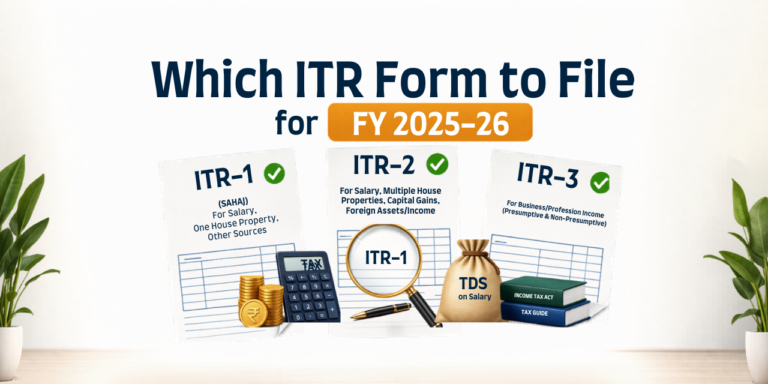
If you are unsure which form is right for your situation, the Which ITR Form to File for FY 2025-26 guide covers every scenario with examples.
ITR-2 vs ITR-1: Key Differences
Many salaried professionals assume ITR-1 is always the right form. Here is where the two forms differ:
| Feature | ITR-1 | ITR-2 |
|---|---|---|
| Salary income | Yes | Yes |
| One house property | Yes | Yes |
| More than one house property | No | Yes |
| Capital gains | No | Yes |
| Foreign income/assets | No | Yes |
| Director in company | No | Yes |
| Unlisted shares | No | Yes |
| Income limit | Rs. 50 lakh | No limit (above Rs. 50 lakh too) |
| Agricultural income | Up to Rs. 5,000 | Above Rs. 5,000 too |
The most common trigger is capital gains. If you have sold even a single mutual fund unit or one share during FY 2025-26 and have a gain or loss, you need ITR-2, not ITR-1.
Deadlines for Filing ITR-2 for AY 2026-27
| Return Type | Deadline |
|---|---|
| ITR-2 (original, no audit) | July 31, 2026 |
| Belated Return | December 31, 2026 |
| Revised Return | March 31, 2027 |
| Updated Return (ITR-U) | March 31, 2031 |
Missing the July 31 deadline means you file a belated return with a late filing fee of Rs. 5,000 (Rs. 1,000 if your income is below Rs. 5 lakh). A belated return also means you lose the ability to carry forward most capital losses, which is a significant cost if you had large short-term losses during the year.
Check the ITR Filing Last Date 2026 article for the full deadline calendar.
What Income Schedules Are in ITR-2?
ITR-2 has a detailed structure. Here are the key schedules you may need to fill:
Schedule HP (House Property): For rental income and home loan interest deduction across one or multiple properties.
Schedule CG (Capital Gains): For STCG and LTCG from equity, debt, property, and other assets. You report each transaction or use a summary if using the portal’s pre-fill feature.
Schedule OS (Other Sources): For interest income from savings accounts, FDs, bonds, and dividends.
Schedule 80C to 80U (Deductions): For all eligible deductions under Chapter VI-A, including Section 80C investments, Section 80D health insurance premiums, and Section 80E education loan interest.
Schedule FA (Foreign Assets): For foreign bank accounts, foreign equity, or overseas income. Mandatory if you are a resident with foreign exposure.
Schedule AL (Assets and Liabilities): Required if your total income exceeds Rs. 50 lakh. You must disclose immovable property, financial assets, cash, vehicles, jewellery, and related liabilities.
Schedule BFLA (Brought Forward Losses): For carrying forward and setting off capital losses from prior years.
How to File ITR-2 Online: Step by Step
Here is how to file the ITR 2 form for AY 2026-27 on the income tax portal:
Step 1: Log In to the Income Tax Portal
Go to incometax.gov.in and log in using your PAN and password. Your PAN is your user ID on the portal.
Step 2: Select the Right Tab and Form
For AY 2026-27, use Tab 1 on the portal. Tab 1 governs income earned during FY 2025-26 under the Income Tax Act 1961. Tab 2 (Income Tax Act 2025) applies to Tax Year 2026-27 and beyond.
Go to: e-File > Income Tax Returns > File Income Tax Return > AY 2026-27 > ITR-2 > Online mode.
Step 3: Use Pre-Filled Data
The portal pre-fills your salary data from Form 130 (earlier Form 16), TDS details from Form 168 (earlier Form 26AS), and AIS data. Review each pre-filled entry carefully. The AIS often picks up dividend income, interest income, and mutual fund redemption data that you may have missed.
Refer to the How to Read Form 26AS and AIS guide before you begin.
Step 4: Fill Schedule CG (Capital Gains)
This is the most important section for most ITR-2 filers. You need to report:
- Equity STCG at 20% under Section 111A (applicable for sales made on or after July 23, 2024)
- Equity LTCG above Rs. 1.25 lakh at 12.5% (Section 112A)
- Debt fund gains at your applicable slab rate
- Property LTCG at 12.5% without indexation (for properties sold on or after July 23, 2024)
Example: Rohan, a salaried professional earning Rs. 14 lakh annually, sold equity mutual funds in December 2025 with a long-term gain of Rs. 1.80 lakh.
His LTCG exemption limit is Rs. 1.25 lakh. Taxable LTCG = Rs. 55,000. Tax on this = 12.5% x Rs. 55,000 = Rs. 6,875.
He fills Schedule CG with these details. The rest of his salary income continues to be taxed under the regular slab.
Step 5: Claim Deductions
In the deductions section, enter your:
- Section 80C investments (EPF, PPF, ELSS, LIC, home loan principal) up to Rs. 1.5 lakh
- Section 80D premiums for health insurance
- Section 80E education loan interest, if applicable
- Any other applicable deductions
Note that deductions under Chapter VI-A are available only under the old tax regime. If you opt for the new regime, these do not apply.
Step 6: Select Your Tax Regime
For FY 2025-26, the new tax regime is the default. If you want to switch to the old regime and claim deductions, you must explicitly select it on the return form.
Salaried individuals can switch between regimes each year. Compare both options on the portal before choosing. If your total deductions (80C + HRA + 80D + home loan interest) exceed Rs. 3.75 lakh, the old regime is often the better choice.
Step 7: Verify Tax Payable and Pay If Required
After filling all schedules, the portal calculates your tax liability. If tax is due, pay it via Challan 280 before submitting the return. For a broader understanding of how income tax works, see our complete income tax guide for India. Any outstanding tax attracts interest under Section 234B.
Check the Advance Tax Payment Guide for how to handle advance tax shortfalls.
Step 8: Submit and Verify the Return
After submission, you must verify the return within 30 days. The easiest option is e-verification via Aadhaar OTP or net banking. If you miss verification, the return is treated as not filed.
Read the How to Verify ITR After Filing guide for all verification options.
Common Mistakes to Avoid While Filing ITR-2
Not reporting capital losses: If you had a loss in FY 2025-26, you must still file ITR-2 and report it to carry it forward. A loss not reported in the original return cannot be carried forward.
Using ITR-1 with capital gains: Some portal interfaces do not immediately block ITR-1 filing. But if you have Schedule CG income, your assessment can be reopened later. Always use the correct form.
Missing AIS data: The AIS often shows dividend income, savings account interest, and broker transaction summaries. Cross-check your broker’s statement with AIS before filing.
Not disclosing foreign assets: If you hold a foreign account or investment and fail to report it under Schedule FA, the penalty can be Rs. 10 lakh under the Black Money Act.
Wrong regime selection: If you intended to claim 80C and HRA deductions but forgot to switch to the old regime, you lose those deductions for the entire year. There is no correction after filing except through a revised return.
Can You File ITR-2 in Offline Mode?
Yes. You can download the ITR-2 utility from the income tax portal, fill it offline, and then upload the JSON or XML file. The offline utility is useful if your capital gains data is complex or if you have many house properties to enter.
However, for most salaried professionals with straightforward capital gains (one or two mutual fund redemptions or one stock sale), online mode with pre-fill is faster and less error-prone.
Frequently Asked Questions
Q1: I have only salary income and one house property but also sold equity mutual funds. Which ITR should I file?
You must file ITR-2. Any capital gains, no matter how small, take you out of ITR-1 eligibility. Even a Rs. 500 gain from a systematic withdrawal plan requires Schedule CG in ITR-2.
Q2: Can I set off my short-term capital loss on shares against my salary income?
No. Capital losses can only be set off against capital gains, not against salary income. STCL on equity can be set off against STCG or LTCG. Unabsorbed losses can be carried forward for 8 years, but only if you file your return on time.
Q3: I am a salaried employee and also a director (without remuneration) in a family company. Do I still need ITR-2?
Yes. Directorship, even without remuneration, requires ITR-2. There are no exceptions based on whether you received payment or not.
Q4: My employer already deducted TDS on my salary. Do I still owe anything?
Possibly. TDS on salary is calculated by your employer without knowing your capital gains. If your total tax liability (after adding capital gains tax) exceeds TDS already deducted, you owe the difference. The portal will show this automatically.
Q5: What if I file ITR-1 but should have filed ITR-2?
Your return can be treated as defective or invalid by the income tax department. You may receive a notice. In that case, you can file a revised return using ITR-2 before March 31, 2027. Read the Belated Return vs Revised Return guide for next steps.