Best Salary Allowances for Tax Savings FY 2026-27
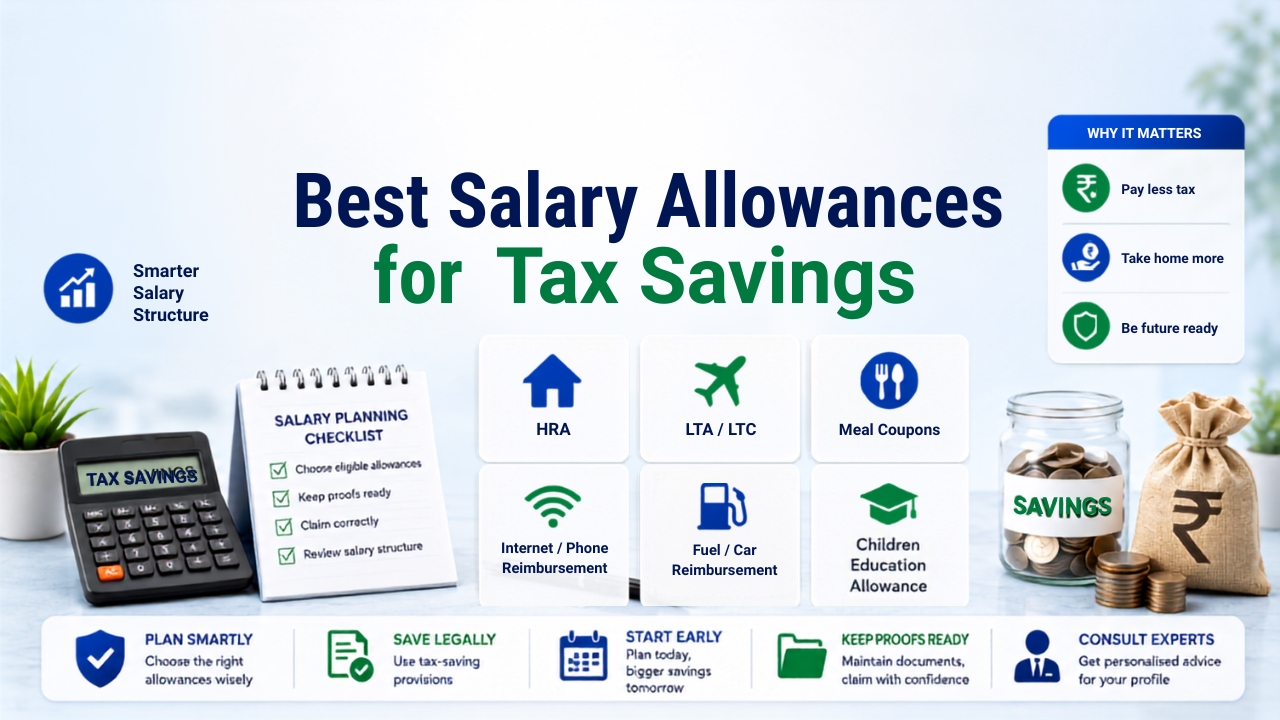
When readers ask me what to negotiate for during their next appraisal, my answer is rarely “ask for more CTC.” It’s “ask for the right allowances inside your existing CTC.” The best salary allowances for tax savings 2026 conversation has genuinely changed this year, since several exemption limits that had been frozen for decades were revised sharply upward from FY 2026-27. If you want the fundamentals of how salary taxation works before diving into this list, my complete income tax guide is a good starting point. Here are the ten allowances worth having in your salary structure this year, ranked roughly by how much they typically save.
1. House Rent Allowance (HRA)
For anyone paying real rent, HRA is usually still the single biggest lever in any best allowances salary tax savings 2026 discussion. The exempt amount is the lowest of the HRA received, 50% of basic in a metro city or 40% elsewhere, and rent paid minus 10% of basic. Old regime only. I’ve written a full walkthrough in my HRA exemption calculation guide.
2. Children’s Education and Hostel Allowance
This is this year’s biggest surprise. The education allowance exemption has jumped from Rs. 100 to Rs. 3,000 per month per child, and the hostel allowance from Rs. 300 to Rs. 9,000 per month per child, both capped at two children, effective FY 2026-27. That’s a possible Rs. 72,000 a year from education allowance alone for two children, or up to Rs. 2,88,000 a year if both children are in hostel. Old regime only, and it must appear as a distinct line item in your salary structure, not folded into Special Allowance, or the exemption doesn’t apply.
3. Employer NPS Contribution (Section 80CCD(2))
The rare allowance that works under both regimes. Private-sector employees can get up to 10% of basic and DA deducted under the old regime, or up to 14% under the new regime, contributed by the employer into their NPS account. It doesn’t reduce your take-home pay and builds a retirement corpus at the same time.
4. Meal Vouchers
Until FY 2025-26, this was capped at Rs. 50 a meal and unavailable under the new regime. From FY 2026-27, the cap has risen to Rs. 200 a meal, roughly Rs. 1,05,600 a year, and it now works under both regimes. This is probably the most universally useful allowance on this list, since it doesn’t depend on renting, having children, or owning a car.
5. Leave Travel Allowance (LTA)
Exempt up to the lowest of the employer’s LTA component and your actual domestic travel fare, twice within a four-year block. The current block runs 2026 to 2029. Old regime only, and only travel fare qualifies, not hotels or sightseeing. It sits under the same broader Section 10 exemptions list as HRA.
6. Telephone and Internet Reimbursement
Fully exempt against actual bills for official use, with no prescribed rupee ceiling under the Act, and it works under both regimes. The only real conditions are that the connection is in your name and you submit bills.
7. Fuel and Driver Reimbursement
If you use your own car partly for official duty and maintain a logbook with employer certification, this can be nil-value. Without proper logbooks, it converts into a flat monthly perquisite instead. Worth having if you genuinely use a vehicle for work, not worth allocating otherwise.
8. Gift Vouchers from Employer
Tax-free up to Rs. 15,000 a year from FY 2026-27, under both regimes. A modest amount, but it’s essentially free money if your employer’s policy allows it.
9. Uniform Allowance
Exempt to the extent of actual expenditure on purchasing and maintaining a uniform required for your role. Relevant mainly for employees in customer-facing, field, or regulated roles where a uniform is mandated. Old regime only.
10. Books and Periodicals Allowance
Fully exempt against actual bills for books, journals, and periodicals related to your work. A smaller allowance, but it’s one more head that converts otherwise taxable Special Allowance into something exempt, provided you keep the receipts.
Best Allowances Salary Tax Savings 2026: Quick Reference
| Allowance | Typical Annual Exemption | Regime |
|---|---|---|
| HRA | Varies with rent, often the largest | Old only |
| Children’s Education + Hostel | Up to Rs. 2,88,000 for 2 children | Old only |
| Employer NPS (80CCD(2)) | 10-14% of basic and DA | Both |
| Meal vouchers | Up to Rs. 1,05,600 | Both, from FY 2026-27 |
| LTA | Actual travel fare, twice per 4-year block | Old only |
| Telephone/internet | Full bill amount, no cap | Both |
| Fuel/driver reimbursement | Nil if wholly official use | Largely regime-neutral |
| Gift vouchers | Up to Rs. 15,000 | Both, from FY 2026-27 |
| Uniform allowance | Actual expenditure | Old only |
| Books/periodicals | Actual expenditure | Old only |
Real Example: Rohan’s Fully Stacked Salary Structure
Rohan earns Rs. 9,60,000 in basic salary, rents a home in a metro city, has two children with one in hostel, travels once a year, and works from a phone he pays for himself. Here’s what stacking these allowances looks like for FY 2026-27, old regime:
- HRA exempt: Rs. 3,60,000
- Children’s Education Allowance (2 kids): Rs. 72,000
- Children’s Hostel Allowance (1 kid): Rs. 1,08,000
- Employer NPS contribution: Rs. 96,000
- Meal vouchers: Rs. 1,05,600
- LTA: Rs. 45,000
- Telephone/internet: Rs. 30,000
- Gift voucher: Rs. 15,000
- Books and periodicals: Rs. 12,000
Total exempt amount: Rs. 8,43,600. At the 30% slab plus 4% cess, that’s roughly Rs. 2,63,200 in tax saved, on the exact same CTC. None of this required a pay raise. It required asking HR to list these as separate, named components instead of one large taxable Special Allowance.
How to Actually Get These Added to Your Salary
Most of these allowances don’t appear automatically. You need to raise them during onboarding, your annual appraisal, or your company’s FBP declaration window, and your employer’s payroll and HR policy has to support each specific head. A few practical points:
- Ask for named components, not a lump sum. An allowance clubbed into Special Allowance gets taxed regardless of how you actually spend the money.
- Keep documentation from day one. Rent receipts, travel tickets, phone bills, and school fee receipts all need to be retained and submitted within your employer’s claim window.
- Check your regime before you optimise. Most of the highest-value items on this best allowances salary tax savings 2026 list only work under the old regime. If your numbers favour the new regime, structuring around HRA, LTA, and the education allowance won’t help you. My old vs new tax regime guide walks through how to make that call, and my broader tax saving tips for salaried employees covers what to do once you’ve picked a regime.
Frequently Asked Questions
Which allowance saves the most tax?
For renters, HRA is usually the largest. For parents with children in hostel, the new Children’s Education and Hostel Allowance limits can now match or exceed HRA.
Do these allowances work under the new tax regime?
Only three from this list currently work under both regimes: employer NPS contribution, meal vouchers, and gift vouchers. Everything else requires the old regime.
Can I add these allowances mid-year?
It depends on your employer’s policy. Most companies open salary restructuring windows once a year, typically at appraisal time or the start of the financial year, though FBP components sometimes allow annual redeclaration.
What happens if my employer doesn’t offer a specific allowance?
You cannot claim the exemption if the component doesn’t exist in your salary structure. These are employer-provided allowances, not self-declared deductions, so the request has to go through HR and payroll. Official provisions are listed on the Income Tax Department’s website.
Do I need bills for all of these?
Most of them, yes. HRA needs rent receipts, LTA needs travel tickets, telephone needs phone bills, and books need purchase receipts. Employer NPS contribution and gift vouchers don’t require employee-side documentation since the employer handles that directly.