Intraday Trading vs F&O vs Equity Investment: Tax Rules Compared 2026
Most retail traders assume all stock market income gets taxed the same way. It doesn’t. The Intraday Trading vs F&O vs Equity Investment Tax 2026 distinction decides your tax rate, which losses you can set off, how long you can carry them forward, and which ITR form you’re even allowed to file. Get the classification wrong, and you risk a defective return notice, not just a wrong number. For the fundamentals of how Indian income tax works before this comparison, see my complete income tax guide.
Intraday Trading vs F&O vs Equity Investment Tax 2026: The Three Categories at a Glance
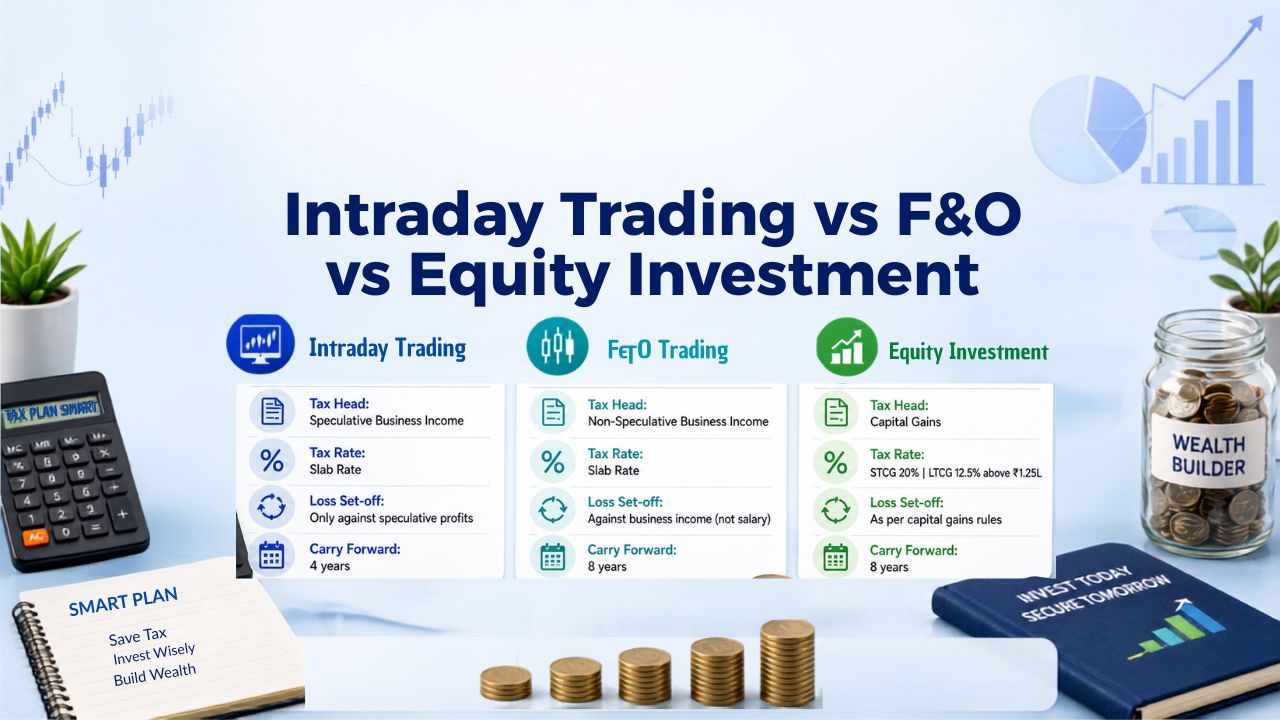
| Factor | Intraday Trading | F&O Trading | Equity Investment |
|---|---|---|---|
| Classification | Speculative business income | Non-speculative business income | Capital gains (STCG/LTCG) |
| Governing provision | Section 43(5) | Section 43(5), proviso (d) | Sections 45, 111A, 112A |
| Tax rate | Your income slab rate | Your income slab rate | 20% (STCG, held ≤12 months) or 12.5% above Rs. 1.25 lakh (LTCG, held >12 months) |
| ITR form | ITR-3 | ITR-3 (or ITR-4 under presumptive scheme) | ITR-2, or ITR-3 if combined with trading income |
| Loss set-off | Only against speculative gains | Against any income except salary | STCG against STCG/LTCG; LTCG against LTCG only |
| Loss carry-forward | 4 years | 8 years | 8 years |
| STT treatment | Deductible as expense | Deductible as expense | Not deductible |
How Intraday Trading is Taxed
Buying and selling the same stock on the same day, without taking delivery, is classified as speculative business income under Section 43(5). It’s taxed at your normal slab rate under the “Profits and Gains of Business or Profession” head, not as capital gains, and there’s no flat-rate benefit here. ITR-3 is mandatory, and Section 44AD’s presumptive scheme doesn’t apply. Losses can only be set off against other speculative income, and if unused, they can be carried forward for just four years, the shortest window of the three categories.
How F&O Trading is Taxed
Futures and options traded on recognised exchanges are also taxed at slab rates under PGBP, but they’re classified as non-speculative business income, since they’re standardised, exchange-traded contracts rather than unstandardised speculative bets. This single word, non-speculative, changes everything for loss planning: F&O losses can be set off against almost any other income in the same year, including business income, rental income, and interest, though not against salary. Unused losses carry forward for eight years, double the intraday window.
How Equity Investment is Taxed
Delivery-based equity holdings fall under capital gains, governed by Section 45 along with Sections 111A and 112A. Sell within 12 months and it’s Short-Term Capital Gains, taxed at a flat 20%. Hold beyond 12 months and it’s Long-Term Capital Gains, taxed at 12.5% on gains above a Rs. 1.25 lakh annual exemption, with no indexation benefit. These flat rates apply regardless of your income slab, and regardless of whether you’ve opted for the old or new tax regime.
The STT Difference Nobody Tells You About
Here’s a detail that trips up even experienced investors, and it sits at the heart of the intraday vs fo vs equity investment tax 2026 comparison. Securities Transaction Tax is charged on every trade, but whether you can deduct it depends entirely on how the income is classified. If you’re reporting capital gains, STT cannot be added to your cost of acquisition and cannot be claimed as a deduction, a rule that’s been in place since Budget 2008. But if the same STT is paid on an intraday or F&O trade classified as business income, it becomes fully deductible under Section 36 while computing your taxable profit. The exact same rupee of STT is worth something under one classification and worth nothing under the other.
Turnover, Tax Audit and ITR Form
For intraday and F&O, turnover isn’t your total buy-sell value, it’s the absolute sum of profit and loss across all trades. A tax audit under Section 44AB becomes mandatory once this turnover crosses Rs. 1 crore, extended to Rs. 10 crore where at least 95% of receipts and payments are digital, which covers most retail traders since exchange settlement is entirely electronic. Below that, F&O traders can opt for presumptive taxation under Section 44AD if turnover stays within Rs. 2-3 crore, declaring a minimum percentage of turnover as profit instead of maintaining full books. Equity capital gains carry no such turnover or audit trigger at all. On the form itself, any intraday or F&O activity, even a single trade, rules out ITR-1 and ITR-2 entirely, forcing a move to ITR-3. My guide to choosing the right ITR form covers this decision in full, and audit cases get until October 31 instead of the usual July 31, details I’ve covered in my ITR deadline guide.
Real Example: The Same Rs. 5 Lakh Profit, Three Different Tax Bills
Consider someone with Rs. 10,00,000 in gross salary under the new regime, who earns an additional Rs. 5,00,000 profit this year. Here’s what that profit costs in tax, depending purely on how it was earned:
- Via intraday or F&O: added to slab income, incremental tax comes to roughly Rs. 97,500
- Via equity STCG: flat 20% on the full amount, roughly Rs. 1,04,000
- Via equity LTCG: 12.5% on Rs. 3,75,000 after the exemption, roughly Rs. 48,750
At this income level, intraday and F&O actually beat STCG slightly, because the profit lands in the 10-15% slab bands rather than a flat 20%. That flips at higher income: run the same numbers on a Rs. 20,00,000 salary, and slab-taxed trading income costs roughly Rs. 1,27,400, well above STCG’s flat rate, because the marginal slab has moved past 20%. LTCG stays the cheapest option at every income level shown here, which is precisely why long-term equity holding remains the most tax-efficient way to hold stock market gains, and why intraday and F&O only make sense as active trading strategies, not tax strategies.
Which One Should You Choose?
This isn’t really a choice you make for tax reasons. Intraday and F&O exist to trade market movement and require active monitoring; equity investment exists to hold quality businesses over time. What the intraday vs fo vs equity investment tax 2026 rules actually tell you is how to plan around whichever activity you’re already doing: keep intraday and F&O losses ring-fenced and use them promptly against eligible income before the carry-forward window shuts, hold equity beyond 12 months whenever you reasonably can to access the far lower LTCG rate, and never mix the two in the same ITR schedule. Understanding your marginal slab matters here too, since it directly decides whether business income taxation helps or hurts you at your income level. My income tax slabs guide for FY 2026-27 has the full rate table.
Frequently Asked Questions
Can I set off F&O losses against my salary?
No. F&O losses can be set off against any other income, but salary income is specifically excluded, regardless of how large the loss is.
Do I need a tax audit for intraday trading?
Only if your turnover, calculated as the absolute sum of profits and losses, crosses the applicable threshold, generally Rs. 1 crore, or Rs. 10 crore where transactions are almost entirely digital.
Is equity investment always taxed lower than F&O?
Not always. At lower income levels, slab-taxed F&O or intraday income can actually cost less than the flat 20% STCG rate. Long-term equity gains remain the cheapest option across most income levels due to the lower 12.5% rate and the exemption.
Which ITR form do I use if I have all three types of income?
ITR-3. Any business income from intraday or F&O forces you into ITR-3, where your capital gains from equity investment get reported separately in Schedule CG within the same form. You can verify current forms on the Income Tax Department’s website.