GSTR-1A: What It Is, When to File and How to Amend GSTR-1
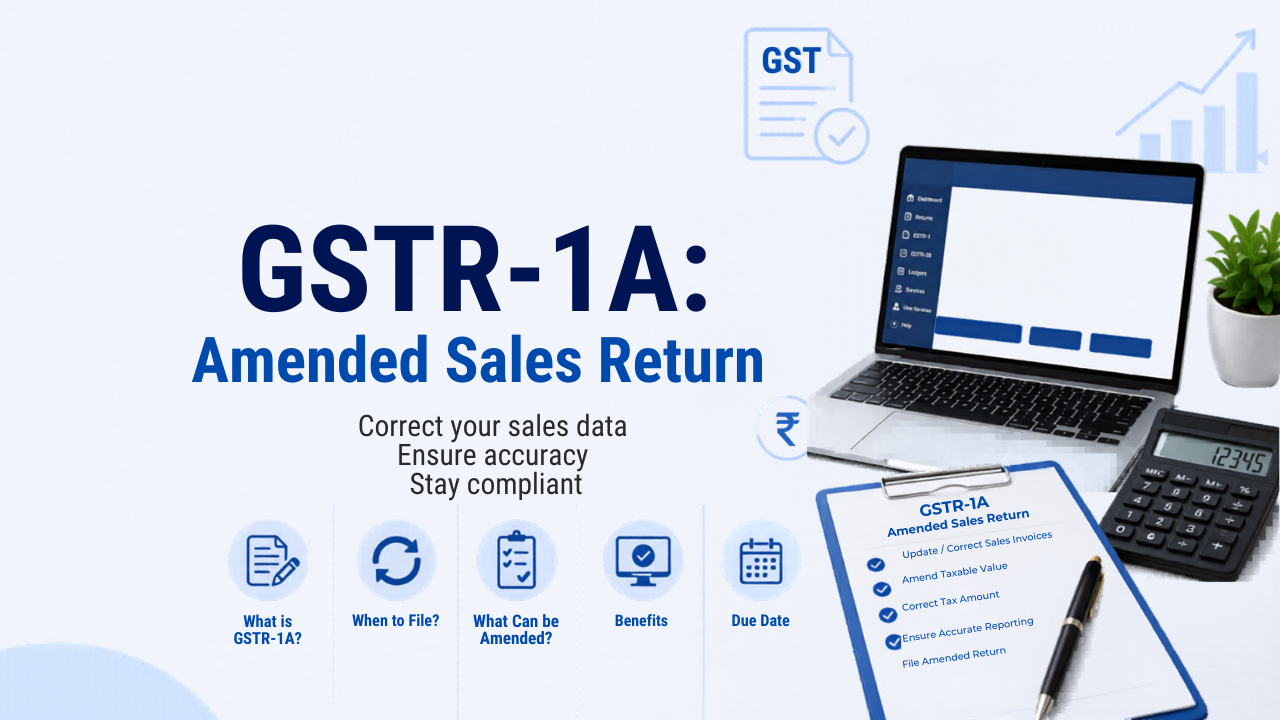
GSTR-1A is the amendment return for GSTR-1. It allows a registered GST taxpayer to correct mistakes or add missed invoices in their already-filed GSTR-1, within the same tax period, before filing GSTR-3B. The form was reintroduced in July 2024 via CBIC Notification No. 12/2024 dated 10 July 2024, after being suspended in 2017. Filing GSTR-1A is optional. There is no late fee or penalty for not filing it.
That said, GSTR-1A has become significantly more important since July 2025, when the GST portal implemented hard-locking of GSTR-3B. From July 2025 onwards, the outward tax liability in GSTR-3B is auto-populated from GSTR-1 and cannot be manually edited. If you made an error in GSTR-1, your only option to fix it within the same tax period is GSTR-1A. After GSTR-3B is filed, that window closes. Missing this window may result in a tax mismatch that the department flags through a demand notice. Read our guide on how to handle income tax demand notices to understand what to do if that happens.
In this guide, I will cover what GSTR-1A is, who should file it, when the filing window opens and closes, the step-by-step process, what you can and cannot amend, how it affects the buyer’s GSTR-2B, and the impact of GSTR-3B hard-locking on your correction strategy.
What is GSTR-1A?
GSTR-1A is a supplementary return under GST that captures only the changes or additions made to outward supply details originally filed in GSTR-1 for the same tax period. It is not a replacement of GSTR-1. It is an amendment layer on top of GSTR-1 for the same month or quarter.
Think of it this way. You file GSTR-1 for May 2025 on 10 June 2025. You then discover that one invoice was entered with the wrong taxable value and one invoice was missed entirely. You cannot go back and edit a filed GSTR-1. But you can file GSTR-1A between 11 June 2025 and the date you file your GSTR-3B for May 2025, which is due on 20 June 2025. The corrected and missing data in GSTR-1A will auto-populate into your GSTR-3B, ensuring the right tax liability is computed.
Before 2024, if you missed an invoice or made an error in GSTR-1, you had to wait until the next month’s GSTR-1 to correct it. GSTR-1A eliminates that waiting period for errors in the current tax period.
Who Can File GSTR-1A?
Any registered taxpayer who files GSTR-1 can file GSTR-1A. This includes:
- Monthly filers: Regular taxpayers with aggregate annual turnover above Rs. 5 crore who file GSTR-1 every month.
- Quarterly filers (QRMP scheme): Taxpayers with turnover up to Rs. 5 crore who file GSTR-1 quarterly. They can also use GSTR-1A to amend records reported through the Invoice Furnishing Facility (IFF) for month 1 or month 2 of the quarter.
- Casual Taxable Persons: Those who file GSTR-1 on a temporary registration basis can also file GSTR-1A.
Composition scheme dealers, Input Service Distributors (ISD), Non-Resident Taxable Persons (NRTP), and those exempt from filing GSTR-1 cannot file GSTR-1A.
GSTR-1A Filing Window: When Does It Open and Close?
The GSTR-1A window opens on the later of two dates:
- The actual date of filing GSTR-1, or
- The due date of GSTR-1 (11th for monthly filers, 13th for quarterly filers)
The window closes the moment GSTR-3B is filed for that same tax period.
There is no separate due date for GSTR-1A. It is not a dated deadline; it is a window that shuts when GSTR-3B is submitted. Once GSTR-3B is filed, GSTR-1A is no longer available for that period. No exceptions.
| Taxpayer Type | GSTR-1A Opens | GSTR-1A Closes |
|---|---|---|
| Monthly filer | Later of: actual GSTR-1 filing date OR 11th of the month | When GSTR-3B is filed (due 20th) |
| Quarterly filer (QRMP) | Later of: actual GSTR-1 filing date OR 13th of the last month of the quarter | When quarterly GSTR-3B is filed |
Example (monthly filer): Priya Enterprises files GSTR-1 for June 2025 on 8 July 2025. GSTR-1A becomes available on 11 July 2025 (the due date, since it is later than the actual filing date). Priya can file GSTR-1A anytime from 11 July until she files GSTR-3B for June 2025, which is due on 20 July 2025.
What Can You Amend in GSTR-1A?
GSTR-1A allows you to amend or add almost all types of outward supply records for the current tax period. Specifically:
- B2B invoices (taxable outward supplies to registered persons)
- B2C inter-state supplies above Rs. 1 lakh to unregistered persons
- Export invoices
- Supplies to SEZ units and developers
- Debit notes and credit notes
- Advances received and adjusted
- HSN-wise summary of outward supplies
- Records reported in IFF for months 1 and 2 (for QRMP filers)
GSTR-1A has 15 tables, mirroring the structure of GSTR-1. Only the tables relevant to your corrections need to be filled. You do not need to re-enter all GSTR-1 data. For a broader understanding of how GST fits within India’s overall tax system, read our complete income tax guide for India.
What You Cannot Amend in GSTR-1A
GSTR-1A has specific restrictions. The following cannot be changed through GSTR-1A:
- Recipient’s GSTIN: If you entered the wrong buyer GSTIN in an invoice, you cannot change it in GSTR-1A. To correct the GSTIN, you must raise a new invoice in the next period’s GSTR-1 and issue a credit note for the original incorrect invoice.
- Records from previous tax periods: GSTR-1A covers only the current period. Errors in GSTR-1 of earlier months must be corrected through a subsequent GSTR-1, within the time limit of 30 November of the following financial year or before filing the annual return GSTR-9, whichever is earlier.
- Invoices already accepted by buyer on IMS: If the buyer has already accepted an invoice on the Invoice Management System (IMS) and you as the supplier have also accepted their modification in GSTR-1A, you cannot amend those invoices again through the same GSTR-1A. GSTR-1A can be filed only once per tax period.
- Nil GSTR-1A: You cannot file a blank or nil GSTR-1A. There must be actual additions or amendments to file.
How to File GSTR-1A: Step-by-Step
- Log in to the GST portal at gst.gov.in using your registered credentials.
- Go to Services > Returns > Returns Dashboard. Select the relevant financial year and tax period (month or quarter).
- On the Returns Dashboard, you will see the GSTR-1A tile once it becomes available (after GSTR-1 due date or actual filing, whichever is later).
- Click Prepare Online on the GSTR-1A tile.
- Navigate to the relevant tables. Add missing invoices or amend incorrect entries in the appropriate table. Processed records appear in green; records with errors appear in red.
- Review all changes carefully. GSTR-1A can be filed only once. There is no option to revise a filed GSTR-1A. If you save records but do not file, you must either delete the saved records, reset the entire GSTR-1A, or file it before proceeding with GSTR-3B.
- Once satisfied, submit GSTR-1A using your Digital Signature Certificate (DSC) or EVC (OTP-based verification).
- An Application Reference Number (ARN) is generated as confirmation of successful filing.
Important: If you have saved records in GSTR-1A but not filed, and you attempt to file GSTR-3B, the portal will throw an error. You must either delete the saved GSTR-1A records, reset the GSTR-1A form, or file GSTR-1A before filing GSTR-3B. The portal will not allow both to remain in a half-done state simultaneously.
How GSTR-1A Affects the Buyer’s GSTR-2B
This is the section most guides miss, and it is the part that matters most for your buyer’s Input Tax Credit (ITC) claims.
When you file GSTR-1A, the amended or added supplies are not immediately reflected in the buyer’s current-period GSTR-2B. They are reflected in the next open GSTR-2B of the recipient.
Here is an example to make this clear. Arjun Traders files GSTR-1 for January 2025 on 8 February 2025. GSTR-2B for January 2025 is generated for the buyer on 14 February 2025. On 15 February 2025, Arjun files GSTR-1A adding a missed invoice. That invoice was not part of the GSTR-2B generated on 14 February. It will now be included in the buyer’s GSTR-2B for February 2025, which is generated in March. The buyer can claim ITC on that invoice only in February, not January.
This one detail is critical for planning. If your buyer needs to claim ITC in the current month, and you missed reporting an invoice, filing GSTR-1A for that month will not help them claim ITC in that same month. They will get it in the following month’s GSTR-2B. This is similar to how mismatches in income tax are handled — pre-filing reconciliation is always better than post-filing corrections. Read our guide on AIS vs Form 26AS for an income tax parallel of the same principle.
GSTR-1A and GSTR-3B Hard-Locking from July 2025
This is the most important update for anyone filing GST returns from the July 2025 tax period onwards.
As per GSTN Advisory No. 606 dated 7 June 2025, the outward tax liability auto-populated in GSTR-3B from GSTR-1 and IFF is now non-editable. Tables 3.1 and 3.2 of GSTR-3B, which capture outward supplies and inter-state supplies to unregistered persons respectively, are locked once populated from GSTR-1 data.
What this means in practice:
- If you entered a wrong taxable value in GSTR-1, that wrong value flows into GSTR-3B and you cannot correct it manually in GSTR-3B.
- Your only option to fix it within the same tax period is to file GSTR-1A before you file GSTR-3B.
- If you miss the GSTR-1A window (i.e., you file GSTR-3B before using GSTR-1A), the correction must wait for the next period’s GSTR-1.
- Missing the correction may require filing Form DRC-03 to pay additional tax liability with applicable interest.
GSTR-1A has effectively become the last line of defence for correcting outward supply errors before GSTR-3B locks them in. The optional nature of GSTR-1A has not changed legally, but functionally, for businesses that make even occasional errors in GSTR-1, it is now an essential part of the monthly compliance workflow.
GSTR-1A vs GSTR-1: Key Differences
| Feature | GSTR-1 | GSTR-1A |
|---|---|---|
| Purpose | Report all outward supplies for the tax period | Amend or add to GSTR-1 for the same period |
| Who files it | Every registered supplier (mandatory) | Supplier who discovers errors after GSTR-1 is filed (optional) |
| Due date | 11th (monthly) / 13th (quarterly) | No fixed due date. Must be filed before GSTR-3B is filed. |
| Frequency | Monthly or quarterly | Once per tax period. Cannot be revised after filing. |
| Data scope | All outward supplies for the period | Only the changes or additions to current period GSTR-1 |
| Impact on GSTR-3B | Auto-populates GSTR-3B | Also auto-populates GSTR-3B (combined with GSTR-1 data) |
| Impact on buyer’s GSTR-2B | Current period GSTR-2B | Next open GSTR-2B of the recipient |
| Nil filing | Allowed (even via SMS) | Not allowed |
| Amendment to past periods | Can amend previous period invoices in tables 9, 10, 11 | Cannot amend records from previous tax periods |
Practical Scenarios: When to Use GSTR-1A
Scenario 1: Wrong Invoice Value
Vikram Textiles filed GSTR-1 for April 2025 showing an invoice of Rs. 2,00,000 which should have been Rs. 2,50,000. The GST on the difference is Rs. 9,000 (18%). Vikram uses GSTR-1A to amend the invoice with the correct value of Rs. 2,50,000. The correct liability of Rs. 45,000 instead of Rs. 36,000 now flows into GSTR-3B. Vikram pays the right tax without facing a mismatch scrutiny.
Scenario 2: Missed Invoice
Meera Pharma missed reporting one B2B invoice worth Rs. 80,000 (GST: Rs. 14,400) in GSTR-1 for March 2025. She files GSTR-1A to add that invoice. The invoice and the associated GST liability are now captured in her GSTR-3B for March 2025. Her buyer will see this invoice in their April 2025 GSTR-2B and can claim ITC then.
Scenario 3: Buyer Rejects Invoice on IMS
Rajan Builders reported a credit note in GSTR-1 for an Rs. 1,20,000 B2B transaction. The buyer rejects it on the Invoice Management System (IMS) because the amount is incorrect. The rejection triggers an auto-update in GSTR-1A. Rajan must accept or decline this change in GSTR-1A before filing GSTR-3B. From July 2025, if Rajan does not address this through GSTR-1A and directly files GSTR-3B, the auto-populated liability will lock in and he will be required to pay higher tax, or file DRC-03 to discharge the additional liability.
Best Practices for GSTR-1A Compliance
- Set an internal review date of the 12th or 13th each month. This gives you a window to file GSTR-1A before GSTR-3B is due on the 20th. Use this window to review your GSTR-1 data, reconcile with your books, and file GSTR-1A if needed.
- Do not save and abandon GSTR-1A. If you start adding records in GSTR-1A but do not file, the portal will block your GSTR-3B filing. Either complete and file GSTR-1A, or delete the saved records before filing GSTR-3B.
- GSTR-1A can be filed only once. Get it right. Unlike GSTR-1 which can be corrected in later periods, GSTR-1A for a given period cannot be revised after filing. There is no second chance for that tax period.
- Inform your buyers when you file GSTR-1A. Since their GSTR-2B update will come in the next period, they need to plan their ITC claims accordingly. A missed communication can cause reconciliation problems on their side.
- Do not use GSTR-1A for past period corrections. Only the current period’s GSTR-1 records can be amended here. For previous months, use the amendment tables in the current GSTR-1. Note that similar time-limit rules apply in income tax as well – read our guide on income tax slabs and compliance rules for reference.
Frequently Asked Questions
Is GSTR-1A mandatory?
No. GSTR-1A is an optional form. There is no late fee or penalty for not filing it. However, from July 2025, with GSTR-3B hard-locking in place, GSTR-1A is the only way to correct GSTR-1 errors within the same tax period. Not filing it when there are errors means those errors carry forward into GSTR-3B and cannot be corrected for that period.
Can I revise GSTR-1A after filing?
No. GSTR-1A can be filed only once per tax period and cannot be revised after submission. This is why it is important to double-check all entries before filing. Any remaining corrections for that period that were not covered in GSTR-1A will need to be done in the next period’s GSTR-1 through the amendment tables.
What happens if I file GSTR-3B before GSTR-1A?
Once GSTR-3B is filed for a tax period, the GSTR-1A window for that period closes permanently. You can no longer file GSTR-1A for that month or quarter. Any corrections to invoices from that period must be done through the amendment tables in a subsequent GSTR-1.
Can I correct a wrong GSTIN in GSTR-1A?
No. The recipient’s GSTIN cannot be changed through GSTR-1A. To address a wrong GSTIN, you need to issue a credit note against the original invoice (in the next period’s GSTR-1) and raise a fresh invoice with the correct GSTIN.
Will the buyer get ITC immediately when I file GSTR-1A?
No. Invoices added or amended in GSTR-1A are reflected in the buyer’s next open GSTR-2B, not the current period’s GSTR-2B. If you file GSTR-1A for May 2025 in June 2025, the buyer will see those invoices in their June 2025 GSTR-2B and can claim ITC in June, not May.
Can QRMP scheme filers use GSTR-1A?
Yes. Quarterly filers under the QRMP scheme can file GSTR-1A. They can also amend records reported through IFF for months 1 and 2 of the quarter in GSTR-1A. The GSTR-1A window for quarterly filers opens after the due date or actual filing of the quarterly GSTR-1, whichever is later, and closes when the quarterly GSTR-3B is filed.