Top 10 Reasons for Income Tax Notice in 2026
Reasons for income tax notice are more varied in 2026 than ever before – the Income Tax Department now has more data about your finances than most taxpayers realise. Between AIS, SFT reports from banks, TDS returns from employers, and registrar data on property transactions, the department can cross-check almost every significant financial transaction you made during FY 2025-26.
In my 7 years of working with salaried professionals, I have seen the same mistakes repeat themselves every filing season. Most notices are not about deliberate fraud. They happen because of small oversights, missed declarations, or incorrect ITR filing. The good news is that most of them are also avoidable.
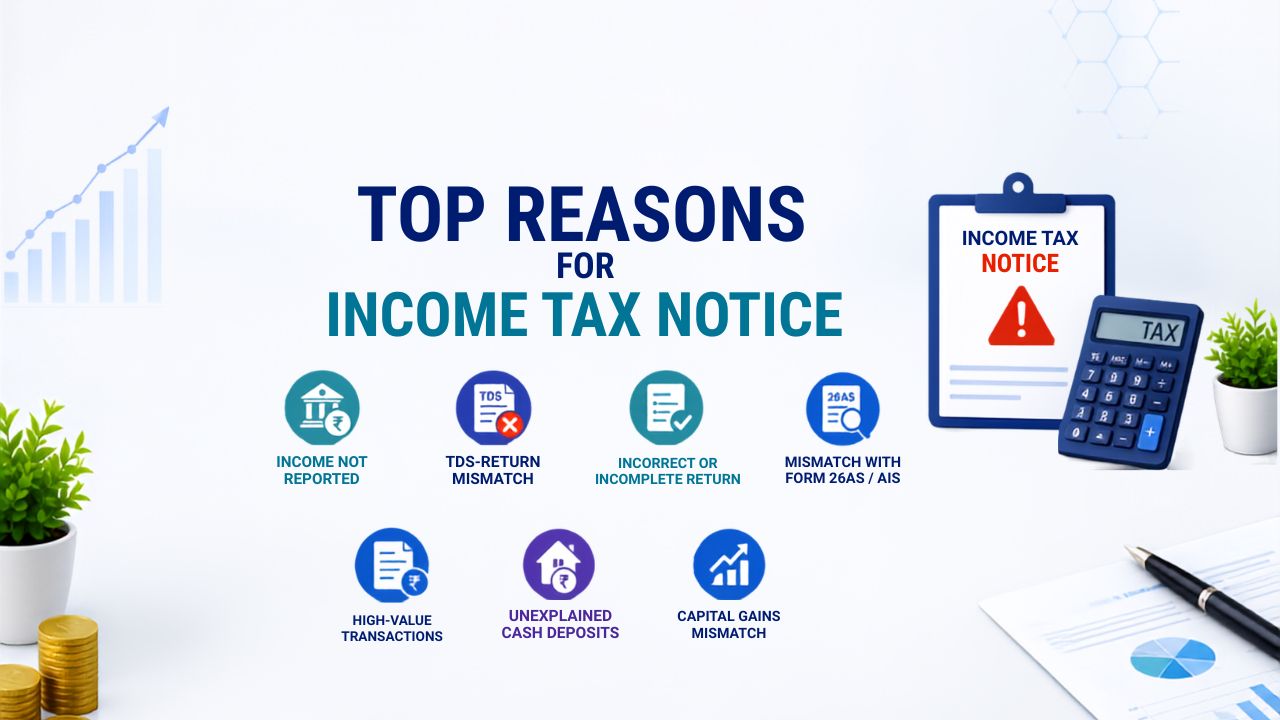
Here are the top 10 reasons taxpayers are receiving income tax notices in 2026, and what you should do if you find yourself in any of these situations.
1. TDS Mismatch Between Your ITR and Form 168
This is the single most common trigger for a Section 143(1) intimation. When you file your ITR, you claim TDS credit based on what was deducted from your salary, bank interest, rent, or other payments. The department compares this against what actually appears in their system via Form 168 (the updated Form 26AS under the new Income Tax Act 2025).
If even a small amount does not match, you receive an intimation with a demand for the difference.
Why it happens: Your employer deducted TDS but filed their TDS return late or with an error in your PAN. Your bank deducted TDS on FD interest but you claimed a different amount. You changed jobs mid-year and one employer’s TDS return has not been filed yet.
What to do: Before filing, always download Form 168 and AIS from the Income Tax portal and cross-check every TDS entry. Only claim what is actually reflected. If something is missing, contact the deductor to file a correction. Our detailed guide on how to read Form 26AS and AIS walks you through this process.
2. High Value Transactions Not Declared
Banks, mutual fund houses, registrars, and other institutions report high value transactions to the Income Tax Department through SFT (Statement of Financial Transactions). If these transactions show up in your AIS but are not explained in your ITR, you will receive a notice.
Key SFT thresholds that trigger reporting:
Cash deposits across savings accounts above Rs. 10 lakh in a year. Fixed deposit bookings above Rs. 10 lakh in a year. Credit card bill payments above Rs. 10 lakh in a year. Mutual fund purchases above Rs. 10 lakh in a year. Purchase of shares or bonds above Rs. 10 lakh in a year. Property sale or purchase above Rs. 30 lakh (reported by the registrar).
What to do: Review your AIS carefully before filing. If a high value transaction appears, make sure your ITR explains the source. If it came from savings, inheritance, or a loan, be prepared to document it.
3. Capital Gains from Property or Equity Not Reported
The registrar reports every property transaction above Rs. 30 lakh to the Income Tax Department. Stock exchanges and depositories report equity transactions. If you sold property, stocks, or mutual funds in FY 2025-26 and did not report the capital gains in your ITR, the department will flag it.
Common scenarios: You sold a flat and used the money to buy another, assuming the Section 54 exemption means you do not need to declare anything. You switched mutual fund schemes, not realising redemption is a taxable event. You inherited property and sold it, unsure whether it was taxable.
All of these require capital gains to be declared in your ITR, even if the final tax is zero after exemptions. Non-declaration itself invites a notice under Section 148 for income escaping assessment.
4. Mismatch Between AIS and Your ITR
AIS (Annual Information Statement) is more comprehensive than Form 168. It includes dividends received, interest from all sources, mutual fund redemptions, property transactions, salary from all employers, and even rent paid if TDS was deducted under Section 194IB.
If your ITR does not account for all income shown in AIS, the department’s system flags it automatically.
What to do: Download your AIS from the Income Tax portal before filing. Go through every entry. If something is incorrect in AIS, you can raise a feedback request on the portal to correct it. If it is correct, make sure your ITR reflects it. Our guide comparing AIS vs Form 26AS explains what each contains and how to use them together.
A Quick Example of How Small This Gap Can Be
Neha earns Rs. 16,00,000 in salary and also holds a fixed deposit that paid her Rs. 45,000 in interest during the year. Her bank deducted Rs. 4,500 as TDS at 10% and credited the rest to her account. Assuming the TDS already settled her obligation, she left this interest out of her ITR entirely. But her bank still reported the full Rs. 45,000 to AIS. Her actual tax liability on that interest, at her slab rate including cess, works out to roughly Rs. 7,020, well above the Rs. 4,500 already withheld. That Rs. 2,520 gap between what was owed and what was already paid is exactly the kind of shortfall the AIS-matching system catches automatically, and it is the reason many salaried taxpayers get a notice for a discrepancy they did not even realise they had created.
5. Non-Filing of ITR Despite Taxable Income
If you had income above the basic exemption limit and did not file your ITR by the due date, the Income Tax Department will eventually reach out. The department receives TDS data, SFT data, and AIS data from multiple sources. If they see TDS deducted from your salary or significant transactions in your name but no ITR filed, a notice under Section 142(1) or Section 148 follows.
Important: Even if your employer deducted the full tax and your net tax liability is zero, you may still be required to file an ITR depending on your income level and transactions. Non-filing is a separate default from non-payment.
What to do: If you missed the July 31, 2026 deadline, you can still file a belated return by December 31, 2026. After that, the department can assess you without your input. Check the deadlines and options in our guide on belated return vs revised return.
6. Bogus or Inflated Deduction Claims
The department pays close attention to deduction claims that seem inconsistent with your income profile. Common deductions that trigger scrutiny include large Section 80C investments claimed without corresponding investment proofs, HRA exemption claimed with cash rent paid to a relative, Section 80D health insurance premiums that do not match insurer records, and donations under Section 80G to organisations that are not registered or where cash donations exceed Rs. 2,000.
These are flagged either through employer-side verification or during scrutiny assessment under Section 143(2).
What to do: Keep all investment proofs, premium receipts, rent agreements, and donation receipts ready for at least 6 years. If you claimed HRA, make sure rent was actually paid, ideally through bank transfer, and that the landlord’s PAN is mentioned if annual rent exceeds Rs. 1 lakh.
7. Large Cash Deposits Not Explained
If you deposited Rs. 10 lakh or more in cash across your savings accounts during FY 2025-26, your bank reported it to the Income Tax Department via SFT. If this cash deposit does not match your declared income or cannot be explained through prior savings or other legitimate sources, you will receive a notice.
What to do: If you deposited large cash amounts, be ready to show the source. Acceptable sources include prior cash savings, agriculture income, gifts from relatives, or sale of assets. The explanation needs to be consistent with your overall income profile and supported by documentation where possible.
8. Defective ITR Notice Under Section 139(9)
A defective ITR notice is different from a scrutiny notice. It means you filed your return but something in it is technically incomplete or incorrect, and the department needs you to fix it.
Common reasons for a defective return: Filing ITR-1 when you should have used ITR-2, for example if you have capital gains. Not filling in all required schedules. Self-assessment tax shown as paid in the ITR but not reflecting in the system. Filing without a digital signature where one is mandatory.
What to do: Respond to the Section 139(9) notice within 15 days of receiving it. If you agree with the defect, correct and re-file the return. If you disagree, you can submit a reply explaining why the return is not defective. Ignoring this notice means your return is treated as not filed at all, which triggers further consequences. Learn how to file your ITR correctly in our ITR filing guide.
9. Crypto and Virtual Digital Asset Gains Not Disclosed
From FY 2022-23 onwards, gains from Virtual Digital Assets including cryptocurrency are taxed at 30% with no deduction allowed except the cost of acquisition. TDS at 1% is deducted on crypto transactions above Rs. 50,000 per year for individuals (Rs. 10,000 for businesses under tax audit) on exchanges.
If you traded crypto during FY 2025-26 and did not declare the gains in your ITR, the department can identify this through TDS returns filed by exchanges and SFT data.
What to do: Report all VDA transactions in the VDA schedule of your ITR. Even if you made a loss, declare it. Losses from VDAs cannot be set off against any other income, including gains from other VDA transactions, and cannot be carried forward. Non-disclosure of transactions invites scrutiny regardless of profit or loss.
10. Foreign Income or Assets Not Declared
If you hold a foreign bank account, overseas investments, or received income from foreign sources such as salary from an overseas employer, rental income from foreign property, or dividends from foreign shares, these must be disclosed in Schedule FA (Foreign Assets) and Schedule FSI (Foreign Source Income) of your ITR.
The department receives information about foreign assets through automatic exchange of information agreements with other countries. Non-disclosure of foreign assets carries severe penalties under the Black Money (Undisclosed Foreign Income and Assets) Act, separate from regular income tax penalties.
What to do: If you have any foreign accounts, investments, or income, use ITR-2 or ITR-3 depending on your income type, and fill in all foreign asset schedules. Even dormant foreign accounts need to be declared.
Bonus: GST Turnover Not Matching Your ITR (For Freelancers and Business Owners)
If you are a freelancer or run a business registered under GST, the department cross-checks the turnover declared in your GST returns against the income shown in your ITR. A mismatch here, even an honest one caused by timing differences between when invoices are raised and when income is recognised for tax purposes, is one of the most common scrutiny triggers for this group of taxpayers.
Why it happens: GST turnover reflects the full invoice value from GSTR-1 and GSTR-3B, while your ITR income might follow a different accounting method, exclude exempt supplies, or treat advances differently. Sometimes the two returns are simply never reconciled before filing.
What to do: Reconcile your GST turnover against your ITR income before filing either return, not after. If a genuine timing difference exists, keep documentation ready to explain it. Doing this reconciliation every quarter, rather than scrambling at year-end, avoids most of these notices entirely.
What to Do If You Receive Any of These Notices
Do not ignore it. Every income tax notice has a deadline for response. Missing it leads to ex-parte assessment orders, which are significantly harder to challenge.
Read the notice carefully. The notice will specify the exact section, the assessment year it relates to, and what the department is asking for. Most Section 143(1) intimations are system-generated and resolve quickly once you respond with the right information.
Respond through the portal. All responses to income tax notices must be submitted through the Income Tax portal under the e-Proceedings section. Keep acknowledgement copies of everything you submit.
File a revised return if needed. If the notice is for AIS mismatch or undeclared income and you agree with the department’s position, filing a revised return before March 31, 2027 is often the cleanest resolution. For reassessment notices under Section 148, the process is different and professional guidance is recommended.
Seek professional help for scrutiny notices. Section 143(2) scrutiny notices and Section 148 reassessment notices are more serious and often benefit from professional guidance.
What Happens After: Demand and Refund Adjustment Notices
Two more notices are worth knowing, since they usually follow one of the 10 reasons above rather than being a trigger by themselves. A Section 156 notice of demand is issued once an assessment determines you owe additional tax, giving you 30 days to pay before interest under Section 220(2) and a penalty under Section 221 start applying. Under the new Income Tax Act, 2025, this provision has been renumbered to Section 289. A Section 245 intimation works differently: if you are owed a refund but also have an outstanding demand from an earlier year, the department adjusts your refund against that demand, but only after giving you 30 days to respond, agree, or dispute it. Miss that window, and the adjustment happens automatically without further notice.
Quick Reference: Notice Type by Reason
| Reason | Notice Section | Action Required |
|---|---|---|
| TDS mismatch | Section 143(1) | Verify Form 168, file rectification |
| High value transactions | Section 142(1) / 143(2) | Explain source in response |
| Capital gains not reported | Section 148 | File revised or updated return |
| AIS mismatch | Section 143(1) | Correct AIS or revise ITR |
| Non-filing | Section 142(1) | File belated return immediately |
| Bogus deductions | Section 143(2) | Submit investment proofs |
| Cash deposits | Section 142(1) | Document source of cash |
| Defective ITR | Section 139(9) | Correct and re-file within 15 days |
| Crypto not disclosed | Section 143(2) / 148 | File revised return with VDA schedule |
| Foreign assets | Section 142(1) | File revised return with Schedule FA |
| GST turnover mismatch | Section 142(1) / 143(2) | Reconcile GST returns with ITR income |
Conclusion
An income tax notice is not the end of the world, but it is always easier to avoid one than to respond to it. The common thread across all 10 reasons above is the same: the Income Tax Department has access to more financial data than most taxpayers realise. Whatever you earn, invest, deposit, or sell is likely already in their system through AIS, SFT, or TDS records.
The safest approach is to review your AIS and Form 168 carefully before filing your ITR for FY 2025-26. Cross-check every entry, declare all income regardless of whether it is taxable, and keep your investment proofs ready. For a complete overview of how to file your ITR correctly this season, refer to our complete income tax guide and the ITR filing last date guide.
Frequently Asked Questions
What is the most common income tax notice for salaried employees?
Section 143(1) intimation due to TDS mismatch is the most common. It is system-generated and usually resolves once you verify your Form 168 and file a rectification if needed.
How much time do I have to respond to an income tax notice?
It depends on the section. Section 139(9) defective return notices require a response within 15 days. Section 143(1) intimations typically give 30 days. Section 143(2) scrutiny notices specify a date for compliance. Always check the specific deadline on the notice itself.
Can I file a revised ITR after receiving a notice?
Yes, if the notice is for AIS mismatch or undeclared income and you agree with the department’s position, filing a revised return before March 31, 2027 is often the cleanest resolution. For reassessment notices under Section 148, the process is different and professional guidance is recommended.
What happens if I ignore an income tax notice?
The department proceeds with ex-parte assessment, which means they determine your income and tax liability based on the information available to them, without your input. This almost always results in a higher tax demand, penalties, and interest. Responding is always the better option.
Is a Section 143(1) intimation the same as a notice?
A Section 143(1) intimation is technically a communication about the processing of your return, not a scrutiny notice. However, if it contains a demand, you must respond or pay the amount within the deadline. Ignoring it converts it into a tax demand with interest.
I received a notice for AY 2023-24. Is it too late to respond? No. Respond immediately through the e-Proceedings section on the portal. The department can issue reassessment notices for up to 3 years for escaped income below Rs. 50 lakh and up to 10 years for escaped income above Rs. 50 lakh. Always respond regardless of the assessment year.