Section 80EEA: Deduction on Home Loan Interest
If you bought your first home under the affordable housing category and your loan was sanctioned between April 1, 2019 and March 31, 2022, you may be sitting on a deduction of up to Rs. 1.5 lakh every year that many taxpayers completely miss. This is Section 80EEA deduction, and it is available over and above the Rs. 2 lakh deduction you already get under Section 24(b).
In 7 years of working with salaried professionals on their tax planning, I have seen this one deduction go unclaimed more often than almost any other. Either the taxpayer does not know it exists, or they assume it expired after 2022. The loan sanction window did close in March 2022, but if your loan falls within that window, the deduction continues every year until your loan is fully repaid.
This guide covers everything you need to know: eligibility, the stamp duty condition, how it stacks with Section 24(b), and exactly where to claim it in your ITR.
What Is Section 80EEA?
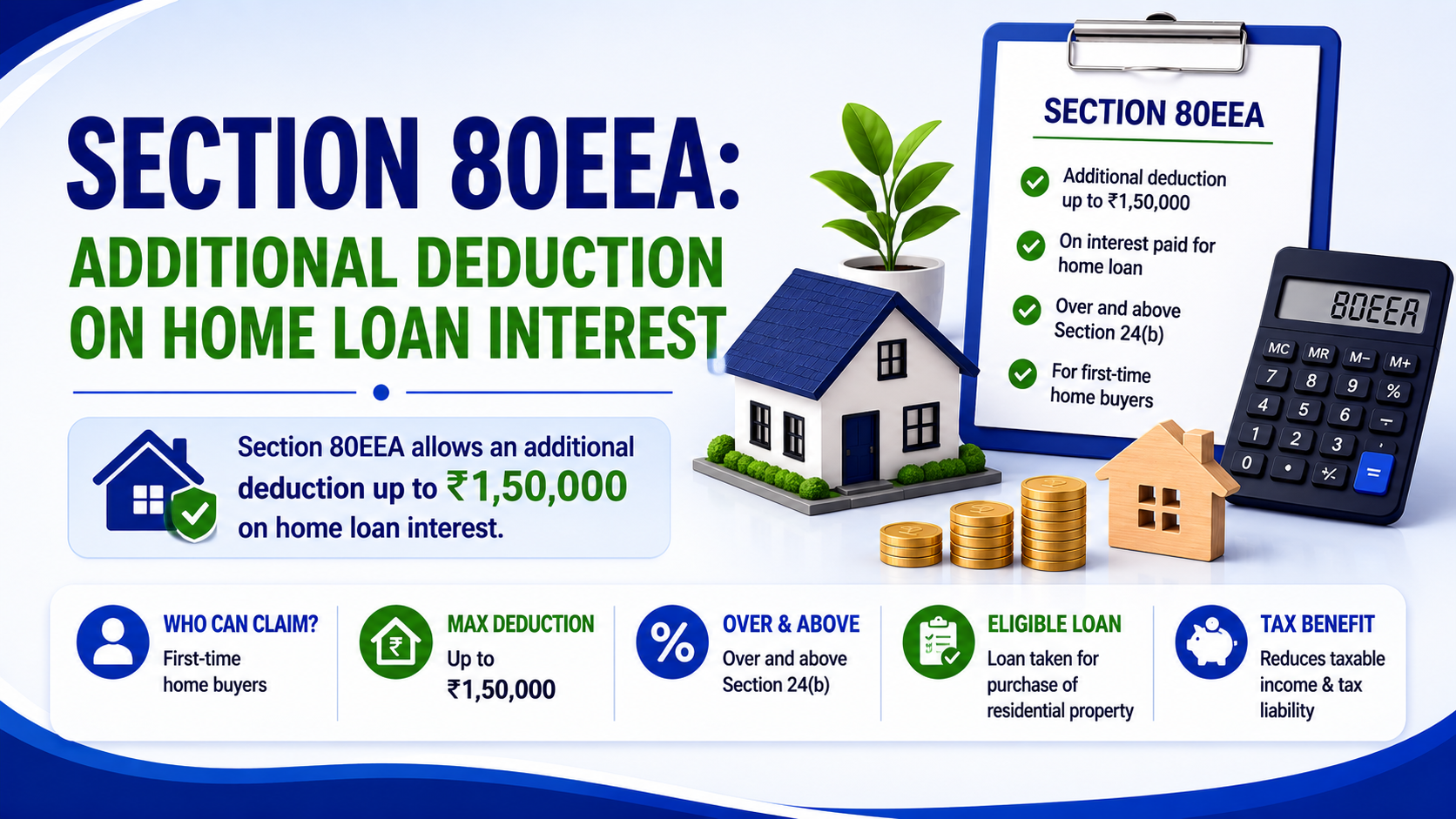
Section 80EEA of the Income Tax Act 1961 was introduced in Budget 2019 under the government’s “Housing for All” initiative. It provides an additional deduction of up to Rs. 1,50,000 per year on home loan interest for first-time buyers purchasing affordable residential property.
The key word here is “additional.” This deduction is over and above the Rs. 2 lakh annual interest deduction available under Section 24(b). So if your annual home loan interest is Rs. 3.5 lakh or more, you can potentially claim the full benefit of both sections and reduce your taxable income by Rs. 3.5 lakh on interest alone.
Section 80EEA is available only under the old tax regime. If you have opted for the new tax regime for FY 2025-26, this deduction is not available to you. You can read more about which regime works better for your salary before deciding.
Section 80EEA Eligibility Conditions
All six conditions below must be satisfied together. If even one is not met, the deduction is not available.
1. Individual taxpayer only Section 80EEA deduction is available only to individuals. HUFs, companies, firms, and other entities cannot claim it.
2. Loan sanctioned between April 1, 2019 and March 31, 2022 This is the most important condition. The loan must have been sanctioned (not disbursed, not applied for, but formally sanctioned by the lender) within this window. No deduction is available for loans sanctioned after March 31, 2022.
3. Stamp duty value of the property must not exceed Rs. 45 lakh The stamp duty value is the value assigned to the property by the state government for stamp duty calculation purposes. This is not the same as the market value or the loan amount. Your property’s stamp duty value must be Rs. 45 lakh or less at the time of purchase.
4. First-time buyer: no other residential property on sanction date On the date the loan was sanctioned, you should not have owned any other residential property. If you already owned a house when the loan was approved, you cannot claim Section 80EEA on the new property.
5. Loan must be from a financial institution or housing finance company The home loan must be from a bank, NBFC, or a registered housing finance company. Loans from family, friends, or private lenders do not qualify.
6. Cannot claim both Section 80EE and Section 80EEA Section 80EE (an older provision for loans sanctioned between April 2016 and March 2017) and Section 80EEA are mutually exclusive. You can claim one or the other, not both.
How Much Can You Claim Under Section 80EEA?
The maximum deduction is Rs. 1,50,000 per financial year on home loan interest paid. This is per individual, so in a joint loan, each co-borrower who meets all the eligibility conditions can claim up to Rs. 1.5 lakh separately.
There is no cap on the number of years you can claim this. As long as your loan is active and you are paying interest on it, and your loan was sanctioned within the eligible window, the deduction continues year after year until the loan is fully repaid.
Section 80EEA and Section 24(b): How They Work Together
This is where the real tax saving lies. Let us understand the sequence:
Section 24(b) allows a deduction of up to Rs. 2 lakh per year on home loan interest for a self-occupied property. This applies to all home loan borrowers regardless of whether it is a first purchase or not.
Section 80EEA applies only to the interest amount that exceeds Rs. 2 lakh. If your total home loan interest paid in a year is less than Rs. 2 lakh, Section 80EEA will not apply because there is no remaining interest left to claim after Section 24(b). The Income Tax Department’s own ITR validation rules confirm this sequence: Section 24(b) interest is entered first, and only the surplus beyond Rs. 2 lakh flows into Section 80EEA.
So the total benefit if you qualify for both:
| Deduction | Maximum Amount |
|---|---|
| Section 24(b): Interest on home loan | Rs. 2,00,000 |
| Section 80EEA: Additional interest deduction | Rs. 1,50,000 |
| Total interest deduction possible | Rs. 3,50,000 |
Add to this the principal repayment benefit under Section 80C (up to Rs. 1.5 lakh), and a first-time buyer of affordable housing can potentially claim Rs. 5 lakh in total deductions from a single home loan.
Practical Example:
Rahul is a salaried professional in Pune who took a home loan of Rs. 32 lakh in August 2020 for a flat with a stamp duty value of Rs. 42 lakh. He is a first-time buyer. His annual home loan interest for FY 2025-26 is Rs. 2,80,000.
| Particulars | Amount |
|---|---|
| Total home loan interest paid (FY 2025-26) | Rs. 2,80,000 |
| Deduction under Section 24(b) | Rs. 2,00,000 |
| Remaining interest | Rs. 80,000 |
| Deduction under Section 80EEA (capped at Rs. 1.5L) | Rs. 80,000 |
| Total interest deduction claimed | Rs. 2,80,000 |
| Additional deduction available (unused 80EEA limit) | Rs. 70,000 (not claimable as interest is exhausted) |
Rahul saves tax on the full Rs. 2.8 lakh of interest he paid. Without Section 80EEA, he would have been capped at Rs. 2 lakh.
Is Section 80EEA Still Available in FY 2025-26?
Yes, with an important clarification.
The loan sanction window closed on March 31, 2022. No new loans after that date qualify for Section 80EEA. However, there has been no amendment to the Act that removes the deduction for loans already sanctioned within the eligible window.
The applicability period for loan sanctions (up to March 31, 2022) remains, but individuals with loans within this period can continue claiming deductions until the loan is repaid.
So for FY 2025-26:
- Loan sanctioned between April 1, 2019 and March 31, 2022 → Section 80EEA deduction available
- Loan sanctioned after March 31, 2022 → Not eligible
- Loan sanctioned before April 1, 2019 → Not eligible (check Section 80EE instead)
Section 80EEA vs Section 80EE: Quick Comparison
| Parameter | Section 80EE | Section 80EEA |
|---|---|---|
| Loan sanction period | April 1, 2016 to March 31, 2017 | April 1, 2019 to March 31, 2022 |
| Maximum deduction | Rs. 50,000 per year | Rs. 1,50,000 per year |
| Property value limit | Rs. 50 lakh (property value) | Rs. 45 lakh (stamp duty value) |
| Loan amount limit | Rs. 35 lakh | No upper limit |
| Can be claimed together? | No | No |
If your loan was sanctioned between April 2016 and March 2017, check Section 80EE. If it was sanctioned between April 2019 and March 2022, Section 80EEA is your deduction.
What About the New Income Tax Act 2025?
The new Income Tax Act 2025 came into effect from April 1, 2026. For ITR filing in July 2026 (FY 2025-26), you are still using the Act 1961 rules under Tab 1 on the income tax portal. For a complete overview of deductions and tax rules this year, see our income tax guide for India.
Under the new Act 2025, Section 80EEA does not have a direct equivalent for the new tax regime. In the new tax regime, deduction is not allowed under sections 24(b), 80C, 80EE and 80EEA. The old tax regime equivalent sections, including 80EEA, remain claimable under Tab 1 for FY 2025-26 returns.
How to Claim Section 80EEA in Your ITR
When you file your ITR through the income tax e-filing portal, here is exactly what you need to do:
Step 1: Choose the old tax regime. Section 80EEA is not available under the new regime.
Step 2: In your ITR form, navigate to the Deductions section under Chapter VI-A.
Step 3: Under Section 80EEA, you will need to enter the following details as per the Income Tax Department’s ITR validation requirements:
- Stamp duty value of the residential property
- Name of the bank or financial institution
- Loan account number
- Date of sanction of the loan
- Total loan amount
- Loan outstanding as on March 31, 2026
- Interest paid under Section 80EEA for FY 2025-26
Step 4: Ensure Section 24(b) interest is entered first. Section 80EEA applies only to interest that exceeds the Rs. 2 lakh Section 24(b) limit. If your total interest paid is below Rs. 2 lakh, Section 80EEA will not apply.
You can refer to the complete ITR filing guide for step-by-step portal navigation.
Documents to Keep Ready
Before filing, gather these documents:
- Home loan sanction letter (showing sanction date clearly)
- Home loan interest certificate from your bank for FY 2025-26
- Sale deed or registration document showing the stamp duty value of the property
- Self-declaration that you did not own any other residential property on the loan sanction date (your CA may ask for this)
Common Mistakes to Avoid
Claiming 80EEA without exhausting Section 24(b): The portal will reject this. Always claim the full Rs. 2 lakh under 24(b) first. Only the interest amount beyond Rs. 2 lakh flows into Section 80EEA.
Assuming the deduction expired in 2022: The loan sanction window closed in 2022, but if your loan was sanctioned within the window, the deduction is very much alive and available every year until repayment.
Confusing stamp duty value with market value: A property with a market value of Rs. 55 lakh may have a stamp duty value of Rs. 43 lakh depending on the state. Always check the stamp duty value specifically, not what you paid for the property.
Claiming under the new tax regime: Section 80EEA is not available under the new tax regime. If you have switched to the new regime for FY 2025-26, this deduction is off the table. Compare both regimes carefully before choosing. Under the old regime, deductions like Section 80D for health insurance and Section 80EEA together can make a significant difference to your tax outgo. You can find more tax saving options for salaried employees to see the full picture.
Frequently Asked Questions
Q: My loan was sanctioned in February 2022. Can I still claim Section 80EEA for FY 2025-26? Yes. February 2022 falls within the eligible sanction window (April 1, 2019 to March 31, 2022). You can continue claiming Section 80EEA every year until your loan is fully repaid.
Q: I have a joint home loan with my spouse. Can both of us claim Section 80EEA? Yes, provided both co-borrowers are also co-owners of the property, and both individually meet all the eligibility conditions including the first-time buyer requirement. Each can claim up to Rs. 1.5 lakh separately.
Q: My property’s stamp duty value was Rs. 43 lakh at the time of purchase but has since increased. Does the current value matter? No. The stamp duty value is checked at the time of purchase, not the current value. If it was within Rs. 45 lakh when you bought the property, you remain eligible.
Q: I claimed Section 80EEA last year. Do I need to re-enter all loan details again this year? Yes. Every year you file your ITR, you need to enter the loan details afresh in the Section 80EEA field. The portal does not carry forward this information automatically.
Q: Can I claim Section 80EEA if I have also claimed HRA? Yes. HRA exemption and Section 80EEA are completely independent. HRA is an exemption under Section 10, while 80EEA is a deduction under Chapter VI-A. You can claim both simultaneously. Learn more about HRA exemption calculation here.
Q: Is there a deduction for Section 80EEA under the new Income Tax Act 2025? For FY 2025-26 (July 2026 filing), you are using Act 1961 rules under Tab 1 on the portal, and Section 80EEA is claimable under the old regime. The new Act 2025 provisions under Tab 2 apply from Tax Year 2026-27 onwards.
Conclusion
Section 80EEA deduction is one of the more generous provisions in the Income Tax Act for first-time homebuyers in the affordable housing segment. If your loan was sanctioned between April 2019 and March 2022, your property’s stamp duty value is within Rs. 45 lakh, and you are filing under the old tax regime, you have up to Rs. 1.5 lakh in additional deductions available every single year until your loan ends.
Combined with Section 24(b) and Section 80C principal repayment benefits, the total deduction from your home loan alone can reach Rs. 5 lakh per year. That is a significant number that is worth getting right.
Check your loan sanction letter, verify the stamp duty value on your registration document, and claim what is rightfully yours before the July 31, 2026 deadline.