Section 10(10D) of Income Tax Act: Life Insurance Tax Exemption Rules
You paid premiums for 20 years, your life insurance policy has finally matured, and you are expecting a tax-free lump sum. But is it actually tax-free? Not always. Whether your maturity proceeds are exempt from income tax depends entirely on whether your policy satisfies the conditions under Section 10(10D) of the Income Tax Act. For a full overview of income tax exemptions, see our income tax guide India.
In my experience working with salaried professionals on their tax planning, life insurance taxation is one of the most misunderstood areas. People assume all insurance payouts are tax-free. They are not. Budget 2021 and Budget 2023 both introduced major changes that made high-premium policies fully taxable at maturity. If your policy was bought after those dates, you need to check carefully before assuming exemption.
This guide covers the complete rules under Section 10(10D), the premium conditions, the ULIP-specific limits, what happens when the exemption is not available, and how death benefits are always treated differently.
What Is Section 10(10D)?
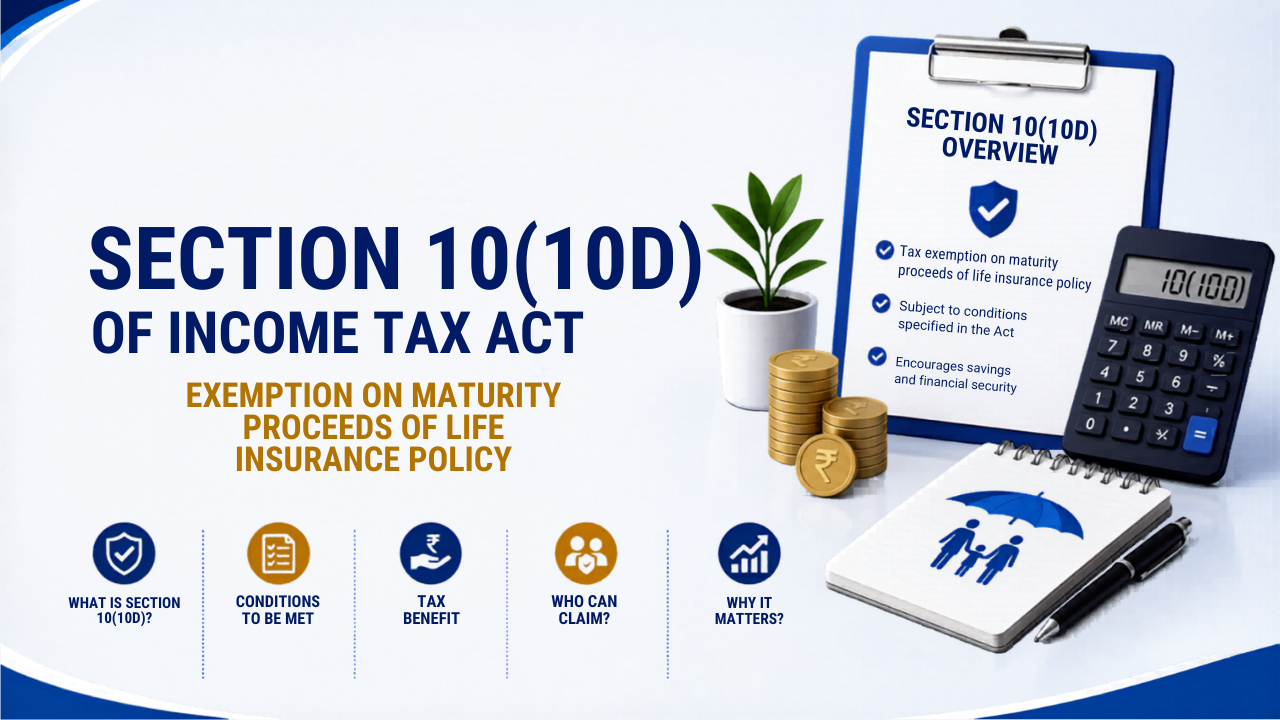
Section 10(10D) of the Income Tax Act 1961 provides a tax exemption on any sum received under a life insurance policy. This includes:
- Maturity proceeds
- Survival benefits
- Bonuses received along with the maturity amount
- Surrender value
The exemption means the entire amount received is excluded from your total income and is not taxed at all. However, this exemption comes with conditions, and those conditions have become significantly stricter since 2021.
Under the new Income Tax Act 2025 (effective April 1, 2026), Section 10(10D) is covered under Schedule II, Sr. No. 2 for Tax Year 2026-27 filings. For FY 2025-26 returns filed in July 2026, the Act 1961 provisions under Tab 1 on the portal apply.
Basic Eligibility Conditions Under Section 10(10D)
For a life insurance policy to qualify for tax exemption under Section 10(10D), the annual premium must not exceed a prescribed percentage of the sum assured. This percentage depends on when the policy was issued:
| Policy Issued | Premium to Sum Assured Ratio |
|---|---|
| Before April 1, 2003 | No specific cap under Section 10(10D) |
| Between April 1, 2003 and March 31, 2012 | Premium must not exceed 20% of sum assured |
| On or after April 1, 2012 | Premium must not exceed 10% of sum assured |
| On or after April 1, 2013 (disabled persons) | Premium must not exceed 15% of sum assured |
If the premium exceeds these limits in any year during the policy term, the maturity proceeds lose the Section 10(10D) exemption entirely and become taxable in the year of receipt.
Example: Suresh bought an endowment policy in 2015 with a sum assured of Rs. 10 lakh. His annual premium is Rs. 1.2 lakh. Since 1.2 lakh is 12% of 10 lakh (which exceeds the 10% cap for post-2012 policies), his maturity proceeds will be fully taxable.
Budget 2021 Amendment: ULIP Taxation Above Rs. 2.5 Lakh
Before Budget 2021, all ULIP maturity proceeds were tax-free under Section 10(10D), regardless of the premium amount. This changed with effect from February 1, 2021.
For ULIPs issued on or after February 1, 2021, the Section 10(10D) exemption is available only if the aggregate annual premium across all ULIPs held by you does not exceed Rs. 2.5 lakh in any financial year during the policy term.
Key points:
- The Rs. 2.5 lakh limit is aggregate across all ULIPs, not per policy
- If you hold multiple ULIPs and their combined annual premium exceeds Rs. 2.5 lakh, the exemption is denied on the excess policies
- For ULIPs issued before February 1, 2021, the old rules continue to apply: maturity is still tax-free regardless of premium amount
- If the exemption is denied, ULIP maturity proceeds are taxed as capital gains similar to equity mutual funds, not as regular income at slab rate
Example: Priya holds two ULIPs issued in March 2022. ULIP A has an annual premium of Rs. 1.8 lakh and ULIP B has an annual premium of Rs. 1.2 lakh. Combined premium: Rs. 3 lakh, which exceeds Rs. 2.5 lakh. ULIP B’s maturity proceeds will be taxable since the aggregate crosses the threshold. ULIP A (Rs. 1.8 lakh, within limit if considered alone for the qualifying amount) may still receive proportionate exemption as per CBDT Circular 2/2022.
Budget 2023 Amendment: Traditional Policy Taxation Above Rs. 5 Lakh
Budget 2023 extended a similar restriction to traditional (non-ULIP) life insurance policies. For policies issued on or after April 1, 2023, the Section 10(10D) exemption is available only if the aggregate annual premium across all such non-ULIP policies does not exceed Rs. 5 lakh in any financial year during the policy term.
This affects:
- Endowment plans
- Money-back policies
- Whole life policies
- Term plans with maturity/survival benefit (return of premium plans)
This does NOT affect:
- Pure term insurance with no maturity benefit (death benefit only)
- Policies issued before April 1, 2023 (old policies continue under previous rules)
- ULIP policies (governed by the separate Rs. 2.5 lakh limit from Budget 2021)
Example: Vikram bought two traditional endowment policies in June 2023. Policy 1 has an annual premium of Rs. 3.5 lakh and Policy 2 has an annual premium of Rs. 2 lakh. Combined: Rs. 5.5 lakh, which exceeds Rs. 5 lakh. The maturity proceeds from both policies will not be fully exempt. The taxable portion will be calculated as per CBDT Circular 15/2023 rules.
Complete Summary: Section 10(10D) Rules by Policy Type
| Policy Type | Issue Date | Condition for Exemption |
|---|---|---|
| Traditional (endowment, money-back) | Before April 1, 2023 | Premium within 10%/20% of sum assured |
| Traditional (endowment, money-back) | On or after April 1, 2023 | Aggregate annual premium across all such policies within Rs. 5 lakh AND within 10% of sum assured |
| ULIP | Before February 1, 2021 | Premium within 10% of sum assured |
| ULIP | On or after February 1, 2021 | Aggregate annual premium across all ULIPs within Rs. 2.5 lakh AND within 10% of sum assured |
| Pure term insurance (no maturity) | Any date | Always exempt (no maturity payout exists) |
| Keyman insurance | Any date | Never exempt under Section 10(10D) |
Death Benefit: Always Tax-Free
This is the one rule that has never changed and applies across all policy types, all premium amounts, and all issue dates.
The death benefit received by a nominee is always exempt under Section 10(10D), regardless of the premium amount.
It does not matter whether:
- The ULIP premium was Rs. 10 lakh per year
- The traditional policy premium exceeded Rs. 5 lakh
- The policy was a Keyman insurance (Keyman death benefits are the only exception and are taxable)
For all regular life insurance policies, the death benefit paid to the nominee is fully tax-free. No TDS is deducted. No income tax is payable. This remains unchanged even after the Budget 2021 and Budget 2023 amendments.
When Is TDS Deducted on Life Insurance Maturity?
When the Section 10(10D) exemption is not available and the maturity proceeds are taxable, the insurance company deducts TDS under Section 194DA before paying you.
TDS rate under Section 194DA: 2% on the income portion of the maturity proceeds (not on the gross amount).
TDS is deducted only if:
- The maturity amount is Rs. 1 lakh or more, and
- The policy does not qualify for Section 10(10D) exemption
If TDS has been deducted, you will see it reflected in your Form 26AS (Form 168 under the new Act 2025). You must include the taxable maturity proceeds under the appropriate income head when filing your ITR and claim credit for TDS already deducted.
How Are Taxable Life Insurance Proceeds Taxed?
When Section 10(10D) exemption is not available, the maturity proceeds are taxed differently depending on the type of policy:
For ULIPs (post February 1, 2021, premium above Rs. 2.5 lakh): Taxed as capital gains, similar to equity-oriented mutual funds. The gains are not treated as regular income, which means they are not added to your salary and taxed at slab rate. The exact computation follows capital gains rules applicable to equity instruments in the year of receipt.
For traditional policies (post April 1, 2023, premium above Rs. 5 lakh): Taxed as income from other sources at your applicable slab rate. The taxable amount is the maturity proceeds minus the total premiums paid. This means if you are in the 30% tax bracket, a large portion of your maturity amount goes to tax.
This is a significant difference. Many high-premium policyholders who bought traditional plans after April 2023 assuming they would be tax-free are in for a surprise at maturity. Understanding this upfront helps in structuring your insurance and tax planning under the old vs new regime more effectively.
Section 10(10D) and the Section 80C Connection
Many policyholders claim the premium paid under a life insurance policy as a deduction under Section 80C (up to Rs. 1.5 lakh per year). This deduction is available regardless of whether the maturity proceeds qualify for Section 10(10D) exemption.
However, there is an important restriction: for policies issued after April 1, 2012, the Section 80C deduction on the premium is limited to 10% of the sum assured. If the premium exceeds 10% of the sum assured, only the portion up to 10% qualifies for Section 80C. The excess premium does not get any deduction.
This means a high-premium policy can lose both benefits: the Section 80C deduction is capped, and the maturity proceeds are taxable. Structured correctly, insurance can still be a useful tax planning tool, but the premium-to-sum-assured ratio must be within limits from day one.
Policies Not Covered Under Section 10(10D)
The following are explicitly excluded from Section 10(10D) benefits:
Keyman Insurance Policies: These are policies taken by an employer on the life of a key employee. Both the premium paid and the maturity/death benefit received are taxable in the employer’s hands. No exemption under Section 10(10D) applies.
Policies where premium exceeds prescribed limits: As explained above, if the premium-to-sum-assured ratio is breached in any policy year, the entire maturity amount loses exemption.
High-premium ULIP and traditional policies: Post Budget 2021 and Budget 2023 rules apply as detailed in earlier sections.
How to Claim Section 10(10D) Exemption in ITR
When you receive a life insurance maturity amount and it qualifies for Section 10(10D) exemption, here is how it is handled in your ITR:
Step 1: Do not include the exempt maturity amount in your gross total income. Exempt income under Section 10 is reported separately and is not added to taxable income.
Step 2: In your ITR form, go to the Schedule EI (Exempt Income) section. Report the maturity amount here under “Any other exempt income” with a note specifying Section 10(10D).
Step 3: If TDS has been deducted by the insurance company (which should not happen if the amount is exempt, but sometimes occurs), report it in Schedule TDS and claim the credit.
Step 4: If the maturity amount is taxable (because exemption conditions are not met), include it under the appropriate income head: capital gains for ULIPs or income from other sources for traditional policies.
You can refer to the complete ITR filing guide for step-by-step portal navigation. All returns for FY 2025-26 are filed using Tab 1 on the income tax portal.
Section 10(10D) Under the New Income Tax Act 2025
The new Income Tax Act 2025 came into effect from April 1, 2026. Under the new Act, the Section 10(10D) equivalent is covered under Schedule II. The substantive rules (premium limits, ULIP thresholds, death benefit exemption) remain the same. The section numbering has changed but the conditions have not been altered.
For FY 2025-26 ITR filing (July 2026), you are using Tab 1 on the portal, which means Act 1961 rules apply including the original Section 10(10D). You can read more about all exemptions under Section 10 and how they apply to your salary and other income.
Frequently Asked Questions
Q: I received maturity proceeds from a policy I bought in 2008. Is it tax-free? If your policy was issued between April 1, 2003 and March 31, 2012, the premium must not have exceeded 20% of the sum assured in any year. If it stayed within that limit, the maturity amount is fully exempt under Section 10(10D). Policies from 2008 are not affected by Budget 2021 or Budget 2023 changes.
Q: My ULIP was issued in 2019. Does the Rs. 2.5 lakh limit apply? No. The Rs. 2.5 lakh limit applies only to ULIPs issued on or after February 1, 2021. Your 2019 ULIP is governed by the old rules: if the premium is within 10% of the sum assured, the maturity is tax-free regardless of the premium amount.
Q: I have three traditional policies bought in 2024 with premiums of Rs. 1 lakh, Rs. 2 lakh, and Rs. 3 lakh. Which ones are taxable at maturity? All three were issued after April 1, 2023. The aggregate annual premium is Rs. 6 lakh, which exceeds Rs. 5 lakh. The maturity proceeds will not be fully exempt. As per CBDT Circular 15/2023, the exemption applies proportionately to policies within the Rs. 5 lakh threshold, and the excess is taxable as income from other sources.
Q: Is the surrender value of a life insurance policy also exempt? Yes, surrender value is also covered under Section 10(10D) and is exempt if all the same conditions are met. If the policy does not qualify for exemption, the taxable portion of the surrender value is taxed as income from other sources.
Q: Is maturity received under a health insurance or accident insurance policy covered under Section 10(10D)? No. Section 10(10D) applies only to life insurance policies. Health insurance, personal accident policies, and general insurance payouts are covered under different provisions.
Q: Does the Section 10(10D) exemption apply under the new tax regime? Yes. Unlike deductions under Chapter VI-A (which are mostly not available under the new tax regime), Section 10(10D) is an exemption under Section 10. Exemptions under Section 10, including life insurance maturity, are available under both the old and new tax regimes. You can check the income tax slabs for FY 2026-27 to understand how your total taxable income is calculated.
Conclusion
Section 10(10D) is one of the most valuable tax exemptions available to individuals, but it is no longer automatic for all life insurance policies. The rules depend on when your policy was issued, what type of policy it is, and how much premium you are paying.
If your policy was issued before February 2021 (for ULIPs) or before April 2023 (for traditional plans), and the premium is within the prescribed percentage of the sum assured, your maturity proceeds are fully exempt. If it was issued after those dates and the aggregate premium crosses the respective threshold, expect a tax liability at maturity.
The time to check these conditions is now, not when the maturity cheque arrives. If your policy structure does not qualify, you have time to plan around it.