Income Tax for Government Employees FY 2026-27
Government employees in India have a specific set of tax rules that differ meaningfully from private sector employees. Some retirement benefits are completely tax-free for central and state government employees, where private sector employees face caps and conditions. Understanding these differences helps you plan your taxes correctly and avoid leaving money on the table. Employment-related benefits like car, housing, and other perks are covered in our guide on perquisite in income tax. For a full reference of TDS rates, see the TDS rate chart FY 2025-26.
This guide covers the complete picture of income tax for government employees for FY 2026-27: salary components, allowances, retirement benefits, old vs new regime comparison, and what changed under the new Income Tax Act 2025 effective April 1, 2026.
Important note for July 2026 ITR filing: Your return for FY 2025-26 (filed by July 31, 2026) is governed by the Income Tax Act 1961. Use Tab 1 on the income tax portal. The new Income Tax Act 2025 applies from Tax Year 2026-27 onwards. This article references both Acts where relevant.
How Government Employee Salary Is Structured for Tax Purposes
A typical government employee’s salary has several components, each with its own tax treatment. Understanding this structure is the starting point for planning your tax liability correctly.
| Salary Component | Tax Treatment |
|---|---|
| Basic Pay | Fully taxable |
| Dearness Allowance (DA) | Fully taxable |
| House Rent Allowance (HRA) | Partially exempt under Section 10(13A) if in old regime |
| Transport Allowance | Rs. 3,200/month tax-free for employees with disability; taxable for others |
| Children Education Allowance | Rs. 300/month per child (max 2 children) exempt |
| Hostel Allowance | Rs. 1,000/month per child (max 2 children) exempt |
| Entertainment Allowance | Exclusive deduction under Section 16(ii) for central government employees only |
| Leave Travel Allowance (LTA) | Exempt for actual travel expenses twice in a block of 4 years (old regime only) |
| Uniform Allowance | Exempt to the extent actually spent on uniforms |
Entertainment Allowance: A Benefit Only Government Employees Get
Central government employees receive an exclusive deduction under Section 16(ii) of the Income Tax Act 1961 for entertainment allowance. This deduction is not available to state government employees or private sector employees.
The deduction is the least of these three amounts: the actual entertainment allowance received, 20% of basic salary, or Rs. 5,000. So if your basic pay is Rs. 50,000 per month and you receive Rs. 1,500 per month as entertainment allowance, the annual allowance is Rs. 18,000. The deduction would be the least of Rs. 18,000, Rs. 1,20,000 (20% of Rs. 6,00,000 annual basic), or Rs. 5,000. So Rs. 5,000 per year is deductible.
This deduction applies only under the old tax regime. Under the new regime, entertainment allowance deduction is not available.
Professional Tax Deduction Under Section 16(iii)
If your state levies a professional tax (most states do, at up to Rs. 2,500 per year), the amount deducted from your salary is fully deductible under Section 16(iii). This applies under both old and new tax regimes. It is one of the very few deductions available under the new regime.
NPS for Government Employees: How It Works and the Tax Benefit
Government employees recruited on or after January 1, 2004 are covered under the National Pension System (NPS). The All India Services (NPS) Rules, 2026 notified in April 2026 now formally govern NPS for All India Services members, reinforcing the contribution structure.
The contribution structure for government employees under NPS is as follows: the employee contributes 10% of basic pay plus dearness allowance, and the government (employer) contributes 14% of basic pay plus DA.
Tax Treatment of NPS Contributions
| NPS Component | Old Regime | New Regime |
|---|---|---|
| Employee contribution (10%) | Deductible under Section 80CCD(1) within Rs. 1.5 lakh 80C limit + Rs. 50,000 extra under 80CCD(1B) | Not deductible |
| Government (employer) contribution (14%) | Fully deductible under Section 80CCD(2), no cap | Fully deductible under Section 80CCD(2), no cap |
| NPS lump sum withdrawal at retirement (60%) | Fully exempt under Section 10(12A) | Fully exempt under Section 10(12A) |
| Annuity purchase from remaining 40% | Exempt at purchase; pension received is taxable | Exempt at purchase; pension received is taxable |
The employer’s 14% contribution to NPS is deductible under both regimes. For a government employee with a basic pay of Rs. 60,000 per month and DA of Rs. 30,000 per month, the monthly emoluments (basic + DA) are Rs. 90,000. The government contributes Rs. 12,600 per month (14% of Rs. 90,000) to your NPS Tier-1. Annually this is Rs. 1,51,200 that is fully deductible even under the new regime, over and above the Rs. 75,000 standard deduction.
Gratuity: 100% Tax-Free for Government Employees
This is one of the most significant tax advantages for government employees. Death-cum-retirement gratuity received by central government employees, state government employees, and local authority employees is fully exempt from income tax without any upper limit.
Under the Income Tax Act 2025 (applicable from Tax Year 2026-27), this exemption continues under Section 19(i) of the new Act, corresponding to Section 10(10)(i) of the old Act.
Compare this with non-government employees: those covered by the Payment of Gratuity Act 1972 can claim exemption only up to Rs. 20 lakh. Non-government employees not covered by that Act get an even lower exemption. Government employees have no such ceiling.
Leave Encashment: Fully Exempt at Retirement for Government Employees
Leave encashment received by government employees at the time of retirement is fully exempt from income tax under Section 10(10AA)(i) of the Income Tax Act 1961. There is no upper limit on this exemption for government employees.
One important condition: leave encashment received while still in service is taxable for all employees, including government employees. The full exemption applies only at retirement or superannuation.
For non-government employees, leave encashment at retirement is exempt only up to Rs. 25 lakh (this limit was increased from Rs. 3 lakh effective April 1, 2023). Government employees face no such cap.
Commuted Pension: Tax Treatment for Government Employees
Government employees typically receive a defined benefit pension. At retirement, they can commute (take as a lump sum) a portion of the pension. The tax treatment depends on whether you are a government employee or not.
For government employees: commuted pension is fully exempt from income tax under Section 10(10A)(i). There is no limit. The monthly pension received after commutation is taxable as salary income.
For private sector employees: commuted pension is exempt only up to one-third of the total pension entitlement if gratuity is also received, or up to half if no gratuity is received.
Budget 2026 Update: Disability Pension Now Fully Exempt
Budget 2026 brought a significant update specifically benefiting armed forces personnel. Disability pension received by members of the armed forces who have been invalidated out of service on account of a bodily disability attributable to or aggravated by military, naval, or air force service is now fully exempt from income tax. This exemption has been extended to paramilitary forces as well.
This exemption is not available if the individual has retired on superannuation or otherwise. It applies only to those invalided out due to a disability linked to their service.
Voluntary Retirement Scheme (VRS): Up to Rs. 5 Lakh Exempt
Government employees who opt for voluntary retirement under a recognized VRS scheme can claim exemption on the compensation received, up to Rs. 5 lakh under Section 10(10C). This benefit is available under both old and new tax regimes. The exemption is a lifetime limit: if you claim it once, you cannot claim it again from any other employer.
General Provident Fund: Tax-Free Accumulation and Withdrawal
Government employees covered under the old pension scheme (recruited before January 1, 2004) contribute to the General Provident Fund (GPF). Contributions to GPF are eligible for deduction under Section 80C (old regime). Interest credited to GPF is tax-free. The full withdrawal from GPF at retirement is exempt from income tax.
Unlike EPF, where interest on contributions above Rs. 2.5 lakh per year became taxable from FY 2021-22, there is no such cap on GPF interest exemption. GPF interest remains fully tax-free without any threshold limit. For the official list of allowances and perquisites applicable to salaried employees, refer to the Income Tax Department’s employee benefits guide.
Income Tax for Government Employees: Old vs New Regime Comparison
This is the most common question. The answer depends on your salary level, DA component, and whether you are in the middle of your career or approaching retirement.
| Benefit | Old Regime | New Regime |
|---|---|---|
| Standard Deduction | Rs. 50,000 | Rs. 75,000 |
| HRA Exemption | Available | Not available |
| Entertainment Allowance deduction | Available (central govt only) | Not available |
| Section 80C (PPF, GPF, etc.) | Up to Rs. 1.5 lakh | Not available |
| Section 80CCD(1B) NPS extra | Rs. 50,000 additional | Not available |
| Employer NPS 14% [80CCD(2)] | Fully deductible | Fully deductible |
| Gratuity exemption | 100% exempt | 100% exempt |
| Leave encashment at retirement | 100% exempt | 100% exempt |
| Commuted pension | 100% exempt | 100% exempt |
| Section 80D (health insurance) | Up to Rs. 25,000 | Not available |
| Professional tax deduction | Actual amount | Actual amount |
| Flexibility to switch regime | Every year (non-business income) | Every year (non-business income) |
Practical Example: Which Regime Saves More?
Rajesh is a central government employee in Delhi with an annual basic pay of Rs. 8 lakh and DA of Rs. 4 lakh. His HRA received is Rs. 2.4 lakh per year and actual rent paid is Rs. 2.1 lakh. He invests Rs. 1.5 lakh in GPF. His employer (government) contributes Rs. 1,68,000 per year to NPS (14% of Rs. 12 lakh).
| Calculation Step | Old Regime | New Regime |
|---|---|---|
| Gross Salary (Basic + DA + HRA) | Rs. 14,40,000 | Rs. 14,40,000 |
| Standard Deduction | Rs. 50,000 | Rs. 75,000 |
| HRA Exemption (least of 3: HRA received, 50% of basic+DA, rent paid minus 10% of basic+DA) | Rs. 90,000 | Nil |
| Employer NPS 80CCD(2) | Rs. 1,68,000 | Rs. 1,68,000 |
| Section 80C (GPF investment) | Rs. 1,50,000 | Nil |
| Section 80CCD(1B) extra NPS | Rs. 50,000 | Nil |
| Entertainment Allowance Deduction | Rs. 5,000 | Nil |
| Professional Tax | Rs. 2,500 | Rs. 2,500 |
| Taxable Income | Rs. 9,24,500 | Rs. 11,94,500 |
| Approximate Tax + Cess | ~Rs. 1,01,296 | ~Rs. 93,528 |
In Rajesh’s case, the new regime saves approximately Rs. 39,468 more than the old regime. This is because his HRA exemption under the old regime is only Rs. 90,000 since rent paid minus 10% of basic+DA is the limiting factor, which does not compensate enough for the higher slab rates. Government employees with significantly higher HRA claims, full 80C investments, 80D health insurance, and home loan deductions will find the old regime more beneficial. For those with fewer deductions, the new regime’s lower slab rates make it the better choice.
One practical point: government employees without business income can switch regimes freely every year. There is no lock-in. This means you can calculate both and choose the better option at the time of ITR filing each year.
What the New Income Tax Act 2025 Changes for Government Employees
The Income Tax Act 2025 is effective from April 1, 2026 (Tax Year 2026-27 onwards). For your July 2026 ITR covering FY 2025-26, nothing changes: you use the old Act numbers and Tab 1 on the portal.
For Tax Year 2026-27 (ITR filed in 2027), here are the key section number changes that government employees should be aware of:
| Benefit | Old Act Section | New Act Section |
|---|---|---|
| Gratuity exemption (govt employees) | Section 10(10)(i) | Section 19(i) |
| Leave encashment (govt employees) | Section 10(10AA)(i) | Corresponding provision in new Act |
| Commuted pension (govt employees) | Section 10(10A)(i) | Corresponding provision in new Act |
| NPS withdrawal (60% lump sum) | Section 10(12A) | Corresponding provision in new Act |
| Employer NPS deduction | Section 80CCD(2) | Schedule XV read with Section 123 |
| TDS on salary | Section 192 | Section 392 |
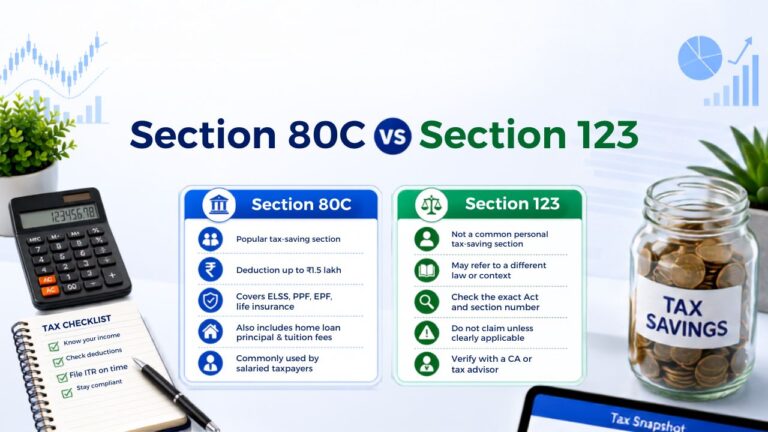
| Section 80C investments (GPF, PPF etc.) | Section 80C | Section 123 |
The actual benefits and exemption amounts remain unchanged. Only section numbering has changed. Your employer’s payroll system should already reflect the new section numbers from April 2026 for Tax Year 2026-27 salary processing.
Which ITR Form Should Government Employees File?
Most government employees with salary and pension income (and no business income) should file ITR-1 (Sahaj) for FY 2025-26, provided they have no more than two house properties, capital gains within the ITR-1 limit, and total income below Rs. 50 lakh. From AY 2026-27, ITR-1 has been expanded to allow two house properties instead of one, which is a meaningful change for government employees who own two residential properties.
If you have capital gains from mutual funds or shares, or rental income from multiple properties, or income exceeding Rs. 50 lakh, you will need ITR-2 instead. Read the New ITR Forms AY 2026-27 guide to confirm which form applies to you.
Key Things Government Employees Must Do Before Filing ITR in July 2026
- Check Form 26AS (now Form 168 from April 2026, but still accessed as Form 26AS under Tab 1 for FY 2025-26): verify that your employer has correctly deposited TDS against your PAN for the entire year, including any month where your DA changed.
- Check AIS: verify salary, interest income on GPF or savings accounts, and any other transactions reported against your PAN.
- Collect Form 16 from your employer: this will be issued by June 2026 for FY 2025-26. It must show your basic pay, DA, HRA, all allowances, and TDS deducted month-wise.
- Choose your tax regime: compare old vs new using your actual figures before submitting the ITR. Government employees without business income can switch every year.
- If retired in FY 2025-26: collect the details of gratuity, leave encashment, and commuted pension received. These are exempt but must still be reported in the ITR under the relevant schedules.
Summary: Key Tax Advantages Government Employees Have Over Private Sector
| Benefit | Government Employee | Private Sector Employee |
|---|---|---|
| Gratuity exemption | 100% exempt, no cap | Up to Rs. 20 lakh |
| Leave encashment at retirement | 100% exempt, no cap | Up to Rs. 25 lakh |
| Commuted pension | 100% exempt | 1/3rd or 1/2 exempt depending on gratuity |
| GPF interest | 100% tax-free, no cap | EPF interest taxable above Rs. 2.5 lakh contribution |
| Entertainment allowance deduction | Available (central govt only) | Not available |
| Employer NPS contribution | 14%, fully deductible | 14%, fully deductible (same) |
For a complete guide on how to file your ITR for FY 2025-26, read the ITR Filing Last Date 2026 guide. For understanding all the deductions available under both regimes, read the Tax Saving Tips for Salaried Employees FY 2026-27. For a detailed comparison of NPS benefits, read the NPS Tax Benefit guide.
Have a specific question about your salary structure or retirement benefit tax treatment? Drop it in the comments below.
📚 Also Read: