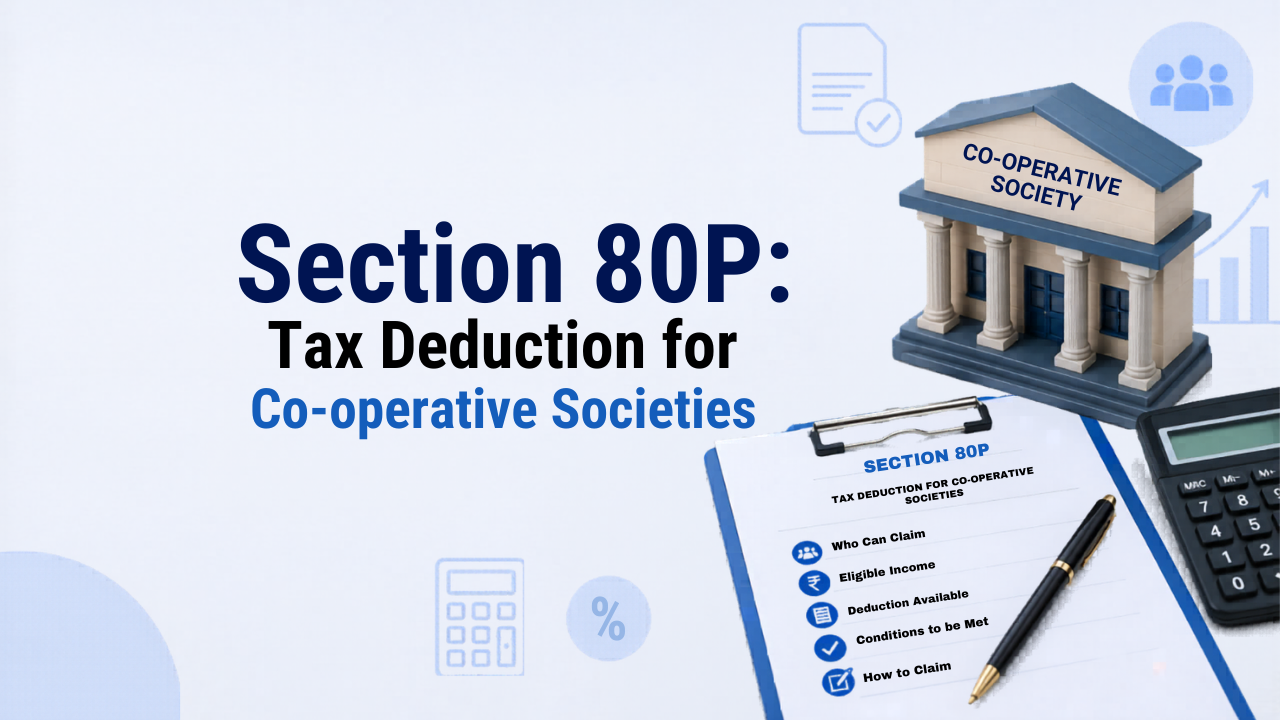
Section 80P: Tax Deduction for Co-operative Societies
Section 80P of the Income Tax Act, 1961, allows registered co-operative societies to claim a deduction on income earned from specified activities. Depending on the type of income and the nature of the society, this deduction can be 100% of the profit, which means the income is effectively tax-free for eligible societies. The deduction is available only if the society files its income tax return on or before the due date.
I want to be clear from the start about who this applies to. Section 80P is a deduction for the co-operative society itself, not for individual members. If you are a member of a housing society or a credit cooperative, dividends you receive from that society are not taxable in your hands. But the deduction under Section 80P is claimed by the society when filing its own ITR.
In this guide, I will cover which co-operative societies qualify, the types of income that get full or partial deductions, the key exclusions including the co-operative bank question, the Finance Act 2006 change that matters most, and how to claim this deduction correctly.
Section 80P provides that certain income earned by a co-operative society, if included in its gross total income, shall be allowed as a deduction while computing the society’s taxable income. The intent is to support cooperative movement in India, particularly in agriculture, rural finance, and cottage industries, by reducing the tax burden on these entities. You can view the full list of deductions under Chapter VI-A on the Income Tax Department’s official deductions guide.
What is Section 80P?
Section 80P provides that certain income earned by a co-operative society, if included in its gross total income, shall be allowed as a deduction while computing the society’s taxable income. The intent is to support cooperative movement in India, particularly in agriculture, rural finance, and cottage industries, by reducing the tax burden on these entities.
A co-operative society for this purpose is defined under Section 2(19) of the Income Tax Act as an entity registered under the Co-operative Societies Act, 1912, or any other state law governing registration of co-operative societies. The section does not require a separate definition beyond this.
One important operational rule: the deduction under Section 80P cannot be claimed if the co-operative society opts for the special tax rates under Section 115BAD or Section 115BAE. It is one or the other, not both.
Which Co-operative Societies Qualify Under Section 80P?
The following types of co-operative societies are eligible to claim deductions under Section 80P, provided their income from specified activities is part of their gross total income:
- Agricultural co-operative societies: Support farmers through credit, marketing, or processing of produce.
- Credit co-operative societies: Provide financial services and credit facilities to their members.
- Consumer co-operative societies: Distribute goods or services to members at fair prices.
- Housing co-operative societies: Facilitate housing for their members.
- Labour and worker co-operatives: Engage collectively in work or manufacturing for members.
- Marketing co-operative societies: Assist members in selling agricultural produce or goods.
- Fishing co-operative societies: Engaged in catching, processing, or marketing fish for members.
Co-operative banks licensed by the Reserve Bank of India are excluded from Section 80P, with two specific exceptions discussed further below.
Section 80P Deduction: Full vs Partial
The deduction under Section 80P is not the same for all income types. Some income attracts 100% deduction, while others are subject to a cap. Here is a clear breakdown:
Income Eligible for 100% Deduction under Section 80P(2)(a)
The entire profit from the following activities is deductible:
| Activity | Deduction |
|---|---|
| Providing credit facilities or banking to members (not co-operative banks) | 100% |
| Cottage industry carried on by the society | 100% |
| Marketing agricultural produce grown by members | 100% |
| Purchase and supply of agricultural implements, seeds, livestock to members | 100% |
| Processing agricultural produce of members without use of power | 100% |
| Collective disposal or management of labour of members | 100% |
| Fishing and allied activities for members (catching, curing, processing, storing, marketing) | 100% |
For the last two activities (labour management and fishing), the co-operative society must restrict its voting rights to: the State Government, members who contribute their labour or carry on the fishing activities, and co-operative credit societies that provide financial assistance to the society.
Other Income with 100% Deduction under Section 80P(2)(b) to (e)
| Sub-section | Income Type | Deduction |
|---|---|---|
| 80P(2)(b) | Profit of a primary co-operative society engaged in supplying milk, oilseeds, fruits or vegetables grown by its members to a federal co-operative society, a government company, or a statutory corporation engaged in such supply to the public | 100% |
| 80P(2)(d) | Interest or dividend income earned from investments in other co-operative societies | 100% |
| 80P(2)(e) | Income from renting out godowns or warehouses for storage, processing or marketing of commodities | 100% |
| 80P(2)(f) | Income from interest on securities or income from house property, provided gross total income does not exceed Rs. 20,000. The society must not be a housing society, an urban consumers’ society, a society carrying on transport business, or a society engaged in manufacturing operations using power. | 100% |
Partial Deduction under Section 80P(2)(c)
For income from activities not specifically covered above, a consumer co-operative society can claim a deduction up to Rs. 1,00,000. For any other co-operative society, the cap is Rs. 50,000.
| Type of Society | Maximum Deduction under 80P(2)(c) |
|---|---|
| Consumer co-operative society | Rs. 1,00,000 |
| Any other co-operative society | Rs. 50,000 |
The Co-operative Bank Exclusion: Finance Act 2006 Change
This is the most important update in the history of Section 80P, and it still causes confusion among many societies today.
Before 2006, co-operative banks could also claim deductions under Section 80P, just like other co-operative societies. The Finance Act 2006 inserted sub-section (4) into Section 80P with effect from Assessment Year 2007-08. This sub-section specifically excluded co-operative banks from the benefit of Section 80P.
The reason given by the government was simple: co-operative banks function just like commercial banks and compete with them. Allowing them a tax deduction that commercial banks do not get creates an uneven playing field. CBDT Circular No. 14 of 2006 explained this intention clearly.
Two exceptions remain: The exclusion does not apply to:
- Primary Agricultural Credit Societies (PACS) as defined under the Banking Regulation Act.
- Primary Co-operative Agricultural and Rural Development Banks whose area of operation is confined to a taluk and whose principal object is to provide long-term credit for agricultural and rural development.
These two types can still claim Section 80P deductions. All other co-operative banks, including Regional Rural Banks, cannot.
Important distinction courts have drawn: A co-operative society that conducts banking activities is not automatically a co-operative bank licensed by the RBI. Several high courts have confirmed that a society must be RBI-licensed to be treated as a co-operative bank for the purpose of the Section 80P(4) exclusion. If a credit co-operative society is not licensed under the Banking Regulation Act, it can still claim Section 80P deductions.
Interest Income Treatment Under Section 80P: What is Allowed
This is where many societies make errors, so I want to address this specifically.
Interest from commercial banks: Not eligible for deduction under Section 80P. If a co-operative society parks its surplus funds in a nationalised or scheduled commercial bank and earns interest, that interest income does not qualify for Section 80P deduction.
Interest from other co-operative societies or co-operative banks: This is deductible under Section 80P(2)(d). Interest or dividend earned by one co-operative society from investments made with another co-operative society, including a co-operative bank, qualifies for 100% deduction. The exclusion under Section 80P(4) applies to co-operative banks themselves, not to other societies earning interest from those banks.
Note: There has been some litigation on this point. The Karnataka High Court had taken a different view at one stage, but the prevailing ITAT rulings and multiple high court decisions now support the position that interest earned by a co-operative society from a co-operative bank qualifies under Section 80P(2)(d).
Section 80P and Alternate Minimum Tax (AMT)
Profits claimed as deduction under Section 80P are not included in the adjusted total income for the purpose of Alternate Minimum Tax (AMT) calculation under Section 115JC. This is a significant benefit. It means the society does not face AMT liability on income that has already been excluded through Section 80P.
Additionally, from Budget 2022, the AMT rate for co-operative societies was reduced from 18.5% to 15%, bringing it in line with the MAT rate applicable to companies.
How to Claim Section 80P: Filing Requirements
There are two conditions that must be met to claim Section 80P:
- File ITR on or before the due date. Section 80P deduction is not available if the return is filed after the due date. This is a hard rule upheld by multiple tribunals. Unlike some other deductions where belated filing costs only a penalty, here the entire deduction is lost if the return is late.
- The income must be included in gross total income. The deduction applies only to income that has been declared in the gross total income of the society. Income kept outside the books cannot be the basis for claiming a deduction.
For filing, co-operative societies use ITR-5. The Section 80P deduction is claimed under Schedule VI-A. Societies with turnover above the prescribed threshold must also get their accounts audited under Section 44AB and maintain proper books of accounts under Section 44AA.
Section 80P vs Section 80C: Key Difference
A common point of confusion: Section 80C is for individual taxpayers investing in specified instruments like PPF, ELSS, and life insurance. Section 80P is exclusively for co-operative societies on their own income. The two operate in entirely different contexts and cannot be compared or interchanged.
Common Mistakes to Avoid
In my experience, these are the errors I see most often when co-operative societies try to claim Section 80P:
- Claiming deduction on interest from commercial banks. Interest from nationalised or scheduled commercial banks does not qualify. Only interest from other co-operative societies qualifies under 80P(2)(d).
- Co-operative banks claiming 80P after AY 2007-08. From AY 2007-08 onwards, co-operative banks (other than PACS and primary agricultural development banks) cannot claim this deduction. Many continue to do so erroneously and face disallowances during scrutiny.
- Filing ITR after the due date. This disqualifies the entire Section 80P claim. There is no provision to revive the deduction through a belated return. File on time, without exception.
- Opting for Section 115BAD or 115BAE and also claiming 80P. These are mutually exclusive. If the society opts for special tax rates, Section 80P is not available.
- Claiming deduction on income from sources not covered by 80P. For example, rental income from property unconnected to warehousing or agricultural activities will not qualify. Only the specific income types listed under Section 80P(2) are eligible.
Frequently Asked Questions
Can individual members claim Section 80P on dividends received from a co-operative society?
No. Section 80P is a deduction available to the co-operative society itself, not to its individual members. However, dividends received by a member from a co-operative society are not taxable in the hands of the member under Section 80P(3). The tax relief operates at the society level, not the member level.
Can a co-operative society claim both Section 80P and other profit-linked deductions?
Yes. A co-operative society can claim Section 80P alongside other profit-linked deductions under Sections 80HH, 80HHB, 80HHC, 80-I, and 80-IA. However, the Section 80P deduction is calculated after first applying those other deductions. The order of computation matters.
Is Section 80P applicable to housing co-operative societies?
Housing co-operative societies can claim deductions, but with important restrictions. Income from house property or interest on securities under Section 80P(2)(f) is available only if the gross total income of the society does not exceed Rs. 20,000, and the society must not be a housing society, an urban consumers’ society, a society carrying on transport business, or a society engaged in manufacturing operations using power. In practice, most housing societies with parking charges, maintenance income, or interest from fixed deposits will need to carefully evaluate what qualifies.
What ITR form does a co-operative society use?
Co-operative societies file ITR-5. The Section 80P deduction is entered under Schedule VI-A of the return. Societies with income above the audit threshold under Section 44AB must attach a tax audit report.
Is there any way to claim Section 80P if the return was filed late?
For AY 2018-19 to AY 2023-24, CBDT issued special circulars (Circular 13/2023 and Circular 14/2024) allowing condonation of delay in filing returns claiming Section 80P deduction. These were one-time reliefs. For AY 2024-25 and AY 2025-26 onwards, there is no such circular available. The rule remains that a belated return cannot claim Section 80P benefits. File on time.