TDS Refund vs Tax Refund: Are They the Same? Comparison 2026
Every July, once ITR filing season picks up, I get some version of the same question from at least a dozen salaried clients. Is my TDS refund the same as my tax refund, or are these two different things? After explaining the TDS refund vs tax refund difference 2026 question so many times this filing season, I think it is worth laying it out clearly, once and for all, so you know exactly what to expect when you file your return for FY 2025-26 (AY 2026-27).
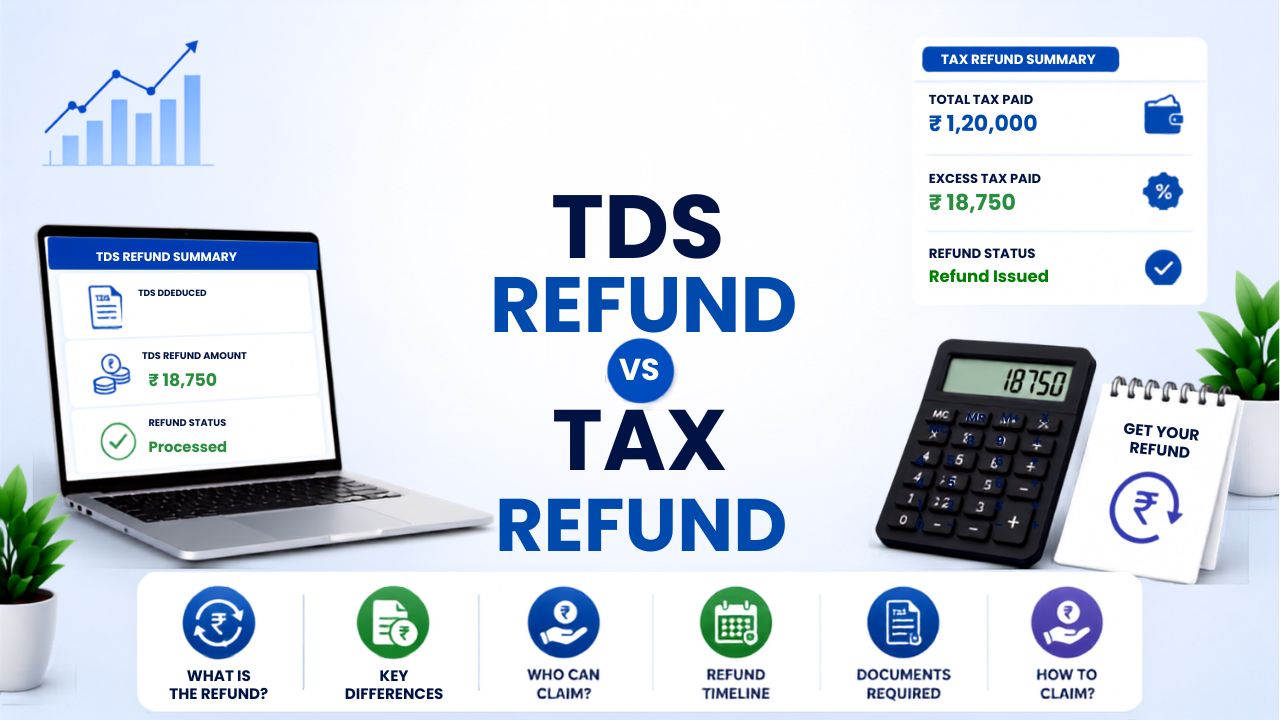
The short answer: every TDS refund is a tax refund, but not every tax refund is a TDS refund. The confusion happens because for most salaried employees, TDS is the only route by which they overpay tax, so the two terms end up meaning the same thing in practice. The moment you have income from more than one source, or you are self-employed, the two start to diverge. If you want the fuller picture of how the Indian tax system fits together beyond refunds, my complete income tax guide covers that end to end.
What Is a Tax Refund
A tax refund is the umbrella term. As per the Income Tax Department’s own definition, it is the amount refunded when the tax you have already paid, through TDS, TCS, advance tax, or self-assessment tax, turns out to be more than your actual tax liability once your return is processed. Note the four routes listed there. TDS is only one of them.
So a tax refund can arise from:
- Excess TDS deducted by your employer, bank, or client
- Excess TCS collected on certain purchases
- Excess advance tax paid based on an estimate that turned out too high
- Excess self-assessment tax paid at the time of filing, usually due to a calculation error
What Is a TDS Refund
A TDS refund is one specific type of tax refund. It arises only when the tax deducted at source, on your salary, fixed deposit interest, freelance payments, or any other TDS-eligible income, is higher than what you actually owe for the year.
Here is a simple example. Rohit works in Bangalore and earns a salary that puts him in the 20 percent slab. His employer deducted TDS of Rs. 42,000 for FY 2025-26 based on the declarations Rohit submitted at the start of the year, under Section 192. Rohit opted for the old tax regime and later invested more under Section 80C than he had originally declared to his employer, so by the time he files his return, his actual tax liability works out to only Rs. 30,000. The difference of Rs. 12,000 becomes his TDS refund, since the entire excess came from tax deducted at source. He can only claim it back by filing his ITR.
This is the scenario most salaried professionals picture when they hear the word refund. But it is really a subset of the larger tax refund category.
TDS Refund vs Tax Refund: Side by Side
| Aspect | TDS Refund | Tax Refund (Overall) |
|---|---|---|
| What it covers | Only excess of TDS over final liability | Excess of TDS, TCS, advance tax, or self-assessment tax combined |
| Who typically claims it | Salaried employees, FD holders, freelancers with TDS deducted | Any taxpayer, including businesses and self-employed individuals |
| Source document | Form 130 (Form 16 for TDS on salary), Form 26AS/AIS | Form 26AS/AIS, advance tax challans, self-assessment tax challans |
| Claimed through | ITR filing | ITR filing |
| Interest on delay | Yes, under Section 244A | Yes, under Section 244A |
| Common trigger | Excess declarations at the start of the year, or TDS deducted without factoring all deductions | Wrong advance tax estimate, or an arithmetic error in self-assessment tax |
Where the Two Overlap, and Where They Do Not
For a salaried employee with no other income, TDS is usually the only tax paid during the year. In that case, TDS refund and tax refund are the same number, and there is no practical difference.
The gap shows up once you look beyond salary. Take Priya, a freelance content writer I worked with last filing season. Her clients deducted TDS correctly on the payments she received, so there was no excess TDS to refund. But Priya had also paid advance tax in three instalments based on an income estimate that turned out higher than what she actually earned. That overpayment of Rs. 8,000 became her tax refund, even though her TDS deduction was accurate. If you only asked her whether she had a TDS refund, the answer would be no. If you asked whether she had a tax refund, the answer would be yes. This is exactly the distinction that gets missed.
The same split applies to anyone who has paid excess self-assessment tax by mistake, for instance by double-counting a tax payment, or misapplying a deduction while estimating liability before filing.
Interest on Your Refund: Section 244A Applies to Both
Whether your refund is purely from TDS or from a mix of TDS, advance tax, and self-assessment tax, the interest rules under Section 244A treat it the same way. The department pays simple interest at 0.5 percent per month, which works out to 6 percent per annum, on the refund amount, provided the refund is more than 10 percent of the tax determined on assessment.
If you filed your ITR by the due date, this interest starts from April 1 of the assessment year and runs until the refund is credited. Even one day into a new month counts as a full month for this calculation.
Going back to Rohit’s example: his refund of Rs. 12,000 is well above the 10 percent threshold on his Rs. 30,000 liability, so interest applies. If his refund gets credited on October 15, 2026, that covers April through October, seven months. At 0.5 percent per month, that is Rs. 420 in interest, taking his total credit to Rs. 12,420.
One thing worth remembering: this interest is not tax free. It gets added to your income under “Income from Other Sources” and is taxable in the year you receive it, so keep it in mind when you file next year’s return.
How Long Does the Refund Actually Take
For FY 2025-26 returns, once you e-verify your ITR, refunds typically get credited within 15 to 45 days, usually closer to four to five weeks for straightforward returns without discrepancies. Processing does not begin at all until e-verification is complete, so that first step matters more than people realise. You can track exactly where your refund stands through my refund status guide.
How to Check Your TDS Credit Before You File
Before you file, it helps to confirm exactly how much TDS has actually been deposited against your PAN, since a refund can only be claimed on tax that has actually reached the government. Your Form 130, the replacement for the old Form 16, shows what your employer deducted and deposited. Cross-checking this against your AIS and Form 26AS catches any mismatch early, rather than after you have already filed and the department flags it during processing.
Why Your Refund Might Get Delayed or Fail
A few practical issues account for most delayed or failed refunds I see clients run into:
- Bank account not pre-validated on the e-filing portal
- Name on the bank account not matching PAN records exactly
- TDS not reflecting in Form 26AS or AIS because the deductor has not filed their TDS return correctly
- An outstanding tax demand from an earlier year, against which your current refund gets adjusted under Section 245
Most of these are fixable before you even file, which is the best time to catch them.
Frequently Asked Questions
Is a TDS refund the same as an income tax refund?
Not exactly. A TDS refund is one type of income tax refund, specifically the one that arises from excess tax deducted at source. Income tax refund is the broader term that also includes excess advance tax or self-assessment tax.
Do I get interest on my TDS refund?
Yes. Section 244A applies interest at 0.5 percent per month on any refund, TDS or otherwise, as long as it exceeds 10 percent of your assessed tax.
How long does a TDS refund take for FY 2025-26 returns?
Most refunds are credited within 15 to 45 days of e-verification, typically on the faster end for simple returns with no mismatches.
Can I get a tax refund even if no TDS was deducted from my income?
Yes. If you paid excess advance tax or excess self-assessment tax, you can still get a tax refund even without any TDS involved, as Priya’s example above shows.
Important Note Before You File
This article is meant to help you understand how TDS refund and tax refund relate to each other, not to replace professional advice for your specific situation. Tax rules and thresholds can change with each budget, so always cross-check the current figures on the income tax portal or with a qualified tax professional before making filing decisions based on this information.