Section 44AD: Presumptive Taxation for Small Businesses
Running a small business in India means dealing with income tax every year. But maintaining detailed books of accounts, getting them audited, and calculating exact profits is not always practical for a small trader or contractor with a turnover of a few crore rupees. If your business is also GST-registered, understand the full picture with our GST basics complete guide India 2026. Key GST filings include GSTR-1A for invoice amendments and GSTR-2A for input tax credit reconciliation. Check the latest GST new rates 2026 for your goods or services category.
Section 44AD of the Income Tax Act solves this problem. It allows eligible small businesses to declare a fixed percentage of their turnover as profit, skip detailed bookkeeping, and file a simple ITR-4. This is called the Presumptive Taxation Scheme.
This article covers everything you need to know about Section 44AD: who can use it, how the profit calculation works, what the turnover limit is, and the one rule that catches many business owners off guard.
What is Section 44AD?
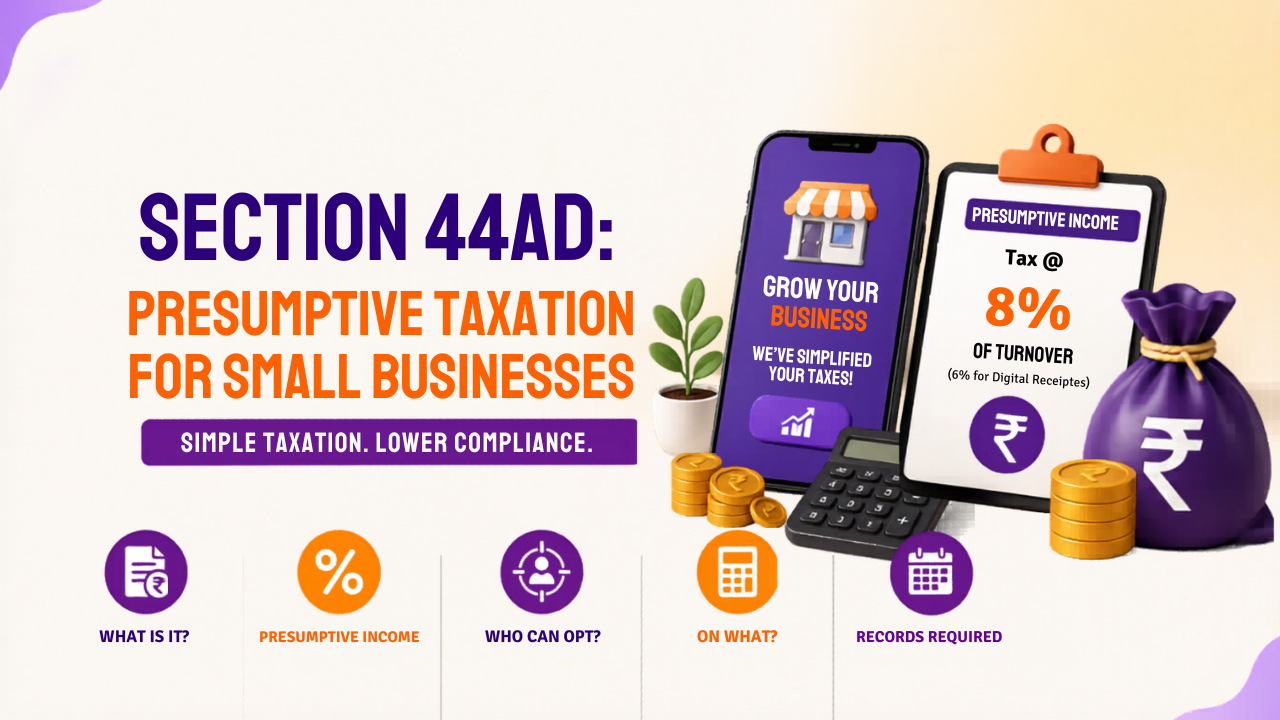
Section 44AD is a presumptive taxation provision that allows small businesses to declare 8% of their gross turnover (or 6% for digital receipts) as their net profit, without maintaining detailed books of accounts.
The word “presumptive” means the income tax department presumes your profit to be a certain percentage of your turnover. You do not need to prove your actual expenses or maintain a full profit and loss account.
This scheme was designed specifically to reduce the compliance burden on small traders, retailers, contractors, and service providers who operate at a small scale.
Who is Eligible for Section 44AD?
Section 44AD is available to the following taxpayers:
- Resident Individuals running a business
- Resident Hindu Undivided Families (HUFs)
- Resident Partnership Firms (excluding LLPs)
The business must be any eligible business, which means any trade, commerce, or manufacturing activity. However, the following are specifically excluded from Section 44AD:
- Professionals (doctors, lawyers, architects, CAs, engineers): covered under Section 44ADA instead
- Persons carrying on agency business
- Persons earning income from commission or brokerage
- Businesses covered under Section 44AE (goods carriage vehicle owners)
- LLPs (Limited Liability Partnerships)
If you are a freelancer or consultant providing professional services, Section 44AD does not apply to you. You would look at Section 44ADA instead. Read our guide on income tax for freelancers to understand which presumptive scheme applies in your case.
What is the Turnover Limit for Section 44AD?
The gross turnover or gross receipts of the business must not exceed Rs. 3 crore in the financial year to be eligible for Section 44AD.
This Rs. 3 crore limit applies only if the cash receipts during the year do not exceed 5% of total receipts. If cash receipts exceed 5% of total turnover, the limit drops back to Rs. 2 crore.
| Cash Receipt Percentage | Turnover Limit |
|---|---|
| Up to 5% of total receipts (mostly digital) | Rs. 3 crore |
| More than 5% of total receipts (significant cash) | Rs. 2 crore |
For most small businesses operating digitally or through bank transfers, the Rs. 3 crore limit applies. For predominantly cash businesses, the limit is Rs. 2 crore.
How is Profit Calculated Under Section 44AD?
Under Section 44AD, profit is calculated as a fixed percentage of gross turnover:
- 8% of gross turnover for cash receipts
- 6% of gross turnover for amounts received through digital modes (bank transfer, UPI, cheque, NEFT, RTGS)
The lower 6% rate was introduced to encourage digital transactions among small businesses.
Example:
Ramesh runs a small trading business in Pune. His turnover for FY 2025-26 is Rs. 80,00,000. Out of this, Rs. 65,00,000 was received digitally and Rs. 15,00,000 in cash.
Profit Calculation:
- Digital receipts: Rs. 65,00,000 x 6% = Rs. 3,90,000
- Cash receipts: Rs. 15,00,000 x 8% = Rs. 1,20,000
- Total Presumptive Income: Rs. 5,10,000
Ramesh declares Rs. 5,10,000 as his business income. He does not need to submit any expense details or maintain a full set of books. This income is then added to any other income he has (salary, interest, etc.) and taxed as per the applicable slab rates.
Can You Declare Higher Profit Than the Presumptive Rate?
Yes. Section 44AD sets a floor, not a ceiling. If your actual profit is higher than 6% or 8% of turnover, you must declare the actual higher profit.
For example, if Ramesh’s actual profit is Rs. 8,00,000 on the same turnover, he must declare Rs. 8,00,000 as income, not Rs. 5,10,000.
The presumptive rate is the minimum you must declare to stay within the scheme. Declaring less than the presumptive rate is not allowed without a tax audit.
Can You Declare Lower Profit Than the Presumptive Rate?
Yes, but only if you are willing to get a tax audit done under Section 44AB.
If your actual profits are lower than 6%/8% of turnover (for example, due to high expenses or a loss year), you can declare the actual lower profit. However, in that case, a chartered accountant must audit your books and you must file the audit report along with your ITR.
This is an important protection for businesses going through a genuinely difficult year. But it comes with the compliance cost of a full audit.
No Books of Accounts Required
One of the biggest practical benefits of Section 44AD is that you are not required to maintain books of accounts under Section 44AA. You also do not need to get your accounts audited under Section 44AB, as long as you declare income at or above the presumptive rate and your turnover is within the limit.
This saves small business owners significant time and money every year.
For the official provisions and latest updates on Section 44AD, refer to the Income Tax Portal.
Advance Tax Under Section 44AD
Businesses under Section 44AD get a simplified advance tax schedule. Instead of the usual four instalments due on 15th June, 15th September, 15th December, and 15th March, businesses under the presumptive scheme need to pay 100% of their advance tax liability in a single instalment by 15th March of the financial year.
This eliminates the need to estimate quarterly profits or track multiple payment deadlines through the year.
Read our advance tax payment guide to understand how to calculate and pay advance tax correctly under this scheme.
Which ITR Form to File Under Section 44AD?
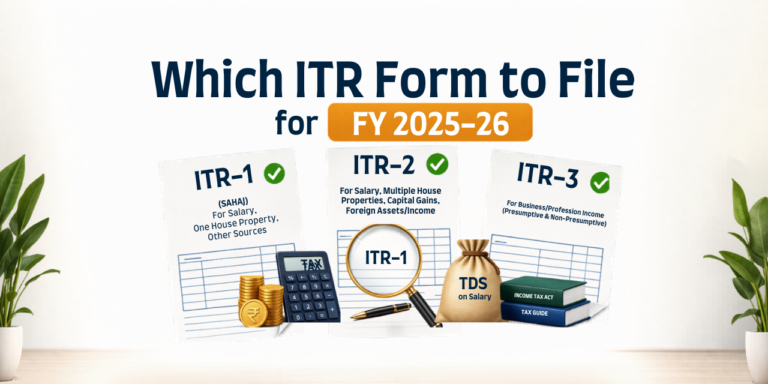
Businesses opting for Section 44AD must file ITR-4 (Sugam). This is a simplified ITR form designed specifically for presumptive income filers.
ITR-4 has a dedicated section for presumptive business income where you enter your turnover, the applicable rate (6% or 8%), and the resulting income. You do not need to fill a detailed profit and loss schedule.
The ITR-4 deadline for FY 2025-26 is August 31, 2026 (non-audit cases). Refer to our guide on which ITR form to file for FY 2025-26 to confirm this applies to your situation.
The 5-Year Lock-In Rule: The Most Important Catch
This is the rule that catches most small business owners off guard.
If you opt for Section 44AD in a particular financial year and then opt out in any of the next 5 consecutive years, you will be barred from using Section 44AD for the next 5 years from the year of opt-out.
Additionally, if you opt out of the scheme, your business income will be computed under normal provisions, which means you will need to maintain books of accounts and may need a tax audit if your income is below the presumptive threshold.
Example:
Sunita opts for Section 44AD for FY 2022-23, 2023-24, and 2024-25. In FY 2025-26, she opts out (declares actual lower profit with audit). Now she cannot use Section 44AD again until FY 2030-31.
This rule means you must think carefully before opting into Section 44AD. If your business is growing rapidly and you expect to exceed the turnover limit soon, or if you have genuine high expenses that bring profits below the presumptive rate frequently, the scheme may not be the right long-term choice.
Section 44AD vs Section 44ADA: Key Differences
| Parameter | Section 44AD | Section 44ADA |
|---|---|---|
| Applicable To | Small businesses (trading, manufacturing) | Specified professionals |
| Who Qualifies | Individual, HUF, Partnership Firm | Individual, Partnership Firm |
| Turnover Limit | Rs. 3 crore (Rs. 2 crore for cash heavy) | Rs. 75 lakh gross receipts |
| Presumptive Rate | 6% (digital) / 8% (cash) | 50% of gross receipts |
| ITR Form | ITR-4 | ITR-4 |
| Books Required | No | No |
| Advance Tax | 100% by 15th March | 100% by 15th March |
If you are a freelance consultant or professional, Section 44ADA is the relevant provision, not Section 44AD.
Deductions Under Section 44AD
When you declare income under the presumptive scheme, the declared profit (6% or 8% of turnover) is treated as net profit after all business expenses. This means:
- You cannot claim any additional business expenses separately
- Depreciation is deemed to have been fully allowed
- No separate deduction for rent, salary to staff, or any other business expense is permitted
However, you can still claim the following personal deductions on top of your presumptive income:
- Section 80C deductions (up to Rs. 1.5 lakh under old regime): read our Section 80C deductions guide
- Section 80D health insurance premium
- Other Chapter VI-A deductions
The regime you choose (old or new) determines which personal deductions are available to you.
Common Mistakes to Avoid
Mistake 1: Opting in without understanding the 5-year lock-in
Many small business owners opt for Section 44AD for one year to save compliance costs, then opt out the next year when profits are lower. This triggers the 5-year bar. Always plan your scheme choice for at least 5 years before opting in.
Mistake 2: Declaring less than 6%/8% without getting audited
If your declared profit is below the presumptive rate and you have not got a tax audit done, your return is defective and the income tax department can reject it or send a notice.
Mistake 3: Assuming all receipts qualify for 6%
Only amounts received through digital modes (bank, UPI, cheque) get the 6% rate. Cash receipts must be declared at 8%. Maintain a clear record of digital vs cash receipts.
Mistake 4: Not paying advance tax by 15th March
The single instalment deadline of 15th March is easy to miss if you are used to the quarterly advance tax schedule. Missing this attracts interest under Section 234B and 234C.
Mistake 5: Treating Section 44AD as available for professionals
Doctors, lawyers, architects, and other specified professionals are not covered under Section 44AD. Using the wrong provision in your ITR can lead to a mismatch and a notice from the income tax department.
Frequently Asked Questions
Can a salaried person with a side business use Section 44AD? Yes. If you have salary income and also run a small business, you can declare the business income under Section 44AD. Both incomes will be combined and taxed as per your applicable slab. You will need to file ITR-4 instead of ITR-1.
Can a partnership firm use Section 44AD? Yes, resident partnership firms (excluding LLPs) are eligible for Section 44AD.
What happens if my turnover crosses Rs. 3 crore mid-year? If your total turnover for the full financial year exceeds the limit, you cannot use Section 44AD for that year. Your income will be computed under normal provisions and a tax audit may be required if your declared profit is below the threshold.
Is Section 44AD available under the new tax regime? Yes. The presumptive taxation scheme under Section 44AD is independent of the old/new regime choice. The regime affects your personal deductions and slab rates, not the method of computing business income.
Can I show a loss under Section 44AD? No. Under Section 44AD, you cannot declare a loss. The minimum declared income is 6%/8% of turnover. To declare a loss, you must opt out of the scheme and get a tax audit done.
Is GST turnover the same as income tax turnover for Section 44AD? Not necessarily. GST turnover includes tax collected, while income tax turnover is typically the net amount received. Consult a CA if you are unclear about which figure to use.