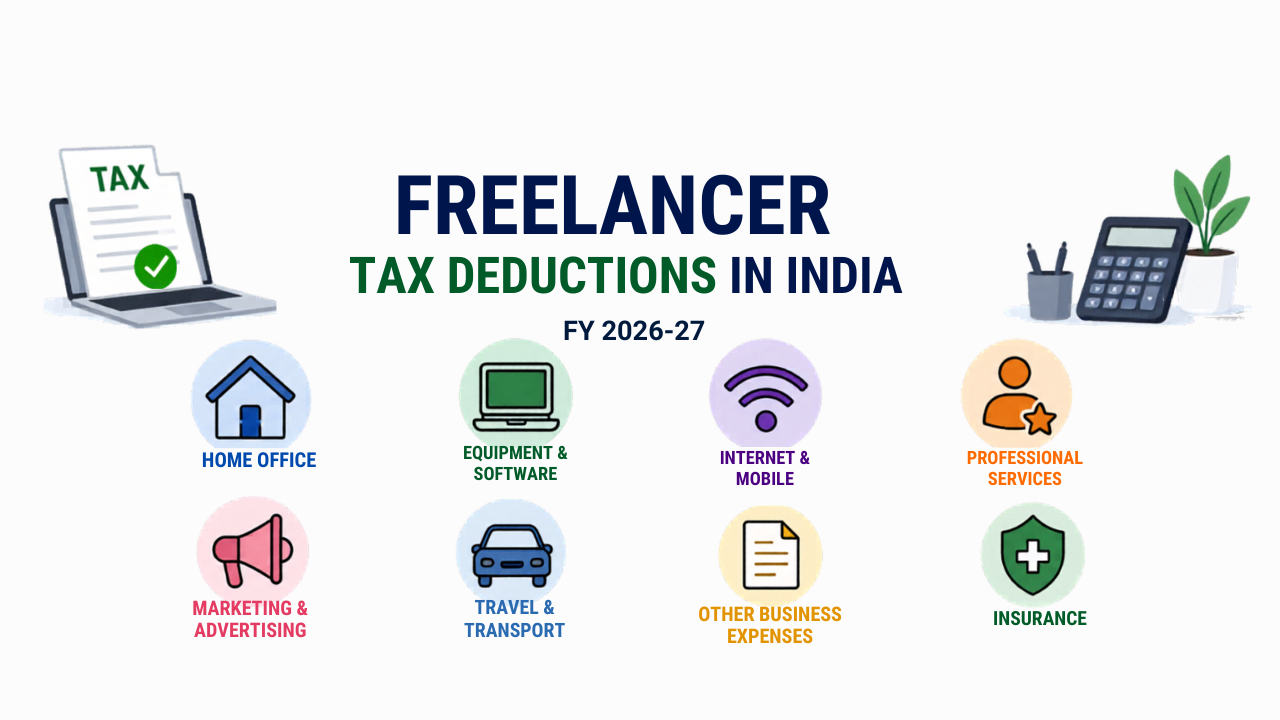
Freelancer Tax Deductions in India FY 2026-27
Freelancer tax deductions in India allow you to legally reduce your taxable income by claiming business expenses – your laptop, internet, software, co-working space, and more. For the complete income tax framework, see our income tax guide India. These are not personal costs. They are business costs, and the Income Tax Act allows you to deduct them from your gross income before tax is calculated.
This guide covers which expenses qualify, which method to use (Section 44ADA or actual expense method), what documents you need, and a worked example so you can see the real tax saving.
Two Ways to Claim Deductions as a Freelancer
Before listing expenses, you need to know which tax filing method you are using. This changes how deductions work for you.
| Method | Who Can Use It | How Deductions Work | ITR Form |
|---|---|---|---|
| Section 44ADA (Presumptive) | Professionals earning up to Rs. 75 lakh per year (limit is Rs. 50 lakh if cash receipts exceed 5% of total gross receipts) | 50% of gross receipts is automatically treated as deductible. No need to itemise expenses. | ITR-4 |
| Actual Expense Method | Anyone (especially if actual expenses exceed 50%) | Every expense must be listed, supported by receipts and invoices, and justified as a business expense. | ITR-3 |
Which method is better for you? If your actual business expenses are less than 50% of your income, Section 44ADA saves time and gives a flat 50% deduction with zero documentation effort. If your expenses are higher than 50%, say you spend heavily on equipment, travel, or software, the actual expense method reduces your taxable income more.
Example: Rahul is a freelance graphic designer earning Rs. 9 lakh per year. Under Section 44ADA, Rs. 4.5 lakh is automatically treated as deductible. His taxable income is Rs. 4.5 lakh. If his actual expenses are Rs. 6 lakh, he is better off using the actual expense method, which reduces his taxable income to Rs. 3 lakh.
Expenses Freelancers Can Claim as Tax Deductions in India
The following expenses are deductible under the actual expense method if they are genuinely incurred for your freelance work. Each must be supported by a proper invoice or receipt.
1. Laptop, Desktop, and Equipment
You cannot deduct the full cost of a laptop in the year you buy it. Instead, the Income Tax Act allows depreciation – a portion of the cost each year over the useful life of the asset.
| Asset | Depreciation Rate (WDV Method) |
|---|---|
| Laptop / Computer / Tablet | 40% per year |
| Mobile Phone (used for work) | 15% per year |
| Camera, recording equipment | 15% per year |
| Office furniture | 10% per year |
Example: You buy a laptop for Rs. 80,000 in April 2025. In FY 2025-26, you can claim 40% of Rs. 80,000 = Rs. 32,000 as depreciation. The remaining value of Rs. 48,000 carries forward to the next year.
If you use the laptop partly for personal use and partly for work, only the business-use portion is deductible. If 70% of your usage is for work, claim 70% of the depreciation.
2. Internet and Phone Bills
Your monthly broadband and mobile data bills are deductible to the extent they are used for freelance work. Keep all bills saved as PDFs. If you have a single plan for personal and work use, deduct a reasonable business portion – typically 50% to 80%.
3. Software Subscriptions
Any software you pay for to do client work is a deductible business expense. This includes:
- Adobe Creative Cloud, Figma, Canva Pro (designers)
- Microsoft 365 or Google Workspace
- Zoom, Loom, or project management tools like Notion, Trello
- Accounting software like Zoho Books or QuickBooks
- SEO tools, coding IDEs, AI writing tools used for client work
Subscriptions paid in USD or other foreign currencies are still deductible. Use the INR equivalent at the time of payment. Save the email receipts.
4. Co-working Space and Office Rent
If you pay for a co-working membership or rent a dedicated office space for your freelance work, the full amount is deductible. Co-working spaces like WeWork, IndiQube, or 91Springboard typically give a GST invoice – save this every month.
If you work from a dedicated room at home, you can claim a proportionate rent deduction based on the area of the room as a percentage of your total home area. This is harder to document and often skipped – consult a CA if you want to claim it.
5. Professional Development and Courses
Any course, certification, or training that directly improves your freelance skills is deductible. This includes:
- Online courses on Udemy, Coursera, LinkedIn Learning
- Industry certifications (Google, HubSpot, AWS, etc.)
- Books or reference material directly related to your work
- Workshop or conference registration fees
A general MBA or unrelated degree does not qualify. The learning must be directly connected to your current freelance profession.
6. Client Travel and Transportation
Travel expenses directly related to client meetings, site visits, or project work are deductible. This includes:
- Cab rides to client offices (Ola/Uber receipts are valid)
- Train or flight tickets for outstation client meetings
- Fuel expenses if you use your own vehicle for client visits
Daily commute from home to a co-working space is generally not deductible. Travel specifically to meet a client or attend a work event is deductible.
7. Marketing and Business Development
If you spend money to get clients or promote your freelance services, it is deductible. This includes:
- Your freelance portfolio website hosting and domain
- LinkedIn Premium (if used specifically for lead generation)
- Paid ads on Google or Meta for your services
- Business cards, brochures, or promotional design work
8. Professional and Accounting Fees
Fees paid to professionals who help you run your freelance business are deductible. This includes:
- CA or tax consultant fees for ITR filing
- Legal fees for drafting client contracts
- Bookkeeping or accounting services
9. Insurance Premiums
Professional indemnity insurance, cyber liability insurance, or any other insurance taken specifically for your freelance business is deductible as a business expense. Note that health insurance for yourself goes under Section 80D, not as a business expense.
What You Cannot Claim as a Business Expense
- Personal grocery, clothing, or lifestyle expenses
- EMI payments on a loan (only interest portion on a business loan may qualify, not the principal)
- Personal travel or vacations, even if you work remotely during the trip
- Fines or penalties paid to any government authority
- Investment in stocks, mutual funds, or fixed deposits
Documents You Need to Maintain
If you are using the actual expense method, the Income Tax Department can ask you to prove every deduction during scrutiny. Maintain the following for each financial year. Before filing, also check your Form 26AS and AIS to verify TDS deducted on any payments received from clients.
- GST invoices from vendors (software, co-working, services)
- Bank statements showing the payments
- Email receipts for digital subscriptions and online purchases
- Purchase invoice for any equipment bought (laptop, camera, etc.)
- Travel receipts – Ola/Uber statement, train/flight ticket PDFs
- Course purchase receipts
Keep all documents for at least 6 years from the end of the relevant assessment year. A simple folder structure sorted by financial year and category works well.
Section 44ADA vs Actual Expense Method: Which Saves More Tax?
Here is a worked example to compare both methods for a freelance content writer earning Rs. 12 lakh in FY 2025-26.
| Expense Category | Annual Amount (Rs.) |
|---|---|
| Laptop depreciation (40% on Rs. 80,000) | 32,000 |
| Internet and phone bills | 18,000 |
| Software subscriptions (Grammarly, MS365, Zoom) | 22,000 |
| Co-working membership | 60,000 |
| Online courses | 15,000 |
| CA fees for ITR filing | 8,000 |
| Marketing and website hosting | 12,000 |
| Total Actual Expenses | 1,67,000 |
| Section 44ADA | Actual Expense Method | |
|---|---|---|
| Gross Income | Rs. 12,00,000 | Rs. 12,00,000 |
| Deduction Allowed | Rs. 6,00,000 (flat 50%) | Rs. 1,67,000 (actual) |
| Taxable Income | Rs. 6,00,000 | Rs. 10,33,000 |
In this case, Section 44ADA gives a much larger deduction (Rs. 6 lakh vs Rs. 1.67 lakh) because the freelancer’s actual expenses are relatively low. Section 44ADA is the better choice here.
Now consider a freelance video editor who spends Rs. 7 lakh on equipment, editing software, and a dedicated office space. Their actual expenses cross 50% of income. For them, the actual expense method reduces taxable income more than the flat 50% presumptive deduction.
How to Claim These Deductions When Filing ITR
If using Section 44ADA: File ITR-4. In the presumptive income section, declare your gross receipts. The system automatically applies the 50% deduction. You do not enter individual expenses.
If using the actual expense method: File ITR-3. Log in to the incometax.gov.in portal and select Tab 1 (Income Tax Act, 1961) for your filing. You will fill in the profit and loss section where each category of expense is entered separately – depreciation, rent, salaries (if any), professional fees, and miscellaneous business expenses. The total of all expenses is deducted from gross income to arrive at your net profit, which becomes your taxable income. The deadline to file your ITR for FY 2025-26 is July 31, 2026. See the complete ITR filing last date guide for all deadlines and late filing penalties.
Frequently Asked Questions
Can I switch between Section 44ADA and the actual expense method every year?
Yes, but with a restriction. If you opt out of Section 44ADA, you cannot switch back to it for the next 5 years. So evaluate your expense pattern carefully before switching. If you also have income from selling shares or mutual funds, read the capital gains tax guide to understand how that income is reported separately.
What if my actual expenses are more than my income?
If your actual business expenses exceed your income, you are showing a business loss. This loss can be carried forward and set off against future business income for up to 8 years. However, if you are using Section 44ADA, you cannot show a loss – the minimum taxable income is 50% of gross receipts.
Is GST paid on software or services deductible?
If you are not GST registered, the entire invoice amount including GST is your expense and is deductible. If you are GST registered and can claim an Input Tax Credit on the GST paid, only the base amount (excluding GST) is your deductible expense.
Can I claim home loan EMI as a business expense?
No. Home loan EMI is a personal liability, not a business expense. The interest portion on a business loan taken specifically for your freelance work can be deducted, but a home loan does not qualify.
What if I do not have invoices for some expenses?
Without documentation, an expense is hard to defend during a tax scrutiny. For cash payments with no receipt, the risk of disallowance is high. Always pay business expenses through bank transfer, UPI, or card so there is an automatic record in your statement.
Summary: Freelancer Tax Deductions in India at a Glance
| Expense | Deductible? | Notes |
|---|---|---|
| Laptop / computer | Yes | Via depreciation at 40% per year |
| Internet and phone bills | Yes | Business-use portion only |
| Software subscriptions | Yes | Full cost if used for work |
| Co-working space | Yes | Full cost with invoice |
| Online courses | Yes | Must be directly related to your work |
| Client travel | Yes | Keep Ola/Uber/train receipts |
| Marketing expenses | Yes | Portfolio website, ads, LinkedIn Premium |
| CA and accounting fees | Yes | Full cost |
| Professional insurance | Yes | Indemnity and cyber liability |
| Personal groceries | No | Not a business expense |
| Personal travel | No | Even if you work during the trip |
| Home loan EMI | No | Personal liability, not business |
If you are earning from freelance work, start tracking your expenses now. Even if you use Section 44ADA this year, having a clear record of your actual costs helps you decide the better method when your income or expense pattern changes. For a broader view of all tax saving options available to you this financial year, see the complete tax saving guide for FY 2026-27