Form 168 vs Form 26AS: New vs Old Annual Tax Statement
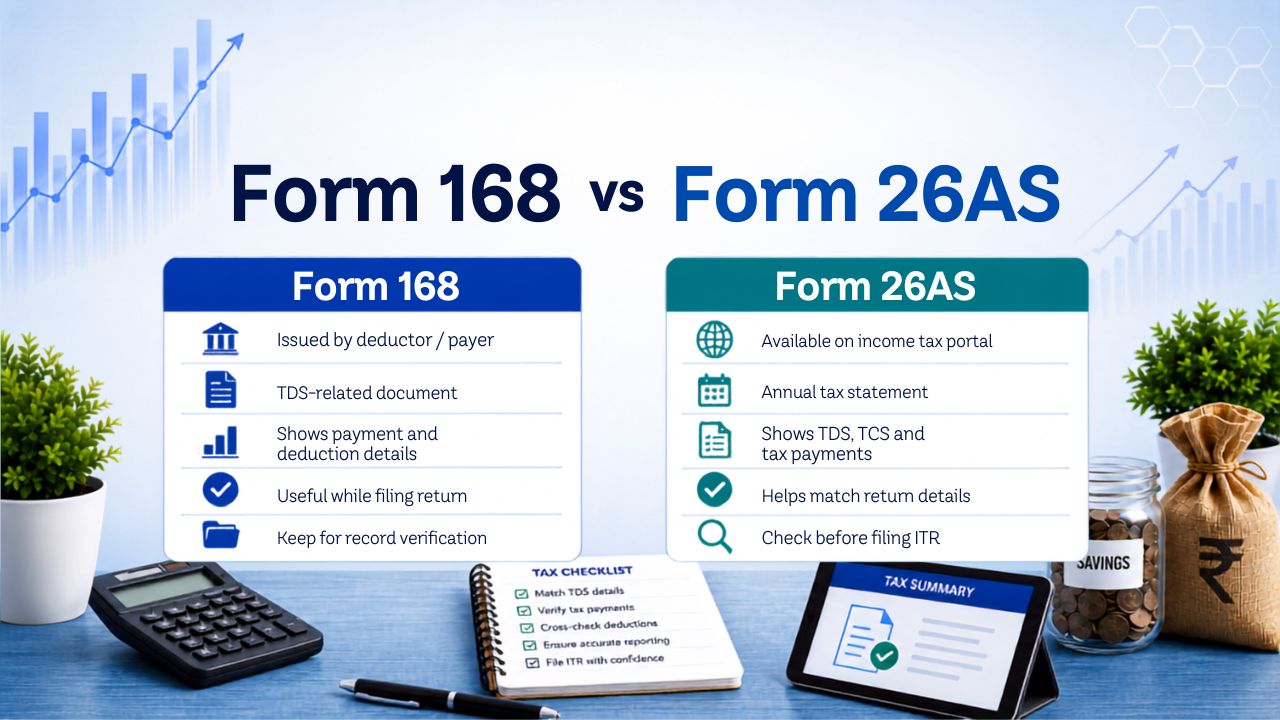
Form 168 vs Form 26AS comparison 2026 is a question many salaried professionals are asking now that the New Income Tax Act 2025 has come into effect. If you have been filing your ITR for a few years, you know Form 26AS as the document that shows your TDS credits, advance tax payments, and high-value transactions. Form 168 is what replaces it under the new Act.
The practical question for July 2026 is straightforward: which form do you use when filing your ITR for FY 2025-26, and what exactly has changed between the two? In my 7 years of working with salaried professionals, I have seen a lot of confusion around form transitions whenever the tax system updates. This comparison lays it out clearly so you know exactly where to look and what to verify before you file.
What Is Form 26AS?
Form 26AS is the annual tax statement generated under Section 203AA of the Income Tax Act 1961. It is essentially a consolidated record of all tax-related activity linked to your PAN for a given financial year.
When you file your ITR, the Income Tax Department cross-checks what you declare against what appears in your Form 26AS. If there is a mismatch – for instance, you claim more TDS than what is reflected in the form – you receive a notice under Section 143(1).
What Form 26AS contains:
Part A covers TDS deducted from your salary, bank interest, rent received, and other income sources. Part A1 shows TDS in cases where you submitted Form 15G or Form 15H. Part A2 covers TDS on immovable property transactions and rent paid above Rs 50,000 per month. Part B shows TCS (Tax Collected at Source) on purchases like cars, foreign remittances, or luxury goods. Part C shows all advance tax and self-assessment tax payments you made directly. Part D shows refund details. Part E shows high-value financial transactions reported by banks, registrars, and financial institutions under SFT (Statement of Financial Transactions). Part F covers TDS deducted by the buyer on property purchases above Rs 50 lakh. Part G shows any outstanding TDS defaults against your PAN.
For a detailed walkthrough of how to read each section, our guide on how to read Form 26AS and AIS covers the full process.
What Is Form 168?
Form 168 is the annual tax statement under the New Income Tax Act 2025. It is the direct replacement for Form 26AS once the new Act’s provisions become fully operative for taxpayers.
The New Income Tax Act 2025 came into effect on April 1, 2026. However, the income tax portal is currently running on two tracks – Tab 1 (which covers the Income Tax Act 1961 and applies to FY 2025-26 ITR filings in July 2026) and Tab 2 (which covers the New Income Tax Act 2025 and will apply to Tax Year 2026-27 filings from July 2027 onwards).
Form 168 is a Tab 2 document. It will become the operative annual tax statement when taxpayers file their first return under the new Act for Tax Year 2026-27.
The underlying purpose of Form 168 is the same as Form 26AS to give every taxpayer a consolidated view of their tax credits, tax payments, and significant financial transactions linked to their PAN. The change is primarily one of renumbering and structural refinement under the new Act’s simplified framework.
Form 168 vs Form 26AS: What Actually Changed
The honest answer is that for most salaried professionals, the day-to-day experience of using Form 168 will not be dramatically different from using Form 26AS. The fundamental content – TDS credits, advance tax, high-value transactions remains the same.
What changes is the legal framework that generates and governs the form. The Income Tax Act 1961 had accumulated layers of amendments over 60+ years, which is part of why the New Act 2025 was introduced as a complete rewrite. Form 168 is part of that cleaner, renumbered structure.
Structural context: Under the old Act, Form 26AS was governed by Section 203AA. Under the new Act, Form 168 sits within the equivalent provision of the New Income Tax Act 2025. The renumbering is part of the broader reorganisation of the entire Act.
Companion documents also change: Form 26AS was cross-referenced with Form 16 (your TDS certificate from your employer). Under the new Act, Form 130 replaces Form 16, and Form 168 replaces Form 26AS. The two transitions happen together. You can read more about this in our article on the income tax act 2025 vs income tax act 1961 comparison.
Which Form Applies for Your July 2026 ITR?
This is the most important practical question, and the answer is clear.
For FY 2025-26 ITR filing (July 31, 2026 deadline): Form 26AS applies.
You are filing under Tab 1 on the income tax portal, which means the Income Tax Act 1961 provisions govern your return. When you log in to the Income Tax portal and check your annual tax statement for FY 2025-26, you will see Form 26AS. This is the document you cross-check your TDS credits against before filing.
Form 168 does not replace Form 26AS for this filing cycle. It becomes relevant from Tax Year 2026-27 onwards, when taxpayers shift to Tab 2 for their filings.
The ITR filing last date for ITR-1 and ITR-2 is July 31, 2026. Make sure you download and verify your Form 26AS well before that date.
The AIS Connection: Where Does It Fit?
A common point of confusion is the relationship between Form 26AS, AIS (Annual Information Statement), and Form 168. These are three distinct documents.
Form 26AS is the tax credit statement primarily TDS, TCS, advance tax, and self-assessment tax. It has been around since the early 2000s.
AIS (Annual Information Statement) was introduced in November 2021 under Section 285BB of the Income Tax Act 1961. It is far more comprehensive than Form 26AS. AIS includes everything Form 26AS covers plus additional data: dividend income, interest from all sources, mutual fund redemption details, capital gains from property transactions, foreign remittances, and more.
Form 168 is the new Act’s replacement for Form 26AS – not for AIS. AIS will have its own equivalent designation under the new Act’s structure.
For the July 2026 filing, you should be checking both Form 26AS (for TDS credits) and AIS (for comprehensive income data) before filing. Our guide on AIS vs Form 26AS explains what each contains and how to use them together effectively.
How to Access Form 26AS on the Income Tax Portal
- Log in to incometax.gov.in using your PAN and password.
- Go to “My Account” in the top menu.
- Click on “View Form 26AS.”
- You will be redirected to the TRACES portal where your Form 26AS is hosted.
- Select the relevant assessment year (AY 2026-27 for FY 2025-26 income).
- Download the PDF or view it online.
Check each part carefully before filing your ITR. Pay particular attention to Part A (TDS from salary and other sources), Part C (your own tax payments), and Part E (high-value transactions).
If any TDS amount in your Form 26AS does not match what your employer has shown in Form 130 (the new Form 16), contact your employer before filing. Do not claim TDS that is not reflected in Form 26AS – it will result in a mismatch notice.
Side-by-Side Comparison
| Factor | Form 26AS | Form 168 |
|---|---|---|
| Governing Act | Income Tax Act 1961 | New Income Tax Act 2025 |
| Governing section | Section 203AA | Equivalent under new Act |
| Operative for | FY 2025-26 and earlier | Tax Year 2026-27 onwards |
| Portal tab | Tab 1 | Tab 2 |
| Applicable ITR filing | July 2026 (current cycle) | July 2027 onwards |
| TDS credits | Yes | Yes |
| TCS details | Yes | Yes |
| Advance tax payments | Yes | Yes |
| High-value transactions | Yes (Part E/SFT) | Yes (integrated) |
| Companion TDS certificate | Form 16 | Form 130 |
| Access on portal | My Account > View Form 26AS | Same portal, Tab 2 when operative |
| Action needed now | Download and verify before July 31, 2026 | No action needed yet |
What This Means Practically for Your ITR Filing
For the July 2026 filing cycle, nothing in your process changes because of Form 168. You continue using Form 26AS exactly as you always have. The transition to Form 168 will happen automatically when you file for Tax Year 2026-27 in 2027.
What does matter right now is making sure you are checking the right version of Form 26AS for the right assessment year. A common error I see is taxpayers checking AY 2025-26 data (last year’s) instead of AY 2026-27 (the current year). Always confirm the assessment year before downloading.
If you are filing your ITR for the first time or want to ensure you are going through the right steps, our ITR filing guide walks through the complete process including how to cross-verify Form 26AS entries before submitting your return.
Conclusion
Form 168 is the future of annual tax statements in India – it is what Form 26AS becomes once the New Income Tax Act 2025 is fully operative. But for the July 2026 filing deadline, Form 26AS remains the document you use, and the process is exactly the same as previous years.
The key takeaway is simple: do not let the existence of Form 168 create confusion about which form applies right now. For FY 2025-26, you are on Tab 1, and Tab 1 means Form 26AS. Verify it carefully before you file, cross-check every TDS entry against your Form 130, and ensure your AIS does not show income that you have missed declaring.
For a broader understanding of what else has changed under the New Income Tax Act 2025, our complete income tax guide covers the full picture of how to navigate both the old and new frameworks during this transition period.
Frequently Asked Questions
Is Form 168 available on the income tax portal right now?
Form 168 will become operative for Tax Year 2026-27 onwards under Tab 2 of the income tax portal. For the current FY 2025-26 ITR filing cycle in July 2026, Form 26AS under Tab 1 is what applies and what you should be checking.
Does Form 168 contain more information than Form 26AS?
Form 168 serves the same fundamental purpose as Form 26AS and covers the same categories of information – TDS, TCS, advance tax, and high-value transactions. The change is primarily one of renumbering and structural reorganisation under the New Income Tax Act 2025, not a major expansion of content.
If my Form 26AS shows different TDS from what my employer told me, what should I do?
Contact your employer immediately and ask them to verify their TDS return filing. The discrepancy usually means the employer has either not yet filed the quarterly TDS return or has made an error in it. Do not claim TDS that is not reflected in your Form 26AS – always file based on what Form 26AS actually shows and pursue the correction separately.
Do I need to check both Form 26AS and AIS before filing?
Yes. Form 26AS focuses on TDS and tax payment credits, while AIS covers a broader range of financial transactions including dividends, mutual fund redemptions, and property transactions. Both should be checked before filing to ensure you have declared all income that the Income Tax Department has data on.
Will Form 26AS disappear completely once Form 168 comes into effect?
For Tax Year 2026-27 onwards (Tab 2 filings from July 2027), Form 168 will be the operative annual tax statement. Form 26AS will remain accessible for historical filing years but will no longer be generated for new tax years under the new Act.
What is the companion document to Form 168 the way Form 16 was to Form 26AS?
Form 130 is the replacement for Form 16 under the New Income Tax Act 2025. Just as you used Form 16 alongside Form 26AS to cross-verify your salary TDS, you will use Form 130 alongside Form 168 once Tab 2 becomes operative for your filings.