Perquisite in Income Tax: Meaning, Types and Valuation Rules
What Is a Perquisite?
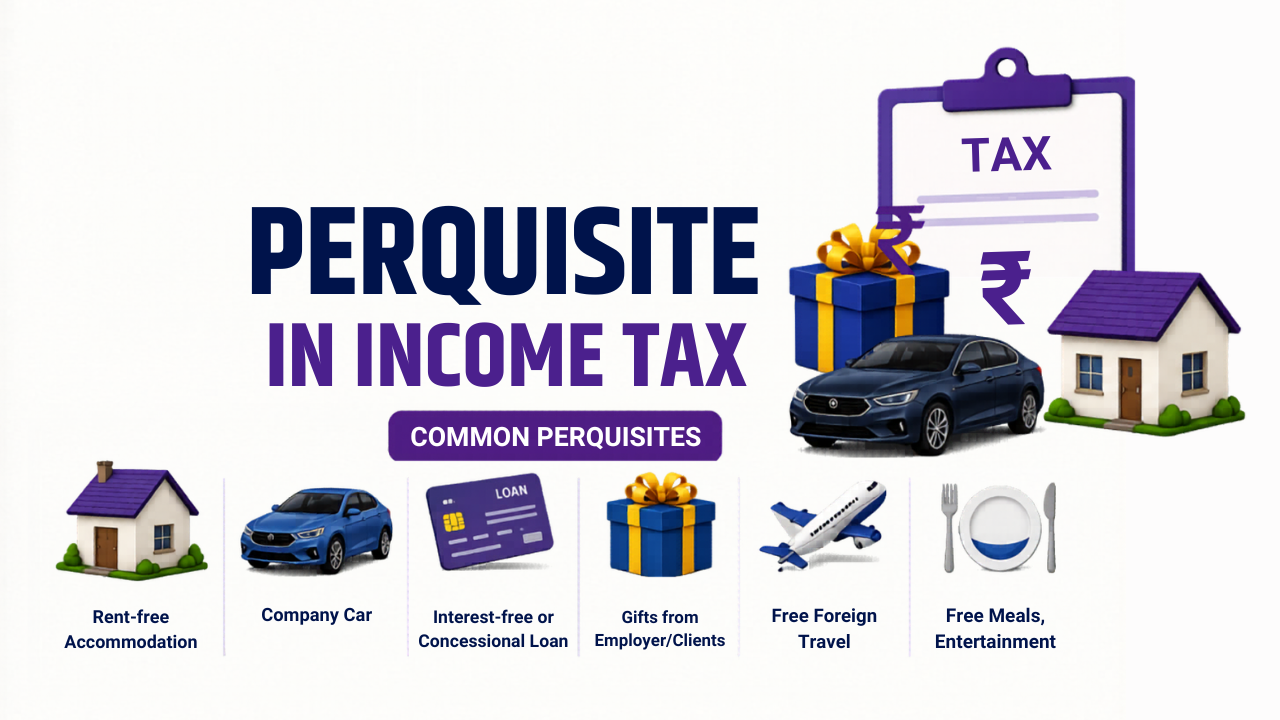
A perquisite is any benefit, facility, or amenity provided by an employer to an employee in addition to their regular salary or wages. Perquisite in income tax can be in cash, in kind, or in the form of services and amenities that have a monetary value. For the complete income tax framework, refer to our complete income tax guide. Under Section 17(2) of the Income Tax Act, the value of perquisites received from an employer is treated as part of salary income and is taxable in the hands of the employee.
Common examples of perquisites include a company-provided car, rent-free accommodation, interest-free or concessional loans, club memberships, ESOPs (Employee Stock Option Plans), free meals, and domestic staff paid for by the employer.
Perquisites are different from allowances. Allowances like HRA and LTA are specific cash payments made to employees for defined purposes. Perquisites are non-cash benefits or facilities provided in kind. Both form part of taxable salary, but their valuation and exemption rules are different.
Taxable vs Non-Taxable Perquisites
Not all perquisites are taxable. The Income Tax Act divides perquisites into three categories based on their taxability. I get asked about this constantly, because the same rupee an employer spends on you can end up completely tax-free or fully taxed, depending purely on how the benefit is structured.
Here is a quick-reference table before we get into the three categories in detail.
| Perquisite | Taxable or Exempt | Key Condition |
|---|---|---|
| Rent-free or concessional accommodation | Taxable | Value depends on salary, city population, and whether the employer is government or private |
| Company car for personal use | Taxable | Only for specified employees; exempt if used purely for official duty with logs maintained |
| ESOPs on exercise | Taxable | FMV on exercise date minus the amount actually paid by the employee |
| Gifts and vouchers above Rs. 5,000 | Taxable | Full value taxable once the Rs. 5,000 threshold is crossed in a year |
| Interest-free or concessional loans | Taxable | Exempt if the aggregate loan amount is up to Rs. 20,000, or for treatment of specified diseases |
| Laptop and computer for official use | Exempt | Must genuinely be for official use, not personal |
| Mobile phone and internet reimbursement | Exempt | Against actual bills for official use |
| Meal vouchers | Exempt, with conditions | Up to Rs. 50 per meal, old regime only, for FY 2025-26. Rises to Rs. 200 per meal under both regimes from FY 2026-27 |
| Employer’s PF contribution | Exempt up to a limit | Up to 12% of salary; combined with NPS and superannuation, capped at Rs. 7.5 lakh a year |
| Transport for office commute | Exempt | Not treated as a perquisite at all |
| Overseas medical treatment travel | Exempt, with conditions | Exempt only if gross total income, excluding this cost, does not exceed Rs. 8,00,000 |
| General miscellaneous perquisites, Section 17(2)(iii) | Exempt up to a limit | Raised from Rs. 50,000 to Rs. 4,00,000 a year, effective FY 2025-26 |
A simple way to remember this: perquisites tied to your personal lifestyle, such as accommodation, a car, loans, or gifts, tend to be taxable. Perquisites tied to your ability to do your job, such as a laptop, phone, or official travel, tend to be exempt. If you are weighing a fixed CTC structure against a flexible benefit plan, this exempt bucket is exactly what decides how much you actually save. I have compared the two approaches in detail in my guide on fixed CTC vs flexible benefit plans.
Take Rohan, a manager in Bengaluru on a Rs. 22 lakh CTC. His employer added Rs. 3,00,000 worth of meal vouchers to his salary structure this year. Since Rohan is on the old regime, the first Rs. 26,400 of that is exempt and the rest gets added to his taxable salary. Had Rohan picked the new regime for FY 2025-26, none of it would have been exempt at all. He asked me whether switching regimes made sense purely because of this one perquisite, and the honest answer is that it depends on how many exempt perquisites his overall package carries. I break this trade-off down in my old vs new tax regime comparison, and you can see how perquisites stack up against straightforward allowances in my guide on the best salary allowances for tax savings.
Category 1: Taxable for All Employees
These perquisites are taxable in the hands of every employee regardless of their salary level or designation:
Rent-free accommodation: If your employer provides you a house or flat free of cost, the value of that accommodation is taxable as a perquisite.
Concessional accommodation: If the employer charges rent below the prescribed value, the difference is taxable.
Interest-free or concessional loans: If your employer gives you a loan at a rate lower than the State Bank of India’s lending rate, the interest benefit is taxable. Loans up to Rs. 20,000 in aggregate are exempt.
Obligation of employee met by employer: If an employer pays for something that is the employee’s personal obligation, such as income tax on salary, personal telephone bills, or car maintenance for the employee’s own vehicle, that amount is taxable as a perquisite.
ESOPs and sweat equity shares: The difference between the Fair Market Value (FMV) on the date of exercise and the amount actually paid by the employee is taxable as a perquisite at the time of exercise.
Gifts and vouchers above Rs. 5,000: Any gift, voucher, or token received from the employer exceeding Rs. 5,000 in a financial year is taxable.
Category 2: Taxable Only for Specified Employees
Some perquisites are taxable only for “specified employees” and are exempt for other employees. A specified employee is one who is:
1. A director of the company, or
2. An employee with a substantial interest (holds 20% or more voting power) in the company, or
3. An employee whose monetary taxable salary (excluding the perquisite value being evaluated) exceeds Rs. 50,000 per year
Perquisites taxable only for specified employees include:
Company car for personal use: When an employer owns a car and provides it as a facility for partly personal use, it is taxable only for specified employees. However, if the employer reimburses running and maintenance expenses for a car owned by the employee, that reimbursement is taxable for all employees regardless of designation.
Domestic servants: The salary paid by the employer for a sweeper, gardener, watchman, or personal attendant is taxable only for specified employees.
Gas, electricity, and water: Utility connections supplied by the employer free of charge are taxable only for specified employees.
Educational facilities for children: If the cost of schooling per child exceeds Rs. 1,000 per month, the excess is taxable for specified employees.
Category 3: Non-Taxable Perquisites (Fully Exempt)
These perquisites are fully exempt from tax for all employees:
Medical facilities at employer’s hospital: Treatment provided at a hospital maintained by the employer is fully exempt.
Laptop and computer for official use: A laptop or computer provided by the employer for official use is not taxable.
Mobile phone for official use: Telephone and mobile phone expenses paid by the employer for official purposes are exempt.
Meal vouchers up to Rs. 50 per meal: Free meals or meal vouchers provided during working hours up to Rs. 50 per meal are exempt for FY 2025-26, but only if you have opted for the old tax regime. Under the new regime, this exemption is not available at all for FY 2025-26. The limit rises to Rs. 200 per meal and becomes available under both regimes from FY 2026-27 onwards.
Recreational facilities for all employees: Facilities like a gymnasium or recreation room provided to all employees uniformly are exempt.
Medical insurance premium paid by employer: Premiums paid by the employer for group medical insurance are not taxable.
Employer’s contribution to PF: The employer’s contribution to a recognised provident fund up to 12% of salary is exempt.
Transport for commuting to office: A conveyance facility provided for commuting between residence and office is not treated as a perquisite and is fully exempt.
Overseas medical treatment travel: From FY 2025-26, the cost of travel for medical treatment abroad for you or your family is exempt only if your gross total income, excluding this travel cost, does not exceed Rs. 8,00,000. Above this threshold, the travel cost becomes a taxable perquisite under Rule 3D.
Finance Act 2025 update: The general perquisite exemption limit under Section 17(2)(iii) has been increased from Rs. 50,000 to Rs. 4,00,000 per year effective FY 2025-26. This covers miscellaneous employer benefits not specifically listed elsewhere in the Act, significantly expanding the tax-free benefit capacity for employees.
Valuation Rules for Common Perquisites
1. Rent-Free Accommodation (RFA)
The taxable value of employer-provided accommodation depends on whether the employer is a government entity or a private employer, and the city’s population.
For non-government employers:
| City Population | Perquisite Value (if employer owns the accommodation) |
|---|---|
| Above 25 lakh | 15% of salary |
| Above 10 lakh but up to 25 lakh | 10% of salary |
| Up to 10 lakh | 7.5% of salary |
If the employer has taken the accommodation on rent, the perquisite value is the lower of the actual rent paid by the employer or 15% of salary.
For furnished accommodation, an additional 10% per year of the original cost of furniture (or actual hire charges) is added to the above value.
The employee’s own rent contribution is reduced from the perquisite value. “Salary” for this purpose includes basic pay, dearness allowance (where included for retirement benefits), bonus, commission, and other taxable allowances but excludes the employer’s PF contribution and perquisite values.
2. Company Car (Motor Vehicle)
For FY 2025-26, the taxable perquisite value for a company car under Rule 3 of the Income Tax Rules depends on who owns the car, who bears the expenses, and how the car is used.
If the car is used wholly for official purposes: Perquisite value is Nil, provided the employer maintains complete records of official journeys.
If the car is used partly for official and partly for personal use (employer bears expenses):
| Engine Capacity | Perquisite Value per Month | If Driver Also Provided |
|---|---|---|
| Up to 1.6 litres | Rs. 1,800 per month | Rs. 1,800 + Rs. 900 = Rs. 2,700 per month |
| Above 1.6 litres | Rs. 2,400 per month | Rs. 2,400 + Rs. 900 = Rs. 3,300 per month |
These are the standard perquisite values for FY 2025-26 under Rule 3. The employer deducts this amount from the actual running and maintenance expenses to arrive at the taxable perquisite value.
If the car is used wholly for personal purposes: The full actual cost incurred by the employer (maintenance, fuel, driver salary, and 10% depreciation on car cost) is taxable as a perquisite.
Note: Commuting between home and office does not count as personal use and is not taxable.
3. ESOPs (Employee Stock Option Plans)
ESOPs are taxed at two stages:
Stage 1: At the time of exercise (when the employee exercises the option and gets shares allotted): The difference between the Fair Market Value (FMV) on the date of exercise and the exercise price paid by the employee is taxable as a perquisite under the head “Salaries.” The employer must deduct TDS on this amount.
Stage 2: At the time of sale (when the employee sells the shares): The difference between the sale price and the FMV on the date of exercise is taxable as capital gains, either short-term or long-term depending on the holding period.
Example: Arjun received ESOPs with an exercise price of Rs. 100 per share. On the date of exercise, the FMV is Rs. 400 per share. He exercises 500 shares.
Perquisite taxable at exercise = (Rs. 400 – Rs. 100) x 500 = Rs. 1,50,000. This Rs. 1,50,000 is added to Arjun’s salary income for the year and taxed at his applicable slab rate.
Later, if Arjun sells the shares at Rs. 550 per share, the capital gain = (Rs. 550 – Rs. 400) x 500 = Rs. 75,000, which is taxed as capital gains.
ESOP tax deferral for startup employees: Employees of eligible startups (certified under DPIIT-certified companies) can defer the tax on ESOP perquisite for up to 48 months from the end of the assessment year in which ESOPs are exercised, or until they leave the company, or until they sell the shares, whichever is earliest. This provides cash flow relief since the employee does not need to pay tax immediately upon exercise.
4. Club Membership
If the employer pays for a club membership (health club, sports club, social club) for the employee’s personal use, the entire amount paid is taxable as a perquisite. Club facilities provided uniformly to all employees at the employer’s premises are exempt. Individual club memberships for personal use of an employee are taxable in full.
5. Interest-Free or Concessional Loans
If your employer provides a loan at an interest rate lower than the SBI’s lending rate (Prime Lending Rate) for the same type of loan, the difference in interest is taxable as a perquisite. The perquisite value is calculated on the maximum outstanding balance of the loan during each month.
Loans up to Rs. 20,000 in aggregate are exempt. Loans for medical treatment of specified diseases are also exempt.
Employer vs Employee Perquisites
Perquisites are always employer-provided. If a benefit is given by anyone other than the employer, it is not a perquisite under Section 17(2) and is instead taxable under “Income from Other Sources.” For example, if a client gifts you a laptop, that is taxable under other sources, not as a perquisite.
From the employer’s side, perquisites are a business expense and are deductible when computing the employer’s taxable income. Employers must also deduct TDS on the value of taxable perquisites provided to employees and reflect them correctly in Form 16 and Form 12BA.
How to Report Perquisites in ITR
The value of all taxable perquisites is included in your gross salary by your employer. When your employer issues Form 16, it shows the total salary including the perquisite value. Specifically:
Form 16 Part B: Shows the breakup of salary income including the value of perquisites under Section 17(2).
Form 12BA: This is a separate statement issued by the employer only when perquisites or profits in lieu of salary have actually been provided to the employee, and the employee’s salary (excluding perquisites) exceeds Rs. 1,50,000 per year. It provides the detailed breakup of all perquisites and their valuation. If no perquisites are provided, Form 12BA is not issued.
In the ITR: When filing your ITR, report the gross salary as shown in Form 16. The perquisite values are already included in the gross salary figure. You do not report them separately as a different income head. They fall under the head “Income from Salaries.”
Log in to incometax.gov.in to file your ITR. For the due date for FY 2025-26 ITR filing, see our guide on the ITR filing last date for AY 2026-27.
For a complete understanding of other exemptions that reduce your taxable salary income, see our guide on exemptions under Section 10 of the Income Tax Act.
Perquisites Under the New Tax Regime
Under the new tax regime, most deductions and exemptions are not available. However, perquisite exemptions are still permitted under the new regime. This makes employer-provided benefits one of the few remaining tax-saving tools for employees who have opted for the new tax regime.
Key perquisite exemptions available even under the new tax regime include:
Laptop and computer for official use
Mobile phone expenses for official use
Employer’s PF contribution up to 12% of salary
Transport for commuting to office
The expanded Rs. 4,00,000 general perquisite exemption under Section 17(2)(iii) from FY 2025-26
Meal vouchers are the one exception worth flagging separately. For FY 2025-26, the Rs. 50 per meal exemption applies only under the old regime, so if you are filing under the new regime this year, meal vouchers are added to your taxable salary in full. This changes from FY 2026-27, when the Rs. 200 per meal exemption becomes available under both regimes.
Employees in the new tax regime can work with their employers to structure salary components in a way that maximises these perquisite exemptions, since deductions like HRA, 80C, and 80D are unavailable.
Frequently Asked Questions
Are all perquisites added to my Form 16 automatically?
Yes. Your employer is responsible for valuing all taxable perquisites and including them in your gross salary for TDS calculation. The total perquisite value appears in Form 16 Part B and Form 12BA. If you find that your employer has not included certain perquisites, you must still report the correct value in your ITR to avoid notices.
Is a company laptop taxable as a perquisite?
No. A laptop or computer provided by the employer for official use is fully exempt from tax and is not treated as a perquisite. This exemption applies to both the old and new tax regimes.
If I get ESOPs from a startup, do I pay tax immediately on exercise?
Not immediately if your employer is a DPIIT-certified eligible startup. For eligible startups, ESOP tax can be deferred for up to 48 months from the end of the assessment year of exercise, or until you leave the company or sell the shares, whichever comes first.
Is the perquisite value of accommodation calculated on my basic salary or CTC?
Salary for perquisite valuation purposes includes basic pay, dearness allowance (where it forms part of retirement benefits), bonus, commission, and other taxable allowances. It does not include the employer’s PF contribution, gratuity, or the value of the perquisite being calculated itself. CTC as such is not used for this calculation.
Can I reduce my taxable income by structuring salary as perquisites?
Yes, to an extent. Certain perquisites have a lower taxable value than their actual cost to the employer. For example, a company car with mixed use has a standard taxable perquisite value of Rs. 1,800 or Rs. 2,400 per month regardless of how much the employer actually spends on fuel and maintenance. Structuring part of CTC as perquisites can reduce the overall tax liability, but must be done correctly with proper documentation and employer cooperation.