Capital Gains Tax FY 2026-27: LTCG and STCG Rates
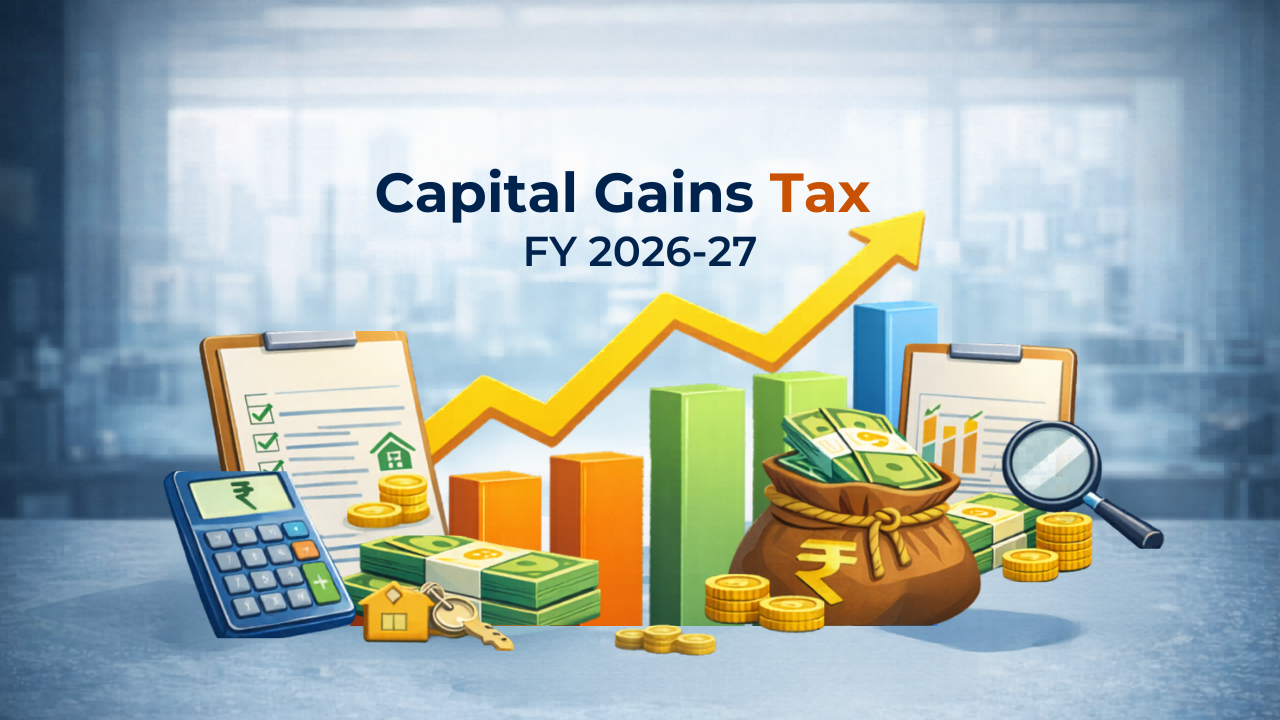
Capital gains tax in India applies when you sell a capital asset at a profit. Whether it is listed shares, equity mutual funds, property, gold, or debt funds, the tax rate and rules depend on how long you held the asset before selling. For FY 2026-27, the framework introduced in Budget 2024 continues without change. Budget 2026 kept all capital gains rates and holding period rules exactly as they were.
This guide covers the complete capital gains tax structure for FY 2026-27, including updated rules for property, equity, debt mutual funds, share buybacks, and the loss set-off rules under the new Income Tax Act 2025.
What Are Capital Gains?
Capital gains arise when you sell a capital asset for more than what you paid for it. The profit is the capital gain. Assets such as residential property, land, listed shares, equity mutual funds, debt mutual funds, gold, sovereign gold bonds, and unlisted shares all fall under this category.
Capital gains are classified as short-term or long-term based on the holding period. The holding period threshold differs by asset class. Once classified, the tax rate applied also differs. Getting these two things right is the starting point for any capital gains calculation.
Holding Period: Short-Term vs Long-Term
| Asset Type | Short-Term (STCG) | Long-Term (LTCG) |
|---|---|---|
| Listed equity shares | Up to 12 months | More than 12 months |
| Equity-oriented mutual funds | Up to 12 months | More than 12 months |
| Units of business trusts (REITs, InvITs) | Up to 12 months | More than 12 months |
| Immovable property (land, building) | Up to 24 months | More than 24 months |
| Unlisted shares | Up to 24 months | More than 24 months |
| Gold (physical, Gold ETF) | Up to 24 months | More than 24 months |
| Debt mutual funds (post April 1, 2023 purchases) | Always STCG regardless of holding | Not applicable |
| Sovereign Gold Bonds (SGB) | Up to 12 months (if listed) | More than 12 months; maturity proceeds tax-free |
Note: The property holding period was reduced from 36 months to 24 months effective from July 23, 2024. This means a property sold after holding it for 25 months is now a long-term asset and qualifies for lower LTCG rates. For detailed rate tables and examples, read our guides on long-term capital gains tax and short-term capital gains tax.
Capital Gains Tax Rates FY 2026-27
| Asset Type | STCG Rate | LTCG Rate | Exemption Limit |
|---|---|---|---|
| Listed equity shares (Section 111A / 112A) | 20% | 12.5% | Rs. 1.25 lakh LTCG exempt per year |
| Equity-oriented mutual funds | 20% | 12.5% | Rs. 1.25 lakh LTCG exempt per year |
| Immovable property (sold after July 23, 2024) | Slab rate | 12.5% (no indexation) | No general exemption; Section 54/54EC apply |
| Immovable property (acquired before July 23, 2024) | Slab rate | 12.5% without indexation OR 20% with indexation (lower is payable) | No general exemption; Section 54/54EC apply |
| Gold (physical, Gold ETF) | Slab rate | 12.5% (no indexation) | None |
| Debt mutual funds (post April 1, 2023) | Slab rate | Always slab rate (no LTCG benefit) | None |
| Unlisted shares | Slab rate | 12.5% (no indexation) | None |
| Share buyback (from Budget 2026) | As per holding period above | As per holding period above | Taxed as capital gains, not dividend |
Budget 2026 confirmed: No changes to any of these rates for FY 2026-27. The uniform 12.5% LTCG rate and 20% STCG rate on equity continue.
Section 87A Rebate Does Not Apply to Capital Gains
This is one of the most important points that many salaried professionals miss. Even if your total income is below Rs. 12 lakh (which would otherwise qualify for the Section 87A rebate under the new regime), capital gains taxed at special rates such as LTCG at 12.5% or STCG at 20% do not get this rebate.
Example: Neha has a salary of Rs. 8 lakh and LTCG of Rs. 2 lakh from equity mutual funds. Her total income is Rs. 10 lakh. She is in the new tax regime. The Rs. 75,000 LTCG above the Rs. 1.25 lakh exemption will be taxed at 12.5%, and she cannot claim the Section 87A rebate to reduce this. She will pay Rs. 9,375 as tax on these gains even though her salary income would have been covered by the rebate.
See the income tax slabs FY 2026-27 for a full breakdown of rebate applicability by income level.
Capital Gains on Property: The July 23, 2024 Rule
Property capital gains have two different calculation methods depending on when the property was acquired. Affordable housing projects sanctioned before March 2022 may also qualify for an additional deduction under Section 80IBA for property developers and buyers.
Property Acquired On or After July 23, 2024
LTCG is calculated at a flat 12.5% on the actual gain. No indexation benefit is available. The Cost Inflation Index (CII) does not apply. The holding period for long-term classification is 24 months.
Property Acquired Before July 23, 2024
For resident individuals and HUFs, two options are available. You can choose whichever results in lower tax:
- Option 1: Pay 12.5% LTCG on the actual gain without indexation
- Option 2: Pay 20% LTCG on the indexed gain (using CII to inflate the purchase price for inflation)
The CII for FY 2025-26 is 363 (base year 2001-02 = 100).
Calculation Example
Sunita bought a flat in Bengaluru in 2012 for Rs. 40 lakh. She sold it in January 2026 for Rs. 90 lakh after spending Rs. 5 lakh on renovation. The CII for 2012-13 is 200 and for 2025-26 is 363.
Option 1: 12.5% without indexation
Gain = Rs. 90 lakh minus Rs. 45 lakh (cost + renovation) = Rs. 45 lakh
Tax = 12.5% of Rs. 45 lakh = Rs. 5.625 lakh
Option 2: 20% with indexation
Indexed cost = Rs. 40 lakh x (363 / 200) = Rs. 72.6 lakh
Indexed renovation = Rs. 5 lakh x (363 / 200) = Rs. 9.075 lakh (approximately)
Gain = Rs. 90 lakh minus Rs. 81.675 lakh = Rs. 8.325 lakh
Tax = 20% of Rs. 8.325 lakh = Rs. 1.665 lakh
Sunita should choose Option 2. She pays Rs. 1.665 lakh instead of Rs. 5.625 lakh.
This choice is available only for properties purchased before July 23, 2024. For newer properties, only 12.5% without indexation applies.
LTCG Exemption of Rs. 1.25 Lakh on Equity
Long-term capital gains on listed equity shares and equity-oriented mutual funds up to Rs. 1.25 lakh per financial year are completely tax-free. Gains above Rs. 1.25 lakh are taxed at 12.5%.
This exemption applies per financial year, per individual taxpayer. A married couple where both are investing can each claim Rs. 1.25 lakh separately, effectively making Rs. 2.5 lakh of combined LTCG tax-free in a year.
Tax harvesting strategy: If your LTCG is approaching Rs. 1.25 lakh in a year, some investors sell equity and immediately repurchase it to “book” the tax-free gain. This resets the cost basis without paying tax. This is legal and widely used, but requires monitoring of holding periods carefully.
Debt Mutual Funds: No LTCG Benefit
Debt mutual funds where less than 35% of assets are in equity, and funds purchased on or after April 1, 2023, are always taxed at slab rate regardless of how long you hold them. There is no separate LTCG rate or indexation benefit for these funds.
This makes debt mutual funds tax-equivalent to fixed deposits for most investors. For debt fund units purchased before April 1, 2023, the old rules (LTCG at 20% with indexation after 36 months) still apply to those specific units.
Sovereign Gold Bonds: Important Change from April 2026
Original subscribers to Sovereign Gold Bonds (SGBs) who hold till maturity continue to receive proceeds that are completely tax-free. This has not changed.
However, from April 2026 onwards, SGB units purchased from the secondary market (stock exchange) will no longer enjoy this tax-free status at maturity. The gains from such SGBs will now be taxed as capital gains based on the applicable holding period and rates. This is a significant change for investors who have been purchasing SGBs from the secondary market expecting tax-free returns.
If you purchased SGBs from the secondary market before April 2026, check the applicable rules for your specific units with a tax professional before assuming tax-free maturity.
Share Buyback: Now Taxed as Capital Gains (Budget 2026)
Budget 2026 changed the taxation of share buybacks. Previously, buyback income was taxed as dividend-like income in the hands of the company. From Budget 2026, proceeds received by shareholders from share buybacks are now treated as capital gains in the hands of the shareholder.
This means if a company you hold shares in does a buyback, the proceeds will be taxed as either STCG (at 20%) or LTCG (at 12.5%) depending on your holding period in those shares. If you held the shares for more than 12 months, it is LTCG. Less than 12 months means STCG at 20%.
Capital Gains Exemptions: Sections 54, 54EC and 54F
Section 54: Reinvestment in Residential Property
If you sell a residential house and use the LTCG to purchase or construct another residential property, you can claim exemption on the capital gains invested.
- New house must be purchased within 1 year before or 2 years after the sale, or constructed within 3 years
- You can invest in up to 2 residential houses if your LTCG is up to Rs. 2 crore (this is a one-time lifetime option)
- Cost of new property above Rs. 10 crore is ignored for exemption calculation
- If the new property is sold within 3 years, the exemption is reversed and added to income
Section 54EC: Investment in Specified Bonds
LTCG from sale of land or building can be invested in specified bonds (NHAI or REC bonds) to claim exemption.
- Maximum investment: Rs. 50 lakh per financial year
- Investment must be made within 6 months of the sale
- Bonds must be held for at least 5 years
- If bonds are transferred or converted to cash before 5 years, exemption is reversed
Section 54F: Sale of Any Asset Other Than Residential Property
If you sell any capital asset other than a residential house and use the net sale consideration (not just the gain) to purchase a new residential property, you can claim exemption proportional to the amount reinvested. See our complete guide on Section 54F for eligibility conditions and investment timelines.
- You should not own more than one other residential house on the date of sale
- The new house must not be sold within 3 years
- Capital Gains Account Scheme (CGAS): If you cannot invest before the ITR filing deadline, deposit the amount in a CGAS account with a designated bank to preserve the exemption
Capital Gains Loss Set-Off Rules FY 2026-27
How you can use capital losses to reduce your tax is important for portfolio planning. Here are the rules:
| Loss Type | Can Be Set Off Against | Carry Forward |
|---|---|---|
| Short-term capital loss (STCL) | Both STCG and LTCG | Up to 8 years |
| Long-term capital loss (LTCL) | LTCG only (not STCG) | Up to 8 years |
| Capital loss (any) | Cannot be set off against salary or business income | Only if ITR filed on time |
Important note on LTCL set-off under the new Income Tax Act 2025: The draft Income Tax Bill 2025 had proposed a one-time transitional relief allowing LTCL accumulated before March 31, 2026 to be set off against STCG from FY 2026-27 onwards. However, this provision was removed in the final Income Tax Act 2025. The standard restriction continues: LTCL can only be set off against LTCG, not STCG. If you were planning your portfolio around this proposed relief, please update your calculations accordingly.
To carry forward any capital loss, you must file your ITR before the due date. Missing the ITR filing deadline of July 31, 2026 means you lose the right to carry forward these losses to future years.
Capital Gains and Tax Regime Choice
Capital gains taxed at special rates (STCG at 20%, LTCG at 12.5%) are computed the same way under both the old and new tax regimes. The regime choice does not change the tax rate on capital gains themselves.
What changes is how the rest of your income is taxed. Slab rate capital gains (such as STCG on property or debt fund income) do get affected by your regime choice since slab rates differ. For a full comparison of how the two regimes work for salaried professionals with investment income, read the old vs new tax regime comparison.
Which ITR Form to Use for Capital Gains
Your ITR form depends on the type of capital gains you have:
- ITR-1 (Sahaj): From FY 2025-26, LTCG up to Rs. 1.25 lakh from listed equity can be reported here. Earlier this was not allowed in ITR-1.
- ITR-2: Required if you have any STCG, LTCG above Rs. 1.25 lakh, capital gains from property, or capital losses to carry forward
- ITR-3: Required if you have capital gains along with business or professional income
For the detailed breakdown of which form applies to your situation, read which ITR form to file for FY 2025-26.
Quick Reference: Capital Gains Tax Summary FY 2026-27
| Question | Answer |
|---|---|
| LTCG rate on equity and equity mutual funds? | 12.5% on gains above Rs. 1.25 lakh per year |
| STCG rate on equity? | 20% (where STT paid) |
| LTCG rate on property? | 12.5% without indexation (pre-July 23, 2024 property: choose 12.5% or 20% with indexation) |
| STCG on property? | Slab rate |
| Holding period for property to be long-term? | 24 months (reduced from 36 months since July 23, 2024) |
| Is indexation available for new property purchases? | No. Only for property acquired before July 23, 2024 |
| Can Section 87A rebate reduce capital gains tax? | No. Special rate capital gains are excluded from Section 87A rebate |
| CII for FY 2025-26? | 363 (base year 2001-02) |
| Did Budget 2026 change capital gains rates? | No. All rates remain unchanged for FY 2026-27 |
| How are share buybacks taxed now? | As capital gains in shareholder’s hands (changed from Budget 2026) |
| SGB purchased from secondary market after April 2026? | No longer tax-free at maturity. Taxed as capital gains |
You can file your return directly at the official portal: incometax.gov.in
Frequently Asked Questions
I sold my flat in March 2026. Which rules apply?
Since the sale happened in FY 2025-26 (before April 1, 2026), you file this in your ITR for FY 2025-26 due by July 31, 2026. If the property was acquired before July 23, 2024, you can choose between 12.5% without indexation or 20% with indexation. If acquired after July 23, 2024, only 12.5% without indexation applies. The holding period for long-term is 24 months.
I have an LTCG of Rs. 80,000 from equity. Do I pay any tax?
No. LTCG from listed equity and equity mutual funds up to Rs. 1.25 lakh per financial year is tax-free. Your Rs. 80,000 falls within this limit. However, you still need to report it in your ITR. If your total income and gains structure allows ITR-1, you can now report up to Rs. 1.25 lakh LTCG there directly.
Can I avoid capital gains tax by gifting shares to a family member?
Gifts between specified relatives are not taxable for the recipient at the time of gift. However, when the recipient eventually sells those shares, capital gains are calculated based on the original cost of acquisition and the original holding period is also counted from when the original owner bought them. The tax is not permanently avoided, only deferred to the eventual sale.
Are capital gains from NPS taxable?
NPS is not treated as a capital gains instrument. The tax treatment on NPS withdrawal is different and covered under salary and retirement benefit provisions, not under capital gains tax rules.
Summary
Capital gains tax in India for FY 2026-27 follows the structure set in Budget 2024 and confirmed unchanged by Budget 2026. Listed equity LTCG is taxed at 12.5% above Rs. 1.25 lakh with STCG at 20%. Property and most other assets also attract 12.5% LTCG, with an indexation option available for property purchased before July 23, 2024. Debt mutual funds purchased after April 2023 are always taxed at slab rate. Share buybacks are now taxed as capital gains. SGB secondary market purchases from April 2026 no longer enjoy tax-free maturity. The LTCL set-off against STCG transitional relief proposed in the Income Tax Bill 2025 draft was removed from the final Act.
For the complete picture of how capital gains fit into your overall tax planning alongside deductions and ITR filing, the Complete Income Tax Guide India on finlecture.in covers all the key rules in one place. Related topics: PPF tax benefits and withdrawal rules, credit card high value transactions that may trigger tax notices, and deferred tax liability concepts for businesses.
Have questions about your specific capital gains situation? Drop them in the comments below.
📚 Also Read:
- Share Buyback Tax Rules Changed from April 2026
- Income Tax on Rental Income FY 2026-27: Calculation, Deductions and ITR Filing
- Income Tax Slabs FY 2026-27: New vs Old Regime Rates
- Old vs New Tax Regime: Which One Should You Choose?
- Demystifying Trading Tax in India: A Guide for Professionals
- Complete Income Tax Guide India 2025-26 & 2026-27