Top 10 Salary Components to Reduce Tax in 2026
Most salaried professionals I work with assume their tax outgo is fixed once their salary is decided. It is not. The way your CTC is broken down, how much goes into basic pay, allowances, and employer contributions, has a direct impact on how much tax you end up paying, often more than any last minute investment can offset. In my 7 years of working with salaried professionals, I have seen the same pattern repeat itself: two people earning the identical CTC end up paying noticeably different tax, simply because one of them has a better structured salary. These are the salary components to reduce tax 2026 that are worth checking in your own payslip, whether you have chosen the old regime or the new one.
Top 10 Salary Components to Reduce Tax Under Old vs New Regime
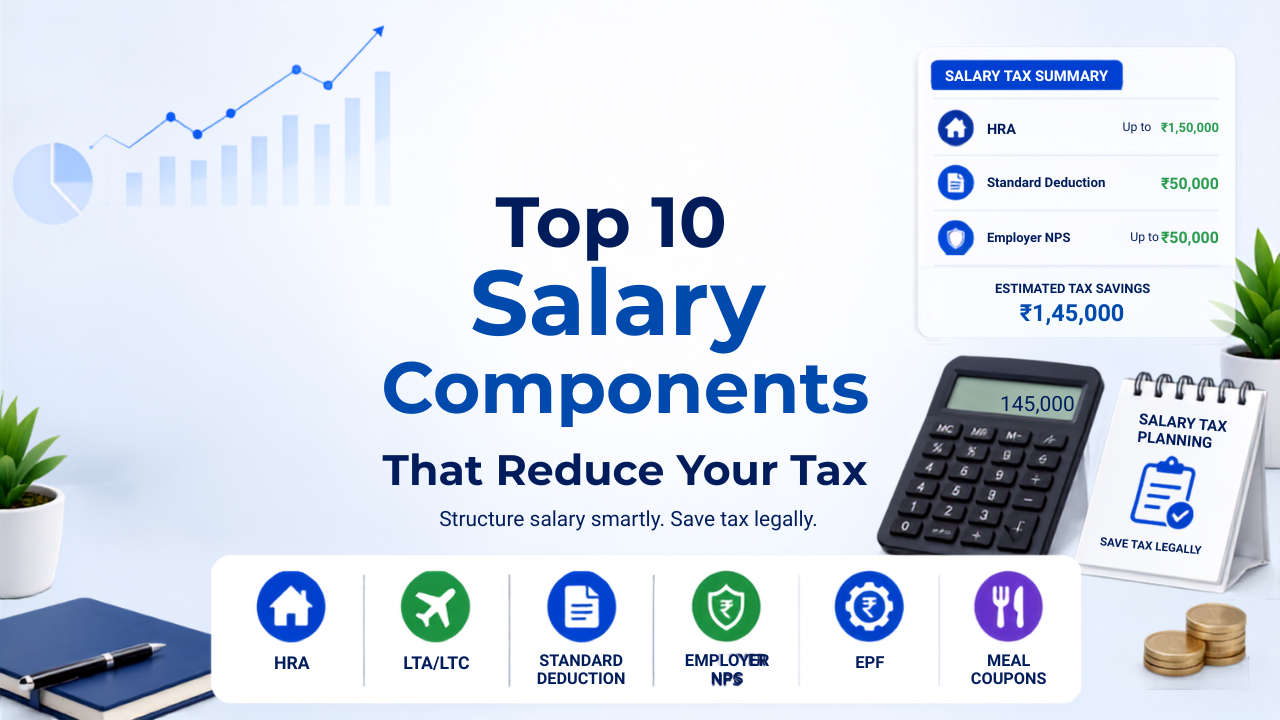
1. Standard Deduction
Every salaried employee gets this automatically, no proof or investment needed. It is Rs 75,000 under the new tax regime and Rs 50,000 under the old regime, as covered in my full standard deduction guide. If your employer or payroll team has not applied it correctly, it is worth flagging with HR.
2. Employer’s Contribution to NPS (Section 80CCD(2))
This is the single most powerful lever available to salaried employees on the new regime, and it works on the old regime too, something I have broken down in detail in my NPS tax benefit guide. From FY 2025-26, employers can contribute up to 14 percent of your basic salary and dearness allowance to your NPS account, and you can claim the entire amount as a deduction, regardless of which regime you choose. Under the old regime, private sector employees are capped at 10 percent, while government employees get 14 percent either way. You can check the official contribution rules on npscra.proteantech.in.
If your basic salary is Rs 7.2 lakh, a 14 percent employer contribution works out to just over Rs 1 lakh a year, money that reduces your taxable salary without you spending a rupee out of pocket. One thing to watch, if your employer’s combined contribution to NPS, EPF, and superannuation fund crosses Rs 7.5 lakh in a year, the excess becomes taxable.
3. HRA Exemption (Old Regime Only)
If you live in rented accommodation and are on the old regime, House Rent Allowance can bring down a meaningful chunk of your taxable income. I have written a separate HRA exemption calculation guide if you want to work out your own number. This exemption is not available under the new regime, so if HRA forms a large part of your salary, it is worth running the numbers on both regimes before you choose.
4. Leave Travel Allowance
LTA lets you claim exemption on travel costs for trips within India, twice in a block of four years. Like HRA, this benefit is only available if you opt for the old regime.
5. Meal Vouchers or Food Cards
This one changed recently and many payroll teams have not caught up yet. From April 1, 2026, meal vouchers or food cards up to Rs 200 per meal are tax free, which can work out to roughly Rs 1.05 lakh a year if structured properly, and this is now meant to apply under both the old and new regimes. The vouchers need to be non transferable and usable only for food and non alcoholic beverages, so check with HR whether your company has updated its meal card policy to reflect this.
6. Gratuity Exemption
Gratuity received on retirement, resignation after five years of service, or death is exempt up to Rs 20 lakh under Section 10(10), and this exemption is available regardless of which tax regime you choose.
7. Leave Encashment Exemption
For non-government employees, leave encashment on retirement or resignation is exempt up to Rs 25 lakh under Section 10(10AA), also available under both regimes. I cover this alongside gratuity in my gratuity vs leave encashment comparison.
8. Employer’s Contribution to EPF
Your employer’s EPF contribution, up to 12 percent of basic salary plus dearness allowance, is not added to your taxable income. It quietly builds your retirement corpus while keeping your current year tax lower, and this benefit works under both regimes.
9. Telephone and Internet Reimbursement
If your role genuinely requires a phone or broadband connection and your employer reimburses the actual bill amount against submitted receipts, this reimbursement is not treated as taxable salary. It is a reimbursement of an official expense rather than an allowance, so it holds up under either regime.
10. Section 80C Investments (Old Regime Only)
If you are on the old regime, salary deductions routed into PF, life insurance premiums, ELSS, or children’s tuition fees can bring down your taxable income by up to Rs 1.5 lakh under Section 80C. This one is exclusive to the old regime, so it only helps if that is the path you have chosen.
What This Looks Like in Practice
Take Priya, a marketing manager with an 18 lakh CTC on the new tax regime, per the income tax slabs for FY 2026-27. If her basic salary is Rs 7.2 lakh, structuring her NPS employer contribution at 14 percent and opting into a compliant meal card benefit reduces her taxable income by roughly Rs 2.06 lakh a year. On the new regime slabs for FY 2025-26, that brings her annual tax down from about Rs 1,50,800 to roughly Rs 1,12,195, a saving of close to Rs 38,600, without touching her take home pay structure in any other way.
Should You Ask HR to Restructure Your Salary?
If your current salary slip does not show employer NPS contribution or a meal card component, it is worth having a conversation with your HR or payroll team. Most companies are open to restructuring within your existing CTC, since it does not cost them anything extra, it simply changes how the same number is split. For more ways to bring down your tax outgo, my tax saving tips for salaried employees article covers additional options beyond salary structuring.
Getting this right is less about finding a loophole and more about making sure your salary is not costing you more tax than it needs to. A few structural changes, discussed with your employer at the right time, can add up to real savings every single year.
Conclusion
Your salary letter shows one number, but how much of it actually reaches your bank account depends on structure, not just size. The components covered here, employer NPS contribution, standard deduction, HRA, meal vouchers, gratuity, leave encashment, EPF, and Section 80C where applicable, are not loopholes. They are provisions the government has built into the tax law specifically to reward smarter salary structuring. Reviewing your salary breakup once a year, ideally before the new financial year begins, is enough to make sure you are not paying more tax than you need to.
Frequently Asked Questions
Can I claim all these components regardless of which tax regime I choose?
No. Employer NPS contribution, standard deduction, gratuity, leave encashment, and EPF employer contribution work under both regimes. HRA, LTA, and Section 80C investments are available only if you opt for the old regime.
Will restructuring my salary reduce my take home pay?
Not if it is done correctly. Restructuring usually reallocates the same CTC into more tax efficient components. Your gross CTC does not change, but the tax you pay on it can go down.
Do I need my employer’s approval to add these components to my salary?
Yes. Components like employer NPS contribution and meal vouchers need to be built into your salary structure by your employer’s payroll team. You cannot add them yourself while filing your return.
Is there a limit on how much I can reduce my taxable salary through these components?
Each component has its own cap, for example 14 percent of basic salary for NPS employer contribution, or Rs 1.5 lakh for Section 80C. There is no single overall ceiling across all of them, but each provision has to be claimed within its own limit.
Should I choose the old regime just to access more of these components?
Not necessarily. The old regime gives you access to HRA, LTA, and Section 80C, but it also comes with higher slab rates. Whether it works out better depends on how much you actually claim under it. It is worth comparing both regimes with your real numbers before deciding.