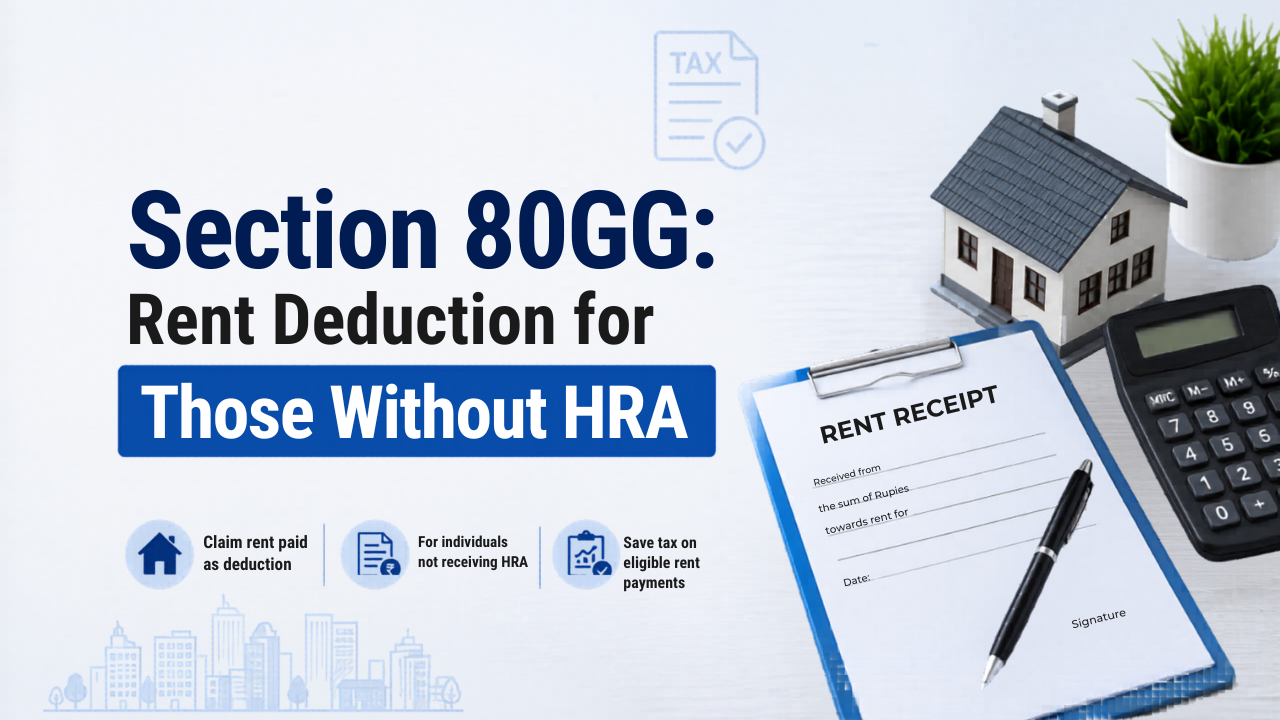
Section 80GG: Rent Deduction for Those Without HRA
What Is Section 80GG?
Section 80GG of the Income Tax Act allows individuals to claim a tax deduction on rent paid when they do not receive House Rent Allowance (HRA) from their employer. It is the rent deduction for everyone the HRA system leaves out: freelancers, self-employed professionals, business owners, and salaried employees whose salary structure does not include HRA as a component.
If you are paying rent every month but cannot claim HRA exemption because your salary slip has no HRA, Section 80GG is how you get a tax deduction on that rent.
The deduction is available only under the old tax regime. If you have opted for the new tax regime, Section 80GG cannot be claimed.
Who Can Claim Section 80GG?
The following categories of taxpayers are eligible to claim Section 80GG:
Salaried individuals without HRA: If your salary structure does not include HRA as a component, you are eligible. Even one rupee of HRA in your salary slip disqualifies the claim entirely, regardless of whether that HRA is fully taxable or partially exempt.
Self-employed professionals and freelancers: Doctors, lawyers, consultants, designers, and other self-employed individuals who pay rent for residential accommodation are eligible.
Business owners: Individuals running a proprietorship or partnership and paying rent for their residence can claim this deduction.
HUF (Hindu Undivided Family): A HUF paying rent for residential accommodation is also eligible, subject to the same conditions.
Important: Section 80GG is not available to companies or LLPs, and it is not available to NRIs. Only resident individuals and resident HUFs can claim this deduction.
Conditions to Claim Section 80GG
All three of the following conditions must be satisfied simultaneously. If even one condition is not met, the deduction is not allowed.
Condition 1: No HRA Received
You must not have received HRA from your employer at any point during the financial year. If your salary structure includes HRA, even if it is a small amount and even if it is fully taxable, you cannot claim Section 80GG. There is no partial eligibility here.
Self-employed individuals and freelancers automatically satisfy this condition since they have no employer paying them HRA.
Condition 2: No Residential Property Owned at Place of Work
You, your spouse, your minor children, or the HUF of which you are a member must not own any residential property in the city or town where you currently reside, work, or carry on your business or profession.
Owning a house in a different city does not disqualify you, as long as that property is not being treated as a self-occupied property (SOP) in your ITR. If you own a house in another city and show it as self-occupied in your ITR while claiming rent deduction in the city where you actually live and work, the deduction will be disallowed.
In simple terms: if you own a house anywhere in India and are treating it as self-occupied, you cannot claim Section 80GG.
Condition 3: Form 10BA Must Be Filed
You must file Form 10BA, a self-declaration form on the income tax e-filing portal, before submitting your ITR. This is not optional. If Form 10BA is not filed, the deduction will be rejected during assessment even if all other conditions are met. For the complete income tax guide covering all deductions, see our income tax guide India.
Form 10BA requires you to declare:
1. That you are paying rent for residential accommodation occupied by you
2. That you have not received any HRA from your employer
3. That you, your spouse, minor children, or your HUF do not own any self-occupied residential property
4. The name and address of your landlord, the rent amount, and the period of occupation
5. The PAN of your landlord, if the annual rent paid exceeds Rs. 1,00,000
How to Calculate the Section 80GG Deduction
The deduction under Section 80GG is the lowest of the following three amounts. You calculate all three and take whichever is the smallest.
Amount 1: Rs. 5,000 per month (Rs. 60,000 per year). This is the absolute maximum cap.
Amount 2: Actual rent paid minus 10% of Adjusted Total Income (ATI).
Amount 3: 25% of Adjusted Total Income (ATI).
What Is Adjusted Total Income (ATI)?
Adjusted Total Income is your gross total income minus all deductions claimed under Chapter VI-A (Sections 80C to 80U) excluding Section 80GG itself, and also excluding any long-term capital gains, short-term capital gains taxable under Section 111A, and income taxable under Sections 115A or 115D.
In most cases for a salaried individual: ATI = Gross Total Income minus all other Chapter VI-A deductions (80C, 80D, etc.)
Worked Example
Priya is a freelance graphic designer in Pune. She pays Rs. 15,000 per month in rent (Rs. 1,80,000 per year). Her gross total income for FY 2025-26 is Rs. 8,00,000. She has claimed Rs. 1,50,000 under Section 80C.
Step 1: Calculate ATI
ATI = Rs. 8,00,000 minus Rs. 1,50,000 (80C) = Rs. 6,50,000
Step 2: Calculate all three amounts
Amount 1: Rs. 5,000 per month = Rs. 60,000 per year
Amount 2: Actual rent minus 10% of ATI = Rs. 1,80,000 minus Rs. 65,000 (10% of Rs. 6,50,000) = Rs. 1,15,000
Amount 3: 25% of ATI = 25% of Rs. 6,50,000 = Rs. 1,62,500
Step 3: Take the lowest
Lowest of Rs. 60,000, Rs. 1,15,000, and Rs. 1,62,500 = Rs. 60,000
Priya’s Section 80GG deduction is Rs. 60,000 for FY 2025-26.
Key point: Rs. 5,000 per month is a ceiling, not the standard deduction. All three tests must be applied every time. The deduction will be lower than Rs. 60,000 if your rent is low relative to income, or if your income itself is low.
Section 80GG Deduction Table
| Amount | Formula | In Priya’s case |
|---|---|---|
| Amount 1 | Rs. 5,000 per month | Rs. 60,000 |
| Amount 2 | Actual rent minus 10% of ATI | Rs. 1,15,000 |
| Amount 3 | 25% of ATI | Rs. 1,62,500 |
| Deduction allowed | Lowest of the three | Rs. 60,000 |
Maximum Deduction Under Section 80GG
The maximum deduction you can ever claim under Section 80GG is Rs. 60,000 per year (Rs. 5,000 per month). This cap has not been revised since Budget 2016 when it was increased from Rs. 2,000 to Rs. 5,000 per month. Given rental inflation across Indian cities, the actual benefit for someone paying Rs. 25,000 or Rs. 30,000 per month in rent is limited.
For comparison, the HRA exemption for salaried employees has no equivalent hard monetary cap as it is calculated on the actual rent paid, the salary, and the city of residence. This asymmetry is a standing concern for self-employed taxpayers who pay high rent.
How to File Form 10BA
Form 10BA must be filed on the income tax e-filing portal before you file your ITR. The steps are:
Step 1: Log in to incometax.gov.in using your PAN and password.
Step 2: Go to e-File, then select Income Tax Forms, then File Income Tax Forms.
Step 3: Search for Form 10BA and click File Now.
Step 4: Select the correct Assessment Year. For FY 2025-26 income, select AY 2026-27.
Step 5: Fill in the required details: name and address of your landlord, complete address of the rented accommodation, period of occupation, and total rent paid during the year. If annual rent exceeds Rs. 1,00,000, the landlord’s PAN is mandatory.
Step 6: Preview, save, and e-verify using Aadhaar OTP or net banking.
Form 10BA is filed and you will receive a confirmation. After this, claim the Section 80GG deduction in your ITR under Chapter VI-A deductions.
Due Date for Form 10BA
The due date for Form 10BA is the same as the ITR filing due date. For FY 2025-26, the due date is 31 July 2026 for non-audit cases. For taxpayers required to get their books audited, the due date is 30 September 2026. See the ITR filing last date for FY 2025-26 for more details.
Section 80GG vs HRA Exemption
| Feature | Section 80GG | HRA Exemption |
|---|---|---|
| Who can claim | Those without HRA in salary | Salaried with HRA component |
| Maximum benefit | Rs. 60,000 per year (hard cap) | No hard cap, based on actual rent |
| Tax regime | Old regime only | Old regime only |
| Form required | Form 10BA mandatory | No separate form, claim in ITR |
| Property ownership | Cannot own SOP anywhere in India | No such restriction |
| Can both be claimed? | No. Only one can be claimed in a financial year. | |
For a detailed breakdown of the HRA exemption calculation, read our guide on HRA exemption: how it is calculated and how to claim it.
When You Cannot Claim Section 80GG
You receive HRA: Even if the HRA component in your salary is small or fully taxable, receiving any HRA disqualifies you from claiming 80GG.
You own a self-occupied property anywhere in India: If you have a house anywhere in India that you treat as self-occupied in your ITR, the deduction is not available.
Your spouse or minor child owns a self-occupied property anywhere in India: Property owned by your spouse or minor children that is treated as self-occupied in any ITR also disqualifies your claim, not just property in your city of work.
You are on the new tax regime: Section 80GG is a Chapter VI-A deduction and is not available under the new tax regime.
Rent paid to spouse: If you are paying rent to your spouse, the deduction is not allowed.
You are not actually paying rent: If you are staying with parents or relatives without any rental arrangement, you cannot claim Section 80GG. However, if you enter into a proper rental agreement with your parents, pay rent to them by bank transfer, and they include it as income in their ITR, the claim is valid.
Documents to Maintain for Section 80GG
You are not required to attach documents to your ITR or Form 10BA when filing. However, if you receive a scrutiny notice, you must be able to produce the following:
Rent receipts: Monthly rent receipts signed by your landlord, showing the amount paid, the period, and the landlord’s name and address.
Rent agreement: A registered or notarised rental agreement showing the rent amount, address, and tenure.
Bank statements: Showing rent transfers to the landlord’s bank account. Cash payments are increasingly difficult to defend in scrutiny.
Landlord’s PAN: Mandatory if annual rent exceeds Rs. 1,00,000. Collect this before filing.
Even though documents are not submitted at the time of filing, maintaining them properly protects you if the claim is questioned. For more on how your deductions and income are cross-verified by the tax department, see our guide on Section 80C deductions and how to claim them.
Frequently Asked Questions
Can I claim Section 80GG if I am paying rent to my parents?
Yes, provided the arrangement is genuine. You must have a proper rental agreement with your parents, pay rent via bank transfer, and your parents must declare the rental income in their ITR. If all of this is in place and you meet all other conditions including no HRA and no property ownership, the deduction is valid.
Can I claim both HRA and Section 80GG in the same year?
No. They are mutually exclusive. If you received HRA from your employer during any part of the financial year, you cannot claim Section 80GG for that year, even for the months when you were not receiving HRA.
I am salaried but my employer does not give me HRA. Can I claim 80GG?
Yes. If your salary structure has no HRA component and you are paying rent, you are eligible provided you satisfy the other conditions about property ownership and file Form 10BA before your ITR.
What if I change jobs during the year and only one employer gave me HRA?
If you received HRA from any employer during any part of the financial year, you cannot claim Section 80GG for that entire year. The condition is that HRA should not have been received at all during the financial year.
Can a freelancer working from home claim Section 80GG?
Yes. If a freelancer is paying rent for their home (which also serves as their workspace), they can claim Section 80GG as long as they meet all three conditions: no HRA received, no self-occupied property, and Form 10BA filed.
Is Section 80GG available under the new tax regime?
No. Section 80GG is a Chapter VI-A deduction and is not available if you have opted for the new tax regime under Section 115BAC. You must be filing under the old tax regime to claim this deduction.
What happens if I forget to file Form 10BA before my ITR?
If Form 10BA is not filed before the ITR, the deduction claimed under Section 80GG is likely to be disallowed during processing or scrutiny. The form cannot be filed after the ITR in most cases. File it first, then file the ITR.
If you are planning your deductions for FY 2025-26, also review the full list of deductions available under Section 80C to maximise your tax savings before filing. And check the ITR filing last date for FY 2025-26 to make sure you do not miss the deadline for either Form 10BA or your ITR.