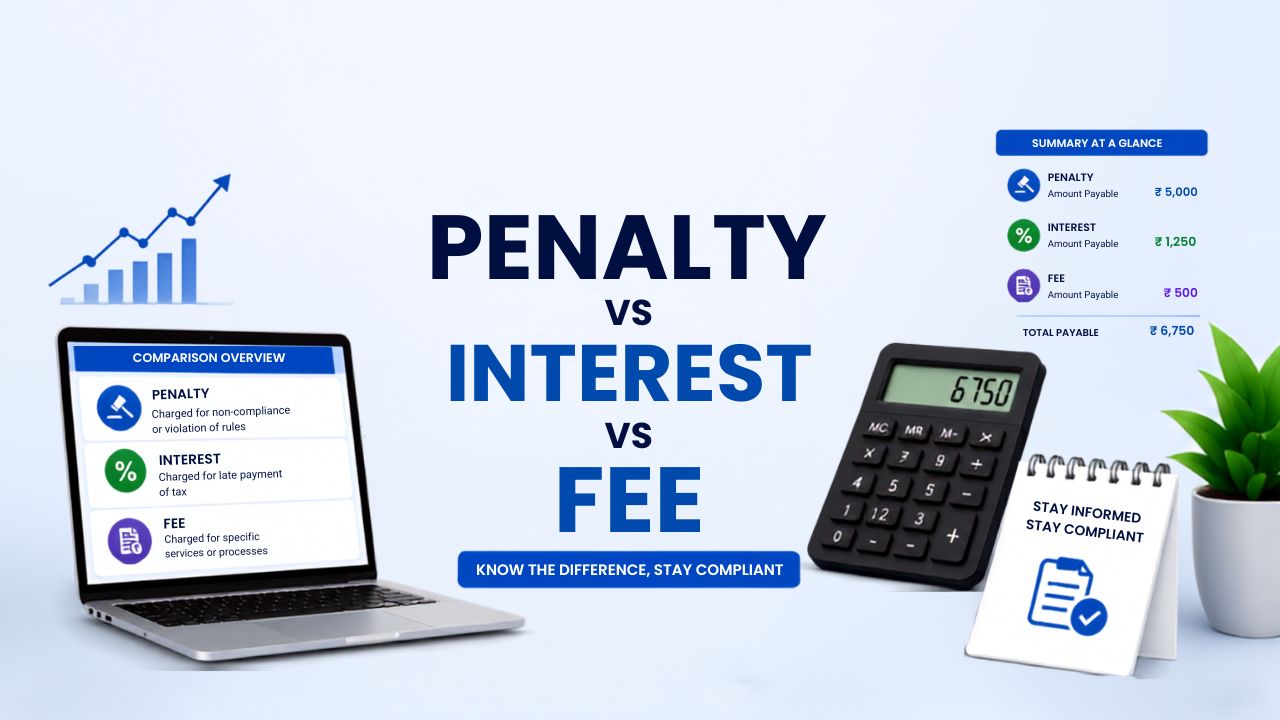
Penalty vs Interest vs Fee: Tax Dues Comparison Under New Income Tax Act
Every intimation or notice that mentions extra tax dues falls into one of three buckets, and mixing them up is one of the most common mistakes I see among salaried professionals and freelancers. Getting your head around penalty vs interest vs fee income tax 2026 rules matters even more this year because the new Income Tax Act has renumbered every section that governs these charges. Interest compensates the government for money it did not receive on time. A fee is a fixed charge for missing a procedural step. A penalty punishes carelessness or deliberate wrongdoing. In my 7 years of working with taxpayers, I have seen people panic over a fee thinking it was a penalty, and others ignore a genuine penalty notice because they assumed it was routine interest. This guide breaks down all three with the exact sections, current rates, and worked examples for FY 2025-26.
Penalty vs Interest vs Fee: What Each Term Actually Means
Penalty: A Consequence for Wrongdoing
A penalty requires a finding of fault, ranging from a careless mistake in reporting income to deliberate concealment. Unlike interest and fee, a penalty is usually a percentage of the tax that was evaded or underpaid, and in the more serious cases it can be followed by prosecution. Penalties involve some level of assessment by a tax officer, since intent and the nature of the default decide how severe the consequence is.
Interest: Compensation for Delay
Interest is charged automatically whenever tax that should have reached the government on a certain date arrives later. It is purely mathematical: a percentage per month on the outstanding amount, with no room for the assessing officer to reduce it based on your explanation. The logic is simple. If you held on to money that belonged to the exchequer, you compensate for the time value of that delay. The reverse also holds true: if the department holds on to a refund that belongs to you, it pays you interest too, though at a lower rate, which I will get to shortly.
Fee: A Fixed Cost for Missing a Deadline
A fee is a flat, one-time amount tied to a specific compliance lapse, most commonly filing your return after the due date. Unlike interest, a fee does not grow every month you delay further. It is set once you cross the deadline, and the only variable that changes the amount is usually your total income, not how late you eventually file. An assessing officer generally has no discretion to waive a fee once the trigger condition is met.
Interest Under Income Tax: Sections 234A, 234B, 234C and 234D
Four separate sections deal with interest, and each addresses a different kind of delay.
Section 234A applies when you file your return after the due date and still have tax outstanding. Interest is charged at 1% per month or part of a month, calculated on the unpaid tax from the day after the due date until the date you actually file.
Take Rohit, a salaried professional in Pune whose ITR-1 due date for FY 2025-26 was 31st July 2026. After adjusting TDS, he still owes Rs. 45,000. He files on 15th October 2026, a delay that counts as three full months (August, September, October), since even a part of a month is treated as a complete month. His interest works out to Rs. 45,000 × 1% × 3 = Rs. 1,350, payable in addition to the outstanding tax.
Section 234B applies when you fail to pay at least 90% of your total tax liability as advance tax during the year. Say Priya, a freelance graphic designer, has a total tax liability of Rs. 1,20,000 for the year but pays only Rs. 70,000 as advance tax by 31st March 2026. Since 90% of her liability is Rs. 1,08,000, she falls short of that threshold, so 234B applies. Once triggered, interest is calculated on the entire shortfall between her total liability and what she actually paid, which is Rs. 50,000, not just the gap from the 90% mark. If she clears the remaining tax only while filing her return in August 2026, interest runs from 1st April 2026 for five months: Rs. 50,000 × 1% × 5 = Rs. 2,500. You can check the full quarterly schedule and thresholds in my advance tax payment guide.
Section 234C penalises shortfalls in the quarterly advance tax installments (15% by 15th June, 45% by 15th September, 75% by 15th December, and 100% by 15th March), even if you eventually pay the full amount by year end. Interest here is charged for three months on the first three installments and one month on the last, again at 1% per month on the shortfall.
Section 234D works in the reverse direction. If the department grants you a refund at the initial processing stage, but a later scrutiny or reassessment finds that refund was excessive, you have to pay back the excess along with interest at 0.5% per month, calculated from the date the refund was granted to the date of the fresh order. It is a smaller, less common provision, but worth knowing if your return gets picked up for detailed assessment after an initial refund. The due dates that decide when 234A starts ticking are covered in detail in my ITR filing deadlines article.
Section 234F: The Late Filing Fee, Not Interest
This is where most taxpayers get confused, so it is worth stating plainly: Section 234F is a fee, not interest, and it applies separately from Section 234A. If your total income exceeds Rs. 5 lakh and you file after the due date, the fee is a flat Rs. 5,000. If your total income is Rs. 5 lakh or below, the fee is capped at Rs. 1,000. If your income is below the basic exemption limit, no fee applies at all, even if you file late.
So a taxpayer with Rs. 8 lakh income who files 45 days late pays both the Rs. 5,000 fee under Section 234F and whatever interest has accrued under Section 234A on the unpaid tax. These are two independent charges stacking on top of each other, not alternatives.
Budget 2026 also extended the revised return deadline for FY 2025-26 from 31st December 2026 to 31st March 2027, but introduced a similar fee for revisions filed after 31st December, matching the same Rs. 5,000 or Rs. 1,000 slab. If you are weighing whether to file a belated return or a revised one, my belated return vs revised return comparison walks through which option costs less in your situation.
Penalty Provisions You Should Know
Section 270A is the one that catches most people off guard. It covers under-reporting and misreporting of income, and the two are treated very differently. Under-reporting, which includes genuine errors or omissions, attracts a penalty of 50% of the tax on the under-reported amount. Misreporting, which involves deliberate falsification such as claiming expenses with no supporting evidence, attracts 200% of the tax.
Consider Sunita, a freelance consultant who fails to disclose Rs. 3,00,000 of consulting income that later shows up in her AIS. If she is in the 30% slab, the tax on this amount, including 4% health and education cess, works out to Rs. 93,600. If the assessing officer treats this as under-reporting, the penalty is 50% of that, or Rs. 46,800. If it is treated as misreporting, because she also claimed fictitious expenses to hide the income, the penalty jumps to Rs. 1,87,200, twice the tax itself.
Two other penalty sections work differently and are worth knowing if you run a freelance practice or small business. Section 271B penalises failure to get your accounts audited when required, at 0.5% of turnover or Rs. 1,50,000, whichever is lower, not a percentage of tax evaded. Section 271C applies if you were required to deduct TDS on a payment, such as rent above the threshold or a contractor payment, and failed to do so; the penalty here equals the tax you should have deducted, again a different formula from 270A. If you employ staff or pay professionals and want to understand your TDS obligations before a penalty notice arrives, my TDS on salary guide covers deductor responsibilities in detail. Freelancers juggling multiple client payments and audit thresholds will also find the practical checklist in my income tax guide for freelancers useful.
When the Government Owes You: Interest on Refunds Under Section 244A
Here is an asymmetry worth knowing. When you owe the department money and delay, you pay interest at 1% per month under Sections 234A, 234B, or 234C. But when the department owes you a refund and delays beyond the permitted period, it pays you interest at only 0.5% per month under Section 244A, half the rate you would pay them.
If you are due a refund of Rs. 25,000 and it takes five months longer than it should, the interest works out to Rs. 25,000 × 0.5% × 5 = Rs. 625. This interest is credited along with your refund, and it is fully taxable as income from other sources in the year you receive it, so remember to report it in your next return. You can track where your refund stands using the process in my ITR refund status guide.
Penalty vs Interest vs Fee at a Glance
| Aspect | Interest | Fee | Penalty |
|---|---|---|---|
| Purpose | Compensates for delay | Fixed charge for a procedural default | Punishes fault or wrongdoing |
| Common sections | 234A, 234B, 234C, 234D | 234F | 270A, 271B, 271C |
| How it is calculated | 1% per month on unpaid tax (0.5% under 234D) | Flat Rs. 1,000 or Rs. 5,000 | 270A: 50% to 200% of tax; 271B and 271C use separate turnover or tax-equivalent formulas |
| Officer discretion | None, automatic | None, automatic | Yes, based on intent and facts |
| Grows with delay | Yes, every month | No, one-time amount | No, fixed once levied |
| Can it be contested | Rarely | Rarely | Yes, appealable before CIT(A) |
New Income Tax Act 2025: How the Section Numbers Change
If you are filing your return for FY 2025-26 by 31st July or 31st August 2026, you are still working under Tab 1 of the income tax e-filing portal, which follows the old Income Tax Act 1961 numbering. The new Act 2025 numbering applies only from Tax Year 2026-27 onward, meaning it will first show up when you file in 2027 under Tab 2. My detailed comparison of the Income Tax Act 2025 versus the 1961 Act explains this transition timeline if you want the full picture.
For reference, here is how the sections discussed above map to the new Act:
| Old Section (Act 1961) | Provision | New Section (Act 2025) |
|---|---|---|
| 234A | Interest for late filing of return | Section 423 |
| 234B | Interest for default in advance tax payment | Section 424 |
| 234C | Interest for deferment of advance tax | Section 425 |
| 234D | Interest on excess refund | Section 426 |
| 234F | Fee for late filing of return | Section 428 |
| 270A | Penalty for under-reporting or misreporting | Section 439 |
Section 244A, the provision under which the department pays you interest on delayed refunds, continues in substance under the new Act, though the exact clause number has not been finalised in publicly available guidance at the time of writing. The other new section numbers in the table above are based on the most detailed legal commentary and government transition FAQs available as of mid-2026; since the new Act is still in its first year of operation, it is worth a quick cross-check against updated CBDT circulars closer to your actual filing date if you are relying on these numbers for a compliance decision rather than general awareness. Form 16 becomes Form 130 under the new framework, which is a related change worth knowing if you handle TDS certificates.
How to Avoid All Three Charges Together
The good news is that all three charges are entirely avoidable with the same set of habits.
File your return before the due date that applies to your category, even if you are still waiting on a document or two. Pay at least 90% of your estimated tax liability as advance tax before 31st March, spread across the quarterly installments rather than as one lump sum at year end. Cross-check every entry in your AIS and Form 26AS against your own records before you file, since a mismatch discovered later by the department is treated far more harshly than one you correct yourself. If you run a freelance practice or small business, track your turnover against the audit threshold well before the financial year closes, and deduct TDS correctly wherever it applies to payments you make.
Getting these basics right removes almost every trigger point discussed in this guide. If you are new to the filing process itself, my complete income tax guide is a good starting point before you dive into the finer points of interest, fee, and penalty.
The distinction between these three terms is not just academic. Knowing which one applies to your situation tells you whether the clock is still running against you, whether the amount is fixed and final, or whether you have grounds to explain your case before it escalates further.
Conclusion
Penalty vs interest vs fee income tax 2026 confusion costs taxpayers real money every filing season, mostly because these three charges get lumped together as “the fine for filing late.” They are not the same thing. Interest under Sections 234A, 234B, and 234C is automatic and compensatory, triggered purely by delay. The Section 234F fee is a fixed, one-time cost for missing the deadline itself, separate from whatever interest has piled up. Penalty under Section 270A and similar provisions is discretionary and tied to fault, ranging from a modest 50% add-on for a genuine oversight to a punishing 200% for deliberate concealment. With the new Income Tax Act 2025 renumbering all three categories starting Tax Year 2026-27, the underlying logic stays the same even as the section numbers change. Knowing which bucket a notice falls into tells you immediately whether you are looking at a fixed bill, a growing one, or one you can actually contest.
Frequently Asked Questions
What is the difference between penalty, interest, and fee under income tax?
Interest compensates the government for tax paid late and is calculated automatically as a percentage per month. A fee is a fixed, one-time charge for a procedural lapse such as filing after the due date. A penalty is a discretionary charge for fault, ranging from careless under-reporting to deliberate concealment, and is usually a percentage of the tax involved rather than a flat amount.
Can I be charged interest under Section 234A and a fee under Section 234F for the same delay?
Yes. These are independent charges that apply together, not as alternatives. If you file after the due date with tax still outstanding, you pay both the monthly interest under Section 234A and the flat fee under Section 234F.
Is Section 234F a penalty or a fee?
It is legally a fee, not a penalty, even though it is commonly called a “late filing penalty” in everyday conversation. It is fixed, automatic, and does not involve any assessment of intent by the officer, unlike a genuine penalty provision such as Section 270A.
Do I have to pay the Section 234F fee even if my tax payable is zero after the Section 87A rebate?
Yes. The fee is based on whether your total income before rebate exceeds the basic exemption limit, not on your final tax payable. So if the Section 87A rebate has brought your actual tax to nil but your total income is above the exemption limit, filing after the due date can still attract the Rs. 1,000 fee.
Will interest and penalty rates change under the new Income Tax Act 2025?
No new rates have been introduced. The 1% per month interest under the sections that replace 234A, 234B, and 234C, the 0.5% per month rate for refund-related interest, and the existing penalty percentages under provisions like Section 270A carry forward unchanged. Only the section numbers are different from Tax Year 2026-27 onward.
Can penalty under Section 270A be avoided or reduced?
In some cases, yes. If the discrepancy reflects a genuine difference of opinion on a debatable tax position rather than concealment, or if you voluntarily correct the income and pay the tax with interest before detection, the case is generally treated as under-reporting rather than misreporting, which keeps the penalty at 50% instead of 200%. Deliberate concealment with fabricated evidence rarely gets this relief.
Does a delay of just a few days into a new month get charged as a full month of interest?
Yes. Under Rule 119A, which governs interest computation across Sections 234A, 234B, 234C, and 234D, any part of a month, even a single day, is treated as a complete month. There is no proportional or daily calculation.