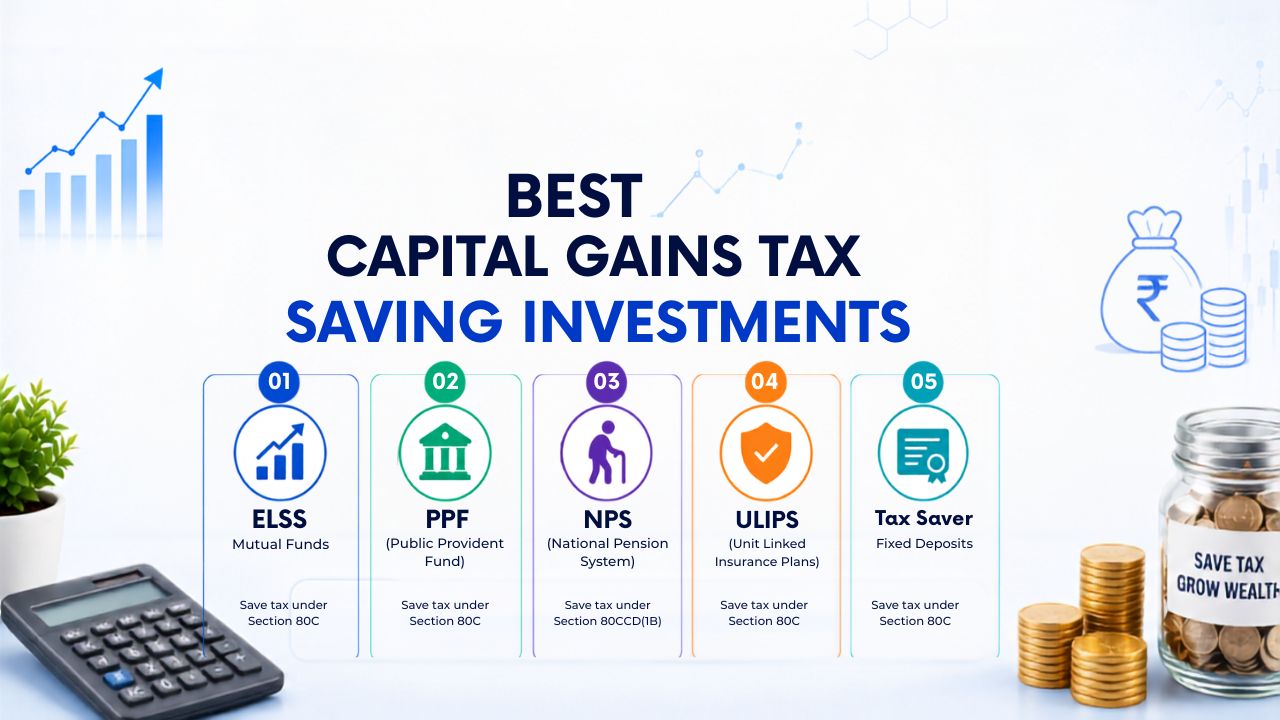
Best Capital Gains Tax Saving Investments FY 2026-27
The best capital gains tax saving investments 2026 has to offer go beyond just picking the right stocks. The tax rates on capital gains have changed significantly after Finance Act 2024, and without the right planning, you could end up paying far more than necessary.
In my working experience, I have seen two types of people: those who plan their capital gains exit strategy in advance and those who discover their tax liability only when filing their ITR. This guide is for helping you stay in the first category.
Before diving into the investments, here is a quick recap of what you are working with for FY 2025-26.
Capital Gains Tax Rates FY 2025-26 at a Glance
Understanding your tax rate is the starting point for any saving strategy.
Equity and equity mutual funds:
Short-term capital gains (held 12 months or less) under Section 111A are taxed at 20%. Long-term capital gains (held more than 12 months) under Section 112A are taxed at 12.5% on gains above Rs. 1,25,000 per year.
Property (land and building):
Short-term gains (held 24 months or less) are taxed at your slab rate. Long-term gains (held more than 24 months) are taxed at 12.5% without indexation. If you bought the property before July 23, 2024, you have the option to choose between 12.5% without indexation or 20% with indexation, whichever works out lower for you.
Debt mutual funds:
Both short-term and long-term gains are taxed at your slab rate. The LTCG benefit on debt funds was removed from April 1, 2023.
You can check how these rates interact with your overall income in our income tax slabs guide for FY 2026-27.
Now, let us look at the best ways to reduce this tax liability legally.
1. Use the Rs. 1,25,000 LTCG Exemption on Equity Every Year
This is the simplest and most underused capital gains tax saving strategy available to equity investors.
Under Section 112A, the first Rs. 1,25,000 of long-term capital gains from equity shares and equity mutual funds is completely exempt from tax every financial year. This exemption resets on April 1 each year.
If you are a long-term equity investor and your unrealised gains are building up, you can book up to Rs. 1,25,000 of gains every March, pay zero tax on them, and reinvest immediately in the same stocks or funds. Over several years, this brings down your average cost and reduces the taxable gains that accumulate in your portfolio.
Example: You have Rs. 3,00,000 in unrealised LTCG in your equity portfolio in March 2026.
You sell enough units to book Rs. 1,25,000 in gains. Tax on this: zero. You reinvest the same amount immediately. Your cost basis resets higher, so the remaining Rs. 1,75,000 in gains now starts accumulating from a fresh price point.
Do this every year before March 31 and you systematically reduce your future LTCG tax burden.
2. Tax Loss Harvesting to Offset Capital Gains
If you have investments sitting at a loss, they are not just dead weight. They are a tax saving tool.
Tax loss harvesting means selling your loss-making investments to generate a capital loss, which can then be set off against your capital gains. The rules are:
Short-term capital losses can be set off against both short-term and long-term capital gains. Long-term capital losses can only be set off against long-term capital gains.
Any losses that cannot be set off in the current year can be carried forward for up to 8 years, as long as you file your ITR on time before the ITR filing last date.
Example: You have Rs. 80,000 in LTCG from equity mutual funds. You also have a stock sitting at Rs. 60,000 in unrealised loss. You sell the loss-making stock to book Rs. 60,000 in LTCG loss. Your net taxable LTCG drops to Rs. 20,000, which is well within the Rs. 1,25,000 exemption. Tax: zero.
One important point: You can repurchase the same stock immediately – India has no wash sale rule. However, if the loss booking appears artificial to the tax officer, it may be scrutinised.
3. Section 54 Exemption: Reinvest Property Sale Gains in a New House
If you have sold a residential property and made a long-term capital gain, Section 54 of the Income Tax Act allows you to claim a full exemption by reinvesting the gains in another residential property in India.
Key conditions:
You must purchase the new property either 1 year before the sale or within 2 years after the sale. If you are constructing a house, you have 3 years from the date of sale to complete the construction. The exemption is capped at Rs. 10 crore. Only one house can be purchased, unless your capital gains are below Rs. 2 crore, in which case you can invest in two houses. This two-house option is available only once in your lifetime.
What if you cannot complete the reinvestment before the ITR deadline?
If the new property purchase or construction is not complete before July 31, 2026, you can deposit the capital gains amount in a Capital Gains Account Scheme (CGAS) account at any nationalised bank before filing your ITR. You can access the relevant forms on the Income Tax portal. You can then use those funds for the property purchase within the allowed time limit and still claim the exemption.
4. Section 54EC Bonds: Lock In Rs. 50 Lakh to Save Property LTCG
If you have sold land or a building and do not want to buy another property, Section 54EC bonds are your alternative.
By investing the long-term capital gains in specified bonds issued by NHAI (National Highways Authority of India) or REC (Rural Electrification Corporation), you can claim an exemption on the entire invested amount.
Key conditions:
You must invest within 6 months of the date of sale. The maximum investment allowed is Rs. 50 lakh per financial year. The bonds have a lock-in of 5 years. You cannot sell or pledge them before maturity. The interest earned on these bonds is fully taxable at your slab rate, but the capital gains exemption itself is tax-free.
Example: You sell a plot in FY 2025-26 and make an LTCG of Rs. 40 lakh. You invest Rs. 40 lakh in REC 54EC bonds within 6 months. Your capital gains tax on Rs. 40 lakh: zero.
5. Sovereign Gold Bonds: Zero Capital Gains Tax at Maturity
If you invest in gold, Sovereign Gold Bonds (SGBs) are the most tax-efficient option available. When you hold an SGB to its full maturity of 8 years, the capital gains on redemption are completely exempt from tax. You pay zero capital gains tax regardless of how much the gold price has appreciated.
Compare this to physical gold or gold ETFs, where LTCG at 12.5% applies after 24 months. On a significant gold holding, the SGB exemption can save a meaningful amount.
Additionally, SGBs pay 2.5% annual interest, which is taxable at your slab rate but is still an income physical gold cannot generate.
The only caveat: if you sell the SGB on the stock exchange before maturity, the capital gains exemption does not apply. LTCG at 12.5% applies after 12 months of holding.
Note that the government has not issued new SGB tranches since early 2024. You can still buy existing SGBs on the stock exchange through your demat account, where the same maturity exemption appli
6. ELSS Funds: Section 80C Deduction Plus Long-Term Equity Growth
ELSS is a tax-saving investment that also benefits from the LTCG rate on its returns. Under the old tax regime, investments up to Rs. 1,50,000 in ELSS qualify for deduction under Section 80C (Section 123 under the new Income Tax Act 2025). At the same time, the returns from ELSS are subject to the favourable LTCG rate of 12.5% above Rs. 1,25,000 after the 3-year lock-in.
This makes ELSS one of the few instruments where you get a deduction on the way in and preferential tax treatment on the way out.
Important: The Section 80C deduction for ELSS is only available under the old tax regime. If you are on the new regime, you do not get the deduction, but the LTCG treatment on returns still applies. You can compare both regimes in our old vs new tax regime guide to decide which works better for your situation.
7. Section 54F: Save LTCG from Any Asset by Buying a House
Section 54F is a broader version of Section 54. While Section 54 applies only when you sell a residential property, Section 54F applies when you sell any long-term capital asset other than a residential house, including equity shares, gold, commercial property, or land, and reinvest the net sale proceeds into a new residential house.
Key conditions:
The exemption is proportional. If you invest only a part of the sale proceeds in the new house, only that proportional gain is exempt. You must not own more than one residential house at the time of sale (other than the one being purchased). The time limits for purchase and construction are the same as Section 54. If the full proceeds cannot be reinvested before the ITR filing deadline, use the Capital Gains Account Scheme as a bridge.
This is particularly useful for investors who have made significant gains from equity portfolios and want to use those gains to fund a home purchase.
Which Strategy Works Best for You?
| Situation | Best Strategy |
|---|---|
| Equity investor with LTCG | Rs. 1,25,000 annual exemption + tax harvesting |
| Sold residential property | Section 54 reinvestment in new house |
| Sold land/commercial property, don’t want to buy house | Section 54EC bonds (up to Rs. 50 lakh) |
| Sold any asset, want to buy a house | Section 54F |
| Gold investor | Sovereign Gold Bonds held to maturity |
| Old regime taxpayer investing for growth | ELSS under Section 80C |
| Mixed portfolio with gains and losses | Tax loss harvesting |
Conclusion
Capital gains tax saving is not about finding loopholes. It is about using the exemptions and reinvestment options that the Income Tax Act itself provides. The strategies above are all legal, well-established, and available to any individual taxpayer.
The key is to plan before you sell, not after. Once you have booked a capital gain, your options narrow considerably. But if you structure your exits and reinvestments thoughtfully, you can bring your capital gains tax liability down significantly while building long-term wealth.
Start by reviewing your portfolio before March 31, 2026 to use the annual LTCG exemption. Then assess whether any of the exemption sections apply to your situation before the ITR filing deadline. If you need guidance on how to report capital gains correctly in your ITR, our ITR filing guide covers the process step by step.
Frequently Asked Questions
Is the Rs. 1,25,000 LTCG exemption on equity available under both old and new tax regimes?
Yes. The Rs. 1,25,000 exemption under Section 112A applies regardless of which tax regime you choose. It is a specific exemption on equity LTCG, not a deduction under Chapter VI-A.
Can I claim Section 54 exemption if I buy a house outside India?
No. Section 54 exemption is available only if the new residential property is purchased or constructed in India.
What happens if I withdraw my Section 54EC bonds before 5 years?
The capital gains exemption claimed at the time of investment will be reversed and added back to your income in the year of premature withdrawal. You cannot withdraw 54EC bonds before maturity under any circumstances.
Does tax loss harvesting work for debt mutual fund losses?
Yes. Losses from debt mutual funds can be set off against gains from any capital asset, subject to the short-term and long-term classification rules.
If I deposit in the Capital Gains Account Scheme but do not use the money in time, what happens?
The unutilised amount in CGAS at the end of the reinvestment period (2 or 3 years) is treated as capital gains in that year and taxed accordingly.