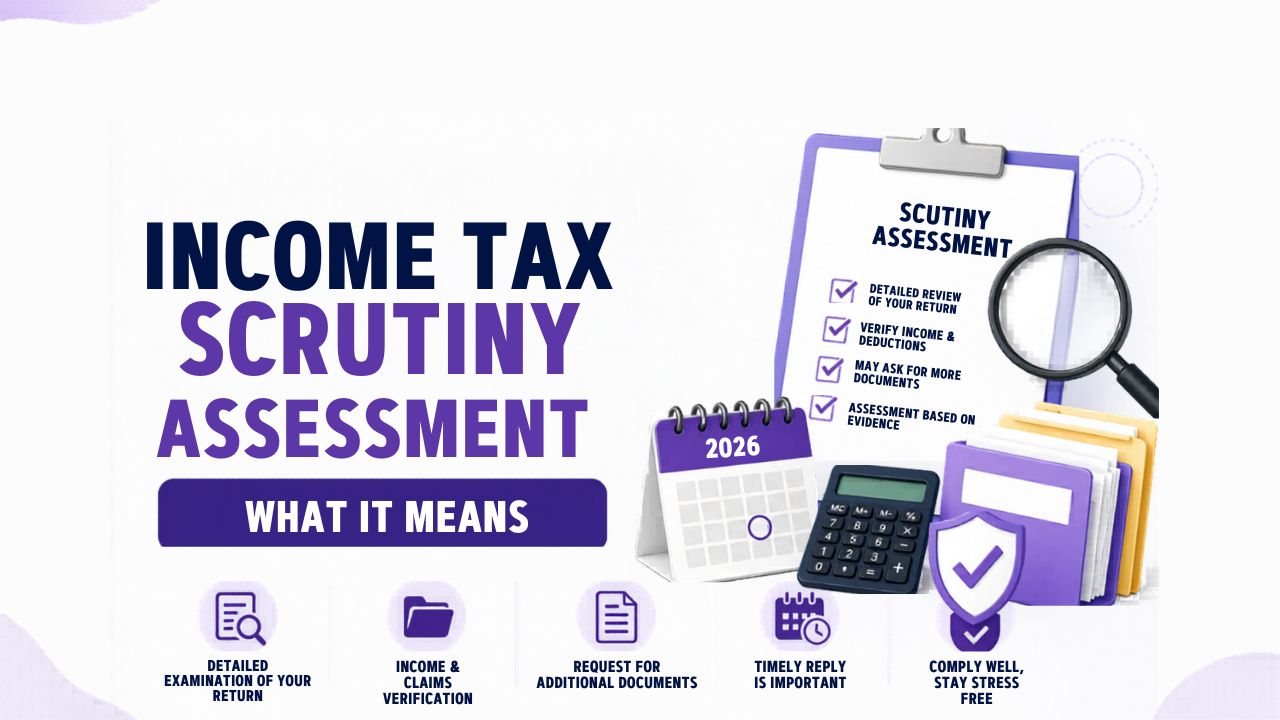
Income Tax Scrutiny Assessment: What It Actually Means for You
Of all the income tax situations I get asked about, scrutiny assessment creates the most anxiety. And I understand why – the word “scrutiny” sounds serious. But in my experience, most people who receive a scrutiny notice have done nothing wrong. They have simply been selected by the department’s system for a closer look at their return, and with the right preparation, the process is manageable.
What makes scrutiny different from a routine intimation is that the department is not just pointing out an error. It is asking you to prove that what you declared in your ITR is accurate. That distinction matters, and it changes how you need to respond.
This guide explains exactly what income tax scrutiny assessment is, why you may have been selected, the difference between limited and complete scrutiny, how the faceless process works in 2026, and the step-by-step approach to responding correctly.
Note for AY 2026-27: All scrutiny proceedings related to AY 2026-27 and earlier years will continue under the Income Tax Act, 1961, even though the new Income Tax Act, 2025 came into force from April 1, 2026. Section 536(2)(c) of the new Act specifically preserves this. So if you receive a scrutiny notice in 2026 for your AY 2025-26 or AY 2026-27 return, the old Act governs the entire process.
What Is Income Tax Scrutiny Assessment Under Section 143(2)?
A scrutiny assessment is a detailed examination of your income tax return by the Income Tax Department. For the complete overview of how income tax works in India, see our income tax guide India. It goes beyond the automated processing done at the Central Processing Centre (CPC). While the CPC checks for arithmetic errors and TDS mismatches, scrutiny assessment is conducted by an Assessing Officer or in most cases today, the National Faceless Assessment Centre (NaFAC) who examines whether you have correctly declared your income, claimed deductions you are entitled to, and paid the right amount of tax.
For AY 2026, the Income Tax Department flagged approximately 1.65 lakh cases for scrutiny – nearly three to four times the usual volume. This is not because there was a sudden surge in tax evasion. It reflects the department’s upgraded data analytics capability through Project Insight and the Annual Information Statement framework, which now gives the department visibility into most financial transactions linked to your PAN before you even file your return.
Receiving a Section 143(2) notice does not mean you have done something wrong. It means the department wants you to substantiate what you declared.
How Scrutiny Assessment Differs from Other Tax Processes
| Process | Section | What Happens | Your Involvement |
|---|---|---|---|
| Automated Processing | 143(1) | CPC checks ITR for arithmetic errors and TDS matching. Result is an intimation – demand, refund, or no action. | Minimal – respond only if there is a demand |
| Scrutiny Assessment | 143(2) + 143(3) | Detailed examination of income, deductions, and claims by Assessing Officer or NaFAC. You must submit supporting documents. | Active – submit documents and explanations within given deadline |
| Best Judgment Assessment | 144 | Initiated when you fail to respond to scrutiny notice. Officer decides based on available information almost always unfavourable. | None – but consequences are serious |
| Reassessment | 148 | Department reopens a past year’s assessment because it believes income was not assessed or was under-assessed. | Active – file fresh return within 3 months of notice |
Types of Scrutiny: Limited vs Complete
Not all scrutiny notices are the same. The scope of examination depends on why your return was selected.
Limited Scrutiny
In limited scrutiny, the department examines only a specific issue mentioned in the notice. The notice will clearly state the area being examined – for example, a property sale, foreign tax credit, or a large deduction under Section 80G. You are only required to submit documents related to that specific issue. You cannot be asked about unrelated parts of your return during limited scrutiny.
Complete Scrutiny
In complete scrutiny, the department examines your entire ITR – all income sources, all deductions claimed, all exemptions, and all transactions. This applies when you fall into one of the compulsory scrutiny categories defined by the CBDT, or when CASS has flagged your return as high-risk based on multiple data points.
How Your Return Gets Selected for Scrutiny
The selection happens through two distinct mechanisms, and understanding which one applies to you tells you a lot about what to expect.
Computer Assisted Scrutiny Selection (CASS)
CASS is the department’s AI-powered risk-profiling system. It compares data in your ITR with information from multiple sources – Form 26AS, AIS, Statement of Financial Transactions (SFT) data submitted by banks and registrars, GST returns, and data from previous years. Returns that cross a risk threshold get flagged.
Common triggers for CASS selection include high-value cash deposits not matching declared income, significant mismatches between your ITR figures and what AIS shows, unusually large deduction claims relative to income, capital gains from share sales not declared, and substantial changes in income compared to previous years.
Compulsory Scrutiny
Compulsory scrutiny is separate from CASS. It follows a rules-based selection for specific categories defined by the CBDT each year. For FY 2025-26, the CBDT has specified six categories where scrutiny is mandatory regardless of the risk profile:
- Survey cases: If a survey was conducted on you or your business under Section 133A on or after April 1, 2023, your return for the corresponding financial year will be compulsorily scrutinised.
- Search and seizure cases: If a search operation under Section 132 was conducted on or after September 1, 2024, the ITR for the relevant year will be scrutinised. These cases generally remain with the jurisdictional officer rather than going to NaFAC.
- Charitable trusts and institutions: Entities claiming exemption under Sections 12A, 12AB, or 10(23C) whose registration was cancelled or not granted on or before March 31, 2024 and who still claimed the exemption in their return will be compulsorily scrutinised, unless there is a favourable appellate order.
- Recurring additions: If the department has added back income or disallowed expenses in past assessments on the same issue, and the amount is Rs. 50 lakh or more in metro cities or Rs. 20 lakh elsewhere, and the same issue appears in the current return, scrutiny is mandatory.
- Credible information of tax evasion: Returns flagged based on specific intelligence from investigative agencies, tip-offs about undisclosed foreign income, benami transactions, or GST mismatches will be compulsorily selected regardless of CASS risk scores.
- Other specific categories: Cases that remain with the jurisdictional officer (rather than going to NaFAC) and meet criteria specified by the CBDT in the annual guidelines.
One important clarification from the CBDT: if you filed your return in response to a notice under Section 142(1) because of an AIS mismatch, TDS discrepancy, or non-filer alert, your case will not go into compulsory scrutiny. It will be handled through CASS instead.
Time Limit: When Can a Scrutiny Notice Be Issued?
This is one of the most important things to know, because a notice issued after the time limit is legally invalid and can be challenged.
A Section 143(2) notice must be issued within 3 months from the end of the financial year in which you filed your return.
How this works in practice:
- If you filed your ITR for AY 2025-26 on July 31, 2024, the financial year in which you filed is FY 2024-25, which ends on March 31, 2025. The scrutiny notice must be issued on or before June 30, 2025.
- If you filed your ITR for AY 2026-27 on July 31, 2025, the notice must be issued on or before June 30, 2026.
If you receive a Section 143(2) notice after this deadline, it is time-barred. Do not respond without first raising this objection with a CA. A time-barred notice can be challenged and the assessment can be set aside on this ground alone.
The time limit for completing a scrutiny assessment (passing the final order) under Section 143(3) is generally 12 months from the end of the assessment year. NaFAC has been directed to complete pending scrutiny cases for AY 2025-26 by March 31, 2026.
How Faceless Scrutiny Assessment Works in 2026
Since 2020, almost all scrutiny assessments are conducted under the Faceless Assessment Scheme under Section 144B. This means there are no physical meetings with a tax officer. Everything happens electronically through the income tax portal.
The process follows this sequence:
- Section 143(2) notice: You receive a notice on the portal, by email, and by SMS to your registered contact details. The notice confirms your return has been selected for scrutiny and specifies the assessment year.
- Section 142(1) questionnaire: This typically follows the 143(2) notice. It lists specific questions and asks for documents – bank statements, investment proofs, sale agreements, ledgers, and whatever else is relevant to the scope of scrutiny. Each item has a deadline.
- Online submission through e-Proceedings: Log in to incometax.gov.in, go to the e-Proceedings section, find your case, and upload responses and documents before the deadline. All submissions must be made through this portal. Physical submissions are not accepted under faceless assessment.
- Draft assessment order: If the department proposes any additions or disallowances, it will issue a draft assessment order giving you an opportunity to respond before the final order is passed.
- Final assessment order: Based on your submissions, the final order is passed. If additional tax is demanded, a Section 156 demand notice will accompany the order.
The toll-free helpline for income tax queries is 1800 103 4215, available on all working days from 9:30 AM to 6:00 PM. For portal access issues during the assessment process, this is the first contact point.
Common Reasons for Scrutiny and What the Department Is Looking For
1. Mismatch Between ITR and AIS or Form 26AS
This is the most common trigger. The department’s system sees FD interest reported by your bank in AIS but not declared in your ITR. Or capital gains from a mutual fund redemption visible in AIS but missing from your return. Or TDS claimed in your ITR that does not match what Form 26AS shows was deposited. Any significant gap between what you declared and what the department’s data shows triggers a flag. The solution, before filing, is to always check your Form 26AS and AIS and reconcile every figure.
2. Large Deduction Claims Relative to Income
Claiming Rs. 1.5 lakh under Section 80C on an income of Rs. 4 lakh is perfectly normal. But claiming Rs. 10 lakh in deductions across multiple sections on a declared income of Rs. 8 lakh raises a flag because the math implies a very high effective deduction rate. High-value donations under 80G, large HRA claims, and multiple deduction sections combined in unusual proportions attract scrutiny.
3. Unexplained High-Value Transactions
Banks, registrars, stock exchanges, and mutual funds report transactions above specified thresholds to the department through the Statement of Financial Transactions. If your ITR declares Rs. 6 lakh in income but AIS shows a property purchase of Rs. 85 lakh, the department will want to know the source of funds. This is handled under Section 133(6) initially, but if unsatisfactory, it escalates to scrutiny.
4. Losses Claimed and Carry Forward
Claiming business losses, capital losses, or speculative losses – especially in large amounts or over multiple years – is a known scrutiny trigger. The department wants to verify that these are genuine losses supported by proper books of accounts, not manufactured to reduce tax liability.
5. Significant Drop in Income from Previous Years
If your income has consistently been Rs. 15 to 18 lakh per year for the past three years, and your current year return shows Rs. 4 lakh, the system will flag it. Either income has genuinely fallen (and you may need to explain why) or income is being suppressed.
What to Do When You Receive a Section 143(2) Notice
Step 1: Verify the Notice Is Genuine
Log in to incometax.gov.in and check the e-Proceedings section. A genuine notice will appear in your portal account. Check the Document Identification Number (DIN) on the notice – every authentic notice from the department carries a DIN. If no DIN is present or if the notice does not appear in your portal, it may be fraudulent. Do not share financial details or make payments to anyone based on a notice you cannot verify on the portal.
Step 2: Note the Assessment Year, Scope, and Deadline
Read the notice carefully. It will specify the assessment year, whether the scrutiny is limited or complete, and the deadline for your initial response. Do not miss this deadline. Missing a response deadline in scrutiny proceedings results in an ex-parte assessment, the officer decides without your input, and the result is almost invariably a large addition to your income and a demand for tax plus interest plus penalty.
Step 3: Pull Together Your Documents
Gather the following based on what the scope of scrutiny covers:
- Your filed ITR and acknowledgment (ITR-V)
- Form 16 from all employers
- Form 26AS and AIS for the relevant year
- Bank statements for all accounts for the full financial year
- Investment proofs for all deductions claimed (PPF passbook, ELSS statements, LIC receipts, tuition fee receipts, home loan certificate)
- Capital gains statements from your broker or CAMS/KFintech
- Sale or purchase agreement if a property transaction is involved
- Proof of source for any large cash deposit or high-value transaction
- Books of accounts if business or professional income is involved
Step 4: Respond Point by Point Through e-Proceedings
Log in to the portal, go to e-Proceedings, open your scrutiny case, and respond to each query raised in the Section 142(1) questionnaire with a written explanation and supporting documents. Responses must be specific and evidence-based. A vague response like “income was correctly declared” without supporting documents will not satisfy the officer. Upload the relevant documents directly against each query. Keep acknowledgment numbers for all submissions.
Step 5: Engage a CA for Complex Cases
For limited scrutiny on a straightforward issue – say, a single capital gains transaction you may be able to handle the response yourself if you have the documents. But for complete scrutiny, search-linked scrutiny, or scrutiny involving business income, professional help is essential. An Assessing Officer’s observations can escalate quickly if responses are poorly structured. A qualified CA not only handles the drafting but also knows what the department typically accepts as sufficient evidence for different categories of claims.
What Happens After You Submit Your Response
After you upload your documents and explanations, the case goes to the Faceless Assessment Unit under NaFAC. The unit reviews your submissions and may ask follow-up questions through additional 142(1) notices. Once satisfied, the assessment is completed. There are three possible outcomes:
- No addition: The department accepts your return as filed. No change in tax liability. This is the most common outcome when all documents are in order.
- Addition with demand: The department adds back some income or disallows some deduction, resulting in a higher tax liability. A draft assessment order is issued first giving you a chance to respond before the final order.
- Penalty proceedings: If the department determines that income was deliberately concealed or inaccurate particulars were furnished, penalty proceedings under Section 270A may be initiated separately. Penalty can range from 50% to 200% of the tax on under-reported income.
How to Appeal Against a Scrutiny Assessment Order
If you disagree with the final assessment order, you have the right to appeal. The first appeal goes to the Commissioner of Income Tax (Appeals), or CIT(A), within 30 days of receiving the assessment order. Filing an appeal does not automatically stay the demand – you need to separately apply for a stay of demand, requesting the department not to enforce payment while the appeal is pending.
If the CIT(A) decides against you, the next appeal goes to the Income Tax Appellate Tribunal (ITAT). Beyond ITAT, appeals lie to the High Court on questions of law. This process can take years, which is why it is far better to resolve the matter at the assessment stage itself with proper documentation.
For appeals related to FY 2025-26 returns filed under the July 31, 2026 deadline, the old Act governs the entire appeal procedure.
How to Reduce the Chances of Being Selected for Scrutiny
You cannot eliminate the possibility of scrutiny – CASS can select any return. But you can significantly reduce the risk by following consistent, clean filing practices:
- Reconcile your ITR figures with Form 26AS and AIS every year before filing. Every income source the department can see in AIS must appear in your return.
- Declare all income – FD interest, savings account interest, dividends, capital gains even when no TDS was deducted. Small undisclosed amounts create larger problems than the tax they save.
- Claim only deductions you can prove. Every Section 80C claim, every 80G donation, every HRA claim must have a supporting document you can produce on demand.
- File the correct ITR form. Using ITR-1 when you have capital gains, or ITR-4 when your turnover exceeds the presumptive limit, creates a defective return that draws additional attention.
- E-verify your ITR within 30 days. An unverified return is treated as not filed, and that triggers its own set of problems.
- Maintain a consistent income declaration across years. Sudden large drops or unexplained jumps in declared income are a known scrutiny trigger.
Frequently Asked Questions
Can I receive a scrutiny notice even if my return was processed and refund was issued?
Yes. Processing under Section 143(1) and a refund being issued does not protect you from a scrutiny notice under Section 143(2). The two are independent processes. A refund means the automated check passed it does not mean your return has been examined in detail.
Do I have to appear physically before an Assessing Officer for scrutiny?
No. Under the Faceless Assessment Scheme, which covers almost all scrutiny cases, there is no physical appearance. Everything is submitted electronically through the e-Proceedings section of the income tax portal. You will never be asked to visit a tax office unless the case specifically falls outside the faceless scheme, which is rare.
What if I cannot gather all documents within the deadline?
Do not stay silent. Log in to the portal and submit a request for a time extension through the e-Proceedings section before the deadline passes. Officers can grant reasonable extensions. An extension request is far better than a missed deadline, which results in an ex-parte assessment.
Can scrutiny result in prosecution?
Scrutiny assessment itself does not lead to prosecution. Prosecution is a separate proceeding initiated under Sections 276B, 276C, or 277 for deliberate tax evasion, failure to deposit TDS, or making false statements. A routine scrutiny that results in an addition to income typically ends with a demand and possibly a penalty – not prosecution.
Is it possible for scrutiny to result in a refund?
Yes. If the scrutiny reveals that you actually paid more tax than was due – for example, because a TDS credit that was not reflected in your original return is now confirmed – the final assessment order can result in an enhanced refund rather than a demand.
My return was selected for scrutiny last year too. Does this mean I will always be selected?
Not necessarily. CASS selection can happen to anyone in any year based on the risk parameters. However, if scrutiny in a previous year resulted in an addition being upheld, and the same issue is present in your current return, you will be selected for compulsory scrutiny under the recurring additions category as long as the amount involved crosses the Rs. 50 lakh or Rs. 20 lakh threshold depending on your city.
If you have received a scrutiny notice and are unsure where to start, the first step is always the same: read it carefully, note the deadline, and check your portal. From there, every problem has a solution, it is just a matter of having the right documents and responding on time. For related guidance, see the complete guide on income tax notice types and how to respond and the belated return vs revised return guide if you need to correct your return before or after receiving a notice.