TDS on Dividend vs Tax on Dividend: How They Work Together 2026
Every year I get the same question from readers holding shares or mutual funds: “My dividend already had TDS deducted, so why does my ITR show additional tax due?” The tds on dividend vs tax on dividend 2026 confusion comes from treating these as the same thing. They aren’t. TDS on dividend is a fixed, upfront withholding. Tax on dividend is your actual liability, computed at your own slab rate. One rarely equals the other exactly, and understanding the gap between them is the whole point of this comparison. For the basics of how Indian income tax works before this, see my complete income tax guide.
What is TDS on Dividend
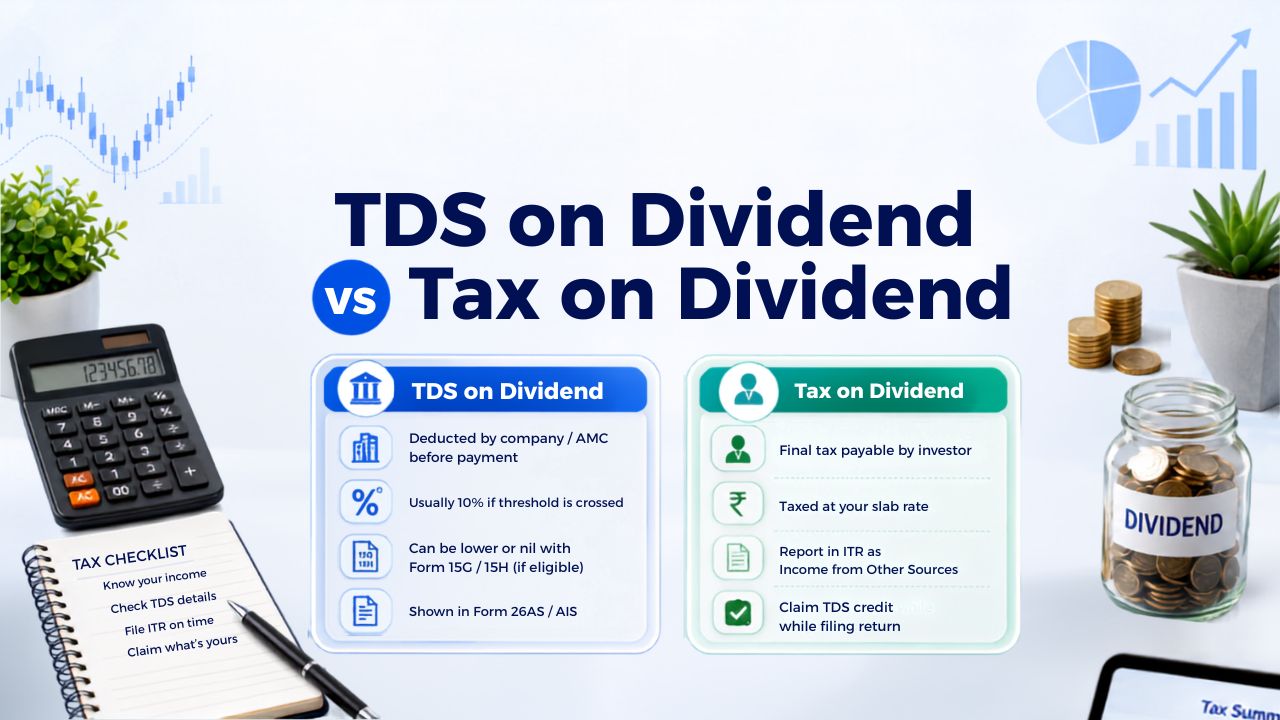
When a company or mutual fund pays you a dividend, it’s required to withhold tax upfront before crediting the amount to your account. For dividends from a domestic company, this falls under Section 194. For dividends or IDCW income from mutual funds, it falls under Section 194K. Both currently deduct a flat 10%, and both apply only once your dividend from that specific company or fund house crosses Rs. 10,000 in a financial year, a threshold that was doubled from Rs. 5,000 effective FY 2025-26. This is a fundamentally different mechanism from TDS on salary under Section 192, which recalculates an average rate through the year based on your estimated total income. Dividend TDS doesn’t care what your income looks like at all, it’s the same flat 10% whether you’re in the 5% bracket or the 30% bracket. My guide to TDS on salary explains that contrasting mechanism in detail.
If you’re filing your ITR for FY 2025-26 this July, your TDS certificate and Form 26AS will reference these old section numbers. But any dividend you receive from now onward falls under the new Income Tax Act, 2025, where both provisions have been consolidated: Section 194 maps to Section 393(1), Table Serial 7, and Section 194K maps to Section 393(1), Table Serial 4(i), both effective from April 1, 2026. The rate and threshold haven’t changed, only the section reference has. My guide to the new Income Tax Act 2025 versus the old Act covers this transition in full.
What is Tax on Dividend
Since the Dividend Distribution Tax was abolished in 2020, dividend income is taxed entirely in your hands, not the company’s. It’s classified as “Income from Other Sources” and added to your total income, then taxed at your own applicable slab rate, whatever that happens to be. There’s no flat rate here, unlike capital gains under Sections 111A or 112A. If you’re in the 30% bracket, your dividend is taxed at 30% plus cess. If you’re in the 5% bracket, it’s taxed at 5% plus cess. The TDS rate of 10% has no relationship to your actual slab rate, which is exactly why the tds dividend vs tax dividend 2026 numbers so rarely match. Dividend income is reported under Schedule OS in ITR-1 or ITR-2, depending on your other income sources; my guide to choosing the right ITR form walks through which one applies to you.
TDS on Dividend vs Tax on Dividend 2026: How the Two Reconcile
| Factor | TDS on Dividend | Tax on Dividend |
|---|---|---|
| Nature | Upfront withholding | Final liability |
| Rate | Flat 10% | Your income slab rate |
| Governing provision | Section 194 / 194K (Section 393(1) from FY 2026-27) | Section 56, taxed as Income from Other Sources |
| When it applies | Only above Rs. 10,000 per payer per year | On every rupee of dividend income, no threshold |
| Who computes it | The company or fund house | You, when filing your ITR |
| Final settlement | Adjusted against your actual liability | Determines refund or additional payment |
The 10% TDS is never the end of the story. It’s simply a credit against whatever your actual tax liability turns out to be once your full income, including this dividend, is assessed at your slab rate.
Real Example: Same Dividend, Three Different Tax Outcomes
Consider three investors, each receiving the same Rs. 50,000 dividend from the same company, each with 10% TDS deducted, leaving Rs. 45,000 credited to their account.
- Investor A, 5% slab: Actual tax liability comes to Rs. 2,600 including cess. Since Rs. 5,000 was already deducted as TDS, she’s owed a refund of Rs. 2,400 when she files her return.
- Investor B, 10% slab: Actual tax liability comes to Rs. 5,200 including cess. TDS covered Rs. 5,000 of it, leaving a small Rs. 200 balance payable, purely because TDS doesn’t include cess while the final computation does.
- Investor C, 30% slab: Actual tax liability comes to Rs. 15,600 including cess. TDS covered only Rs. 5,000, leaving Rs. 10,600 additional tax payable, ideally through advance tax rather than waiting until the return is filed.
Same dividend, same TDS, three completely different outcomes, purely based on each investor’s own slab rate.
Advance Tax and the Section 234C Relaxation for Dividend Income
If your total tax liability for the year is Rs. 10,000 or more, advance tax rules apply, and that includes tax on dividend income. This creates a genuine problem: dividends are declared and paid at unpredictable times through the year, so estimating them in advance for the June or September installment is often impossible. The law recognises this. If a shortfall in an advance tax installment happens solely because of dividend income you couldn’t have anticipated, no interest is charged under Section 234C, provided you pay the balance in a subsequent installment within the same year. Under the new Income Tax Act, this relaxation now sits under Section 448(4). The one exception is deemed dividends under Section 2(22)(e), which don’t get this benefit, and attract interest on any shortfall regardless of predictability.
The One Deduction You Can Claim Against Dividend Income
Dividend income doesn’t offer much room for deductions, but there is exactly one: interest expense incurred to earn the dividend, such as interest on a loan taken to buy shares, is deductible under Section 57, capped at 20% of the dividend income for that year. No other expense, brokerage, demat charges, advisory fees, or subscription costs, is allowed against dividend income. This is worth knowing before you assume any investment-related cost reduces your dividend tax bill.
How to Avoid TDS Altogether: Form 15G and 15H
If your total estimated income for the year falls below the basic exemption limit, you can submit Form 15G to the company or mutual fund before the dividend is paid, and TDS won’t be deducted at all. Senior citizens with nil estimated tax liability can use Form 15H for the same purpose. This only prevents the withholding, it doesn’t change whether the dividend is taxable, so it only makes sense if your actual liability is genuinely nil or negligible. Filing this incorrectly, when you do have taxable income, just shifts a larger balance to be paid later, possibly with interest.
Frequently Asked Questions
Why did I get a refund even though TDS was deducted on my dividend?
Because TDS is deducted at a flat 10% regardless of your income level. If your actual slab rate is lower than 10%, you’ve overpaid at source, and you get the difference back when you file your return.
Do I need to pay tax on dividends below Rs. 10,000?
Yes. The Rs. 10,000 threshold only decides whether TDS gets deducted upfront. Every rupee of dividend income is still taxable and must be reported in your ITR, regardless of the amount.
Is dividend income taxed differently from capital gains?
Yes, completely differently. Capital gains under Sections 111A and 112A carry flat rates. Dividend income has no flat rate at all and is simply added to your total income and taxed at your slab rate.
What happens if I don’t report dividend income because TDS was already deducted?
This is a common and costly mistake. TDS being deducted doesn’t mean your obligation ends. You still need to report the gross dividend in your ITR and pay any shortfall between your actual liability and the TDS already deducted. You can verify current provisions on the Income Tax Department’s website.
Does this apply to dividends from foreign companies too?
No. TDS under Section 194/194K applies only to Indian companies and Indian mutual funds. Foreign dividends have no Indian TDS, but they’re still fully taxable at your slab rate, and you may be able to claim foreign tax credit if tax was withheld overseas.