Section 80C vs Section 123: Old Act vs New Act Deduction Comparison
If you’ve claimed Section 80C every year without a second thought, here’s the short version: it hasn’t gone anywhere, it’s just wearing a new number. The section 80c vs section 123 old new act 2026 question comes up constantly right now, because the renumbering lands exactly when most people are still mentally anchored to the old section they’ve used for years. For the fundamentals of how Indian income tax fits together before this comparison, see my complete income tax guide, and I’ve written the full list of eligible investments under the old provision in my Section 80C deductions guide.
What is Section 80C (Income Tax Act, 1961)
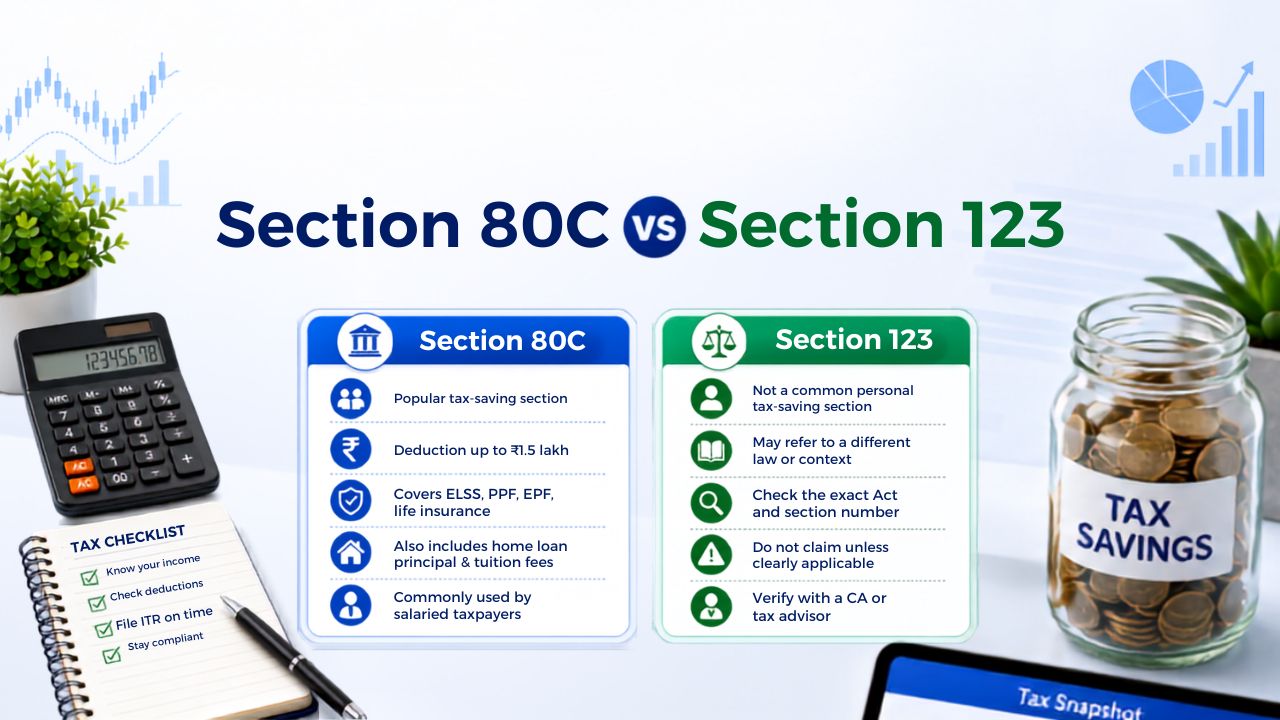
Section 80C has been the backbone of old-regime tax planning for decades. It lets individuals and HUFs deduct up to Rs. 1,50,000 a year from their taxable income against specified investments and payments. This limit is combined with Section 80CCC (pension plan contributions) and Section 80CCD(1) (your own NPS contribution), so all three together still cap out at Rs. 1,50,000, not Rs. 1,50,000 each. It’s available only under the old tax regime.
What is Section 123 (Income Tax Act, 2025)
Section 123 is simply Section 80C’s new address. Effective from April 1, 2026, for Tax Year 2026-27 onward, it sits under Chapter VIII of the new Act and carries forward the exact same Rs. 1,50,000 limit, the exact same list of eligible investments, and the exact same old-regime-only restriction. The one real structural change is where the list of eligible instruments lives: instead of being written directly into the section text the way Section 80C was, it now sits in a separate Schedule XV, with Section 123 itself just stating the deduction and the ceiling. This is the core of the section 80c vs section 123 old new act 2026 story: everything financial stayed put, only the drafting moved.
What’s Actually Listed in Schedule XV
This is worth walking through properly, since the sub-conditions on individual instruments haven’t changed either, and these are exactly where people make mistakes:
- Life insurance premium for self, spouse, or children, capped at 10% of the sum assured for policies issued on or after 1 April 2012. Pay more than that and the excess simply doesn’t count toward your deduction.
- EPF, but only your own contribution. Your employer’s matching contribution doesn’t count toward your Rs. 1,50,000 limit at all, it’s a separate, employer-side benefit.
- PPF, with its standard 15-year lock-in, contributions capped at Rs. 1,50,000 a year in the PPF account itself.
- ELSS mutual funds, carrying just a 3-year lock-in, the shortest of any instrument on this list.
- ULIPs, under broadly similar conditions to regular life insurance.
- NSC, five-year tax-saver bank fixed deposits, Sukanya Samriddhi Yojana, and the Senior Citizens Savings Scheme.
- Deferred annuity and pension plan payments from LIC or other notified insurers.
- Home loan principal repayment, along with stamp duty and registration charges paid on a house purchase, claimable in the year actually paid.
- Tuition fees for up to two children, for full-time education in India, excluding donations or development fees.
Section 80C vs Section 123 Old New Act 2026: What Actually Changed
| Factor | Section 80C (Act 1961) | Section 123 (Act 2025) |
|---|---|---|
| Deduction limit | Rs. 1,50,000 | Rs. 1,50,000, unchanged |
| Eligible investments | PPF, ELSS, LIC, NSC, tuition fees, home loan principal, etc. | Identical list, unchanged |
| Where the list is defined | Within the section itself | Schedule XV |
| Regime availability | Old regime only | Old regime only |
| Combined with pension/NPS contribution (80CCC/80CCD(1)) | Yes, same Rs. 1,50,000 cap | Yes, same cap, still combined |
| Applies to | Income up to March 31, 2026 | Income from April 1, 2026 onward |
| Chapter | Chapter VI-A | Chapter VIII |
Every honest answer to the section 80c vs section 123 old new act 2026 comparison lands in the same place: this is a drafting and numbering reform, not a policy change. The CBDT has been explicit that tax slabs, deduction limits, and eligible instruments were deliberately preserved during this rewrite.
The Lock-In Trap: When Section 123 Deductions Get Reversed
One thing that carries over unchanged, and catches people out every year: these deductions aren’t unconditional once claimed. If you redeem ELSS units before completing the 3-year lock-in, or let a life insurance policy lapse or get surrendered before the minimum holding period, the deduction you already claimed in an earlier year can get added back to your taxable income and taxed in the year you break the condition. This isn’t new to Section 123, it carried over directly from Section 80C, but it’s worth flagging precisely because people assume a completed deduction is a closed matter. It isn’t, until the lock-in period actually finishes.
What Else Moved: Section 124 and the NPS Deduction
This is where people genuinely get confused, because 123, 124, 125, and 126 all sit close together and cover different things. Section 124 is not related to Section 80C at all, it’s the new home for the additional Rs. 50,000 NPS deduction that used to live under Section 80CCD(1B). That’s a separate deduction that stacks on top of the Section 123 limit, exactly as it did before under the old Act. If you invest the full Rs. 1,50,000 under Section 123 and also contribute Rs. 50,000 to NPS under Section 124, your total old-regime deduction from these two provisions alone comes to Rs. 2,00,000. My guide to the Income Tax Act 2025 versus the old Act has the fuller mapping if you’re tracking other renumbered sections too.
Which One Applies to You Right Now
If you’re filing your ITR for FY 2025-26 this July, you’re claiming Section 80C, since that income was earned before the new Act took effect. But for any investment you make from April 1, 2026 onward, in Tax Year 2026-27, you’re technically claiming it under Section 123. Your investment proofs, Form 16, and tax planning conversations with your employer may still casually reference “80C” out of habit for a while, and that’s fine, the substance hasn’t changed. Just don’t be surprised if your AIS, ITR utility, or a CA quotes Section 123 going forward. Either way, this deduction, under either number, only helps if you’ve chosen the old tax regime; the new regime doesn’t allow it at all.
Real Example: Same Investment, Two Section Numbers
Priya invests Rs. 1,50,000 across PPF, ELSS, and her life insurance premium every year, and sits in the 30% slab under the old regime. In FY 2025-26, she claims this under Section 80C and saves Rs. 46,800 in tax, including cess. In FY 2026-27, she makes the identical investment and claims it under Section 123, and saves the exact same Rs. 46,800. If she also contributes Rs. 50,000 to NPS under Section 124, her combined deduction rises to Rs. 2,00,000, saving her Rs. 62,400 in total. The section number changed. Her tax bill didn’t.
Real Example: Rahul’s Over-Investment Trap
Rahul, also in the 30% slab, spreads his savings across EPF (Rs. 55,200), ELSS (Rs. 60,000), home loan principal repayment (Rs. 45,000), and a life insurance premium (Rs. 30,000). Add these up and he’s invested Rs. 1,90,200 across genuinely eligible instruments. But Section 123 doesn’t add up beyond its own ceiling: his deduction stays capped at Rs. 1,50,000, saving him Rs. 46,800, exactly the same as Priya, despite investing Rs. 40,200 more. That extra Rs. 40,200 is still his money, well placed, but it earns him no additional tax benefit under Section 123 at all. If he’d known the cap in advance, that amount could have gone into a flexible investment with no lock-in instead of into ELSS purely for a deduction that was never going to apply.
Frequently Asked Questions
Do I need to do anything differently to claim Section 123 instead of Section 80C?
No. The eligible investments, the Rs. 1,50,000 limit, and the documentation requirements are unchanged. Only the section reference in the law itself has changed.
Will my old Section 80C investment proofs still be valid?
Yes. PPF passbooks, ELSS statements, LIC premium receipts, and similar proofs work exactly the same way. The renumbering doesn’t require new documentation formats.
Is the combined 80C, 80CCC, 80CCD(1) limit still Rs. 1.5 lakh under Section 123?
Yes. Section 123 continues to combine what used to be Sections 80C, 80CCC, and 80CCD(1) under a single Rs. 1,50,000 ceiling.
Can I claim Section 123 under the new tax regime?
No. Just like Section 80C before it, Section 123 deductions are available only if you’ve opted for the old tax regime.
Does my employer’s EPF contribution count toward my Rs. 1.5 lakh limit?
No. Only your own EPF contribution counts toward the Section 123 deduction. Your employer’s matching contribution is a separate benefit and doesn’t reduce your available limit.
Where can I find the full list of eligible investments under Section 123?
They’re listed in Schedule XV of the Income Tax Act, 2025. You can also check the official provisions on the Income Tax Department’s website.