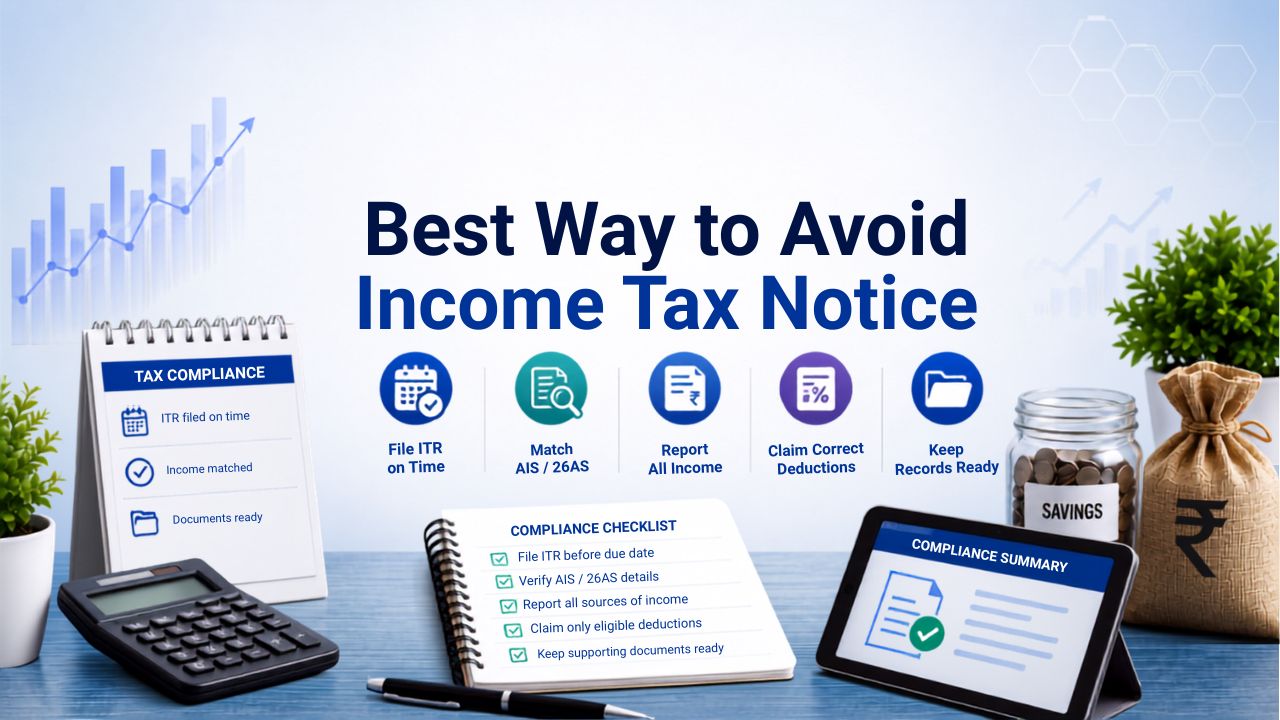
Best Way to Avoid Income Tax Notice: Top 10 Precautions in 2026
In my 7 years of working with salaried professionals and freelancers, I have noticed that most tax notices are not the result of dishonesty. They come from small gaps between what a taxpayer declares and what banks, employers, and mutual fund houses report to the department. If you want best way to avoid income tax notice 2026 troubles altogether, the real work happens before you click submit on your return, not after a notice lands in your inbox. This guide walks through the precautions that actually make a difference, based on the patterns I see every filing season.
Since we are in the transition period between the two income tax laws, everything below applies under Tab 1 (Income Tax Act 1961), which governs your ITR for FY 2025-26 filed in July 2026. Tab 2, based on the New Income Tax Act 2025, becomes relevant only from Tax Year 2026-27 onward, so keep that distinction in mind if you are cross-referencing forms on the portal.
Ten Ways to Avoid Income Tax Notice 2026 Situations
Once a notice is issued, you are already reacting to a mismatch someone else flagged. I have covered how to respond to notices section-wise in a separate guide, but the smarter approach is preventing the trigger in the first place. Here are the ten precautions I recommend to every client.
1. Reconcile your AIS before you file, not after
Your Annual Information Statement pulls data from banks, registrars, mutual fund houses, and employers through the Statement of Financial Transactions mechanism. Before filing, log into the incometax.gov.in portal, go to Services and then Annual Information Statement, and match every entry against your own records. Sunita, a marketing manager in Pune, once found her mutual fund SIP was reported at NAV value instead of investment amount. She corrected it through the AIS feedback option and avoided a mismatch flag entirely.
2. Match TDS credit with your Form 26AS
Rohan, a sales professional with a Rs. 12,00,000 annual salary, noticed his Form 16 showed Rs. 58,000 deducted as TDS, but Form 26AS reflected only Rs. 45,000 credited. A Rs. 13,000 gap like this usually means the employer delayed the quarterly TDS return. He got this corrected with HR before filing rather than discovering it after a demand notice. I always recommend checking this reconciliation alongside the TDS on Salary process so the numbers tie out cleanly.
3. Report every income source, even small ones
Savings account interest, recurring deposit interest, and dividend income are fully reported to the department regardless of amount, there is no threshold below which they go unnoticed. Priya forgot to add Rs. 8,400 in savings interest one year and received a routine e-campaign query. It was resolved quickly, but it was avoidable.
4. Watch the high-value transaction thresholds
Certain transactions get reported automatically: cash deposits above Rs. 10 lakh in a savings account in a financial year, current account transactions above Rs. 50 lakh, mutual fund or share purchases above Rs. 10 lakh, and property transactions above Rs. 30 lakh. Rahul bought a flat valued at Rs. 32 lakh and made sure the entire payment trail was through banking channels, with the transaction reflected consistently across his AIS and his ITR.
5. Never split transactions to dodge a threshold
I have seen taxpayers try to stay under the Rs. 10 lakh cash deposit limit by depositing smaller amounts across the year. The system looks at aggregated totals per PAN across accounts, not individual transactions, so this strategy backfires and often draws more attention, not less.
6. Choose the correct ITR form
Filing the wrong form is a common, easily avoidable trigger. A salaried employee with 44ADA consultancy income needs ITR-4, not ITR-1. Getting this wrong can lead to a defective return notice, which then needs a fresh response and refiling.
7. Keep documentary proof for every deduction and exemption you claim
If you claim HRA, home loan interest, or Section 80C investments, keep rent receipts, loan statements, and investment proofs on hand even after filing. A notice asking for justification is far less stressful when you already have the paperwork organized.
8. File within the original due date wherever possible
A belated return forces you into the new tax regime and blocks loss carry forward, except for house property loss. Beyond the compliance cost, late filers also show up more often in the department’s scrutiny selection criteria, since delayed filing is itself treated as a risk indicator.
9. Give AIS feedback the moment you spot an error, don’t wait for a notice
The AIS portal lets you flag an entry as confirmed, partially correct, not mine, or incorrect. Neha found a joint account deposit wrongly attributed entirely to her PAN. She filed feedback the same week and the correction was reflected before her filing deadline.
10. Keep your KYC and PAN details consistent across banks and demat accounts
A mismatch in name format or an outdated KYC entry between your bank and your PAN records can itself cause a reporting error that has nothing to do with your actual income. Ramesh updated his KYC across two banks after noticing his name was recorded differently, which had been quietly causing duplicate reporting of the same fixed deposit.
The Common Thread
Every precaution above comes back to one habit: reconcile before you file, don’t assume the department’s data matches your own. If you want a deeper look at what causes notices in the first place, I have broken down the top 10 reasons for income tax notices and the TDS mistakes that commonly trigger them separately. And if you are filing online this season, running through how to file your ITR alongside a fresh AIS versus Form 26AS check is a good habit to build into your annual routine.
Frequently Asked Questions
Does a mismatch notice always mean I did something wrong?
No. Many mismatches come from reporting errors by banks or third parties, not from anything you did incorrectly. That is exactly why AIS feedback exists.
How often should I check my AIS?
I recommend checking it at least twice: once mid-year to catch reporting errors early, and once just before filing your return.
Can I file self-assessment tax if I find a shortfall during reconciliation?
Yes. If your reconciliation reveals unpaid tax, you can clear it through self-assessment tax before filing your return.
What if I already received a notice despite following these precautions?
Respond within the timeline mentioned in the notice. I have a section-wise guide on how to respond to an income tax notice that walks through this in detail.