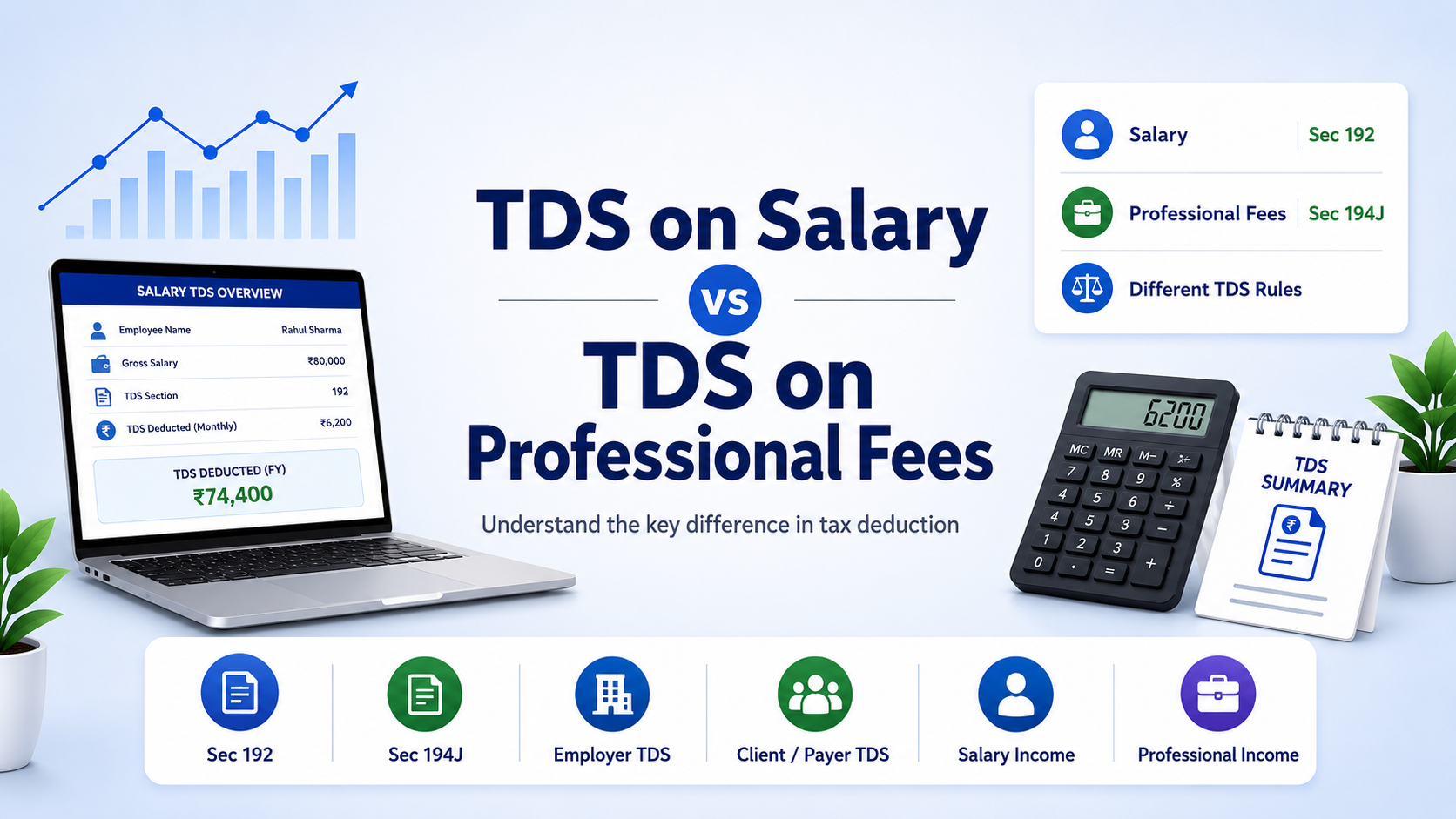
TDS on Salary vs TDS on Professional Fees: Key Differences 2026
Every salaried professional who also takes up freelance work eventually asks me the same question. Why does my company deduct tax so differently from my salary compared to the consulting invoices I raise on the side. In my seven years of working with salaried professionals and freelancers, I have found that most confusion around TDS on salary vs TDS on professional fees 2026 comes down to one thing. Section 192 and Section 194J are built on two completely different logics. One is designed to match your actual tax liability as closely as possible. The other deducts a flat rate regardless of what you finally owe. Once you understand this difference, TDS stops feeling random and starts making sense.
What Is TDS on Salary (Section 192)?
Section 192 applies to every employer paying salary to an employee. At the start of the financial year, your employer estimates your total salary income, factors in the standard deduction, adds any other income you declare, and applies the tax regime you have chosen. This gives a projected annual tax liability. That figure is then divided across the remaining months of the year to arrive at your monthly TDS.
This is why Section 192 does not have a flat threshold amount the way most other TDS sections do. TDS on salary kicks in only when your projected tax liability, after standard deduction and the Section 87A rebate, works out to more than zero. You can read the full computation method, including how employers handle mid-year salary changes and multiple Form 12BB declarations, in our detailed guide on TDS on salary under Section 192. The mechanics also change depending on whether you are under the old or new tax regime, so your employer needs your regime choice before the calculation can even begin.
What Is TDS on Professional Fees (Section 194J)?
Section 194J applies when any person, other than an individual or HUF not liable for tax audit, pays a resident for professional or technical services. From April 1, 2025, the threshold for this section was raised from Rs 30,000 to Rs 50,000. The moment your total professional or technical fee payments from one payer cross Rs 50,000 in a financial year, TDS applies on the entire amount.
The rate depends on the nature of the service. Professional services such as those provided by a CA, lawyer, doctor, architect, or consultant attract 10% TDS. Technical services, which cover managerial, technical, or consultancy work such as IT support or engineering services, attract 2%. Royalty and non-compete fees are taxed at 10%. Director remuneration that is not salary has no threshold at all, TDS applies from the first rupee. If PAN is not furnished, the rate jumps to 20% regardless of the category.
This structure is one reason freelancers and consultants often see a larger chunk of their invoice withheld than they expect, especially early in their career when their actual tax liability may be much lower than 10% of their income.
TDS on Salary vs TDS on Professional Fees: Key Differences
| Basis | Section 192 (Salary) | Section 194J (Professional Fees) |
|---|---|---|
| How TDS is calculated | Based on projected annual tax liability using slab rates | Flat rate on gross payment |
| Rate | Slab rate, varies by income (0% to 30%) | 10% professional, 2% technical |
| Threshold | No fixed amount, applies once projected tax is above zero | Rs 50,000 per payer per category, per year |
| Considers deductions and rebate | Yes, employer factors in standard deduction and Section 87A rebate | No, rate applies regardless of recipient’s final liability |
| Who deducts | Any employer paying salary | Any payer except individual or HUF not liable for tax audit |
| Deduction frequency | Monthly, spread across the year | On each payment once threshold is crossed |
| TDS certificate | Form 16 (Form 130 under new Act), issued annually | Form 16A, issued quarterly |
| Return filed by deductor | Form 24Q | Form 26Q |
| No PAN furnished | Higher of slab rate or 20% | Flat 20% |
| New Act 2025 section | Section 392 | Section 393 |
The Real Difference: One Matches Your Liability, the Other Does Not
This is the part most people miss. Section 192 tries to deduct exactly what you will owe. Section 194J deducts a fixed percentage no matter what.
Take Ramesh, a salaried employee earning Rs 12,75,000 a year under the new regime. After the Rs 75,000 standard deduction, his taxable income is Rs 12,00,000, which qualifies for the full Section 87A rebate. His final tax liability is zero, so his employer deducts no TDS at all through the year under Section 192.
Now take Priya, a consultant who earns the same Rs 12,75,000 in professional fees from one client. Since this is 194J territory, her client deducts a flat 10% the entire year, which comes to Rs 1,27,500, roughly Rs 10,625 every month, regardless of what Priya’s actual tax liability turns out to be. If Priya files under presumptive taxation and her final liability is low or nil, she has to wait until she files her return to claim that money back as a refund.
The gap gets more interesting at higher income too. Say Rohan earns Rs 20,00,000 in salary under the new regime. After the Rs 75,000 standard deduction, his actual tax liability for the year works out to about Rs 1,92,400, so his employer’s Section 192 deductions add up to almost exactly that. But if a consultant earns the same Rs 20,00,000 from a single client, 194J deducts a flat Rs 2,00,000 over the year, about Rs 7,600 more than what an equivalent salaried person would pay in tax. That extra amount sits with the government until the consultant files their return and reconciles it.
This is the core structural difference. Section 192 is a running estimate of what you owe. Section 194J is a blunt instrument that assumes nothing about your final liability and leaves the reconciliation entirely to your income tax return.
Why This Matters If You Have Both Salary and Consultancy Income
A growing number of salaried professionals also take up freelance or consulting assignments on weekends. If that describes you, both sections apply to you separately. Your employer deducts TDS under Section 192 on your salary. Any client paying you more than Rs 50,000 for professional or technical work deducts TDS under Section 194J on those payments. Neither deductor knows about the other income stream, so neither TDS is calculated with your total picture in mind.
This is exactly why your total tax liability needs to be worked out afresh at the time of filing, using the correct ITR form for your income mix. If your combined TDS falls short of your actual liability once both incomes are added together, you may also need to pay advance tax during the year to avoid interest under Section 234B and 234C.
Reconciling TDS From Both Sections
Every rupee deducted under Section 192 and Section 194J shows up against your PAN in your Annual Information Statement. Before filing your return, it is worth checking how to read your Form 26AS and AIS to confirm both your employer and your clients have correctly deposited and reported the TDS they deducted. Mismatches are common, especially with smaller clients who deduct 194J TDS but delay filing their quarterly return, which means the credit does not reflect in your AIS on time.
If your total TDS across both sections is more than your final tax liability, you get the difference back as a refund. If it is less, you settle the balance as self-assessment tax before filing.
New Income Tax Act 2025: What Changes and What Does Not
Under the new Income Tax Act 2025, effective from April 1, 2026, Section 192 becomes Section 392 and Section 194J becomes part of Section 393. The rates and thresholds themselves are not changing, only the section numbers and reporting codes used by deductors. For your ITR filing in July 2026, which covers FY 2025-26, you continue to use the old section numbers, 192 and 194J, since that income was earned and largely paid before the new Act took effect. You can see the complete section-by-section mapping in our guide on Income Tax Act 2025 vs Income Tax Act 1961. The Income Tax Department has also published detailed transition guidance on how employers and deductors should handle TDS during this changeover, available on the official e-filing portal.
Common Mistakes to Avoid
A few patterns show up repeatedly when I review queries from readers.
Assuming no salary TDS means no tax liability at all. Zero TDS under Section 192 usually means your projected liability is nil, but if you have other income such as freelance fees or capital gains, your final liability could still be positive.
Assuming professional fee TDS reflects your actual tax bracket. A 10% deduction under 194J does not mean you owe 10% tax. It is a flat withholding, not a personalised calculation.
Not tracking the Rs 50,000 threshold correctly. This limit applies per category of payment, per payer, per year. If the same client pays you Rs 45,000 for professional advice and Rs 40,000 separately for technical work, neither individually crosses the threshold, so no TDS applies to either, even though the combined amount exceeds Rs 50,000.
Forgetting that individuals and HUFs who are not liable for tax audit do not need to deduct 194J TDS at all. If you are a salaried individual hiring a freelance designer or consultant for personal work, this section usually does not apply to you as a deductor.
Frequently Asked Questions
Is the TDS rate on salary and professional fees the same?
No. Salary TDS follows slab rates based on your total projected income, so it can range from zero to 30%. Professional fees TDS is a flat 10% or 2% depending on the nature of the service, regardless of the recipient’s income level.
Can I avoid TDS under Section 194J if my income is below the taxable limit?
You can apply to your Assessing Officer for a lower or nil deduction certificate under Form 13 if your projected tax liability is genuinely lower than what flat-rate TDS would deduct. Without this certificate, the payer is required to deduct at the standard rate.
What if I have both salary and consultancy income in the same year?
Both Section 192 and Section 194J apply independently to their respective income streams. You reconcile your actual total liability only when you file your ITR, and this is when you claim any excess TDS as a refund or pay any shortfall as self-assessment tax.
Understanding this difference is not just an academic exercise. It affects how much cash actually lands in your account each month, whether you need to plan for advance tax, and how large a refund or additional payment to expect at filing time. Once you see Section 192 and Section 194J for what they really are, one a running estimate and the other a flat withholding, the rest of your tax planning gets a lot easier to reason about.