EPF Withdrawal Online: Step-by-Step Guide and Tax Rules
If you are planning to do an EPF withdrawal online, two things matter most: whether you are eligible to withdraw, and how much tax you will pay on it. Get either of these wrong and you either face a claim rejection or an unexpected tax deduction.
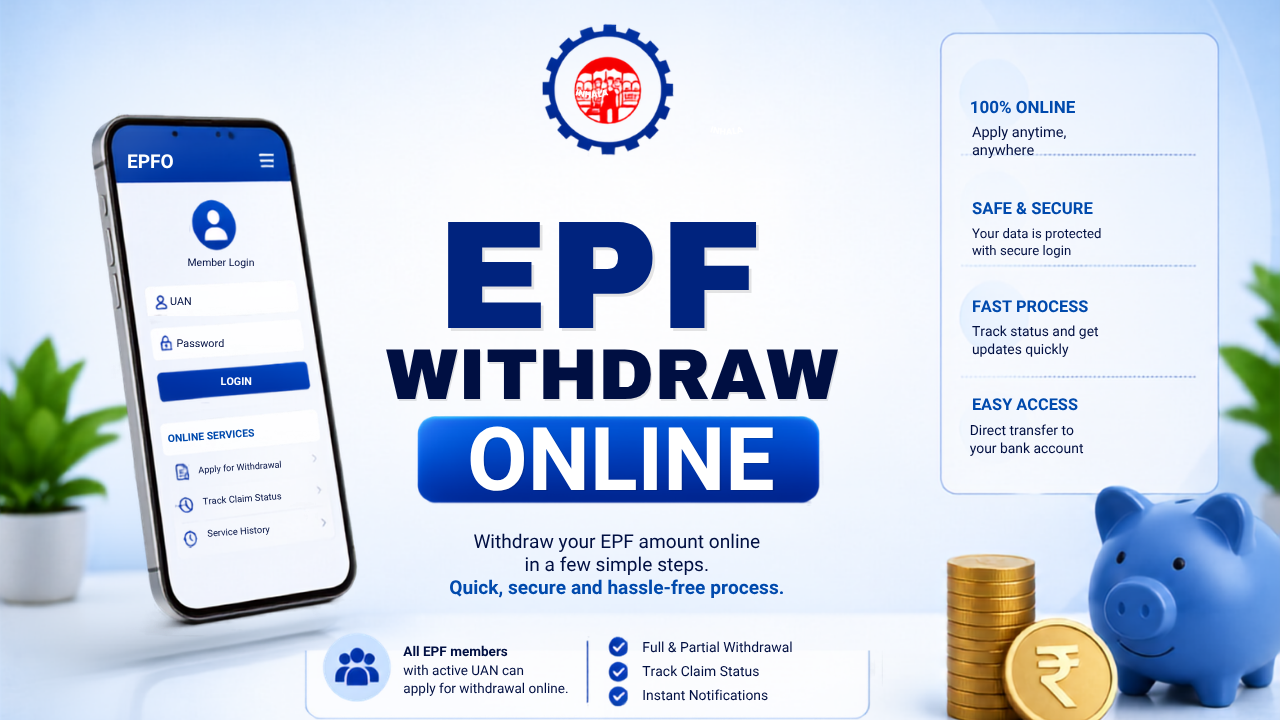
This guide covers the complete EPF withdrawal online process, partial withdrawal rules under EPFO 3.0, full withdrawal conditions, and the exact tax treatment depending on your years of service.
What is EPF and Who Can Withdraw It?
The Employees’ Provident Fund (EPF) is a mandatory retirement savings scheme administered by the EPFO (Employees’ Provident Fund Organisation). Every month, both you and your employer contribute 12% of your basic salary plus dearness allowance into your EPF account.
The accumulated corpus can be withdrawn under specific conditions. EPFO does not allow free withdrawals while you are actively employed, except for approved partial withdrawals.
Types of EPF Withdrawal
There are two types of EPF withdrawal: full settlement and partial withdrawal.
Full EPF Withdrawal
Full withdrawal means receiving 100% of your EPF balance, including employee contribution, employer contribution, and all interest. This is allowed only in these situations:
- Upon retirement at age 58
- After remaining unemployed for two months or more
- Upon permanent settlement abroad
After one month of unemployment, you can withdraw up to 75% of your balance. After two months, the remaining 25% becomes available.
Partial EPF Withdrawal
Partial withdrawal is allowed for specific purposes while you are still employed. Under the revised EPFO 3.0 rules approved by the Central Board of Trustees in October 2025, the old 13 withdrawal categories have been merged into 3 simplified categories. The minimum service period for all partial withdrawals has been reduced to 12 months uniformly.
Partial EPF Withdrawal Rules Under EPFO 3.0
Category 1: Essential Needs
Covers medical treatment, higher education, and marriage.
| Purpose | Minimum Service | Withdrawal Limit | Frequency |
|---|---|---|---|
| Medical treatment (self, spouse, children, parents) | 12 months | Up to 75% of total balance | As needed |
| Higher education (self or child) | 12 months | Up to 50% of employee contribution | Up to 10 times |
| Marriage (self, child, sibling) | 12 months | Up to 50% of employee contribution | Up to 5 times |
Category 2: Housing Needs
Covers home purchase, construction, loan repayment, and renovation.
| Purpose | Minimum Service | Withdrawal Limit |
|---|---|---|
| Home purchase or construction | 12 months | Up to 36 months of basic salary |
| Home loan repayment | 12 months | Up to 90% of total EPF balance |
| Home renovation | 12 months | Up to 12 months of basic salary |
Category 3: Special Circumstances
Covers unemployment and financial emergencies. No reason needs to be specified for withdrawals under this category.
| Situation | Withdrawal Limit |
|---|---|
| Unemployment after 1 month | Up to 75% of total balance |
| Unemployment after 2 months | 100% of total balance |
| Natural calamity or unforeseen financial stress | Up to Rs. 5,000 or 50% of own contribution, whichever is lower |
Important: At least 25% of your total EPF balance must remain in the account after any partial withdrawal while you are employed. Under 2026 rules, partial withdrawals can include both employee and employer contributions, not just your own share.
EPF Withdrawal Online: Step-by-Step Process
Before You Begin: KYC Requirements
Your UAN (Universal Account Number) must be active and your KYC must be complete. The following must be linked and verified on the EPFO portal before you initiate an EPF withdrawal online:
- Aadhaar number
- PAN number
- Bank account with IFSC code
- Mobile number linked to Aadhaar
If your KYC is incomplete, your claim will be rejected at the first step itself.
Step 1: Log In to the EPFO Member Portal
Go to unifiedportal-mem.epfindia.gov.in and log in using your UAN and password.
Step 2: Go to Online Services
Click on the “Online Services” tab in the top menu. Select “Claim (Form-31, 19, 10C and 10D)” from the dropdown.
Step 3: Verify Your Bank Account
Enter the last 4 digits of your registered bank account number and click “Verify”. This is a security step before the claim is processed.
Step 4: Click “Proceed for Online Claim”
After bank verification, click the “Proceed for Online Claim” button.
Step 5: Select the Claim Type
Choose the appropriate form based on your withdrawal purpose:
| Form | Purpose |
|---|---|
| Form 19 | Full EPF settlement on resignation, retirement, or unemployment |
| Form 10C | EPS (pension) withdrawal or scheme certificate |
| Form 31 | Partial withdrawal or non-refundable advance |
| Form 10D | Monthly pension after retirement |
Step 6: Fill in the Details and Upload Documents
Enter the purpose of withdrawal and the amount. Upload Form 15G or Form 15H if you want to request zero TDS deduction. These forms declare that your total income is below the taxable limit.
Step 7: Submit the Claim
Click “Submit”. You will receive an SMS on your registered mobile with a claim reference number.
Step 8: Track Your Claim Status
Go to Online Services > Track Claim Status. Online claims with complete KYC are typically processed within 7 to 15 working days. Under EPFO 3.0 auto-settlement, eligible claims up to Rs. 5 lakhs can be processed within 48 to 72 hours.
For the official EPFO portal and claim tracking, visit epfindia.gov.in.
EPF Withdrawal Tax Rules
This is where most salaried professionals get caught off guard. The tax treatment of your EPF withdrawal depends entirely on one factor: how many years of continuous service you have completed.
Tax Rule 1: After 5 Years of Continuous Service
Your EPF withdrawal is completely tax-free. No TDS is deducted and you do not need to report it as income in your ITR. The 5-year period is cumulative across employers, as long as you transferred your EPF balance each time instead of withdrawing it.
Example: Rohit worked at Company A for 3 years and transferred his PF to Company B. He worked at Company B for 2 more years before resigning. His total continuous service is 5 years. His EPF withdrawal is fully tax-free.
Tax Rule 2: Before 5 Years of Continuous Service
If you withdraw before completing 5 years, your EPF corpus becomes taxable. The four components are treated differently:
| Component | Tax Treatment |
|---|---|
| Employer contribution | Taxable as salary income |
| Interest on employer contribution | Taxable as Income from Other Sources |
| Employee contribution (if 80C deduction was claimed) | Taxable as salary income |
| Employee contribution (if 80C deduction was NOT claimed) | Not taxable |
| Interest on employee contribution | Taxable as Income from Other Sources |
Example: Priya resigned after 3 years of service. Her EPF corpus is Rs. 2,00,000: employee contribution Rs. 80,000, employer contribution Rs. 80,000, interest Rs. 40,000. She had claimed Section 80C deduction on her employee contribution in all 3 years.
Taxable amount: Rs. 80,000 (employer share) + Rs. 40,000 (interest) + Rs. 80,000 (employee contribution, since 80C was claimed) = Rs. 2,00,000. The full amount is added to her income for that year and taxed at her slab rate.
TDS on EPF Withdrawal: Section 192A
TDS under Section 192A of the Income Tax Act 1961 (now Section 392(7) under the Income Tax Act 2025) applies when your total EPF withdrawal exceeds Rs. 50,000 and you have served for less than 5 years.
| Situation | TDS Rate |
|---|---|
| PAN submitted | 10% |
| PAN not submitted | Maximum Marginal Rate (approximately 34.6%) |
| Form 15G or 15H submitted, income below taxable limit | Nil |
| Withdrawal below Rs. 50,000 | No TDS (but may be taxable in ITR) |
| After 5 years of continuous service | No TDS |
| Termination due to ill health or business closure | No TDS |
| EPF transferred to NPS | No TDS |
Critical point: Even if no TDS is deducted because the withdrawal is below Rs. 50,000, the amount may still be taxable when you file your ITR. TDS exemption and tax exemption are not the same thing.
How to Avoid TDS on EPF Withdrawal
Option 1: Complete 5 Years of Continuous Service
This is the cleanest solution. Your entire withdrawal becomes tax-free with no TDS, no reporting required.
Option 2: Transfer, Do Not Withdraw
When you change jobs, transfer your EPF balance to your new employer’s account using Form 13 online via the UAN portal. This maintains continuity of service and avoids triggering any tax event. Every time you withdraw instead of transferring, your service count resets to zero.
Option 3: Submit Form 15G or Form 15H
If your total income including the EPF withdrawal is below the taxable limit, submit Form 15G (for individuals below 60 years) or Form 15H (for senior citizens). No TDS will be deducted. This is a self-declaration, so ensure your income is genuinely below the taxable limit before submitting.
Option 4: Link Your PAN Before Withdrawing
Even if you cannot avoid TDS entirely, always link your PAN to your UAN. This reduces TDS from approximately 34.6% to 10%. You can claim the 10% TDS as a refund when filing your ITR if your overall tax liability is lower.
EPF Withdrawal and Section 80C: What Happens to Past Deductions
If you claimed a deduction on your EPF contributions under Section 80C (now Section 123 under the Income Tax Act 2025) in previous years, and you withdraw before completing 5 years of service, those past deductions are reversed. The employee contribution amount on which you claimed 80C benefit becomes taxable as salary income in the year of withdrawal.
This is one of the most overlooked aspects of early EPF withdrawal. Many salaried professionals assume their own contribution is always tax-free on withdrawal. It is not, if 80C was claimed earlier.
To understand how Section 80C works and what deductions are available, read our guide on Section 80C deductions.
What to Do If TDS Is Already Deducted
If TDS has been deducted on your EPF withdrawal, it will appear in your Form 26AS (now Form 168 under the Income Tax Act 2025). You can claim a refund of this TDS when you file your ITR, provided your total tax liability for the year is lower than the TDS deducted.
Report the EPF withdrawal amount under the correct head of income in your ITR, and the TDS credit will be automatically adjusted. To know how to file your ITR correctly, refer to our guide on how to file ITR online.
Common Mistakes to Avoid
Not linking PAN to UAN: A missing PAN triggers TDS at approximately 34.6%. Link your PAN through the EPFO portal under KYC settings before initiating any claim.
Withdrawing instead of transferring: Every time you withdraw your PF on changing jobs, your service continuity resets. After two or three job changes, you may never reach the 5-year threshold, making every future withdrawal taxable.
Assuming partial withdrawals are tax-free: EPFO permitting a partial withdrawal for housing or education does not mean income tax exempts it. Before 5 years of service, the withdrawal is still taxable.
Not reporting EPF withdrawal in ITR: Even if no TDS is deducted (withdrawal below Rs. 50,000), you must report the taxable amount in your ITR. Missing this can result in notices from the income tax department.
For more strategies to reduce your tax legally, refer to our tax saving tips for salaried employees.
Frequently Asked Questions
Can I withdraw EPF while I am still employed?
No, full withdrawal is not allowed during employment. Partial withdrawals are allowed under the three EPFO 3.0 categories: essential needs, housing needs, and special circumstances.
How long does EPF withdrawal take online?
Standard online claims with complete KYC are processed in 7 to 15 working days. Under EPFO 3.0 auto-settlement, eligible claims up to Rs. 5 lakhs can be settled in 48 to 72 hours.
Is EPF withdrawal taxable after retirement?
No. EPF withdrawal after retirement at age 58 with 5 or more years of continuous service is completely tax-free.
What if my EPF claim is rejected?
Common reasons: incomplete KYC, name or date of birth mismatch between Aadhaar and EPFO records, bank account not pre-validated, or employer KYC not approved. Resolve the specific issue mentioned in the rejection SMS and resubmit.
Can I withdraw only my employee contribution and leave the employer share?
No. EPFO does not allow selective withdrawal of only one component. The withdrawal follows the applicable rules for the full eligible balance under your chosen category.
If I am a freelancer, does EPF apply to me?
Freelancers working independently without an EPF-registered employer are generally not covered under EPF. For tax planning specific to your situation, read our article on income tax for freelancers. For the complete income tax framework, refer to our income tax guide India.