ITR-4 (Sugam) AY 2026-27: Presumptive Scheme Filing Guide
If you run a small business, work as a freelancer, or operate a transport business, the ITR 4 form is almost certainly the right form for you. ITR-4, also called Sugam, is one of the most widely used return forms in India, designed specifically for taxpayers who declare income under the presumptive taxation scheme.
This guide covers who should file ITR-4, what the eligibility conditions are, what income you can report in it, and how to file it correctly for AY 2026-27 (FY 2025-26).
What Is ITR-4 (Sugam)?
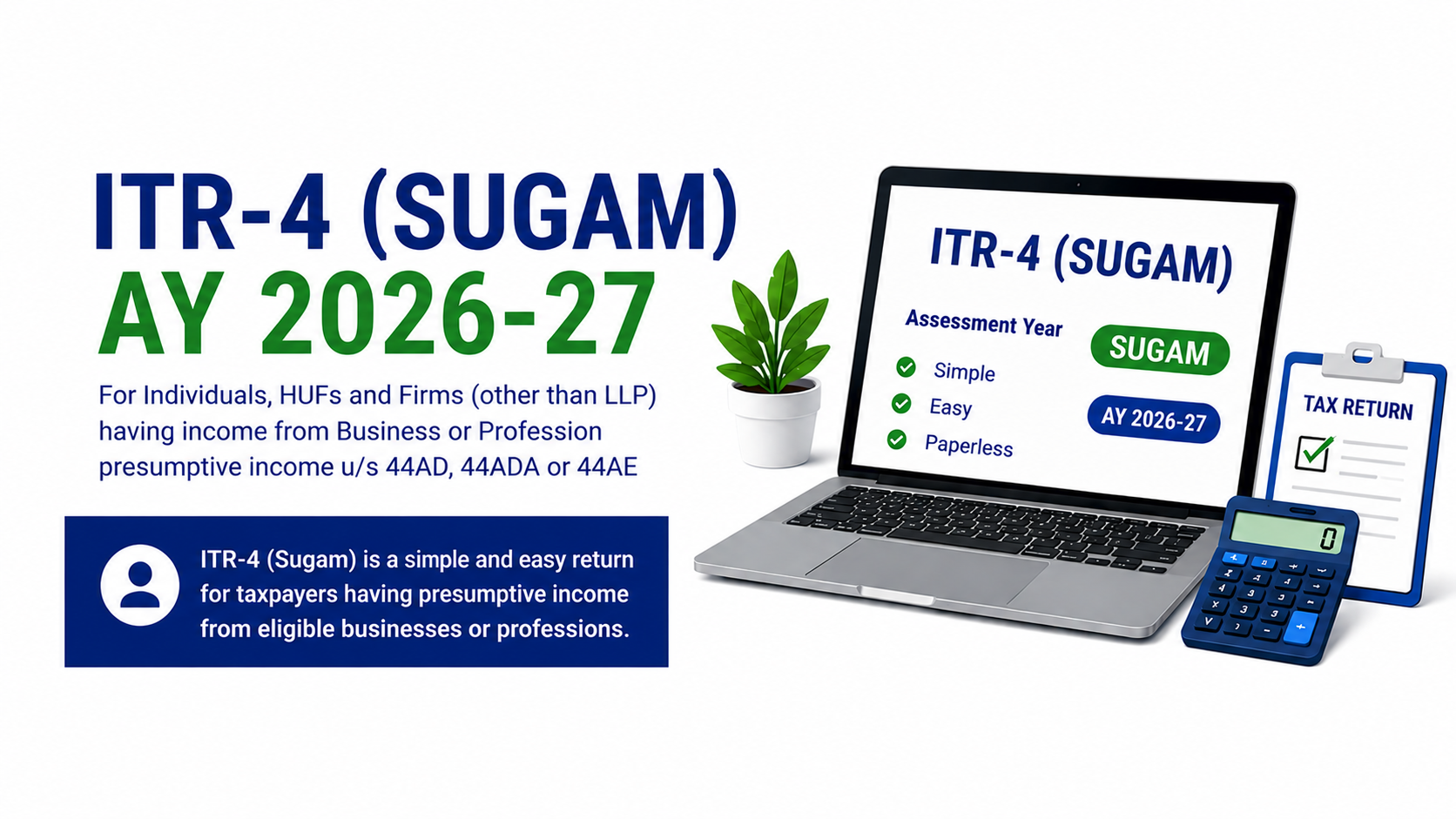
ITR-4 is an income tax return form for individuals, Hindu Undivided Families (HUFs), and firms (other than LLPs) who have opted for the presumptive taxation scheme under:
- Section 44AD: for small businesses
- Section 44ADA: for specified professionals such as freelancers, consultants, doctors, and architects
- Section 44AE: for goods transport operators
Instead of maintaining detailed books of accounts and calculating actual profits, you declare a fixed percentage of your turnover as income. The Income Tax Department accepts this declared percentage as your profit, and no separate expense justification is required.
For AY 2026-27, the ITR-4 form is filed under the Income Tax Act 1961 (Tab 1 on the income tax portal). The new Income Tax Act 2025 applies from Tax Year 2026-27 onwards and will be relevant when you file next year’s return.
Who Should File ITR-4 for AY 2026-27?
You should file the ITR 4 form if all of the following conditions apply to you:
| Condition | Requirement |
|---|---|
| Residential status | Resident individual, HUF, or firm (not LLP) |
| Business income | Opted for Section 44AD or 44AE |
| Professional income | Opted for Section 44ADA |
| Total turnover | Up to Rs. 3 crore (business) or Rs. 75 lakh (profession) |
| Other income allowed | Salary, one house property, interest income |
| Directorship in company | Not allowed |
| Investments in unlisted shares | Not allowed |
Important: If you have income from more than one house property, capital gains of any kind, or foreign income, ITR-4 does not apply to you. In that case, ITR-3 is the correct form. Refer to our guide on which ITR form to file for FY 2025-26 for a complete comparison.
Understanding the Three Presumptive Sections
Section 44AD: For Small Businesses
Section 44AD applies to individuals, HUFs, and firms (excluding LLPs) running eligible businesses such as trading, retail, manufacturing, restaurants, and agencies. It does not apply to professions listed under Section 44AA.
Turnover limit: Up to Rs. 3 crore, provided at least 95% of receipts are received through banking or digital channels. If cash receipts exceed 5%, the limit reduces to Rs. 2 crore.
Presumptive income rate: 8% of turnover for cash receipts, or 6% of turnover for digital receipts.
Example: Ramesh runs a grocery store with annual turnover of Rs. 60 lakh, all transactions through bank. His presumptive income is 6% of Rs. 60 lakh = Rs. 3.6 lakh. He is not required to maintain books of accounts and can file using ITR-4.
Important: If you opt out of Section 44AD in any year, you cannot opt back in for the next five consecutive years. This decision should be evaluated carefully before the return is filed.
Section 44ADA: For Specified Professionals
Section 44ADA is designed for freelancers, consultants, and professionals in fields listed under Section 44AA(1). This is the section most self-employed professionals use when filing the ITR 4 form.
Eligible professions include: Legal professionals (lawyers), medical practitioners (doctors), engineers, architects, accountants, technical consultants, interior designers, film artists, and company secretaries.
Gross receipts limit: Up to Rs. 75 lakh, provided at least 95% of receipts are received through non-cash channels. The limit is Rs. 50 lakh if cash receipts exceed 5%.
Presumptive income rate: 50% of gross receipts.
Example: Priya is a freelance architect earning Rs. 18 lakh per year, all payments received via bank transfer. Her presumptive income = 50% of Rs. 18 lakh = Rs. 9 lakh. She can file ITR-4 under Section 44ADA without any audit requirement.
For a detailed breakdown of how freelancers are taxed in India, see our article on income tax for freelancers.
Section 44AE: For Transport Operators
Section 44AE applies to individuals, HUFs, and firms owning and operating goods carriages, provided they own no more than 10 vehicles at any point during the year.
Presumptive income rate:
- Rs. 1,000 per tonne of gross vehicle weight (GVW) per month for heavy goods vehicles (GVW exceeding 12 tonnes)
- Rs. 7,500 per vehicle per month for other vehicles
Example: Sunil owns 3 heavy trucks, each with a GVW of 16 tonnes. His presumptive income for FY 2025-26 = 3 x 16 x Rs. 1,000 x 12 = Rs. 5,76,000. He is not required to maintain accounts and files using ITR-4.
What Income Can You Report in ITR-4?
The ITR 4 form accepts the following sources of income:
- Business income under Section 44AD (up to Rs. 3 crore turnover)
- Professional income under Section 44ADA (up to Rs. 75 lakh receipts)
- Transport business income under Section 44AE (up to 10 vehicles)
- Salary or pension from one employer
- Income from one house property (self-occupied or let out)
- Interest income from savings accounts, FDs, or other sources
- Family pension
What Deductions Are Available in ITR-4?
Even under the presumptive scheme, you can claim deductions to reduce your taxable income. For the full context on how income tax works alongside these deductions, see our income tax guide India. The most commonly used ones are:
- Section 80C: PPF, ELSS, LIC, EPF, home loan principal up to Rs. 1.5 lakh (old regime only). Read our detailed Section 80C deductions guide.
- Section 80D: Health insurance premiums for self, family, and parents (old regime only)
- Section 80CCD(1B): Additional NPS contribution up to Rs. 50,000 (available under both regimes)
- Standard deduction: Rs. 75,000 if you also have salary income under new regime, or Rs. 50,000 under old regime
Note: If you opt for the presumptive scheme, you cannot claim business expenses separately. The declared percentage (6%, 8%, or 50%) is treated as inclusive of all expenses.
Old Regime vs New Regime for ITR-4 Filers
From FY 2025-26, the new tax regime is the default for all taxpayers. If you are filing ITR-4, you can still opt for the old regime, but you must select it explicitly during filing.
| Feature | New Regime | Old Regime |
|---|---|---|
| Standard deduction (salary) | Rs. 75,000 | Rs. 50,000 |
| Section 80C deduction | Not available | Up to Rs. 1.5 lakh |
| Section 80D deduction | Not available | Available |
| Tax rebate (Section 87A) | Zero tax up to Rs. 12 lakh income | Zero tax up to Rs. 5 lakh income |
| Best suited for | Lower income, fewer investments | Higher deductions claimable |
For most freelancers and small business owners with significant Section 80C investments, running a comparison before filing is worth the time. Our old vs new tax regime guide walks through this calculation in detail.
Advance Tax Rules for Presumptive Scheme Filers
One significant relief for ITR-4 filers: if you opt for Section 44AD or 44ADA, advance tax is required in only one instalment, 100% by March 15.
Regular taxpayers must pay advance tax in four instalments across June, September, December, and March. The single-payment rule simplifies cash flow planning considerably for small businesses and freelancers.
If you miss the March 15 deadline, interest under Section 234B and 234C applies on the shortfall. See our advance tax payment guide for the full calculation.
Step-by-Step: How to File ITR-4 for AY 2026-27
Step 1: Log in to the Income Tax Portal using your PAN and password.
Step 2: Navigate to e-File, then Income Tax Returns, then File Income Tax Return.
Step 3: Select Assessment Year 2026-27 and filing mode as Online.
Step 4: Select the ITR form as ITR-4.
Step 5: Choose your tax regime (new or old). If you want to use the old regime, select it explicitly at this stage.
Step 6: Fill in your personal details: PAN, Aadhaar, address, and bank account details for refund credit.
Step 7: In the Presumptive Business/Profession section, enter the nature of business or profession, gross turnover or gross receipts, and presumptive income (the system calculates this automatically based on the applicable percentage).
Step 8: Add any other income: salary from Form 16, house property income, and interest income under Other Sources.
Step 9: Enter deductions under Chapter VI-A (80C, 80D, etc.) if you are filing under the old regime.
Step 10: Review your tax computation. Pay any balance tax due before submitting, or verify the refund amount if taxes paid exceed liability.
Step 11: Submit the return and complete e-verification using Aadhaar OTP, net banking, or bank account validation.
For a detailed walkthrough of the portal process, see our guide on how to file ITR online.
Portal note for AY 2026-27: Use Tab 1 on the income tax portal. Tab 1 covers the Income Tax Act 1961, which applies to FY 2025-26 returns. Tab 2 is for the new Income Tax Act 2025 and will be relevant from AY 2027-28 onwards.
ITR-4 Filing Deadline for AY 2026-27
| Return Type | Deadline |
|---|---|
| ITR-4 without audit requirement | August 31, 2026 |
| ITR-4 with audit (if applicable) | October 31, 2026 |
| Belated return | December 31, 2026 |
Missing the August 31 deadline results in a late filing fee of Rs. 5,000 under Section 234F (Rs. 1,000 if total income is below Rs. 5 lakh).
Common Mistakes to Avoid When Filing ITR-4
1. Filing ITR-4 with capital gains income: Any capital gain from mutual funds, shares, or property disqualifies you from ITR-4. Switch to ITR-3 in that case.
2. Declaring income below the presumptive percentage: If your actual profits are lower than the prescribed percentage and you want to declare the lower figure, your books of accounts must be audited and you must file ITR-3.
3. Applying the wrong section: A doctor cannot use Section 44AD. A trader cannot use Section 44ADA. The sections are activity-specific and cannot be interchanged.
4. Missing the advance tax payment: Even though only one instalment is required, the March 15 deadline is often overlooked, resulting in avoidable interest under Section 234B and 234C.
5. Not reporting interest income: FD interest, savings account interest, and other passive income must be reported under Other Sources even when filing ITR-4 under the presumptive scheme.
Frequently Asked Questions
Can a freelancer file ITR-4? Yes. Freelancers in specified professions such as software consultants, architects, doctors, lawyers, and accountants can file ITR-4 using Section 44ADA, provided gross receipts do not exceed Rs. 75 lakh (or Rs. 50 lakh if more than 5% is received in cash).
What is the turnover limit for Section 44AD in FY 2025-26? Rs. 3 crore if 95% or more of business receipts are through banking or digital channels. Rs. 2 crore if cash receipts exceed 5% of total receipts.
Can I claim home loan interest deduction in ITR-4? Home loan interest can be claimed under house property income (up to Rs. 2 lakh for self-occupied property under the old regime). It cannot be claimed separately as a business expense under the presumptive scheme.
Is GST turnover the same as income tax turnover for ITR-4? Not necessarily. GST turnover is calculated under GST law and may include certain amounts excluded from income tax turnover. Use income tax-specific turnover figures when filling in your ITR-4.
Do I need to maintain books of accounts if I file ITR-4? No. The presumptive scheme exempts you from the books of accounts requirement under Section 44AA. This is one of the most practical advantages of filing under Sugam.
Can a partnership firm file ITR-4? Yes, a partnership firm (not an LLP) can file ITR-4 under Section 44AD or 44AE. LLPs must file ITR-5.