GST E-Invoice: Who Must Generate, How to Create & QR Code Rules
GST e invoice compliance has expanded steadily since 2020, and by FY 2025-26, any business with an annual turnover above Rs. 5 crore needs to generate e-invoices for B2B transactions. If you are a business owner, freelancer running a firm, or finance professional managing GST compliance, understanding how the e-invoice system works saves you from invalid invoices, blocked ITC, and penalties.
In my experience working with business owners on tax compliance, e-invoicing is one area where errors happen most often during the first few months of implementation. This guide covers who must generate GST e-invoices, how the IRP portal process works, what the QR code contains, and which categories are exempt.
What Is GST E-Invoice?
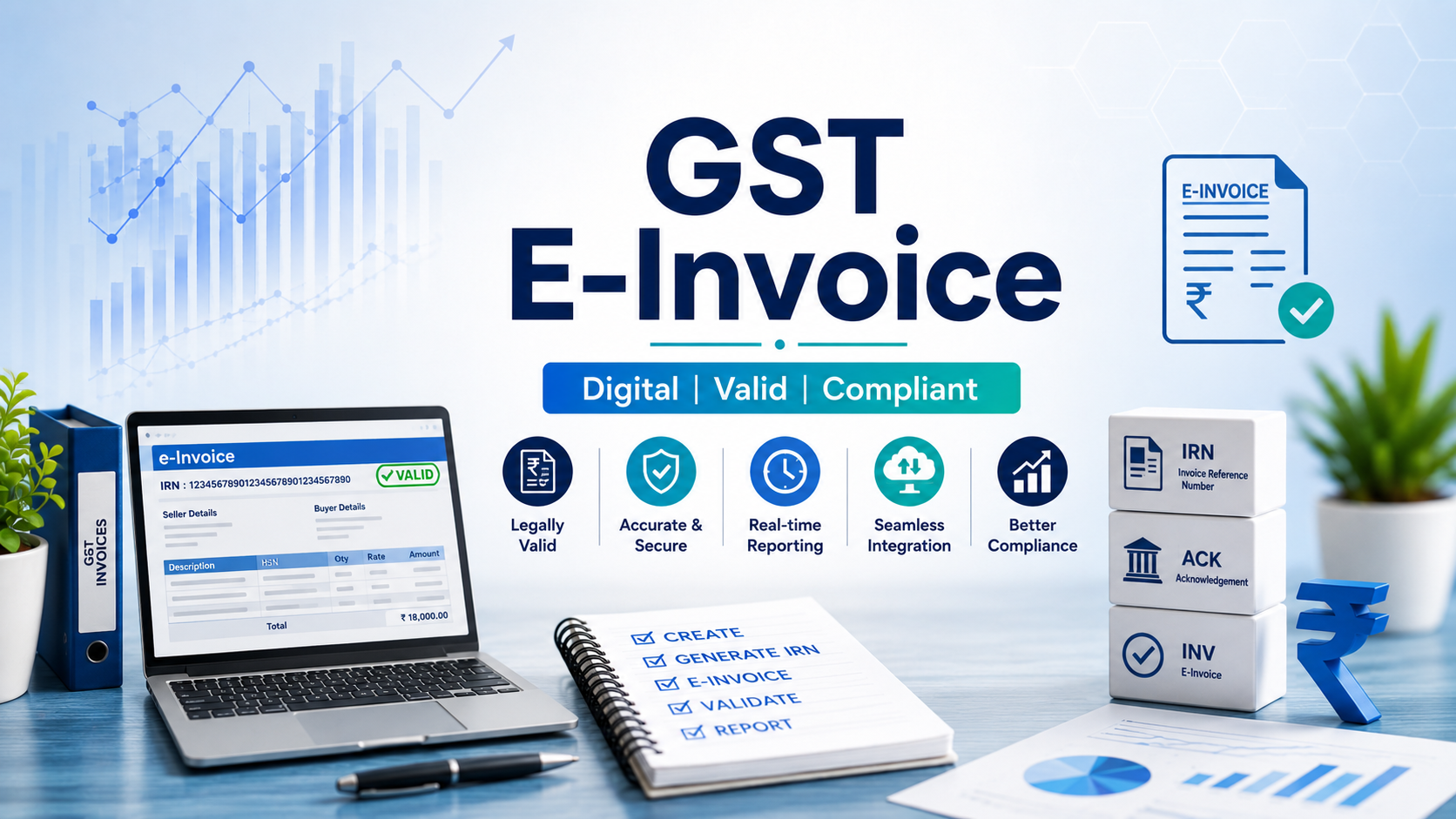
GST e-invoice is not a PDF invoice sent by email. It is a system where eligible businesses report invoice details to a government-authorised portal called the Invoice Registration Portal (IRP), which then validates the invoice and returns a unique Invoice Reference Number (IRN) and a digitally signed QR code.
Only an invoice registered on the IRP and carrying a valid IRN is considered a legally valid GST invoice for B2B transactions. A buyer cannot claim Input Tax Credit (ITC) on an invoice that does not have a valid IRN.
The system was designed to standardise invoice data, eliminate fake invoices, reduce GST mismatch errors, and auto-populate GSTR-1 without manual data entry.
Who Must Generate GST E-Invoice in FY 2025-26?
E-invoicing is mandatory for all GST-registered businesses whose Aggregate Annual Turnover (AATO) exceeds Rs. 5 crore in any financial year from FY 2017-18 onwards.
Key points to note:
Turnover is calculated on a PAN-India basis. If your business has multiple GSTINs under the same PAN across different states, all turnover is combined to determine whether you cross the Rs. 5 crore threshold.
Once applicable, always applicable. If your turnover crossed Rs. 5 crore in any previous year since FY 2017-18, e-invoicing applies to you even if your current year turnover has fallen below that limit.
Threshold crossed mid-year. If your AATO crosses Rs. 5 crore during FY 2024-25, e-invoicing becomes mandatory from FY 2025-26 onwards. It does not apply mid-year from the date of crossing.
Which Transactions Require E-Invoice?
E-invoicing applies to the following types of transactions for eligible businesses:
- B2B supplies (invoices to other GST-registered businesses)
- Exports (with or without payment of IGST)
- Supplies to SEZ units and SEZ developers
- Deemed exports
- Credit notes and debit notes for the above transactions
B2C transactions are not covered. Invoices issued directly to unregistered end consumers do not require IRN generation under the current rules.
Who Is Exempt from GST E-Invoicing?
Even if turnover exceeds Rs. 5 crore, certain categories of registered persons are exempt from e-invoicing under CBIC Notification No. 13/2020 (Central Tax) and subsequent amendments:
- Banks, NBFCs, and other financial institutions
- Insurance companies
- Goods Transport Agencies (GTAs) supplying road transport services
- Passenger transport service providers
- Multiplex cinema operators issuing admission tickets
- SEZ units (note: SEZ developers are not exempt)
- Government departments and local authorities
This exemption is entity-based, not transaction-based. An exempt entity does not need to generate IRNs for any of its supplies, regardless of the transaction type.
The IRP Portal: How E-Invoice Generation Works
The Invoice Registration Portal (IRP) is the government-authorised gateway for e-invoice registration. There are six authorised IRPs currently operational, including the NIC-managed portal at einvoice1.gst.gov.in.
Here is how the process works step by step.
Step 1: Prepare the invoice in your accounting or ERP system.
Your software generates the invoice data in a prescribed JSON format aligned with the PEPPOL schema. This includes mandatory fields such as GSTIN of supplier and buyer, invoice number, invoice date, HSN or SAC codes, item details, and tax breakup.
Step 2: Upload the JSON to the IRP.
The JSON can be uploaded directly on the official IRP portal at einvoice1.gst.gov.in, through a GST Suvidha Provider (GSP), or via API integration with your accounting software.
Step 3: IRP validates and checks for duplicates.
The IRP verifies the invoice data, checks for duplicate invoices using a central registry, and confirms that the supplier GSTIN is active and valid.
Step 4: IRN is generated.
On successful validation, the IRP generates a unique Invoice Reference Number (IRN) using a SHA-256 hash algorithm based on the supplier GSTIN, document number, financial year, and document type. Each IRN is unique across the entire GST system for a given financial year.
Step 5: IRP digitally signs the invoice and embeds the QR code.
The authenticated e-invoice with the IRN and QR code is returned to the supplier.
Step 6: Data auto-flows to GSTR-1 and e-way bill system.
The IRP automatically shares the invoice data with the GST portal and the e-way bill system. This eliminates the need to re-enter invoice data manually in GSTR-1, though you still need to log in and file GSTR-1 each month.
Step 7: Share the invoice with the buyer.
The supplier downloads the signed invoice PDF with the IRN and QR code printed on it and shares it with the buyer. An invoice without a valid IRN is not a valid B2B GST invoice.
The 30-Day Reporting Rule (From April 1, 2025)
From April 1, 2025, businesses with AATO of Rs. 10 crore and above must upload eligible invoices to the IRP within 30 days of the invoice date. Invoices reported after the 30-day window are automatically rejected by the IRP and become invalid for ITC purposes.
This rule currently applies only to businesses with turnover above Rs. 10 crore. Businesses between Rs. 5 crore and Rs. 10 crore are not subject to this time limit as of FY 2025-26, though the government is expected to extend it further.
What Does the QR Code on an E-Invoice Contain?
The QR code embedded in every GST e-invoice contains the following details:
- GSTIN of the supplier
- GSTIN of the buyer
- Invoice number and invoice date
- Invoice value
- Number of line items
- HSN code of the primary item (by value)
- IRN (the unique hash generated by IRP)
- Digital signature of the IRP
The QR code can be scanned by tax authorities, buyers, or auditors to instantly verify the authenticity of any invoice. From 2026, printing the QR code on all physical invoice copies is mandatory for businesses above the e-invoice threshold.
Can You Cancel an E-Invoice?
Yes, but only within 24 hours of generation. Once 24 hours have passed, the IRN cannot be cancelled on the portal. If the invoice needs to be reversed after that window, a credit note must be issued against it.
Cancellations on the e-invoice portal also require cancellation of the linked e-way bill, if one was generated. Partial cancellation of an e-invoice is not permitted.
E-Invoice and GSTR-1: How Auto-Population Works
One of the key benefits of e-invoicing is that B2B invoice data reported to the IRP is automatically pushed to GSTR-1 in Table 4A (B2B invoices) without manual entry. This reduces data entry errors and reconciliation mismatches.
However, auto-population is not a substitute for GSTR-1 filing. You still need to log in to the GST portal, review the auto-populated data, add B2C details and HSN summary, and file GSTR-1 each month. E-invoicing feeds data into GSTR-1 but does not file it for you.
If you are new to GST return filing, my guide on GST basics for Indian businesses covers the full filing structure.
Penalties for Non-Compliance
Failing to generate an e-invoice where it is mandatory has direct consequences:
Invalid invoice. An invoice without a valid IRN is not a legally valid GST invoice for B2B purposes.
ITC blocked for the buyer. The buyer cannot claim Input Tax Credit on a purchase invoice that does not carry a valid IRN, even if GST has been paid.
Penalty under GST law. Non-issuance of a proper tax invoice attracts a penalty of Rs. 10,000 per invoice or 100% of the tax due, whichever is higher.
Blocked e-invoicing access. Repeated non-compliance can result in access to the IRP being restricted.
Phase-Wise Rollout: How the Threshold Has Changed
It helps to understand how quickly the government has expanded e-invoicing coverage since launch:
| Effective Date | Turnover Threshold |
|---|---|
| October 1, 2020 | Above Rs. 500 crore |
| January 1, 2021 | Above Rs. 100 crore |
| April 1, 2021 | Above Rs. 50 crore |
| April 1, 2022 | Above Rs. 20 crore |
| October 1, 2022 | Above Rs. 10 crore |
| August 1, 2023 | Above Rs. 5 crore |
The direction is clear: the threshold is being lowered progressively. Businesses nearing Rs. 5 crore should begin preparing their accounting systems for e-invoice compliance before they cross the limit.
Conclusion
GST e-invoice compliance is no longer limited to large corporations. With the threshold now at Rs. 5 crore and the 30-day upload rule applying to businesses above Rs. 10 crore from April 2025, the system covers a significant portion of the registered business base.
The core principle is straightforward: generate the invoice in your accounting system, upload it to the IRP, get the IRN and QR code, and share the authenticated invoice with your buyer. What makes it critical is that a B2B invoice without a valid IRN is not a valid GST invoice, and your buyer’s ITC claim depends on it.
If your business is approaching the Rs. 5 crore mark, start configuring your accounting software for e-invoice compatibility now. Waiting until you cross the threshold leaves no time to test the integration before compliance becomes mandatory. For freelancers and self-employed professionals navigating GST compliance alongside income tax, my guide on income tax for freelancers covers how both systems interact.
Frequently Asked Questions
My turnover was above Rs. 5 crore in FY 2022-23 but has since dropped. Do I still need to generate e-invoices?
Yes. Once your turnover has exceeded the threshold in any financial year from FY 2017-18 onwards, e-invoicing applies permanently, regardless of whether your current turnover is below the limit.
Does e-invoicing apply to service businesses?
Yes. E-invoicing applies to both goods and services businesses above the turnover threshold. There is no distinction between goods and services for this purpose, except for sector-specific exemptions like banking, insurance, and transport.
Can I generate e-invoices manually on the IRP portal without accounting software?
Yes. The IRP portal offers a web-based interface for manual entry. However, for businesses with high invoice volumes, API integration through accounting software or a GSP is more practical.
Does e-invoicing replace the e-way bill?
No. E-invoicing and e-way bills are separate requirements. However, when an e-invoice is generated for a transaction requiring an e-way bill, Part A of the e-way bill is auto-populated using the e-invoice data. You still need to complete Part B with transporter details.
What if I generate an e-invoice with incorrect details?
You can cancel the e-invoice within 24 hours of generation and re-generate with correct details. Beyond 24 hours, a credit note is the only correction mechanism.
Is e-invoicing applicable for supplies made to government departments?
Yes. Supplies to government departments by eligible businesses require e-invoicing. Government departments themselves are exempt from generating e-invoices for their own outward supplies.