Best Tax-Free Investment Options in India
Ramesh assumed his EPF balance was completely tax-free no matter how much he contributed, until a Voluntary Provident Fund top-up pushed him past a threshold he had never heard of. Searching for best tax free investment options in India usually turns up lists that treat every entry as unconditionally exempt, when several of the most popular ones only stay tax-free up to a specific limit. Here is a properly ranked tax free investment India list for FY 2025-26, caveats included.
1. Public Provident Fund
PPF sits at the top of this list because it has no partial-taxability catch. Contribution, interest, and maturity are all exempt, a genuine EEE structure, and since annual contributions are capped at Rs. 1,50,000 by rule, there is no way to accidentally contribute your way into a taxable slice of interest the way you can with EPF. The trade-off is a 15-year lock-in and a government-set interest rate that moves periodically rather than tracking the market.
2. Sukanya Samriddhi Yojana
For a girl child under 10, this scheme offers the same clean EEE treatment as PPF, contribution, interest, and maturity all tax-free, typically at a rate a notch higher than PPF’s own. The account matures when the girl turns 21, or can close earlier for her marriage after she turns 18, and the annual contribution cap sits at the same Rs. 1,50,000 as PPF.
3. EPF, With a Threshold Most People Don’t Know About
EPF interest is tax-free, but only on your own contribution up to Rs. 2,50,000 a year, or Rs. 5,00,000 if your employer does not contribute at all, as with some government pension arrangements. Interest earned on whatever you contribute above that threshold is taxable as income from other sources. This mainly affects higher earners who top up their EPF through a Voluntary Provident Fund without realising the exemption has a ceiling. On Rs. 1,00,000 contributed above the threshold, at the current 8.25% rate, that works out to roughly Rs. 8,250 in interest, taxed at your slab rate, close to Rs. 2,570 in tax at 30% including cess, on money many people assumed was entirely tax-free.
4. Life Insurance Maturity Proceeds
Under Section 10(10D), a traditional life insurance policy’s maturity payout is tax-free if the annual premium stays within 10% of the sum assured, and for policies issued on or after April 1, 2023, the aggregate annual premium across all such policies must also stay within Rs. 5,00,000. ULIPs follow a similar 10% rule, with a lower Rs. 2,50,000 aggregate premium ceiling for policies issued on or after February 1, 2021. Pure term insurance, which pays out only on death and has no maturity value, is always exempt, since there is no maturity payout to tax in the first place.
5. Sovereign Gold Bonds, Held to Maturity by the Original Subscriber
Capital gains on an SGB are exempt at its 8-year maturity, but from April 2026 onward this exemption is restricted to investors who bought directly from RBI at issue and held continuously to maturity, a rule I have covered in more depth in my bonds vs debentures vs FD guide. Secondary market buyers and anyone exiting early through the 5-year premature redemption window now pay 12.5% LTCG on the gain. The 2.5% annual interest on SGBs remains taxable at slab rate throughout, this exemption only ever covered the capital gains portion at exit.
6. Legacy Tax-Free Bonds
Older government-notified bonds from issuers like NHAI, PFC, and IRFC, issued mainly between 2012 and 2016, carry fully tax-exempt interest under Section 10(15). No new tax-free bond issues have come to market in recent years, so this option applies only to investors who already hold this older paper, typically bought on the secondary market, since these bonds are no longer issued fresh.
7. Agricultural Income
Genuine agricultural income is fully exempt from income tax under the Constitution, not just the Income Tax Act. The one nuance worth knowing is partial integration, if you also have non-agricultural income above the basic exemption limit, your agricultural income still gets added to determine which tax slab your other income falls into, even though the agricultural income itself is never actually taxed.
8. Gratuity
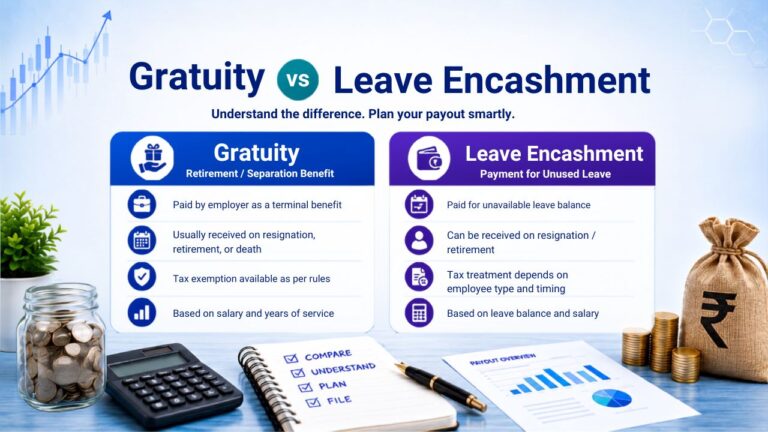
Gratuity received by a government employee is fully exempt with no ceiling at all. Private sector employees get the same exemption only up to Rs. 20,00,000, with anything above that taxable. Since this depends entirely on when and how you retire rather than a choice you make while investing, it belongs on this list more as an outcome to plan around than an investment to actively pursue.
9. Leave Encashment
The same government-versus-private split applies here. Government employees get full exemption on leave encashment at retirement, private sector employees are capped at Rs. 25,00,000. Like gratuity, this is a retirement benefit rather than something you actively invest in, but it is worth knowing the ceiling before assuming your entire payout will be tax-free.
10. Scholarships
Scholarships granted to meet the cost of education are fully exempt under Section 10(16), with no upper monetary limit specified in the section itself. This applies whether the scholarship comes from the government, an educational institution, or a private trust, as long as it is genuinely intended to cover educational expenses rather than being a disguised salary or stipend for work performed.
Why Tax Free Investment Options in India Beat an Equivalent FD
The value of a genuinely tax-free return is easiest to see against a taxable equivalent earning the identical rate. On Rs. 1,00,000 at 7.1% for a year, a PPF-style tax-free instrument delivers the full Rs. 7,100 in interest with nothing deducted. A fixed deposit paying the same 7.1% hands you Rs. 7,100 in gross interest too, but after tax at a 30% slab plus cess, only about Rs. 4,885 actually reaches you. That is a gap of roughly Rs. 2,215 on the same nominal rate, purely from taxability, which is exactly why a lower headline rate on a genuinely tax-free instrument can still outperform a higher-rate taxable one once you compare what actually lands in your hands.
This is also why the threshold-based entries on this list deserve real attention rather than a passing glance. An EPF balance that stays under the Rs. 2,50,000 annual contribution threshold captures this full advantage. Push past it through an aggressive VPF top-up, and the portion above the threshold quietly starts behaving like a taxable FD instead, without the tax-free investment India label most people mentally attach to their entire EPF balance.
Why the Caveats Matter More Than the Ranking
In my seven years of reviewing portfolios, the mistake I see most with tax free investment India lists is treating every entry as unconditionally exempt. PPF and Sukanya Samriddhi genuinely are, no asterisks attached. EPF, life insurance, SGBs, gratuity, and leave encashment all carry a threshold or condition that quietly caps how much of your actual payout stays tax-free. Knowing exactly where that line sits for each one matters more than simply picking a name off a list.
Conclusion
PPF and Sukanya Samriddhi remain the cleanest fully tax-free options available today, with no conditions to track. Everything else on this list is genuinely tax-free too, just within a specific boundary worth knowing before you assume the entire amount is protected. Check your own numbers against these thresholds, particularly if you are a high earner topping up EPF voluntarily or holding a large traditional life insurance policy, since that is exactly where people quietly lose the exemption they thought they had. None of this means avoiding EPF, life insurance, or SGBs, it simply means sizing your contribution or entry with the actual threshold in mind rather than assuming unlimited exemption applies. For a broader comparison of tax-saving investments generally, see my PPF vs ELSS vs NPS guide.
Frequently Asked Questions
Is fixed deposit interest ever tax-free?
No, regular fixed deposit interest is always taxable at your slab rate, it does not belong on a genuinely tax-free list, though TDS may not be deducted if your interest stays under the threshold and you submit Form 15G or 15H.
Does the new tax regime change any of these exemptions?
Most of these exemptions, PPF, Sukanya Samriddhi, EPF interest within the threshold, life insurance maturity, agricultural income, gratuity, leave encashment, and scholarships, apply regardless of which regime you choose, since they operate as exemptions on the income itself rather than as Chapter VI-A deductions tied to the old regime.
Can I still buy a legacy tax-free bond today?
Only on the secondary market from an existing holder, since no new issues have come to market in recent years. Capital gains on selling such a bond before its own maturity are still taxable under the normal bond rules, only the interest itself carries the exemption.
How do I know if my EPF contribution is close to the Rs. 2.5 lakh threshold?
Add your mandatory EPF contribution and any Voluntary Provident Fund top-up together for the year, since both count toward the same limit. Your payslip or annual PF statement shows the combined figure, and it is worth checking this before deciding how much extra to route into VPF for the year.
Does the Rs. 2.5 lakh EPF threshold include my employer’s contribution?
No, the threshold applies only to your own contribution, including any Voluntary Provident Fund amount, not your employer’s share. Your employer’s contribution is tracked separately under its own combined limit alongside NPS and superannuation contributions.
Are PPF and Sukanya Samriddhi worth it if I am already on the new tax regime and lose the 80C deduction?
The 80C deduction on the contribution itself is lost under the new regime, but the tax-free interest and maturity treatment still applies regardless of regime, since that exemption operates independently of Section 80C. You give up the upfront deduction benefit, not the tax-free growth on whatever you do contribute.