LTA vs HRA: Which Salary Component Saves More Tax in 2026
Every salaried employee I speak with eventually asks me the same question during salary structuring season: LTA or HRA, which one actually saves more tax? The honest answer to the lta vs hra tax saving 2026 question is that it depends entirely on your salary structure and your life circumstances, but the two allowances are not interchangeable, and most people are comparing them the wrong way. Let me walk you through how each one actually works before we get to the comparison.
What is HRA and How Does the Exemption Work
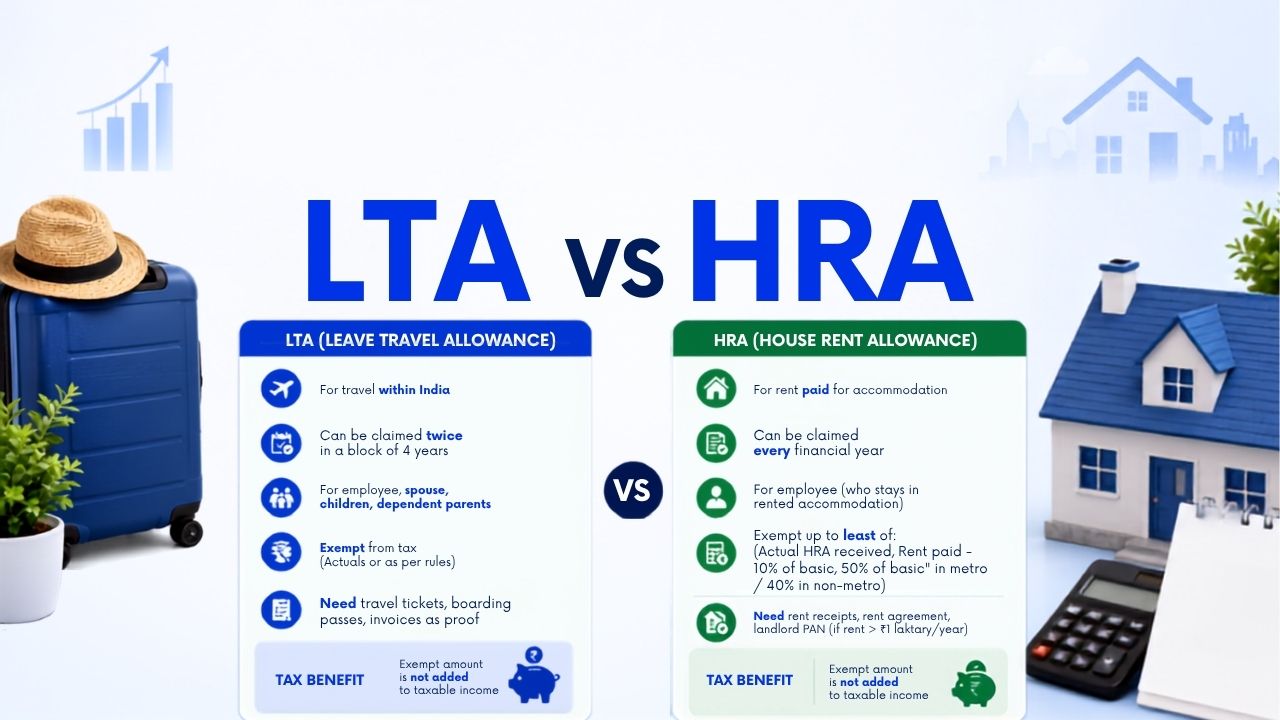
House Rent Allowance is the salary component your employer pays you to help cover rent. It is exempt under Section 10(13A), but only if you are paying rent and you have chosen the old tax regime. The exempt amount is the lowest of three figures:
- Actual HRA received from your employer
- 50% of basic salary if you live in a metro city, or 40% if you live elsewhere
- Rent paid minus 10% of basic salary
Whichever of these three numbers is smallest becomes your tax-free HRA. Everything above that gets added back to your taxable salary. I have written a complete walkthrough with formulas and city-wise rules in my HRA exemption calculation guide if you want the full detail.
One point that trips people up every year: for the ITR you are filing this July for FY 2025-26, only Delhi, Mumbai, Kolkata and Chennai count as metro cities at the 50% rate. Bengaluru, Hyderabad, Pune and Ahmedabad move to the 50% bracket only from FY 2026-27 onward, which is the salary you are earning right now but will only file for in July 2027.
What is LTA and How Does the Exemption Work
Leave Travel Allowance works completely differently. It is exempt under Section 10(5), and it rewards actual domestic travel rather than a fixed monthly cost. To claim it, you need to actually take leave and travel within India, and the exemption is capped at the lowest of your employer’s LTA component, the actual fare you paid, and the fare for the shortest route by an eligible mode: economy class for air travel, AC first class for rail, or the equivalent for road transport. Hotels, food and sightseeing are never covered, only the fare itself.
The other big difference is timing. LTA runs on four-calendar-year blocks, not financial years, and you can claim it for only two journeys per block. The block that just ended ran from 2022 to 2025. We are now inside the new block, which runs from 1 January 2026 to 31 December 2029. If you did not use both journeys in the last block, you can carry forward one unused journey into 2026, but only into 2026, not any later year of the new block.
LTA vs HRA Tax Saving in 2026: Side by Side Comparison
| Factor | HRA (Section 10(13A)) | LTA (Section 10(5)) |
|---|---|---|
| What it covers | Rent for your residence | Domestic travel fare during leave |
| Frequency | Every month, ongoing | Twice per 4-year block |
| Exemption basis | Lowest of HRA received, 50%/40% of basic, rent minus 10% of basic | Lowest of employer LTA amount and actual eligible fare |
| Documentation | Rent receipts, rent agreement, landlord PAN if rent exceeds Rs. 1 lakh a year | Travel tickets, boarding passes, proof of leave |
| Family coverage | Not applicable, based on your own rent | Self, spouse, up to 2 children, dependent parents/siblings |
| Regime availability | Old regime only | Old regime only |
| Typical exemption size | Large, often several lakhs a year for renters in expensive cities | Smaller, capped by actual travel fare and employer’s LTA component |
Real Example: Priya’s LTA vs HRA Tax Saving in 2026
Priya works in Bengaluru on a basic salary of Rs. 60,000 a month, receives Rs. 30,000 a month as HRA, and pays Rs. 28,000 a month in rent. She has opted for the old regime.
Her HRA exemption:
- Actual HRA received: Rs. 3,60,000
- 40% of basic (Bengaluru is still non-metro for this filing year): Rs. 2,88,000
- Rent minus 10% of basic: Rs. 3,36,000 minus Rs. 72,000 = Rs. 2,64,000
- Exempt amount (lowest of the three): Rs. 2,64,000
Her LTA exemption:
Her employer gives her Rs. 40,000 a year as LTA. This year she travelled by AC first class train with her family of three, and the eligible fare came to Rs. 32,000.
- Exempt amount (lower of the two): Rs. 32,000
- The remaining Rs. 8,000 of her LTA component becomes taxable, since she did not spend that much on eligible travel
At the 30% tax slab, her HRA exemption saves her roughly Rs. 79,200 in tax, while her LTA exemption saves her roughly Rs. 9,600. Between the two, HRA is doing more than eight times more work for Priya this year, simply because it is a much larger, monthly component tied to a real, recurring cost.
Worth noting: even under the FY 2026-27 rule where Bengaluru becomes a 50% metro city, Priya’s exemption would not actually increase, because the binding constraint in her case is rent minus 10% of basic, not the metro percentage. The metro upgrade helps most when rent is high relative to the 40%/50% ceiling itself, not in every case.
When HRA Saves You More Tax
For most salaried employees paying real market rent in a city, HRA saves more tax than LTA, and it isn’t close. This is really the core of the lta vs hra tax saving 2026 decision for most renters: HRA is a large, recurring exemption that runs every single month of the year. If you are paying meaningful rent and your basic salary supports it, HRA will almost always be the bigger lever in your salary structure, and it deserves more attention than LTA when you are negotiating your CTC breakup with HR.
When LTA Saves You More Tax
LTA becomes more relevant when HRA isn’t available to you at all, most commonly because you live in your own house or with family and pay no rent. In that case, your HRA exemption is zero regardless of how much HRA your employer pays you, and LTA becomes one of the few salary-linked exemptions still open to you under the old regime.
Take Rahul, who owns his home in his home city and receives Rs. 28,000 a month as HRA. Since he pays no rent, his entire Rs. 3,36,000 in annual HRA is taxable. His employer gives him Rs. 50,000 a year as LTA, and this year he used it on a family trip with an eligible fare of Rs. 46,000. That entire amount is exempt, saving him roughly Rs. 13,800 in tax at the 30% slab. It is a smaller number than Priya’s HRA saving, but for Rahul, it is his only lever, so it matters a great deal.
Can You Claim Both LTA and HRA Together?
Yes. There is no rule that forces you to pick one over the other. If your salary structure includes both components, you are eligible to rent your home, pay for it, and claim HRA, while also travelling on leave and claiming LTA, in the same financial year, under the old regime. They sit under the same broader umbrella of Section 10 exemptions, and most well-structured CTCs are designed to let you use both.
Why This Comparison Doesn’t Matter If You Choose the New Regime
Both HRA and LTA exemptions disappear completely under the new tax regime, which has been the default since FY 2025-26. Whichever way your lta vs hra tax saving 2026 comparison plays out on paper, none of it applies if you pick the new regime, since your entire HRA and LTA components become fully taxable as salary, regardless of your rent or your travel. This is exactly why the old vs new regime decision has to come first. I have broken down that full comparison, including where the crossover point typically lands based on your deductions, in my old vs new tax regime guide. If you pay substantial rent and travel regularly, the old regime combined with LTA, HRA and your Section 80C investments usually wins. For a broader list of ways to bring down your tax outgo beyond these two, my tax saving tips for salaried employees covers the rest of the toolkit.
Frequently Asked Questions
Is LTA or HRA better for tax saving in 2026?
For most renters, HRA saves more because it is a larger, monthly exemption. LTA saves more only when HRA is unavailable, typically because you live in your own home and pay no rent.
Can I claim LTA and HRA in the same year?
Yes, both can be claimed together in the same financial year under the old tax regime, as long as you meet the conditions for each separately.
What is the current LTA block year?
The current block runs from 1 January 2026 to 31 December 2029. You can claim exemption for two journeys within this block, plus one carried-forward journey from the 2022-2025 block, but only if used within 2026.
Are LTA and HRA available under the new tax regime?
No. Both exemptions are available only under the old tax regime. Under the new regime, both components are fully taxable.
Does LTA cover international travel?
No. LTA under Section 10(5) covers domestic travel within India only. International trips do not qualify for any exemption.
Do I need to submit proof to claim these exemptions?
Yes. For HRA, you need rent receipts and a rent agreement, with landlord PAN if annual rent exceeds Rs. 1 lakh. For LTA, you need travel tickets, boarding passes, and proof that you were on sanctioned leave. You can find the official provisions for both on the Income Tax Department’s website.