Tax on Online Gaming in India: 30% Rate, TDS and How to Report in ITR
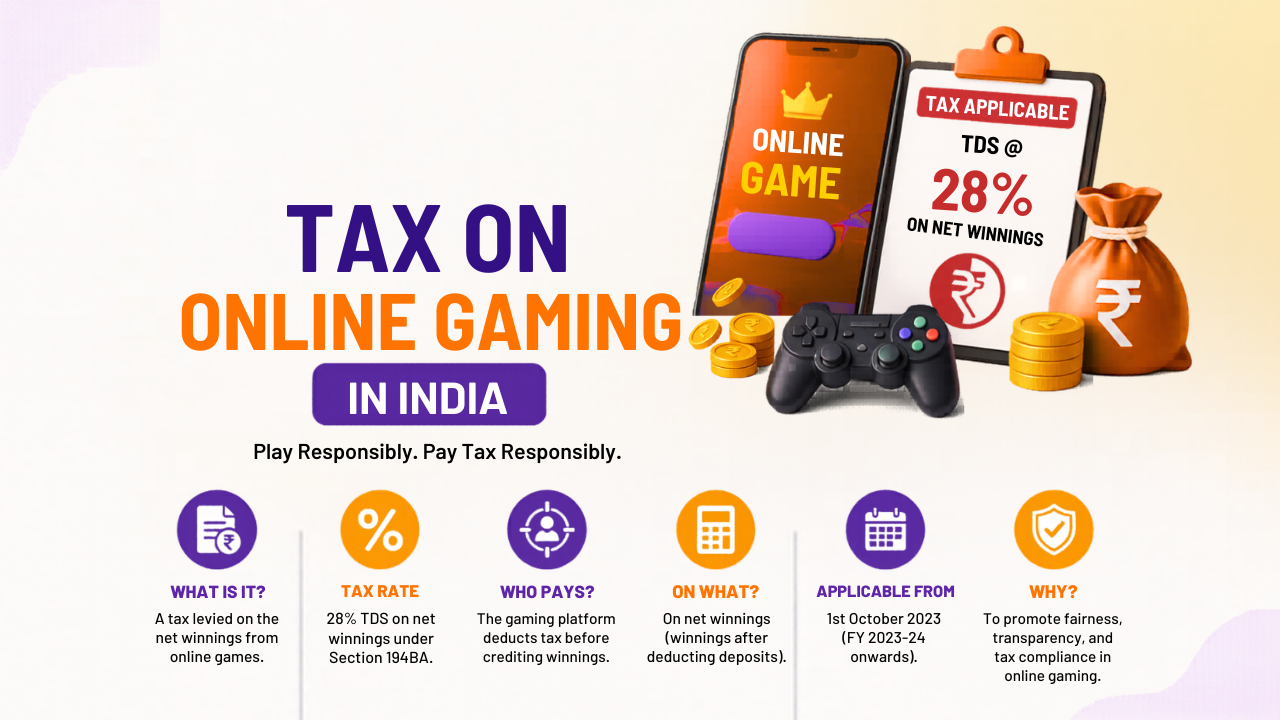
Tax on online gaming in India is charged at a flat 30% rate under Section 115BBJ of the Income Tax Act. If you earned money through Dream11, MPL, Rummy Circle, WinZO or any other real-money gaming platform before August 22, 2025, that income is taxable. The Income Tax Department receives this data directly from gaming platforms through TDS returns. If it appears in your AIS and you do not declare it in your ITR, you will receive a notice.
This guide explains exactly how online gaming income is taxed in India, how TDS works, how net winnings are calculated, and where to report this income in your ITR for FY 2025-26.
Important Update – Online Gaming Act 2025: The Promotion and Regulation of Online Gaming Act, 2025 received Presidential assent on August 22, 2025. This Act bans all real-money online gaming platforms in India. Winnings earned before August 22, 2025 remain taxable and must be reported in your FY 2025-26 ITR. Constitutional challenges to the Act are ongoing in the Karnataka High Court and other forums.
The Legal Framework: Two Sections, One Special Tax Regime
The Finance Act 2023 introduced a dedicated tax regime for online gaming income through two provisions:
- Section 115BBJ charges income tax at a flat 30% on net winnings from online games, applicable from FY 2023-24.
- Section 194BA requires gaming platforms to deduct TDS on those net winnings, applicable from April 1, 2023.
The Income Tax Act 2025, effective from April 1, 2026, retains this framework. For your FY 2025-26 ITR filed in July 2026, you will still reference the old section numbers because the new Act section numbers apply only from Tax Year 2026-27 onwards. For details on how the renumbering works, see New Income Tax Section Numbers: Complete Mapping.
What Is Taxed: Net Winnings, Not Gross Winnings
Tax under Section 115BBJ is levied on net winnings, not gross winnings. This is the core difference between online gaming and lottery or gambling, where tax applies to gross winnings under Section 115BB.
Net winnings represent your actual profit across the financial year, calculated after accounting for all deposits, withdrawals, and account balances using the formula prescribed in Rule 133 of the Income Tax Rules.
How Net Winnings Are Calculated: Rule 133
CBDT introduced Rule 133 via Notification No. 28/2023 dated May 22, 2023. It prescribes different formulas for three situations: your annual tax liability under Section 115BBJ, TDS at the time of each withdrawal under Section 194BA, and TDS on the closing balance at year-end under Section 194BA.
Formula 1: Annual tax liability under Section 115BBJ
Net Winnings = (A + D) minus (B + C)
A = Aggregate amount withdrawn from the user account during the financial year B = Aggregate non-taxable deposits made during the financial year C = Opening balance at the beginning of the financial year D = Closing balance at the end of the financial year
This is the formula you use when calculating your total tax liability for the year when filing your ITR.
Formula 2: TDS on the first withdrawal during the financial year
Net Winnings = A minus (B + C)
A = Amount withdrawn from the user account B = Aggregate non-taxable deposits made during the financial year up to the time of this withdrawal C = Opening balance at the beginning of the financial year
Net winnings will be treated as zero if B plus C equals or exceeds A.
Formula 3: TDS on each subsequent withdrawal during the financial year
Net Winnings = A minus (B + C + E)
A = Aggregate amount withdrawn during the financial year up to and including this withdrawal B = Aggregate non-taxable deposits made during the financial year up to this withdrawal C = Opening balance at the beginning of the financial year E = Net winnings from earlier withdrawals during the financial year on which TDS has already been deducted under Section 194BA
Net winnings will be treated as zero if B plus C plus E equals or exceeds A. The variable E prevents double taxation on amounts already taxed in earlier withdrawals.
Formula 4: TDS on the closing balance at year-end (March 31)
Net Winnings = (A + D) minus (B + C + E)
A = Aggregate amount withdrawn from the user account during the financial year B = Aggregate non-taxable deposits made during the financial year C = Opening balance at the beginning of the financial year D = Closing balance at the end of the financial year E = Net winnings from all earlier withdrawals during the financial year on which TDS has already been deducted under Section 194BA
Net winnings will be treated as zero if B plus C plus E equals or exceeds A plus D.
What counts as a non-taxable deposit: Non-taxable deposits are amounts deposited by the user from already-taxed income or income not chargeable to tax, such as money borrowed and deposited into the gaming account. Only non-taxable deposits are deducted in the formulas.
What counts as a taxable deposit: As clarified in CBDT Circular No. 5/2023 (dated May 22, 2023), bonuses, referral bonuses, incentives and promotional credits given by the platform are taxable deposits. They increase the account balance and are not deducted in the formula. Exception: if a bonus is credited solely for playing and cannot be withdrawn, it is excluded from both opening and closing balance calculations. If the platform later allows that bonus to be withdrawn, it becomes a taxable deposit at that point.
Worked example using Formula 1:
| Item | Amount |
|---|---|
| Opening balance (April 1) | Rs. 0 |
| Non-taxable deposits during the year | Rs. 20,000 |
| Total withdrawn during the year | Rs. 35,000 |
| Closing balance (March 31) | Rs. 2,000 |
| Net winnings: (35,000 + 2,000) minus (20,000 + 0) | Rs. 17,000 |
| Tax at 30% | Rs. 5,100 |
If net winnings work out to a negative figure, no tax is payable. That loss cannot be set off against any other income and cannot be carried forward to future years.
Multiple accounts: If you have more than one account or wallet with the same gaming platform, all accounts are aggregated for calculating net winnings. A transfer between two accounts of the same user on the same platform is not treated as a withdrawal or deposit.
Tax Rate: 30% Flat with No Deductions
Section 115BBJ charges a flat 30% tax on net winnings. This rate applies regardless of your total income or tax slab.
- No basic exemption limit. Even Rs. 500 of net winnings is taxable from the first rupee.
- No deductions of any kind are allowed, including Section 80C, Section 80D, standard deduction, or gaming-related expenses such as internet charges or subscription fees.
- Losses from one game cannot be set off against winnings from another game or against income under any other head.
- Losses cannot be carried forward.
- Section 115BBJ contains a non-obstante clause that overrides all other provisions of the Act. Even if you play online games full-time as a profession with a dedicated setup and employees, your winnings are taxed under Section 115BBJ at 30% and not as business income at slab rates.
In addition to the base 30% tax, Health and Education Cess at 4% applies on the tax amount. Surcharge applies only if your total income from all sources exceeds Rs. 50 lakh.
How TDS Works Under Section 194BA
The gaming platform is responsible for deducting TDS, not the player. TDS is deducted in two situations.
At the time of each withdrawal: When you withdraw money from your gaming account, the platform applies Formula 2 for your first withdrawal of the year and Formula 3 for each subsequent withdrawal. It deducts 30% TDS on the net winnings calculated at that point before crediting the remaining amount to your bank account.
At the end of the financial year (March 31): On any net winnings remaining in your account at year-end that have not yet been subject to TDS, the platform applies Formula 4 and deducts TDS on the closing balance.
There is no minimum threshold under Section 194BA. Unlike Section 194B, which applies to lottery winnings only when they exceed Rs. 10,000, Section 194BA applies from the first rupee of net winnings.
CBDT Circular No. 5/2023 concession for very small amounts: For platforms where users play with very small amounts, the circular allows TDS to be skipped on a particular withdrawal if net winnings in that withdrawal do not exceed Rs. 100 in a month. In such cases, TDS must be deducted either when net winnings in a subsequent withdrawal exceed Rs. 100 in the same or next month, or at year-end, whichever comes first. The platform must undertake responsibility for any shortfall if the user’s account balance is insufficient at the time of deduction.
Why your AIS may show unexpected TDS entries: Many players find TDS entries in their Annual Information Statement for amounts they did not expect to be taxed on. The reason is the year-end deduction. If you had net winnings sitting in your gaming account on March 31, the platform deducted TDS on that balance even if you had not withdrawn it. This TDS is reported to the Income Tax Department under your PAN and appears in your AIS under the online gaming category.
Online Gaming vs Lottery and Gambling: Key Differences
| Online Gaming | Lottery, Gambling, Horse Racing | |
|---|---|---|
| Applicable section | 115BBJ and 194BA | 115BB and 194B |
| What is taxed | Net winnings | Gross winnings |
| TDS threshold | No threshold | Rs. 10,000 per winning |
| Loss set-off | Not permitted | Not permitted |
| ITR schedule | Schedule OS, Section 115BBJ field | Schedule OS, Section 115BB field |
Reporting gaming income under the lottery field or vice versa creates a mismatch between your ITR and your AIS data, which can trigger a processing notice.
Winnings in Kind: Merchandise, Vouchers and Prizes
If you win a laptop, smartwatch, travel voucher or any non-cash prize, its Fair Market Value on the date of receipt is included in your net winnings and taxed at 30%. If the platform purchased the prize before awarding it, the purchase price is used as the value. If the platform manufactured the prize, the price it charges customers for that item is used.
The platform must ensure tax is settled before releasing the prize. If the prize is partly in cash and partly in kind, and the cash portion is insufficient to cover the full TDS liability, the platform releases the prize only after the winner provides proof of tax payment such as challan details.
Note: GST is not included in the valuation of prizes for TDS purposes under Section 194BA, as clarified by CBDT.
How to Report Online Gaming Income in Your ITR
Online gaming winnings are reported under Income from Other Sources.
Which ITR form to use:
| Income profile | Correct form |
|---|---|
| Salary income plus gaming winnings | ITR-2 |
| Business or professional income plus gaming | ITR-3 |
| ITR-1 (Sahaj) | Cannot be used; ITR-1 has no Section 115BBJ schedule |
For a complete guide on selecting the right form, see New ITR Forms AY 2026-27: Who Should File Which Form.
Step-by-step:
Step 1: Check your AIS first. Log in to incometax.gov.in, go to e-File, then AIS, and review the Online Gaming Winnings category. Cross-check the TDS entries against what you received from each platform.
Step 2: Open ITR-2 or ITR-3 under Tab 1. Select Tab 1 (Income Tax Act 1961) for your AY 2026-27 return. Tab 2 is for Tax Year 2026-27 returns filed in 2027.
Step 3: Enter winnings in Schedule OS. In Schedule OS, enter your net winnings in the dedicated Section 115BBJ field. Do not enter it in the lottery or gambling field.
Step 4: Claim TDS credit in Schedule TDS. Enter the TDS details from your Form 26AS and AIS in Schedule TDS to receive credit for tax already deducted by the platform.
Step 5: Do not claim any deductions. No expenses, no Section 80C, no standard deduction applies to income under Section 115BBJ.
Advance tax: If TDS deducted by the platform falls short of your actual tax liability at 30%, you may need to pay advance tax to avoid interest under Sections 234B and 234C.
Common Mistakes That Attract Notices
Not declaring gaming income. The platform reports TDS under your PAN directly to the Income Tax Department. This data appears in your AIS. If your ITR does not reflect this income, the system flags the mismatch automatically.
Filing ITR-1 when ITR-2 is required. ITR-1 has no Section 115BBJ schedule. Filing ITR-1 with gaming income results in a defective return notice under Section 139(9). See ITR Filing FY 2025-26: Step-by-Step Guide for the complete process.
Not claiming TDS credit. If you do not enter platform TDS in Schedule TDS, you lose the credit for tax already paid.
Attempting to set off gaming losses. The ITR utility does not permit a negative figure in the Section 115BBJ field. Any attempt to set off gaming losses against other income will be rejected during processing.
Reporting under the wrong schedule. Online gaming income (Section 115BBJ) and lottery income (Section 115BB) are entered in different fields within Schedule OS. Entering gaming income in the lottery field causes a mismatch with your AIS.
Key Facts at a Glance
| Point | Detail |
|---|---|
| Tax rate | 30% flat under Section 115BBJ |
| What is taxed | Net winnings, not gross |
| Annual net winnings formula | (A + D) minus (B + C) |
| TDS rate | 30% under Section 194BA |
| TDS threshold | None, applies from first rupee |
| Who deducts TDS | Gaming platform, not the player |
| Deductions allowed | None |
| Loss set-off | Not permitted |
| Carry forward of losses | Not permitted |
| ITR form | ITR-2 or ITR-3 |
| Where in ITR | Schedule OS, Section 115BBJ field |
| TDS credit | Schedule TDS in ITR |
| Due date (salaried) | July 31, 2026 |
| Due date (business without audit) | August 31, 2026 |
For all ITR deadlines including belated and revised return dates, see ITR Filing Last Date 2026.