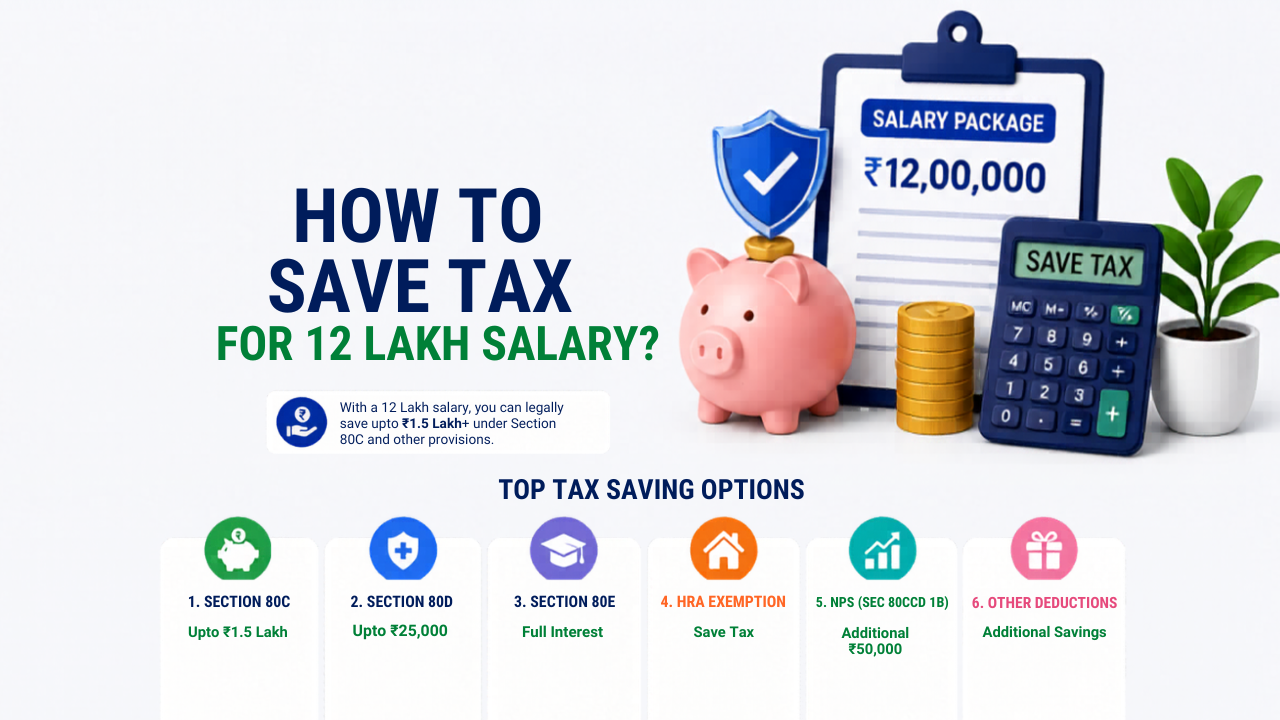
How to Save Tax for 12 Lakh Salary?
For FY 2025-26, taxpayers earning income up to Rs. 12 lakh enjoy zero tax liability under the new tax regime. This is due to relaxed tax slabs and a tax rebate of up to Rs. 60,000 under Section 87A. However, if your income is above Rs. 12 lakh, the rebate is not available and tax applies on the full computed amount. With the right deductions and exemptions, you can still bring down your tax liability significantly under both regimes.
This guide covers all available options under the new and old tax regime, with a worked example and a practical strategy to help you plan for FY 2025-26. You can also check the applicable slab rates in our Income Tax Slabs FY 2026-27 guide.
Key Deductions Under the New Tax Regime
The new tax regime does not allow most Chapter VI-A deductions. However, the following are still available:
1. Standard Deduction: Rs. 75,000
A flat standard deduction of Rs. 75,000 is available against salary income under the new tax regime. This is automatic and requires no documentation. Read more in our Standard Deduction FY 2026-27 guide.
2. Employer Contribution to NPS: Section 80CCD(2)
Employer’s contribution to NPS can be claimed as a deduction under Section 80CCD(2), up to 14% of basic pay under the new tax regime. This is one of the most effective deductions available under the new regime and works in addition to the standard deduction.
3. Home Loan Interest on Let-Out Property: Section 24
If you have rented out your property, the entire interest paid on the home loan can be claimed as a deduction under Section 24, without any upper limit. This is available under both old and new tax regime for let-out properties.
4. Retirement Benefits
Gratuity, leave encashment, and other retirement settlements are eligible for exemptions under the new regime, subject to threshold limits prescribed under the Income Tax Act.
Key Deductions and Exemptions Under the Old Tax Regime
The old tax regime allows a broader set of exemptions and deductions against salary income. These are divided into two categories: exemptions and deductions.
Exemptions Available Under the Old Regime
| Salary Component | Taxability |
|---|---|
| Basic Pay | Fully taxable |
| Dearness Allowance (DA) | Fully taxable |
| House Rent Allowance (HRA) | Exempt up to a certain limit |
| Leave Travel Allowance (LTA) | Actual travel ticket expenses exempt for two trips in 4 years under Section 10(5) |
| Mobile/Internet Reimbursement | Exempt if used predominantly for office purposes and bills are submitted |
| Children’s Education and Hostel Allowance | Rs. 4,800 per child (maximum 2 children) |
| Food Expenses | Rs. 50 per meal (maximum 2 meals a day). Annual exemption = Rs. 26,400 |
| Professional Tax | Generally Rs. 2,400 (varies from state to state) |
For the full HRA exemption calculation method, refer to our HRA Exemption Calculation guide.
Deductions Available Under the Old Regime
| Particulars | Limit |
|---|---|
| Standard Deduction | Rs. 50,000 |
| Section 80D: Health Insurance Premium | Self, spouse, and dependent children: Rs. 25,000 (Rs. 50,000 if aged 60 and above). Parents: Rs. 25,000 (Rs. 50,000 if aged 60 and above) |
| Section 80E: Education Loan Interest | Interest deduction for 8 years from the year of repayment of loan taken for higher education of yourself, spouse, dependent children, or a student of whom you are the legal guardian |
| Section 80G: Donations to Charity | 50% or 100% of the eligible amount depending on the institution |
| Section 80C: Tax Saving Investments | Up to Rs. 1.5 lakh per year. Eligible options include EPF, PPF, ELSS, home loan principal repayment, stamp duty, Sukanya Samriddhi Yojana, NSC, 5-year fixed deposits, and more |
| Section 80DD: Disabled Dependents | 40% disability: Rs. 75,000. Severe or 80% disability: Rs. 1,25,000 |
| Home Loan Deductions | Principal repayment: up to Rs. 1.5 lakh under Section 80C. Interest: up to Rs. 2 lakh under Section 24(b) |
| Life Insurance Policy Maturity | Maturity proceeds are tax exempt if sum assured is at least 10x the annual premium for policies issued after 1 April 2012 (20x for policies issued before 1 April 2012, and 15x for policies issued after 1 April 2013 for persons with disability or disease) |
For full details on all Section 80C investment options, read our Section 80C Deductions guide. For Section 80D limits and eligibility, refer to our Section 80D Health Insurance guide.
Tax Calculation Example: Rs. 12 Lakh Salary Under Old and New Regime
Consider Mr. A with a gross salary of Rs. 12 lakh who is eligible to claim the following:
- HRA: Rs. 60,000
- LTA: Rs. 20,000
- Professional Tax: Rs. 2,400
- Section 80C: Rs. 1,50,000
- Section 80D: Rs. 50,000
- Section 80E: Rs. 25,000
| Particulars | Old Tax Regime | New Tax Regime |
|---|---|---|
| Gross Salary under Section 17(1) | Rs. 12,00,000 | Rs. 12,00,000 |
| Less: HRA Exemption | Rs. 60,000 | Not applicable |
| Less: LTA Exemption | Rs. 20,000 | Not applicable |
| Less: Standard Deduction | Rs. 50,000 | Rs. 75,000 |
| Less: Professional Tax | Rs. 2,400 | Not applicable |
| Income under Head Salary | Rs. 10,67,600 | Rs. 11,25,000 |
| Less: Section 80C | Rs. 1,50,000 | Not applicable |
| Less: Section 80D | Rs. 50,000 | Not applicable |
| Less: Section 80E | Rs. 25,000 | Not applicable |
| Net Taxable Income | Rs. 8,42,600 | Rs. 11,25,000 |
| Tax including surcharge and cess | Rs. 84,261 | Rs. 52,500 |
| Less: Rebate under Section 87A | Nil | Rs. 52,500 |
| Final Tax Liability | Rs. 84,261 | Zero |
For a gross salary of Rs. 12 lakh in FY 2025-26, the new tax regime results in zero tax, saving Rs. 84,261 compared to the old regime. This is the direct benefit of the Section 87A rebate under the new regime.
How to Save Tax for 12 Lakh Salary?
If your total income is above Rs. 12 lakh, the Section 87A rebate is not available. You can consider the following options to reduce your tax liability:
Under the New Tax Regime:
- Claim the standard deduction of Rs. 75,000 against salary income.
- Choose the most beneficial regime by comparing your tax liability under both. The old regime has more deductions and exemptions while the new regime has relaxed slab rates with fewer deductions.
- Section 80CCD(2) allows a deduction for employer contribution to NPS, up to 14% of basic pay under the new regime.
- If you have rented out your property, the entire interest on the home loan can be claimed as a deduction under Section 24 without any limit.
- Exemptions on gratuity and leave encashment received at the end of employment tenure are available under both regimes.
Under the Old Tax Regime:
- Invest in NPS, ELSS, PPF, and other Section 80C instruments to claim the full Rs. 1.5 lakh deduction.
- Pay health insurance premiums for yourself and your parents to claim deductions under Section 80D.
- Claim HRA exemption if you are living in a rented house.
- Claim home loan interest deduction up to Rs. 2 lakh under Section 24(b) for a self-occupied property.
To understand which regime works better for your specific income and deduction profile, read our Old vs New Tax Regime guide. For a consolidated list of all deduction strategies, read our Tax Saving Tips for Salaried Employees guide.
How TDS Is Affected by Your Investment Declarations
Your employer deducts TDS on salary based on your projected annual tax liability. If you do not submit your investment declarations and proof of deductions on time, your employer will deduct higher TDS throughout the year. Submit your home loan interest certificate, insurance premium receipts, rent receipts for HRA, and any other relevant documents before your employer’s internal deadline.
To understand how TDS on salary is computed and adjusted based on your declarations, read our TDS on Salary guide. You can also verify the TDS deducted against your income on the official Income Tax portal.
Frequently Asked Questions
Which tax regime is better for Rs. 12 lakhs income in FY 2025-26?
The new tax regime is more beneficial as the tax liability is zero for income up to Rs. 12 lakh in FY 2025-26 due to the Section 87A rebate.
How to claim a tax rebate under Section 87A?
While filing your income tax return, if your taxable income is up to Rs. 12 lakh under the new regime (or Rs. 5 lakh under the old regime) after all applicable deductions and exemptions, you can receive a tax rebate of up to Rs. 60,000 (Rs. 12,500 under the old regime).
What is the limit for tax deduction under Section 80D?
Section 80D offers deductions on health insurance premiums. For premiums paid for yourself, the deduction is Rs. 25,000. If you pay premiums for yourself and parents below 60, the total deduction is Rs. 50,000. If your parents are above 60, the total deduction goes up to Rs. 75,000.
Is employer NPS contribution deductible under the new tax regime?
Yes. Employer contribution to NPS under Section 80CCD(2) is deductible under the new tax regime up to 14% of basic pay. This is one of the few deductions available under the new regime.
What deductions are Agniveers eligible for under Section 80CCH?
Agniveers enrolled in the Agnipath Scheme can claim a deduction equal to the amount deposited in the Agniveer Corpus Fund under Section 80CCH.