Direct Tax vs Indirect Tax: Meaning, Examples & Differences
The difference between direct tax vs indirect tax affects every Indian taxpayer every single day. Every time you receive a salary, a portion is deducted as income tax before it reaches your bank account. Every time you buy groceries, a restaurant meal, or a mobile phone, GST is added to the bill. Both are taxes, but they work very differently. Income tax is a direct tax. GST is an indirect tax. Understanding this difference is not just academic. It helps you know what you are paying, why you are paying it, and how to plan your finances better.
In this guide, I will explain what direct and indirect taxes are, give you real examples of each, walk through the key differences between them, and explain how India’s tax revenue mix has changed since GST was introduced in 2017.
What is Direct Tax?
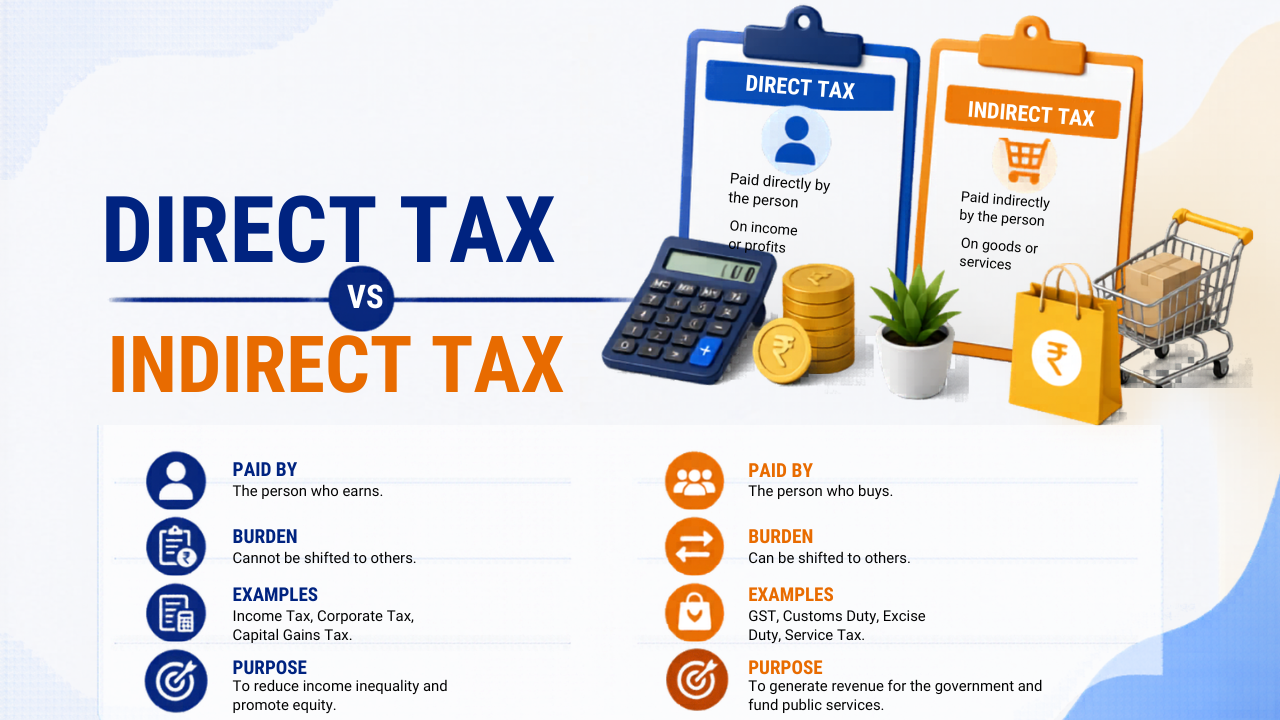
A direct tax is a tax levied directly on a person or entity based on their income, profits, or assets, and paid directly to the government. The key feature of a direct tax is that the burden cannot be transferred to someone else. If income tax is levied on you, you pay it. You cannot pass it on to your employer, your tenant, or your customers.
In India, direct taxes are governed and administered by the Central Board of Direct Taxes (CBDT), which operates under the Ministry of Finance. The primary law governing direct taxes is the Income Tax Act, 1961, now replaced by the Income Tax Act, 2025 with effect from 1 April 2026.
Examples of Direct Tax in India
- Income Tax: Levied on the annual income of individuals, HUFs, and other entities based on applicable tax slabs. The most common direct tax for salaried professionals.
- Corporate Tax: Levied on the net profits of companies. Domestic companies pay at rates ranging from 17.16% to 34.94% depending on their size and the regime opted for.
- Capital Gains Tax: Levied on profits from the sale of assets such as shares, mutual funds, real estate, or gold. Classified as Short Term Capital Gains (STCG) or Long Term Capital Gains (LTCG) depending on the holding period.
- Securities Transaction Tax (STT): Levied on the purchase and sale of listed securities like stocks and equity mutual funds on recognised stock exchanges.
- Minimum Alternate Tax (MAT): Applicable to companies to ensure they pay a minimum tax even when taxable income is reduced through deductions and exemptions.
- Alternate Minimum Tax (AMT): Similar to MAT but applicable to non-corporate taxpayers such as LLPs claiming specified deductions.
What is Indirect Tax?
An indirect tax is a tax levied on goods and services rather than on income or profits. The key feature of an indirect tax is that the burden can be transferred. A manufacturer pays indirect tax to the government, but passes the cost on to the distributor. The distributor passes it on to the retailer. The retailer passes it on to you, the final consumer. You are the one who ultimately bears the indirect tax, but you pay it as part of the price of the product or service, not directly to the government.
In India, indirect taxes are governed by the Central Board of Indirect Taxes and Customs (CBIC), also under the Ministry of Finance.
Examples of Indirect Tax in India
- Goods and Services Tax (GST): India’s primary indirect tax since 1 July 2017. A destination-based, consumption tax levied on the supply of goods and services at rates of 0%, 5%, 12%, 18%, and 28%. GST replaced multiple earlier indirect taxes including excise duty, service tax, VAT, and central sales tax. You can view the complete GST rate schedule on the CBIC official GST rates page.
- Customs Duty: Levied on goods imported into India. Protects domestic industries and generates revenue for the government.
- Excise Duty: Most excise duty was subsumed under GST in 2017. However, excise duty still applies to specific items: petroleum products (petrol, diesel, aviation turbine fuel) and alcohol for human consumption are fully outside GST. Tobacco products are under GST (with compensation cess) but also attract an additional central excise duty over and above GST.
- Compensation Cess: An additional levy on luxury goods and sin goods such as tobacco, pan masala, and high-value cars, collected as cess on top of GST.
Direct Tax vs Indirect Tax: Key Differences
| Feature | Direct Tax | Indirect Tax |
|---|---|---|
| Who pays it to the government | The taxpayer directly | An intermediary (seller, manufacturer, service provider) collects and remits it |
| Who bears the burden | The taxpayer on whom it is levied. Cannot be transferred. | The final consumer. The burden is passed along the supply chain. |
| Based on | Income, profits, or assets | Consumption of goods and services |
| Nature | Progressive: higher earners pay more | Regressive: everyone pays the same rate regardless of income |
| Visibility | Transparent: taxpayers know exactly how much they pay | Less visible: embedded in the price of goods and services |
| Governing body | CBDT (Central Board of Direct Taxes) | CBIC (Central Board of Indirect Taxes and Customs) |
| Examples | Income tax, corporate tax, capital gains tax, STT | GST, customs duty, excise duty (on petroleum and tobacco) |
| Filing requirement | Annual ITR filing required for most taxpayers | Monthly/quarterly GST returns for registered businesses |
| Identification number | PAN (Permanent Account Number) | GSTIN (Goods and Services Tax Identification Number) |
| Impact on prices | Does not directly affect product prices | Directly affects the price of goods and services |
Progressive vs Regressive: What This Means for You
This distinction matters more than most people realise.
Direct taxes are progressive. A person earning Rs. 5 lakh pays a lower percentage of their income in income tax than a person earning Rs. 50 lakh. Higher income means higher tax rate. This is by design. The tax system is built to redistribute income and reduce inequality.
Indirect taxes are regressive. When you buy a Rs. 100 product with 18% GST, you pay Rs. 18 in tax whether you earn Rs. 3 lakh a year or Rs. 3 crore a year. The tax amount is the same in absolute terms. But for a lower-income individual, that Rs. 18 represents a much larger share of their income. This is why economists and policymakers are careful about the rate of GST on essential goods. Basic food items, medicines, and education are either exempt from GST or taxed at lower rates to reduce the burden on lower-income households.
How GST Changed India’s Indirect Tax System
Before July 2017, India had a fragmented indirect tax structure. Businesses had to deal with multiple taxes: central excise duty, service tax, VAT (which varied by state), central sales tax, entry tax, and several others. This created a cascading effect where tax was levied on tax at each stage of the supply chain, inflating the final price of goods and services unnecessarily.
The Goods and Services Tax, introduced on 1 July 2017, replaced most of these taxes with a single, unified indirect tax structure. Key features of GST that resolved the old problems:
- One nation, one tax: A product or service is taxed at the same rate across India, eliminating state-level price differences caused by varying VAT rates.
- Input Tax Credit (ITC): Businesses can claim credit for GST paid on their purchases against GST collected on their sales. This eliminates the cascading effect and ensures tax is paid only on the value added at each stage.
- Destination-based taxation: GST revenue goes to the state where the goods or services are consumed, not where they are produced. This benefits consuming states and reduced the old inter-state tax disputes.
However, certain items remain outside GST: petrol, diesel, aviation turbine fuel, alcohol for human consumption, and natural gas. These are taxed separately under state excise laws and central excise, which is why fuel prices vary significantly from state to state.
India’s Tax Revenue Mix: Direct vs Indirect
Historically, India relied more on indirect taxes for government revenue because they are easier to collect and harder to evade. Over the last decade, this balance has shifted. Direct tax collections have grown significantly as more taxpayers come into the formal system, digital payment infrastructure improves, and tax administration becomes more data-driven through tools like AIS, Form 26AS, and the Annual Information Statement.
For FY 2024-25, India’s gross direct tax collections stood at approximately Rs. 25.87 lakh crore, while gross GST collections reached Rs. 22.08 lakh crore for the year. For the first time, direct tax collections have exceeded indirect tax collections. This represents a significant structural shift in India’s revenue mix, reflecting the expanding formal economy and improving tax compliance.
The government’s policy direction is clearly toward increasing the direct tax base by bringing more individuals and businesses into the formal tax net, while rationalising GST rates to reduce the burden on essential goods.
Direct Tax and Indirect Tax: Impact on the Common Person
As a salaried professional or small business owner, both types of taxes affect your finances every day:
- Your salary is subject to income tax (direct tax), deducted as TDS by your employer every month.
- When you buy a smartphone, clothing, or eat at a restaurant, you pay GST (indirect tax) embedded in the price.
- When you sell listed shares or equity mutual funds after holding them for more than 12 months, you pay Long Term Capital Gains tax (direct tax). For a flat or real estate, the holding period for LTCG is 24 months.
- When you fill petrol, you pay excise duty and state VAT (indirect tax). This is why petrol prices differ across states.
- When you pay your health insurance premium, the insurer adds 18% GST (indirect tax) on top of the base premium. This same premium then qualifies for Section 80D deduction (direct tax benefit).
Understanding both types helps you see the full picture of what you contribute to the government, plan your finances more effectively, and make informed decisions about your investments, purchases, and business structure.
Frequently Asked Questions
Is TDS a direct tax or indirect tax?
TDS (Tax Deducted at Source) is a mechanism for collecting direct tax. It is a method of advance collection of income tax, not a separate tax. When your employer deducts TDS from your salary, it is collecting income tax on behalf of the government. The underlying tax is income tax, which is a direct tax.
Is GST a direct tax or indirect tax?
GST is an indirect tax. It is levied on the supply of goods and services. The seller collects it from the buyer and remits it to the government. The final consumer bears the burden of GST as part of the purchase price.
Can the same income attract both direct and indirect tax?
Yes, in some cases. For example, a freelancer’s professional income is subject to income tax (direct tax). But if they are GST-registered and their turnover exceeds Rs. 20 lakh (Rs. 10 lakh for special category states), they must also charge GST on their invoices (indirect tax). The income tax and GST are separate obligations on the same business income.
Why are petrol and alcohol not under GST?
Petrol, diesel, aviation turbine fuel, alcohol for human consumption, and natural gas are kept outside the GST framework because they are major revenue sources for state governments. If these were brought under GST, states would lose a significant portion of their independent revenue. The GST Council has the authority to include them under GST in the future, but there has been no consensus on this as of 2026.
Which is better for the economy: direct tax or indirect tax?
Both are essential. Direct taxes are more equitable and progressive but require a strong tax administration system and broader taxpayer base. Indirect taxes are easier to collect and harder to evade but can be regressive. Most developed economies rely more on direct taxes as their economic and administrative systems mature. India has now crossed this threshold, with gross direct tax collections exceeding gross GST collections for the first time in FY 2024-25.