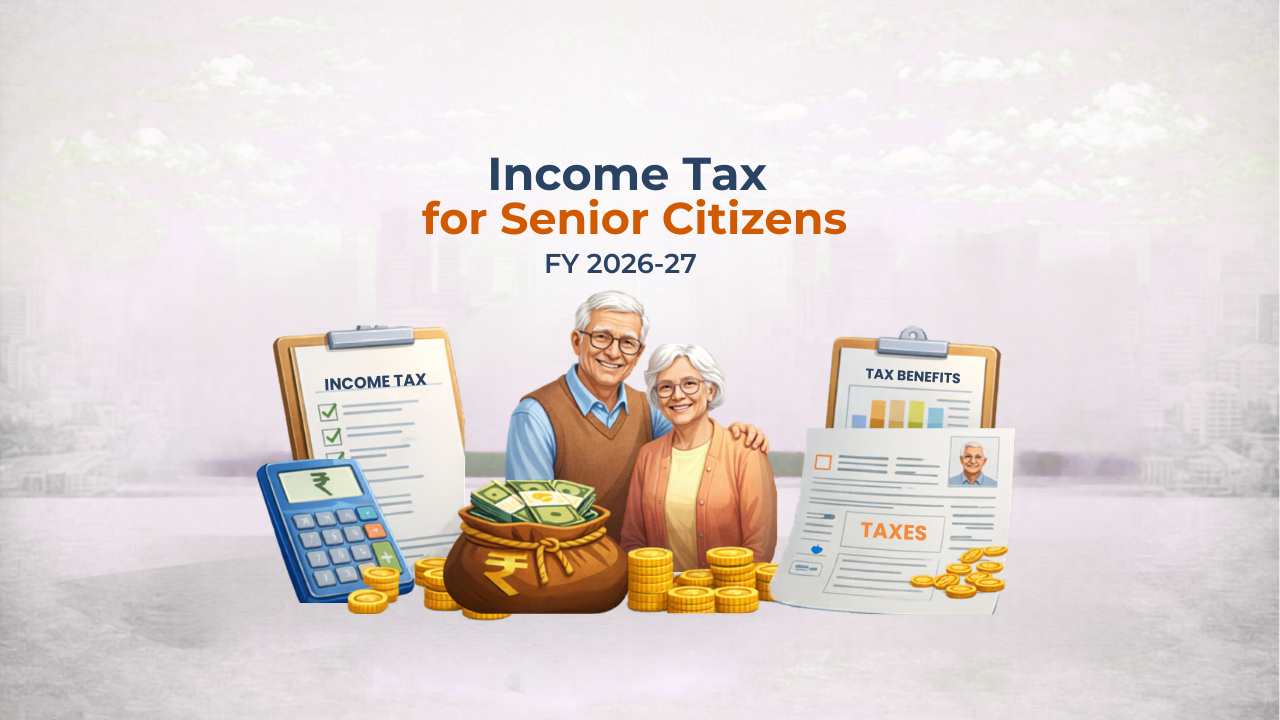
Income Tax for Senior Citizens FY 2026-27: Slabs, Deductions and Key Benefits
If you are filing income tax on behalf of a parent, spouse, or yourself after retirement, the rules are different from what applies to regular salaried individuals. Senior citizens get higher basic exemption limits under the old tax regime, exclusive deductions that younger taxpayers cannot claim, and certain filing exemptions that reduce compliance burden significantly.
This complete guide to income tax for senior citizens FY 2026-27 covers everything: higher exemption limits, the Budget 2026 update to Section 80TTB, old vs new regime comparison, and ITR filing rules.
Who Qualifies as a Senior Citizen for Tax Purposes?
The Income Tax Act defines two categories based on age:
| Category | Age Criteria | Basic Exemption (Old Regime) |
|---|---|---|
| Senior Citizen | 60 years or more but less than 80 years | Rs. 3,00,000 |
| Super Senior Citizen | 80 years or more | Rs. 5,00,000 |
The age is determined at any point during the financial year. So if you turn 60 on March 31, 2026, you qualify as a senior citizen for the entire FY 2025-26.
These higher exemption limits apply only under the old tax regime. Under the new tax regime, the basic exemption limit is Rs. 4 lakh for everyone regardless of age – senior citizens get no additional benefit on the slab structure itself.
Also important: these higher exemption limits are available only to resident individuals. Senior citizen NRIs follow the same basic exemption limit as regular taxpayers.
Income Tax for Senior Citizens FY 2026-27
Old Tax Regime: Senior Citizens (Age 60 to 79)
| Income Range | Tax Rate |
|---|---|
| Up to Rs. 3,00,000 | Nil |
| Rs. 3,00,001 to Rs. 5,00,000 | 5% |
| Rs. 5,00,001 to Rs. 10,00,000 | 20% |
| Above Rs. 10,00,000 | 30% |
Section 87A rebate applies under the old regime: if taxable income is up to Rs. 5 lakh, tax liability becomes zero. So a senior citizen with income up to Rs. 5 lakh pays no tax under the old regime.
Old Tax Regime: Super Senior Citizens (Age 80 and above)
| Income Range | Tax Rate |
|---|---|
| Up to Rs. 5,00,000 | Nil |
| Rs. 5,00,001 to Rs. 10,00,000 | 20% |
| Above Rs. 10,00,000 | 30% |
Super senior citizens get a Rs. 5 lakh basic exemption under the old regime. Section 87A rebate does not provide any additional benefit here since the exemption already covers Rs. 5 lakh.
New Tax Regime: Same for All Ages
| Income Range | Tax Rate |
|---|---|
| Up to Rs. 4,00,000 | Nil |
| Rs. 4,00,001 to Rs. 8,00,000 | 5% |
| Rs. 8,00,001 to Rs. 12,00,000 | 10% |
| Rs. 12,00,001 to Rs. 16,00,000 | 15% |
| Rs. 16,00,001 to Rs. 20,00,000 | 20% |
| Rs. 20,00,001 to Rs. 24,00,000 | 25% |
| Above Rs. 24,00,000 | 30% |
Under the new regime, Section 87A rebate of up to Rs. 60,000 makes income up to Rs. 12 lakh effectively tax-free. For senior citizens with pension or interest income up to Rs. 12 lakh and no major deductions, the new regime can work out better despite no age-based exemption advantage.
Budget 2026 Update: Section 80TTB Raised to Rs. 1 Lakh
This is the most significant change for senior citizens in Budget 2026 and one that most people are not yet aware of.
Section 80TTB allows senior citizens (age 60 and above) to claim a deduction on interest income from savings accounts, fixed deposits, recurring deposits, and post office deposits. Until FY 2025-26, this limit was Rs. 50,000. Budget 2026 has raised it to Rs. 1,00,000 starting FY 2026-27.
This deduction is available only under the old tax regime.
What This Means in Practice
Consider Ramesh, a 67-year-old retired bank officer with Rs. 15 lakh parked in fixed deposits earning 7.5% interest. His annual interest income is Rs. 1,12,500.
Under the old limit: Rs. 1,12,500 minus Rs. 50,000 exemption = Rs. 62,500 taxable interest.
Under the new Rs. 1 lakh limit: Rs. 1,12,500 minus Rs. 1,00,000 exemption = Rs. 12,500 taxable interest.
The additional Rs. 50,000 deduction saves Ramesh Rs. 10,000 in tax if he is in the 20% slab. This is a meaningful real-world saving for retirees who depend on FD interest as their primary income.
Note: Section 80TTB replaces Section 80TTA for senior citizens. Section 80TTA (which covers savings account interest for regular taxpayers at Rs. 10,000) is not available to senior citizens – they get the more generous 80TTB instead.
Deductions Available to Senior Citizens
Section 80D: Higher Health Insurance Deduction
Senior citizens get a higher deduction limit on health insurance premiums under Section 80D. If you are paying the premium for a senior citizen parent or if the senior citizen is paying for their own health insurance, the limit is Rs. 50,000 instead of Rs. 25,000.
Practical combinations for salaried individuals with senior citizen parents:
- Your own family’s health insurance: Rs. 25,000 deduction
- Parents’ health insurance (senior citizens): Rs. 50,000 deduction
- Combined maximum: Rs. 75,000
Even if your parents do not have health insurance, you can claim Rs. 50,000 for medical expenditure actually incurred on senior citizen parents. This is one deduction that does not require an insurance premium out-of-pocket medical expenses qualify directly. For full details on claiming this, read the Section 80D health insurance deduction guide.
This deduction is available only under the old tax regime.
Section 80C and Other Deductions
Senior citizens can claim all standard deductions under Section 80C up to Rs. 1.5 lakh – PPF, NSC, tax-saving FDs, ELSS, LIC premium. There is no restriction on these based on age. The Rs. 1.5 lakh overall limit applies equally.
Senior citizens who contribute to NPS can also claim the additional Rs. 50,000 deduction under Section 80CCD(1B) under the old regime.
Standard Deduction on Pension
Pension received from a former employer is treated as salary income. Senior citizens receiving such pension can claim the standard deduction of Rs. 50,000 under the old regime and Rs. 75,000 under the new regime – same as working salaried individuals.
Family pension (pension received by a nominee after the pensioner’s death) is treated as income from other sources, not salary. A standard deduction of Rs. 15,000 or one-third of the pension amount, whichever is lower, is available on family pension.
ITR Filing Exemption for Senior Citizens Above 75: Section 194P
Senior citizens aged 75 years or above are exempt from filing an income tax return if all three conditions are met:
- Their income consists only of pension and interest income
- The interest income comes from the same bank where they receive their pension
- They submit a declaration to that specified bank, which then deducts the correct TDS after accounting for all applicable deductions and exemptions
This provision, introduced under Section 194P, removes the requirement to file ITR for this category. The bank handles the tax calculation and deduction, and no separate return is needed.
If your elderly parent has only pension and FD interest from the same bank, they may qualify for this exemption. Check with the specific bank whether they are a “specified bank” notified by the Central Government for this purpose.
This exemption does not apply if the senior citizen has any other income source – rental income, capital gains, or interest from a different bank than the pension bank.
Form 15H: No TDS on Interest Income
Senior citizens whose total income is below the taxable threshold can submit Form 15H to their bank to ensure no TDS is deducted on their FD interest. This prevents the hassle of claiming a refund later.
Form 15H can be submitted by individuals aged 60 years and above whose estimated tax liability for the year is nil. It needs to be submitted at the beginning of each financial year.
Budget 2026 update: Senior citizens can now submit Form 15H once through the NSDL or CDSL depository portal, and it automatically applies to all linked banks and companies. Earlier, a separate Form 15H had to be submitted to each bank individually. This is a meaningful compliance simplification for senior citizens with deposits in multiple banks.
Old Regime vs New Regime: Which Works Better for Senior Citizens?
The right choice depends entirely on the income composition and the deductions available. There is no single correct answer, but here are the key scenarios:
When Old Regime Works Better
- Income is primarily FD interest and the 80TTB deduction of Rs. 1 lakh significantly reduces taxable income
- Health insurance premiums for self and senior citizen parents together create Rs. 75,000 deduction under Section 80D
- Active 80C investments of Rs. 1.5 lakh bring taxable income down significantly
- For super senior citizens: Rs. 5 lakh basic exemption in old regime vs Rs. 4 lakh in new regime already creates a base advantage
When New Regime Works Better
- Income is up to Rs. 12 lakh with minimal deductions – Section 87A rebate makes it tax-free
- No major health insurance, 80C investments, or FD interest deductions to claim
- Simpler compliance without tracking investment proofs and certificates
Example Comparison: Meena, Age 65, Pension Rs. 8 Lakh and FD Interest Rs. 1.2 Lakh
| Item | Old Regime (Rs.) | New Regime (Rs.) |
|---|---|---|
| Pension Income | 8,00,000 | 8,00,000 |
| FD Interest | 1,20,000 | 1,20,000 |
| Gross Total Income | 9,20,000 | 9,20,000 |
| Standard Deduction | (50,000) | (75,000) |
| Section 80TTB (FD Interest) | (1,00,000) | Not available |
| Section 80D (own health insurance) | (50,000) | Not available |
| Section 80C | (1,50,000) | Not available |
| Taxable Income | 5,70,000 | 8,45,000 |
| Tax + Cess (approx.) | Rs. 14,040 | Rs. 46,800 |
In Meena’s case, the old regime saves over Rs. 32,000. The Rs. 1 lakh 80TTB deduction on FD interest alone makes a significant difference. For the full comparison framework, read the old vs new tax regime comparison.
Capital Gains Tax for Senior Citizens
Capital gains tax rates are the same for senior citizens as for other taxpayers – 12.5% LTCG on equity above Rs. 1.25 lakh, 20% STCG on equity, and 12.5% LTCG on property (with indexation option for property bought before July 23, 2024).
One practical advantage: senior citizens under the old regime have a higher basic exemption limit of Rs. 3 lakh. This means the basic exemption can be used to offset non-special-rate income first, potentially leaving more room for capital gains to fall in lower effective rate bands.
Section 87A rebate does not apply to special rate income like LTCG and STCG on equity – this applies to senior citizens as well. Even if a senior citizen’s total income including capital gains is below Rs. 5 lakh (old regime) or Rs. 12 lakh (new regime), the capital gains portion taxed at special rates cannot be sheltered by the rebate.
ITR Filing for Senior Citizens: Deadlines and Forms
Senior citizens who are required to file an ITR must follow the same deadlines as other taxpayers. The deadline for FY 2025-26 is July 31, 2026 for ITR-1 and ITR-2. Read the ITR filing last date 2026 guide for complete deadline details.
For most retired senior citizens with pension, interest income, and one house property, ITR-1 (Sahaj) is the correct form. ITR-2 is needed if there are capital gains, two or more properties, or foreign income.
Senior citizens above 80 years (super senior citizens) cannot file ITR-1 online – they are required to file ITR-2 if they need to file at all. However, super senior citizens who qualify under Section 194P are exempt from filing altogether.
For step-by-step guidance on filing, the how to file ITR online guide walks through the complete process.
Advance Tax: Senior Citizens Without Business Income Are Exempt
This is a benefit that many retired individuals are not aware of. Senior citizens aged 60 years and above who do not have income from business or profession are completely exempt from paying advance tax.
For regular taxpayers, if total tax liability exceeds Rs. 10,000 in a year, advance tax must be paid in four installments through the year. Senior citizens with only pension, interest, rental, or capital gains income do not need to follow this schedule. They pay all their tax as self-assessment tax at the time of filing the ITR.
This is a meaningful cash flow benefit – the money can stay in the FD earning interest until the ITR filing deadline rather than being paid out in quarterly installments.
Common Mistakes Senior Citizens Make While Filing ITR
In seven years of working with income tax education, a few mistakes come up repeatedly when senior citizens or their family members file returns:
Not claiming Section 80TTB: Many senior citizens declare their FD interest as income but forget to claim the 80TTB deduction separately. This results in paying tax on interest that could have been sheltered. From FY 2026-27, this deduction has doubled to Rs. 1 lakh – even more reason to ensure it is claimed.
Missing the medical expenditure deduction: If your elderly parents do not have health insurance, you can still claim Rs. 50,000 under Section 80D for actual medical expenses paid on their behalf. This requires keeping bills and payment records but is a legitimate deduction that most people skip.
Choosing the new regime without calculating: The new regime’s simplicity is attractive, but for a senior citizen with FD interest, health insurance, and 80C investments, the old regime often saves significantly more. Always run the numbers for both before deciding.
Not submitting Form 15H early: Submitting Form 15H after TDS has already been deducted means waiting months for a refund. Submit at the beginning of the financial year to prevent TDS deduction entirely.
Treating family pension incorrectly: Family pension is not salary income. It goes under income from other sources. Treating it as salary and claiming the wrong standard deduction amount is a common error that leads to notices.
Frequently Asked Questions
My father is 78 and has only FD interest of Rs. 6 lakh. Does he need to file ITR?
Under the old regime, after the Rs. 3 lakh basic exemption and Rs. 1 lakh Section 80TTB deduction, taxable income is Rs. 2 lakh – below the taxable threshold. No tax liability. However, he should still check whether filing is mandatory based on other conditions like high-value transactions. If he qualifies under Section 194P (pension and interest from same bank, age 75+), he may be exempt from filing entirely.
Can a senior citizen claim both Section 80TTB and Section 80TTA?
No. Section 80TTB specifically covers senior citizens and replaces Section 80TTA for them. A senior citizen can claim either 80TTB (up to Rs. 1 lakh on all interest including FDs) or nothing under 80TTA. 80TTB is always more beneficial since it covers FD interest and has a higher limit.
Is pension from EPF or NPS taxable for senior citizens?
EPF lump sum withdrawal after 5 years of continuous service is tax-free. Monthly NPS annuity pension is fully taxable as income in the year received, at the applicable slab rate. This applies to senior citizens as well.
Can a senior citizen switch tax regimes every year?
Yes. Senior citizens without business income can switch between old and new regimes every financial year. The choice is made at the time of filing the ITR. This flexibility allows comparison and choosing the more beneficial option each year based on actual income and deductions.
Summary
Senior citizens have meaningful tax advantages over regular taxpayers – higher basic exemption limits under the old regime (Rs. 3 lakh for 60-79 age group, Rs. 5 lakh for 80+), the Section 80TTB deduction on FD interest now raised to Rs. 1 lakh from Budget 2026, higher Section 80D limits for health insurance, exemption from advance tax, and the Section 194P filing exemption for those above 75 with simple income structures.
The old regime remains more beneficial for most retired individuals who earn FD interest and have health insurance and 80C investments. The new regime can work better for those with income up to Rs. 12 lakh and minimal deductions. The comparison should always be done with actual numbers, not assumptions.
For a complete overview of all deductions available under both regimes for FY 2026-27, the Complete Income Tax Guide India covers every section in one place.
📚 Also Read: