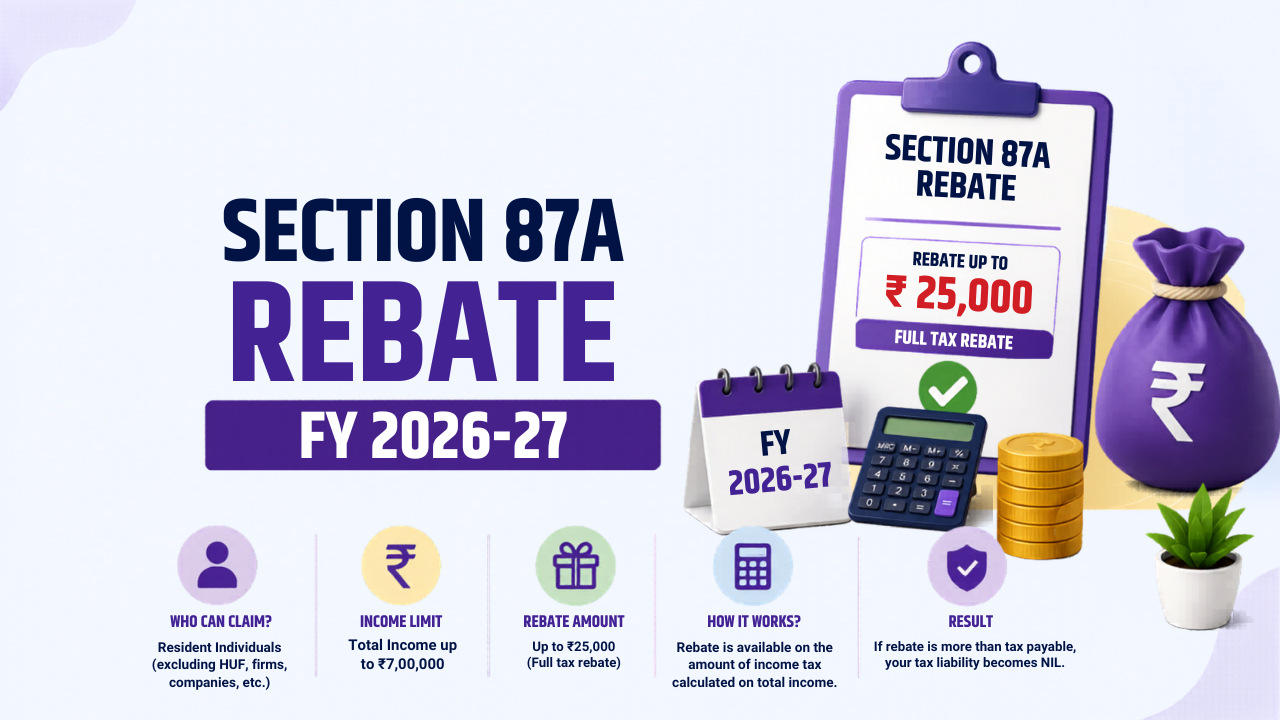
Section 87A Rebate FY 2026-27: ₹60,000 Tax Rebate Under New Tax Regime
Section 87A rebate is the most powerful tax-saving tool available in India right now – it makes income up to ₹12 lakh completely tax-free under the new tax regime in FY 2026-27. Here’s everything you need to know: who qualifies, exact calculation, FY 2026-27 rules, and common mistakes to avoid.
✅ Section 87A Rebate – FY 2026-27 At a Glance
- New Tax Regime: Rebate up to ₹60,000 | Applicable if net taxable income ≤ ₹12,00,000
- Old Tax Regime: Rebate up to ₹12,500 | Applicable if net taxable income ≤ ₹5,00,000
- Salaried effective limit (new regime): ₹12,75,000 gross income → ₹0 tax
- Rebate applies: Before adding Health & Education Cess (4%)
What is Section 87A Rebate?
Section 87A of the Income Tax Act provides a tax rebate (not a deduction) directly from your computed income tax liability. Unlike deductions that reduce taxable income, a rebate reduces the final tax payable. If your rebate equals or exceeds your tax liability, your effective tax is zero – even if you technically fall in a taxable slab.
The rebate was substantially enhanced in Union Budget 2025: under the new tax regime, the rebate was raised from ₹25,000 to ₹60,000, and the income threshold was raised from ₹7 lakh to ₹12 lakh.
Section 87A Rebate FY 2026-27 – New vs Old Regime
| Parameter | New Tax Regime | Old Tax Regime |
|---|---|---|
| Maximum Rebate | ₹60,000 | ₹12,500 |
| Income Threshold (Net Taxable) | ≤ ₹12,00,000 | ≤ ₹5,00,000 |
| Effective tax-free limit (salaried) | ₹12,75,000 gross | ~₹5,50,000 gross |
| Applicable from | FY 2025-26 (AY 2026-27) | Always (unenhanced) |
How to Calculate Section 87A Rebate – Step by Step
Example 1: ₹11 Lakh Gross Salary (New Regime)
| Gross Salary | ₹11,00,000 |
| Less: Standard Deduction (new regime) | −₹75,000 |
| Net Taxable Income | ₹10,25,000 |
| Tax: ₹4L@0% + ₹4L@5% + ₹2.25L@10% | ₹42,500 |
| Less: 87A Rebate (income ≤ ₹12L) | −₹42,500 |
| Total Tax Payable | ₹0 🎉 |
Example 2: ₹12.75 Lakh Gross Salary (New Regime) – Maximum Tax-Free
| Gross Salary | ₹12,75,000 |
| Less: Standard Deduction | −₹75,000 |
| Net Taxable Income | ₹12,00,000 |
| Tax: ₹4L@0%+₹4L@5%+₹4L@10% | ₹60,000 |
| Less: 87A Rebate (income = ₹12L ✓) | −₹60,000 |
| Total Tax Payable | ₹0 🎉 |
Example 3: ₹13 Lakh Gross Salary – Rebate Crossed, Tax Applies
| Gross Salary | ₹13,00,000 |
| Less: Standard Deduction | −₹75,000 |
| Net Taxable Income | ₹12,25,000 |
| Tax: ₹4L@0%+₹4L@5%+₹4L@10%+₹0.25L@15% | ₹63,750 |
| 87A Rebate (income > ₹12L → NOT eligible) | ₹0 |
| + 4% Health & Education Cess | ₹2,550 |
| Total Tax Payable | ₹66,300 |
Who is Eligible for Section 87A Rebate?
- Resident Individual taxpayers only (not NRIs, HUF, firms, or companies)
- Net taxable income ≤ ₹12 lakh (new regime) or ≤ ₹5 lakh (old regime)
- Available for all types of income: salary, business, profession, rent, interest
Who is NOT eligible:
- Non-Resident Indians (NRIs)
- HUF, Partnership Firms, LLPs, Companies, AOP, BOI
- Individuals with income above the threshold (₹12L new / ₹5L old)
- Income from special rates may be excluded (see controversy below)
87A Rebate on Special Rate Income: What the Law Now Says
Finance Act 2025 has expressly clarified in law that from AY 2026-27 (FY 2025-26) onwards, Section 87A rebate is not available against tax on any special-rate income. This is no longer a grey area or a portal restriction – it is settled law.
- Short-Term Capital Gains on listed equity and equity mutual funds (Section 111A) – taxed at 20%
- Long-Term Capital Gains on listed equity and equity mutual funds above ₹1.25 lakh (Section 112A) – taxed at 12.5%
- Lottery and game show winnings (Section 115BB)
Even if your total income including these gains is below ₹12 lakh, the tax on the special-rate portion must be paid separately. The 87A rebate will reduce only the tax calculated on your normal slab-rate income. Consult a CA if you have significant capital gains alongside regular income.
Section 87A vs Deductions – Key Difference
| Feature | Section 87A Rebate | Deductions (80C, 80D etc.) |
|---|---|---|
| Applied to | Final tax payable | Taxable income |
| Available in new regime | ✅ Yes (enhanced) | ❌ Most not available |
| Max benefit | ₹60,000 direct tax reduction | Depends on slab and deduction amount |
FAQs on Section 87A Rebate
📚 Also Read: