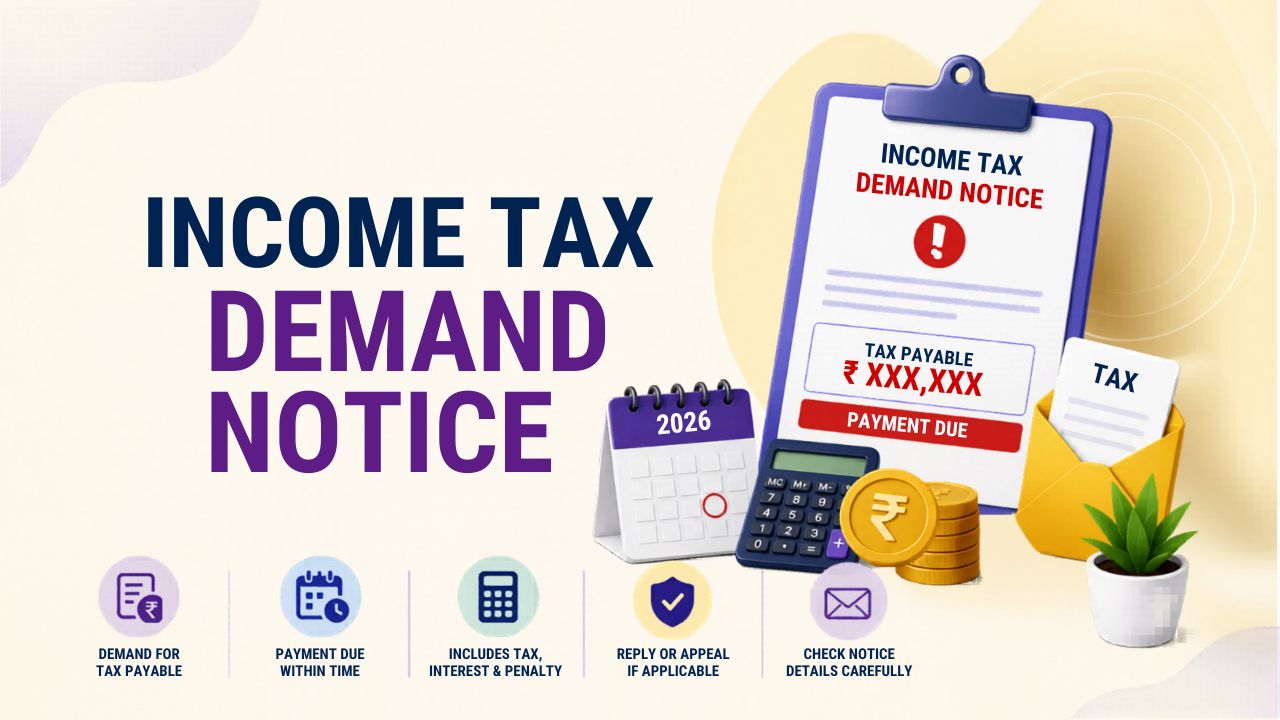
Income Tax Demand Notice Under Section 143(1): What It Means
You filed your ITR on time, did everything right, and then one morning an email from the income tax department lands in your inbox. Subject line: Intimation under Section 143(1). Your stomach drops.
I see this every year with salaried professionals. The panic is immediate and almost always unnecessary. A Section 143(1) intimation is not a court notice. It is not a sign of fraud or tax evasion. It is a system-generated processing summary from CPC Bengaluru that compares what you declared in your ITR with what their automated system calculated. The email tells you one of three things: you have a refund coming, you owe additional tax, or your return was processed with no changes at all.
In the majority of cases where a demand is raised, the reason is something as simple as a TDS entry missing from Form 26AS or a challan detail not entered in the ITR. These are fixable in days, not months. Let me walk you through exactly what this intimation means and what to do about it.
What Is an Income Tax Demand Notice 143 (1) and Why Did You Get It?
After you file your ITR, the Central Processing Centre (CPC) at Bengaluru runs an automated check on your return. This check is not a manual audit. No income tax officer reviews your return at this stage. The system verifies three things:
- Arithmetical accuracy of your tax calculations
- Internal consistency of the data entered in different schedules
- Whether your TDS, advance tax, and self-assessment tax credits match what banks and employers reported to the department
Once this check is complete, you receive an intimation under Section 143(1). The new Income Tax Act 2025 has renumbered most provisions, but since most taxpayers and portals still reference the 1961 numbering, this article uses the original section references throughout.
The time limit for issuing this intimation is within nine months from the end of the financial year in which you filed the return. So if you filed your return in FY 2024-25, the intimation can arrive up to December 2026.
The Three Possible Outcomes: Demand, Refund, or No Change
Every 143(1) intimation falls into one of these three categories. Understanding which one applies to you determines what you need to do next.
| Outcome | What It Means | Action Required |
|---|---|---|
| No Demand, No Refund | CPC’s calculation matches yours exactly. Return accepted as filed. | None. File this email safely. |
| Refund Due | You paid more tax than you owed. Refund will be credited to your pre-validated bank account. | None. Wait for credit (usually 1-3 weeks). |
| Tax Demand | CPC’s calculation shows you owe more tax than you paid. A demand is raised for the difference plus interest. | Pay within 30 days or file rectification if you disagree. |
How to Open the Intimation (Password)
The intimation PDF is password protected. The password is your PAN in lowercase followed by your date of birth in DDMMYYYY format, with no spaces.
Example: PAN is ABCDE1234E, date of birth is 15 March 1990. Password is: abcde1234e15031990
Once opened, the document shows two columns: your declared figures on the left, and the department’s computed figures on the right. Any mismatch between these two columns is the source of either a demand or an additional refund.
Common Reasons a Tax Demand Is Raised Under 143(1)
In my experience working with salaried professionals, the same five issues keep coming up in 143(1) demands. Most of them are fixable with a rectification request rather than actual payment.
1. TDS Not Reflecting in Your AIS or Form 26AS
This is the most common reason. Your employer deducted TDS from your salary but either filed their TDS return late or made an error in your PAN. CPC cannot give you credit for TDS it cannot see against your PAN. The intimation shows a demand because it treated your TDS credit as zero or partial.
A real example: Rahul, a software engineer in Pune drawing Rs. 14 lakh per year, received a 143(1) demand of Rs. 22,000 last year. His employer had deducted the full TDS correctly but filed their Q4 TDS return three weeks after the due date. By the time CPC processed Rahul’s ITR, the TDS was not reflecting against his PAN. The demand was not because Rahul did anything wrong. It was an employer filing delay. Once the employer filed the corrected TDS return and it reflected in Form 26AS, Rahul filed a rectification and the demand was withdrawn within 30 days.
Fix: Check your Annual Information Statement (AIS) and Form 26AS immediately. If the TDS is missing, contact your employer’s accounts team to file a correction in their TDS return. Once corrected, the credit will reflect and you can file a rectification request.
2. Self-Assessment Tax or Advance Tax Challan Not Entered in ITR
You paid tax through Challan 280 before filing your return but forgot to enter the challan details in Schedule IT while filling the ITR. CPC cannot automatically pick up your self-assessment tax payment unless you declare it. The system sees tax unpaid and raises a demand.
Fix: File a rectification request and add the challan details. The demand gets reversed after verification.
3. Deduction Disallowed Due to Missing or Incorrect Entry
Section 80C deductions, HRA exemption, or Section 80D premium claims are disallowed when the entry does not match what the system expects. A common example: you claimed HRA exemption but did not fill Schedule HRA correctly. CPC adds back the disallowed amount to your income and raises a demand on the additional tax.
Fix: If the deduction is valid but was entered incorrectly, file a rectification request with the correct schedule filled. If the deduction was genuinely ineligible, you need to pay the demand.
4. Loss Carry-Forward Claimed But Return Was Filed After the Due Date
The Income Tax Act does not allow you to carry forward losses from previous years if your return was filed after the due date. CPC disallows the loss set-off, which increases your taxable income and results in a demand.
This is one situation where you generally cannot file a rectification to reverse the demand. The disallowance is correct in law.
5. Deduction Claimed After Due Date Under Section 10AA or 80-IA Cluster
Certain profit-linked deductions under the Section 80-IA cluster can only be claimed if the ITR is filed on or before the original due date. A belated return forfeits these deductions. CPC disallows them and raises a demand accordingly.
What to Do If You Receive a Tax Demand Under 143(1)
You have 30 days from the date of the intimation to respond. Note that the 30 days are counted from the date printed on the intimation PDF, not from when you received the email. There is often a 2 to 5 day gap between these two dates. Do not let this deadline pass. The department assumes silence means agreement, and unpaid demands accumulate interest at 1% per month under Section 220(2).
Step 1: Read the Intimation and Identify the Mismatch
Open the PDF using the password format explained above. Compare the two columns line by line. The department will show a reason code against each adjustment. Note every line where their figures differ from yours.
Step 2: Log In to the Income Tax Portal and Respond
Go to incometax.gov.in and log in.. Navigate to Pending Actions, then e-Proceedings. You will see the 143(1) intimation listed. Click on it and submit your response. You have two options:
- Agree with the demand: Pay the tax using Challan 280. For a demand raised under Section 143(1)(a) specifically, select Minor Head 400 (Tax on Regular Assessment), not Minor Head 300 (Self-Assessment Tax). Both are accepted by the system in practice, but 400 is the technically correct head for assessment-based demands. Mark the response as agreed on the portal. The demand will be marked settled once payment is verified.
- Disagree with the demand: Submit your response as disagreed and provide the reason. This does not close the demand but puts it under review. File a rectification request immediately under Section 154 (covered below).
Step 3: File a Rectification Under Section 154 If You Disagree
A rectification is how you tell CPC that their computation has an error. It is not an appeal. It is a correction request for a mistake apparent from the record.
To file a rectification: Log in to the portal, go to e-File, click Rectification, and select New Request. Choose the Assessment Year, select the relevant return, and identify the type of mistake. Common rectification types include additional tax credit claimed (for TDS credit issues), schedules wrongly omitted, and incorrect computation of tax.
After submission, CPC typically processes the rectification within 15 to 45 days and sends a fresh intimation. If the correction is accepted, the demand is revised or withdrawn.
How to Pay a Tax Demand If You Agree
Go to the tax payment section on the income tax portal and select Challan 280. Choose the assessment year for which the demand was raised, not the current financial year. Select “Self-Assessment Tax” as the type of payment. Pay via net banking or debit card. After payment, the challan appears in your AIS within 3 to 5 working days and the demand is automatically settled once CPC verifies the credit.
143(1) vs 143(1)(a): What Is the Difference?
143(1) is the broad section covering the intimation itself. Within it, there are sub-sections that specify the type of adjustment CPC made:
- 143(1)(a): Adjustment made due to arithmetical error or incorrect claim apparent on face of return. This is the sub-section under which most demands are raised.
- 143(1)(b): Refund is due.
- 143(1)(c): Intimation of processed return with no demand and no refund.
If your email subject or intimation PDF references 143(1)(a), it means CPC made a specific adjustment to your return and is demanding additional tax. This is the version that requires your response within 30 days.
What Happens If You Ignore a 143(1) Demand?
Ignoring the intimation does not make the demand disappear. Here is what actually happens:
- Interest at 1% per month under Section 220(2) starts accruing on the outstanding demand from the date it was raised.
- The outstanding demand appears in your AIS and on the portal permanently under “Outstanding Demand.”
- Future refunds can be adjusted against this outstanding demand under Section 245, meaning your next year’s refund may be withheld and applied to clear this amount.
- In cases of large demands, the department can escalate to recovery proceedings.
I have seen cases where a small Rs. 3,000 demand from two years ago compounded with interest into Rs. 7,000 because the taxpayer thought ignoring it would resolve it. It does not. Respond within 30 days, every time.
Frequently Asked Questions
Is a 143(1) intimation the same as an income tax notice?
No, and this is the most important thing to understand. A 143(1) intimation is a processing summary, not a formal notice. Think of it as the department’s way of saying “we processed your return, here is what we found.” A formal notice under Section 142(1) or 143(2) is a different matter entirely – that is when the department wants to scrutinise your return in detail. Most 143(1) intimations need zero action from you. Only the demand variant requires a response within 30 days. For a full explanation of the types of income tax notices and what each one means, read the linked guide.
I received a refund but the amount is less than what I expected. What should I do?
Do not assume the department is right. Open the intimation PDF and compare their refund calculation against your own figure line by line. If CPC disallowed a deduction or added back income, you will see exactly which line was adjusted in the right-hand column. If the adjustment is incorrect, file a rectification under Section 154 specifying the entry that is wrong. I have seen many cases where a valid 80C or HRA claim was disallowed simply because of a schedule entry error – all of them were reversed after a rectification.
My employer’s TDS is not showing in Form 26AS. Should I pay the demand first?
Do not pay the demand yet. This is one situation where paying immediately is the wrong move. Contact your employer’s HR or accounts team first and confirm whether they have filed their TDS return for the quarter and whether your PAN is correctly entered. If there is an error, ask them to file a correction. TDS corrections typically take 7 to 15 days to reflect in your Form 26AS. Once reflected, file a rectification. Paying a demand caused by a TDS error means you have paid tax twice, and getting a refund of that double payment is a process that takes months.
Can a 143(1) intimation lead to scrutiny?
A single 143(1) intimation by itself does not trigger scrutiny. However, if the same discrepancy appears year after year, or if the demand amount is significant, the department’s risk-based selection system may flag the return for a scrutiny notice under Section 143(2) in a subsequent year. Resolving 143(1) demands promptly every year is the simplest way to stay off that radar.
What is the time limit to file a rectification under Section 154?
You can file a rectification under Section 154 within four years from the end of the financial year in which the order was passed. So if you received a 143(1) intimation in FY 2024-25, you technically have until March 2029. But please do not use that as a reason to delay. File the rectification as soon as you identify the error, ideally within the 30-day window. The longer the demand sits unresolved, the more interest accumulates under Section 220(2).
The Bottom Line
A Section 143(1) intimation with a demand is a solvable problem in most cases. The demand usually exists because of a TDS credit mismatch, a missing challan entry, or a deduction that was entered incorrectly. These are administrative errors, not tax fraud.
The most important thing to remember: do not ignore the 30-day deadline. Read the intimation, identify the mismatch, and then either pay the demand if it is correct or file a rectification if it is not. Both paths are straightforward if you act in time.
If you are unsure about the ITR filing deadline for the current year or need to understand your complete tax filing obligations, read the linked guides. For help reading what is in your AIS and Form 26AS, the Form 26AS and AIS reading guide walks through every section of both documents.
Questions about a specific demand you received? Drop them in the comments below.