Credit Card High Value Transactions & Income Tax (2026)
If you spend more than Rs. 10 lakh in a year on your credit card, the income tax department already knows about it. Banks are legally required to report credit card high value transactions to the tax department through a Statement of Financial Transactions (SFT). This data flows directly into your Annual Information Statement (AIS) visible to you and to your Assessing Officer. Spending beyond the threshold is not illegal, but if your ITR income does not explain your spending pattern, you can receive an income tax notice.
This article explains exactly what is reported, what triggers scrutiny, and what to do if you receive a notice.
Credit Card High Value Transactions: How SFT Reporting Works
Statement of Financial Transactions (SFT) is a mandatory annual reporting mechanism under Section 285BA of the Income Tax Act 1961, which continues under the New Income Tax Act 2025 as part of the SFT framework. Banks, financial institutions, mutual fund houses, and registrars are required to report certain high-value transactions to the income tax department by May 31 each year.
For credit cards specifically, banks report the following to the tax department:
- Cash payments against credit card bills of Rs. 1 lakh or more in a year
- Total credit card spending of Rs. 10 lakh or more in a financial year (across all modes of payment – cash, cheque, online)
Both triggers are per card, per bank. If you have two credit cards from two different banks and spend Rs. 7 lakh on each, neither bank individually crosses the Rs. 10 lakh threshold, but both transactions are still visible in your AIS because all SFT data is aggregated there under your PAN.
Exact Thresholds That Trigger SFT Reporting
| Transaction Type | Reporting Threshold | Reported By |
|---|---|---|
| Credit card spending (total annual) | Rs. 10 lakh or more | Bank / card issuer |
| Cash payment against credit card bill | Rs. 1 lakh or more | Bank / card issuer |
| Cash deposit in savings account | Rs. 10 lakh or more | Bank |
| Fixed deposit (cash) | Rs. 10 lakh or more | Bank |
| Property purchase or sale | Rs. 30 lakh or more | Registrar |
| Mutual fund purchases (cash) | Rs. 10 lakh or more | AMC / Registrar |
| Foreign remittance under LRS | Rs. 7 lakh or more | Bank |
The credit card threshold of Rs. 10 lakh per year works out to roughly Rs. 83,000 per month in spending. For urban salaried professionals with high monthly expenses – rent, school fees, travel, online shopping – this threshold is not difficult to reach.
Where Does This Data Appear?
All SFT data reported by banks feeds into two places:
- Annual Information Statement (AIS) – visible under “Part B: SFT Information” when you log into the income tax portal. It shows the card issuer’s name, the financial year, and the total amount reported.
- Form 26AS – older format, shows SFT entries in Part E. Both AIS and Form 26AS are available on incometax.gov.in under your PAN. You can log in and check your SFT entries directly on the Income Tax Portal.
Your Assessing Officer can access the same data. During scrutiny assessments, this is one of the first things they check – whether your declared income is proportional to your reported spending and financial activity.
Does High Credit Card Spending Mean You Will Get a Notice?
Not automatically. The tax department does not issue notices simply because your credit card spending crossed Rs. 10 lakh. What triggers a notice is a mismatch – specifically, when your total visible spending appears disproportionate to the income declared in your ITR.
Example: If your ITR shows total income of Rs. 8 lakh for the year but your credit card spend alone is Rs. 12 lakh, the tax department’s system flags this as an anomaly. The income tax department uses a risk-scoring system to identify such mismatches. Accounts with high risk scores are selected for scrutiny. If selected, you will receive a notice asking you to explain the source of funds for your spending.
Common Scenarios and Whether They Are a Problem
| Scenario | Risk Level | What to Do |
|---|---|---|
| Salaried person, income Rs. 18 lakh, credit card spend Rs. 12 lakh | Low – income clearly covers spending | File ITR accurately, no action needed |
| Salaried person, ITR income Rs. 6 lakh, credit card spend Rs. 11 lakh | High – mismatch flagged | Explain source: spouse’s income used for joint expenses, reimbursements, etc. |
| Business owner, declares Rs. 5 lakh income, credit card spend Rs. 15 lakh | Very high | Ensure business income is fully declared; credit card may be used for business expenses |
| Cash payments of Rs. 1.5 lakh against credit card bill | Medium – cash usage reported separately | Be able to explain source of cash if asked |
| Corporate credit card used for company expenses, reimbursed by employer | Low – reimbursements are not income | Keep reimbursement records; clarify if notice arrives |
New Rule from April 2026: Corporate Card Personal Expenses Are Now Taxable
From April 1, 2026, personal expenditure incurred on employer-issued credit cards is treated as a taxable perquisite. Such expenses are added to the employee’s taxable income. This is a change from the earlier, ambiguous treatment of corporate card usage.
What this means practically:
- Work-related spending: travel, client meetings, official events – remains tax-exempt if backed by proper documentation and employer reimbursement records.
- Personal spending on a company-issued card – dining, shopping, personal travel will now be added to your salary income as a perquisite and taxed accordingly.
- Employers are required to maintain clear records of business vs. personal usage and reflect the personal portion in Form 16.
If you use a corporate card, check with your employer or payroll team on how personal expenses are being classified from FY 2026-27 onward.
What If You Receive a Notice?
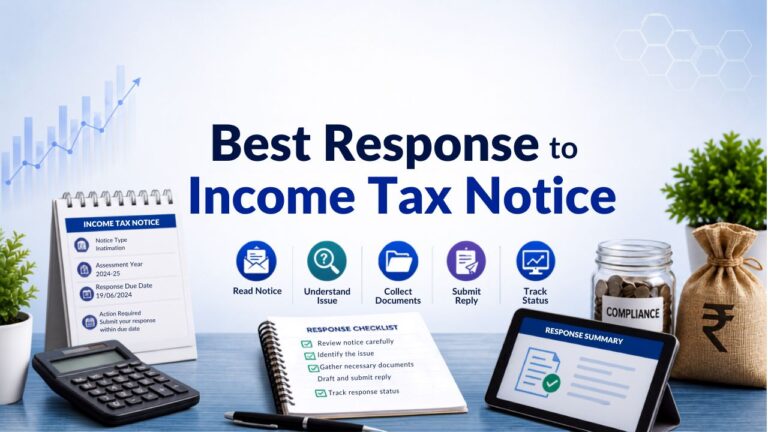
If the tax department sends you a notice referencing high-value credit card transactions, here is the process:
- Do not ignore it. All notices from the income tax department have a response deadline. Missing the deadline leads to ex-parte assessment – the officer decides without your explanation, almost always unfavourably.
- Log into the income tax portal and check your AIS. Verify which SFT entry triggered the notice and the exact amount reported.
- Prepare your explanation in writing. Common valid explanations include: salary and other declared income covers the spending; expenses were partially paid by another family member; corporate card reimbursed by employer; amount includes business expenses already shown in books.
- Respond through the portal under “e-Proceedings” with supporting documents – bank statements, salary slips, employer reimbursement records, or joint account proof as applicable.
- If your ITR was incorrect – for example, you forgot to declare freelance income or rental income – consider filing a updated return (ITR-U) to correct it before the notice reaches assessment stage. This reduces penalties significantly.
How to Check Your Own AIS for SFT Entries Before Filing ITR
Before filing your ITR every year, checking your AIS is a good habit. Here is how:
- Log into incometax.gov.in with your PAN and password
- Go to Services → Annual Information Statement
- Select the relevant financial year
- Click on Part B: SFT Information
- Check if any credit card entries appear and note the amounts
If the AIS shows an SFT entry that is incorrect – for example, a corporate card wrongly reported under your PAN – you can raise a feedback or dispute directly in the AIS portal. The bank will be asked to verify and correct the entry.
For the full AIS walkthrough, see our guide on AIS vs Form 26AS: what is the difference.
Tips to Stay Compliant Without Reducing Spending
- File your ITR accurately and on time. If your income legitimately covers your spending, there is nothing to worry about. The ITR filing deadline for salaried individuals is July 31.
- Avoid paying large cash amounts against credit card bills. Cash payments of Rs. 1 lakh or more are separately reported and attract more scrutiny than digital payments.
- Declare all income sources. Freelance income, rental income, interest income – all of these add to your declared income and help explain high spending.
- Keep records for corporate card reimbursements. If your employer reimburses credit card expenses, maintain records for at least 6 years. Reimbursements are not income but you need to prove it if asked.
- Check your AIS every year before filing. Catch and correct errors before the tax department flags them.
Frequently Asked Questions
Is credit card spending taxable?
No. Credit card spending itself is not taxable – you are spending money you have already earned. What is taxable is the income that funds your spending. The tax department cross-checks spending data against declared income to identify people who may be under-reporting earnings.
What is the credit card SFT threshold for FY 2026-27?
The threshold is Rs. 10 lakh in total annual credit card spending across all payment modes. Cash payments against credit card bills are separately reported at Rs. 1 lakh or more. These thresholds remain unchanged for FY 2026-27.
Does international credit card spending get reported?
Yes. credit card – whether in India or abroad are included in the total annual spend reported to the tax department. Additionally, foreign remittances under the Liberalised Remittance Scheme (LRS) of Rs. 7 lakh or more are separately reported by banks.
If I have two credit cards from different banks and each has Rs. 8 lakh in spend, is it reported?
Each bank reports independently based on its own threshold. Neither bank individually crosses Rs. 10 lakh. However, both transactions are visible in your AIS and the tax department can see the combined picture of Rs. 16 lakh total credit card activity. The risk-scoring system looks at your total financial footprint, not just individual SFT entries.
Can I dispute an incorrect SFT entry in my AIS?
Yes. Log into incometax.gov.in, go to your AIS, find the incorrect entry, and click “Optional: Feedback”. Select “Information is incorrect” and provide the correct details. The bank or reporting entity will be asked to verify. Track the feedback status in the AIS portal under the same section.
Will the New Income Tax Act 2025 change these reporting rules?
The SFT reporting framework continues under the New Income Tax Act 2025. The thresholds and categories of reportable transactions remain the same for FY 2026-27. The key change from April 2026 is tighter PAN linkage for credit cards and stricter enforcement consistency – the rules were always there, but data integration is now more robust. Any future changes to thresholds would be notified via a CBDT circular.
📚 Also Read: