Standard Deduction FY 2026-27: Rs. 75,000 for New Regime, Rs. 50,000 for Old Regime
Standard deduction is the single most underutilised tax benefit for salaried professionals in India. Not because people do not know about it, but because most do not know the difference between the two regimes, who qualifies, and how to ensure it is correctly applied in their ITR.
This guide covers everything you need to know about standard deduction FY 2026-27 (Tax Year 2026-27 under the new Income Tax Act 2025), with real salary examples and practical guidance.
What Is Standard Deduction?
Standard deduction is a flat amount deducted from your gross salary before calculating taxable income. You do not need to submit any bills, proofs, or receipts to claim it. It is automatic, available to every salaried employee and pensioner in India, and applies at the time of filing your ITR.
It was reintroduced in Budget 2018 to compensate for the removal of transport allowance and medical reimbursement exemptions. Since then, it has been a fixed, no-paperwork deduction that reduces taxable income directly.
Standard Deduction Amount for FY 2026-27
The standard deduction amounts for FY 2026-27 remain the same as FY 2025-26. Budget 2026 made no changes to this figure.
Under the new tax regime: Rs. 75,000
Under the old tax regime: Rs. 50,000
For family pensioners: Rs. 25,000 (new regime) and Rs. 15,000 (old regime)
The higher standard deduction under the new regime is by design. Since the new regime does not allow HRA, Section 80C, Section 80D, or most other deductions, the government increased the standard deduction to partially compensate salaried professionals for those lost benefits.
Who Can Claim Standard Deduction?
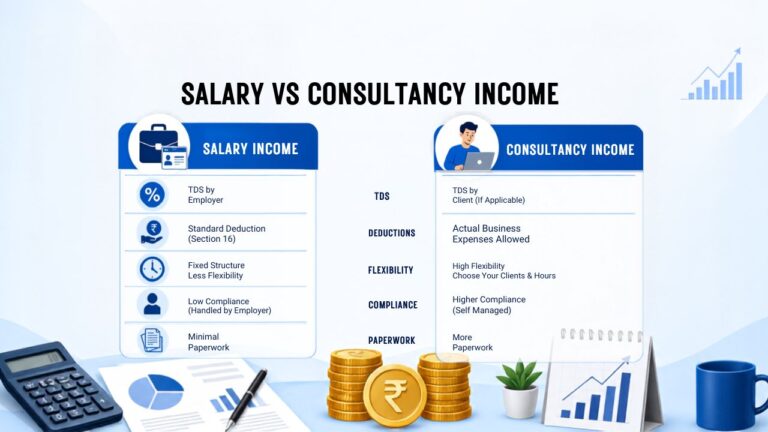
Standard deduction is available to salaried employees and pensioners only. It is not available to freelancers, self-employed professionals, or business owners who declare income under business or profession heads.
Specifically, you can claim it if your income falls under the head “Income from Salaries,” which includes regular salary from an employer, pension from a former employer, and family pension received after the death of a salaried employee.
One important rule that many salaried professionals miss: if you changed jobs during FY 2026-27, you get only one standard deduction for the full year, not one per employer. The deduction applies to total salary income for the year, regardless of how many employers you had.
Freelancers earning income under Section 44ADA cannot claim standard deduction. If you have both salary income and freelance income in the same year, standard deduction applies only to the salary portion. This is why the income tax for freelancers guide is worth reading if you have mixed income sources.
How Standard Deduction Works: Real Salary Examples
Example 1: Rs. 12.75 lakh gross salary, new tax regime
Gross salary: Rs. 12,75,000
Standard deduction: Rs. 75,000
Taxable income: Rs. 12,00,000
Tax before rebate: Rs. 60,000
Section 87A rebate: Rs. 60,000
Tax payable: Rs. 0
This is why Rs. 12.75 lakh is the effective zero-tax threshold under the new regime for salaried individuals. The standard deduction bridges the gap between Rs. 12 lakh (the rebate limit) and Rs. 12.75 lakh gross salary.
Example 2: Rs. 10 lakh gross salary, old tax regime
Gross salary: Rs. 10,00,000
Standard deduction: Rs. 50,000
Taxable salary before other deductions: Rs. 9,50,000
After Section 80C (Rs. 1,50,000): Rs. 8,00,000
After Section 80D (Rs. 25,000): Rs. 7,75,000
Tax at old regime slabs: approximately Rs. 82,500 plus cess
Without standard deduction, taxable salary would have started at Rs. 10 lakh instead of Rs. 9.5 lakh, costing approximately Rs. 15,600 more in tax (Rs. 50,000 at 30% plus 4% cess). Standard deduction quietly saves this amount every year without any effort.
Example 3: Rs. 8 lakh gross salary, new tax regime
Gross salary: Rs. 8,00,000
Standard deduction: Rs. 75,000
Taxable income: Rs. 7,25,000
Tax at new regime slabs: Rs. 30,000 (5% on Rs. 3,25,000 above Rs. 4 lakh) plus Rs. 25,000 on first Rs. 4 lakh
Wait, total is approximately Rs. 30,000
Section 87A rebate does not apply (income exceeds Rs. 12 lakh threshold is not crossed, but income is above Rs. 7 lakh so partial tax applies)
Net tax: approximately Rs. 30,000 plus 4% cess = Rs. 31,200
Without standard deduction, taxable income would be Rs. 8 lakh and tax would be approximately Rs. 40,000 plus cess. Standard deduction saves approximately Rs. 10,400 at this income level.
Standard Deduction Under Income Tax Act 2025
From Tax Year 2026-27, standard deduction is covered under Section 22 of the Income Tax Act 2025, replacing the old Section 16(ia) of the Income Tax Act 1961. The amount, eligibility, and application are identical. Only the section number changed.
For your ITR filing in July 2026 covering FY 2025-26, standard deduction was under Section 16(ia) of the old Act. For Tax Year 2026-27 returns filed in July 2027, the reference will be Section 22 of the new Act.
If you are checking your Form 130 (new Form 16, applicable from June 2027) or submitting Form 124 (new Form 12BB) to your employer for Tax Year 2026-27, it will reference the new section numbers. Your employer’s payroll system should already be updated to reflect this. For more details, read the complete guide on Form 16 replaced by Form 130.
Standard Deduction for Pensioners
Pensioners receiving pension from a former employer can claim standard deduction since pension is treated as salary income under Indian tax law.
Under the new tax regime: Rs. 25,000 for family pensioners (those receiving pension after the death of the original pensioner)
Under the old tax regime: Rs. 15,000 for family pensioners
Regular pensioners (the original retired employee) can claim the full Rs. 75,000 (new regime) or Rs. 50,000 (old regime), same as salaried employees.
However, pensioners receiving pension from the government through the National Pension System (NPS) should note that the standard deduction applies to the pension component. The NPS lump sum withdrawal on retirement has separate tax treatment and is not affected by standard deduction. Read the complete guide on income tax slabs and exemptions for senior citizens for more detail.
Standard Deduction vs Old Transport and Medical Allowances
Before FY 2018-19, salaried employees could claim two separate exemptions: transport allowance of Rs. 19,200 per year and medical reimbursement of Rs. 15,000 per year, totalling Rs. 34,200 annually. These required receipts and employer documentation.
Standard deduction replaced both with a single flat amount that requires no documentation. The current Rs. 75,000 under the new regime is more than double the old combined exemption, making it substantially better for most salaried professionals even without the documentation hassle.
How Standard Deduction Is Applied in Your ITR
You do not need to do anything special to claim standard deduction when filing your ITR. The income tax portal automatically applies the deduction based on your regime choice.
When your employer deducts TDS from your salary each month, they already account for standard deduction in their calculation. This is why your Form 16 or Form 130 will show gross salary and then standard deduction as a line item, arriving at net taxable salary.
If you switch from old to new regime while filing your ITR (which salaried employees can do every year), the system automatically applies Rs. 75,000 instead of Rs. 50,000. No manual adjustment needed.
If you had multiple employers during the year, your total standard deduction remains Rs. 75,000 or Rs. 50,000 for the full year. Some employers with incomplete salary history from your previous employer may deduct it separately, but at ITR filing stage, only one deduction applies to total income. For a step-by-step guide on filing, read how to file ITR online.
Standard Deduction and NPS: The Powerful Combination Under New Regime
For professionals on the new tax regime, standard deduction combined with employer NPS contribution is the strongest tax-saving combination available.
Employer NPS contribution up to 14% of basic salary is deductible under Section 80CCD(2) even under the new regime. This is over and above the standard deduction of Rs. 75,000.
Example: Basic salary Rs. 6 lakh per year. Employer NPS at 14% = Rs. 84,000. Add standard deduction Rs. 75,000. Total deduction = Rs. 1,59,000. This is almost equivalent to the full Section 80C benefit under the old regime, without any additional investment from your side.
If your employer offers NPS contribution and you have not opted for it, discuss with HR immediately. It reduces your taxable income without reducing your take-home salary since the contribution comes from the employer side. For a full breakdown of tax saving strategies, read the tax saving tips for salaried employees guide.
Common Questions on Standard Deduction
Can I claim both standard deduction and HRA?
Yes, but only under the old tax regime. Under the old regime, standard deduction of Rs. 50,000 and HRA exemption are both available simultaneously. Under the new regime, HRA is not available, only standard deduction of Rs. 75,000 applies. For HRA calculation and eligibility, read the HRA exemption guide.
Does standard deduction apply to income from house property or capital gains?
No. Standard deduction applies only to income under the head “Salaries.” Income from house property, capital gains, business or profession, and other sources are not eligible for this deduction.
I am a freelancer. Can I claim standard deduction?
No. Standard deduction is available only to those whose income falls under the salary head. Freelance income falls under profits and gains from business or profession, which is not eligible. For tax-saving options available to freelancers, read the complete guide on income tax for freelancers.
If I worked at two companies this year, do I get two standard deductions?
No. Only one standard deduction of Rs. 75,000 (new regime) or Rs. 50,000 (old regime) applies per year, regardless of the number of employers. Your ITR portal will apply it automatically on the total salary income from all sources combined.
Is standard deduction available on pension income?
Yes, pension from a former employer is treated as salary and is eligible for standard deduction. Regular pensioners get Rs. 75,000 (new regime) or Rs. 50,000 (old regime). Family pensioners get Rs. 25,000 (new regime) or Rs. 15,000 (old regime).
Does standard deduction change if I switch regimes?
Yes. If you switch from old to new regime, your standard deduction increases from Rs. 50,000 to Rs. 75,000. Salaried employees can switch regimes every year at the time of filing their ITR. To understand which regime saves you more overall, use the old vs new tax regime comparison guide.
The Bottom Line
Standard deduction is the simplest tax benefit available to salaried professionals in India. It requires no documentation, no investment, and no declaration beyond your regime choice. At Rs. 75,000 under the new regime, it saves Rs. 15,600 in tax at the 20% slab and Rs. 23,400 at the 30% slab, every single year, automatically.
The only decision you need to make is which regime to choose. If you are unsure, run both calculations using the HRA calculator for your exemptions and compare total tax under both regimes before your employer’s investment declaration deadline in April.
For a complete picture of all deductions available under both regimes, read the Complete Income Tax Guide India.
Questions about how standard deduction interacts with your specific salary structure? Drop them in the comments below.
📚 Also Read: