Section 80D: Health Insurance Deduction FY 2026-27
Section 80D: The One Tax Deduction That Protects Both Your Health and Your Wallet
Medical inflation in India is running at 10 to 12% per year. A single hospitalization in a Tier 1 city now costs Rs. 3 to 6 lakh on average. Yet most salaried professionals either have inadequate health insurance or are not claiming the full tax benefit they are entitled to under Section 80D.
Section 80D is one of the few deductions that works on top of the Rs. 1.5 lakh limit of Section 80C. It is entirely separate. A professional who uses both sections correctly can reduce their taxable income by Rs. 2.5 lakh to Rs. 3.25 lakh combined, saving Rs. 75,000 to Rs. 1,00,000 in taxes annually depending on their bracket.
This guide covers every aspect of Section 80D: deduction limits, who can be covered, what qualifies, what does not, and the scenarios most people miss.
Important: Section 80D deductions are available only under the old tax regime. If you have chosen the new tax regime, you cannot claim this deduction. Before reading further, confirm which regime you are in. If you are unsure, the old vs new tax regime comparison will help you decide.
What Is Section 80D?
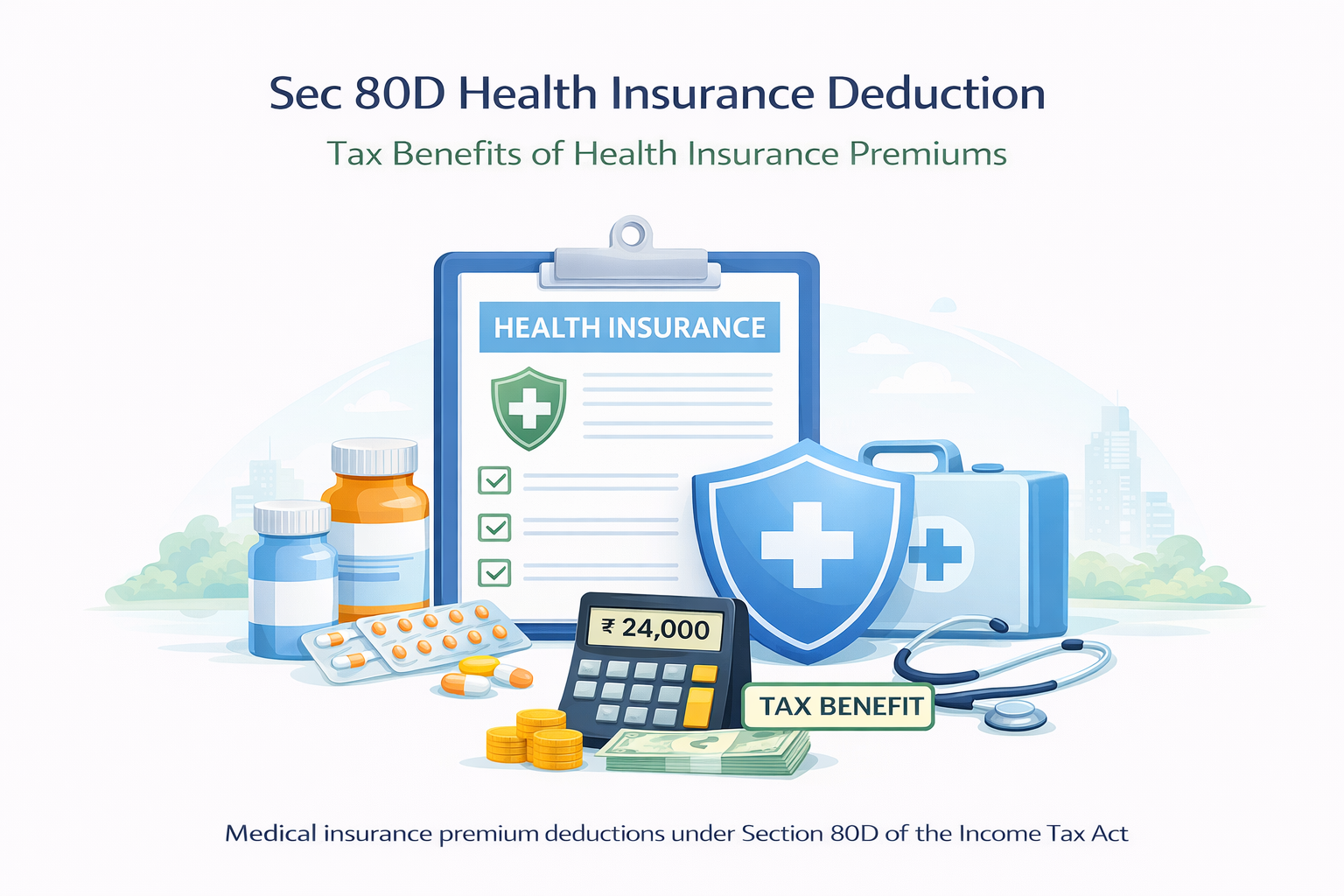
Section 80D of the Income Tax Act allows individuals and HUFs to claim a deduction on premiums paid for health insurance policies. The deduction also covers preventive health check-up expenses and, in specific cases, actual medical expenditure incurred on senior citizens who do not have health insurance.
The key difference from Section 80C is that 80D has two separate deduction buckets: one for yourself and your family, and one for your parents. Both can be claimed simultaneously, making the total potential deduction Rs. 1,00,000 per year in the best case.
Section 80D Deduction Limits: Complete Table
| Who Is Covered | Age Below 60 | Age 60 and Above (Senior Citizen) |
|---|---|---|
| Self, Spouse, Dependent Children | Up to Rs. 25,000 | Up to Rs. 50,000 |
| Parents (separately) | Up to Rs. 25,000 | Up to Rs. 50,000 |
| Maximum Total Deduction | Rs. 50,000 (both below 60) | Up to Rs. 1,00,000 (both senior) |
The Rs. 5,000 preventive health check-up deduction is included within these limits, not over and above them.
All Possible Scenarios: Exact Deduction in Each Case
This is where most guides are unclear. Let me break down every possible combination.
Scenario 1: You and family below 60, parents below 60
- Self and family premium: Rs. 22,000
- Parents premium: Rs. 20,000
- Total deduction: Rs. 42,000 (maximum possible: Rs. 50,000)
Scenario 2: You and family below 60, parents are senior citizens
- Self and family premium: Rs. 25,000
- Parents premium: Rs. 48,000
- Total deduction: Rs. 73,000 (maximum possible: Rs. 75,000)
Scenario 3: You are senior citizen, parents also senior citizens
- Self and family premium: Rs. 50,000
- Parents premium: Rs. 50,000
- Total deduction: Rs. 1,00,000 (maximum possible: Rs. 1,00,000)
Scenario 4: Parents are senior citizens with NO health insurance
- Self and family premium: Rs. 24,000
- Parents have no insurance, actual medical expenses: Rs. 38,000
- Total deduction: Rs. 62,000 (Rs. 24,000 plus Rs. 38,000)
This is the scenario most professionals do not know about. If your parents are senior citizens and do not have any health insurance policy, you can claim their actual medical expenses as a deduction up to Rs. 50,000. This is completely separate from the regular premium route.
Scenario 5: Preventive health check-up
- Self and family premium: Rs. 20,000
- Preventive health check-up expenses: Rs. 5,000
- Total claim: Rs. 25,000 (check-up is within the Rs. 25,000 cap, not additional)
| Your Age | Parents’ Age | Maximum 80D Deduction |
|---|---|---|
| Below 60 | Below 60 | Rs. 50,000 |
| Below 60 | 60 and above | Rs. 75,000 |
| 60 and above | 60 and above | Rs. 1,00,000 |
| Below 60 | No insurance (senior) | Rs. 75,000 (medical expenses route) |
Who Can Be Covered Under Section 80D
Eligible family members:
- Self
- Spouse
- Dependent children (not working or financially independent)
- Parents (whether dependent or not, both father and mother)
NOT eligible under Section 80D:
- In-laws (your spouse’s parents)
- Siblings
- Grandparents
- Working or financially independent children
- Any other relative
One thing professionals often miss: your parents do NOT need to be financially dependent on you to claim the deduction. Even if your parents have their own income, if you are paying their health insurance premium, you can claim the deduction. This is a common misconception that causes many people to miss out on Rs. 25,000 to Rs. 50,000 of deduction every year.
What Qualifies Under Section 80D
1. Health Insurance Premiums
Premiums paid to any IRDAI-approved insurer for health insurance policies covering eligible family members. This includes individual policies, family floater policies, top-up plans, and critical illness riders attached to health policies.
What does NOT qualify:
- Group health insurance provided by your employer (the premium your company pays on your behalf)
- Premiums paid in cash (must be paid by bank transfer, UPI, cheque, or card)
- Premium for life insurance policies (those go under Section 80C)
2. Preventive Health Check-up Expenses
- Maximum: Rs. 5,000 per year
- Covers: Annual health check-ups, blood tests, ECG, cancer screening, etc. for self, spouse, children, and parents
- Payment mode: Cash is allowed for this specific expense only
- Important: This Rs. 5,000 is part of the overall limit, not an additional deduction on top
3. Medical Expenditure for Uninsured Senior Citizen Parents
- Maximum: Rs. 50,000 per year
- Condition: Your parent must be a resident senior citizen (60 years and above) with NO active health insurance policy
- Covers: Doctor consultation fees, hospital bills, medicines, diagnostic tests
- Payment mode: Must be non-cash (bank transfer, UPI, card). Cash payments do not qualify
- Both conditions must be met simultaneously: senior citizen AND no insurance
4. Contribution to Central Government Health Scheme (CGHS)
Contributions made to CGHS or any other notified government health scheme qualify within the 80D limits. Government employees who contribute to CGHS can claim this as part of their Section 80D deduction.
Payment Mode Rules: Critical to Get Right
| Type of Expense | Cash Allowed? | Non-Cash Required? |
|---|---|---|
| Health insurance premium | No | Yes (bank transfer, UPI, card, cheque) |
| Medical expenses for uninsured senior parent | No | Yes (bank transfer, UPI, card, cheque) |
| Preventive health check-up | Yes (up to Rs. 5,000) | Not mandatory |
Paying a health insurance premium in cash is a mistake that costs the entire deduction. Even if the premium amount is small, a cash payment makes it ineligible. Always pay via bank transfer or UPI. The payment trail is also what protects you if the tax department ever asks for verification.
How Section 80D Works with Section 80C Together
Many professionals do not realise that 80D gives deduction over and above the Rs. 1.5 lakh 80C limit. They are completely separate.
Example for a professional aged 35 with senior citizen parents:
| Deduction Type | Amount |
|---|---|
| Section 80C (PPF, ELSS, EPF, etc.) | Rs. 1,50,000 |
| Section 80D: self and family premium | Rs. 25,000 |
| Section 80D: senior citizen parents premium | Rs. 50,000 |
| Standard Deduction | Rs. 50,000 |
| Total Deductions | Rs. 2,75,000 |
On a salary of Rs. 15 lakh, these combined deductions reduce taxable income from Rs. 15 lakh to Rs. 12.25 lakh, saving approximately Rs. 56,000 to Rs. 78,000 in tax depending on other deductions.
For the complete picture of all deductions working together, read the Complete Income Tax Guide India 2025-26 and 2026-27.
Documents Required to Claim Section 80D
| Expense Type | Documents to Keep |
|---|---|
| Health insurance premium | Premium receipt, policy schedule showing insured members, insurer name and policy number |
| Senior parent medical expenses | Doctor consultation receipts, hospital bills, medicine bills, diagnostic test reports, bank statement showing payments |
| Preventive health check-up | Check-up invoice or receipt (cash receipts acceptable) |
From AY 2025-26, when filing your ITR, you need to provide the insurer’s name and policy number for each health insurance policy you claim. Keep these details handy before filing.
How to Submit 80D to Your Employer
At the start of the financial year, your employer collects investment declarations via Form 12BB. In this form, you declare your expected health insurance premium payments for the year. Based on this declaration, your employer reduces your monthly TDS.
At year end, your employer will ask for actual premium receipts to confirm. Submit the receipt along with the policy schedule showing the names of insured members.
If you miss the employer deadline, claim the deduction directly when filing your ITR. Any excess TDS deducted will be refunded.
Special Situations Most Professionals Miss
Situation 1: Both Spouses Pay Premium Separately
If both you and your spouse pay health insurance premiums for a family floater policy in different proportions, each of you can claim deduction proportional to what you paid. However, the total claim between both spouses cannot exceed the applicable limit. Keep clear bank records showing who paid what amount.
Situation 2: Multi-year Premium (Two-Year Policy)
If you pay a premium for a two-year policy in one go, you can claim deduction only for the proportionate premium applicable to the current financial year. If you pay Rs. 30,000 for a two-year policy, you can claim Rs. 15,000 per year, not the full Rs. 30,000 in year one.
Situation 3: Critical Illness Rider
If your health insurance policy has a critical illness rider, the premium paid for that rider also qualifies under Section 80D. The combined premium including the rider is eligible, subject to the overall limits.
Situation 4: NRIs
NRIs can claim Section 80D deduction for health insurance premiums paid for policies purchased from Indian insurers, subject to the same limits. NRI status does not disqualify you from this deduction.
Situation 5: HUF
A Hindu Undivided Family can claim Section 80D deduction for health insurance premiums paid for any member of the HUF, up to Rs. 25,000 (or Rs. 50,000 if the insured member is a senior citizen).
Common Mistakes That Reduce Your 80D Benefit
Mistake 1: Paying premium in cash
The single most common and expensive mistake. Cash payment disqualifies the entire premium from deduction. Switch to UPI or bank transfer immediately if you have been paying in cash.
Mistake 2: Not claiming parents’ premium separately
Many professionals add parents’ premium into their own family floater or claim it as part of the self and family limit. Parents have a completely separate deduction bucket. Claim them separately to maximise the total deduction.
Mistake 3: Forgetting medical expenses for uninsured senior parents
If your parents are above 60 and have no health insurance, their actual medical expenses up to Rs. 50,000 paid by non-cash mode qualify. This is one of the least-known provisions in Section 80D and is missed by a large number of professionals.
Mistake 4: Claiming group insurance provided by employer
The health cover your employer provides through a group policy does not qualify under Section 80D because you are not paying the premium. Only premiums you personally pay qualify.
Mistake 5: Claiming 80D under new tax regime
Section 80D is not available under the new tax regime. If you have opted for the new regime, this deduction cannot be claimed. This is one of the key reasons to compare both regimes carefully before choosing.
Frequently Asked Questions on Section 80D
What is the maximum deduction under Section 80D?
The maximum possible deduction is Rs. 1,00,000 per year. This applies when you (senior citizen) pay Rs. 50,000 for self and family health insurance, and your senior citizen parents have a premium of Rs. 50,000. For professionals below 60 with senior citizen parents, the maximum is Rs. 75,000.
Is Section 80D available in the new tax regime?
No. Section 80D deduction is not available under the new tax regime. It is exclusively available under the old tax regime. This is one of the significant advantages of the old regime for people with health insurance.
Can I claim 80D for my in-laws’ health insurance?
No. In-laws are not covered under Section 80D. The section covers only self, spouse, dependent children, and parents (your own parents, not your spouse’s).
Can I claim 80D if my parents are not dependent on me?
Yes. Section 80D does not require parents to be financially dependent on you. Even if your parents have their own income or pension, if you are paying their health insurance premium, you can claim the deduction.
What if my employer reimburses my health insurance premium?
If your employer reimburses your premium, you cannot claim it under Section 80D because the expense has not been borne by you. Only premiums you personally pay from your own pocket qualify.
Can I claim both 80C and 80D in the same year?
Yes. Section 80C and Section 80D are completely separate deduction heads with independent limits. Claiming Rs. 1,50,000 under Section 80C does not affect your 80D claim. Both can be claimed simultaneously under the old tax regime.
Is the preventive health check-up deduction separate from the premium deduction?
No. The Rs. 5,000 preventive health check-up deduction is included within the overall 80D limit of Rs. 25,000 or Rs. 50,000. It is not an additional deduction on top of the premium.
Can I claim 80D for a top-up health insurance policy?
Yes. Premiums paid for top-up health insurance plans qualify under Section 80D, subject to the same overall limits. Top-up plans are an increasingly popular way to get high coverage at lower premiums, and the tax benefit is available on them.
The Bottom Line
Section 80D is one of the most underutilised deductions among salaried professionals. The combination of self and family cover plus parents’ cover can deliver Rs. 50,000 to Rs. 1,00,000 in deductions annually, translating to Rs. 10,000 to Rs. 31,200 in direct tax savings depending on your bracket.
Three things to do right now:
- Check if your parents have health insurance. If they are senior citizens without a policy, their medical expenses up to Rs. 50,000 paid by you via bank transfer qualify as a deduction.
- Ensure all premium payments are via bank transfer or UPI. No cash payments.
- Verify that your employer has accounted for both your own premium and your parents’ premium separately in your Form 16.
For a complete understanding of all deductions available to you including Section 80C, HRA exemption, and standard deduction, read the Complete Income Tax Guide India 2025-26 and 2026-27.
Questions about your specific 80D situation? Drop them in the comments below.