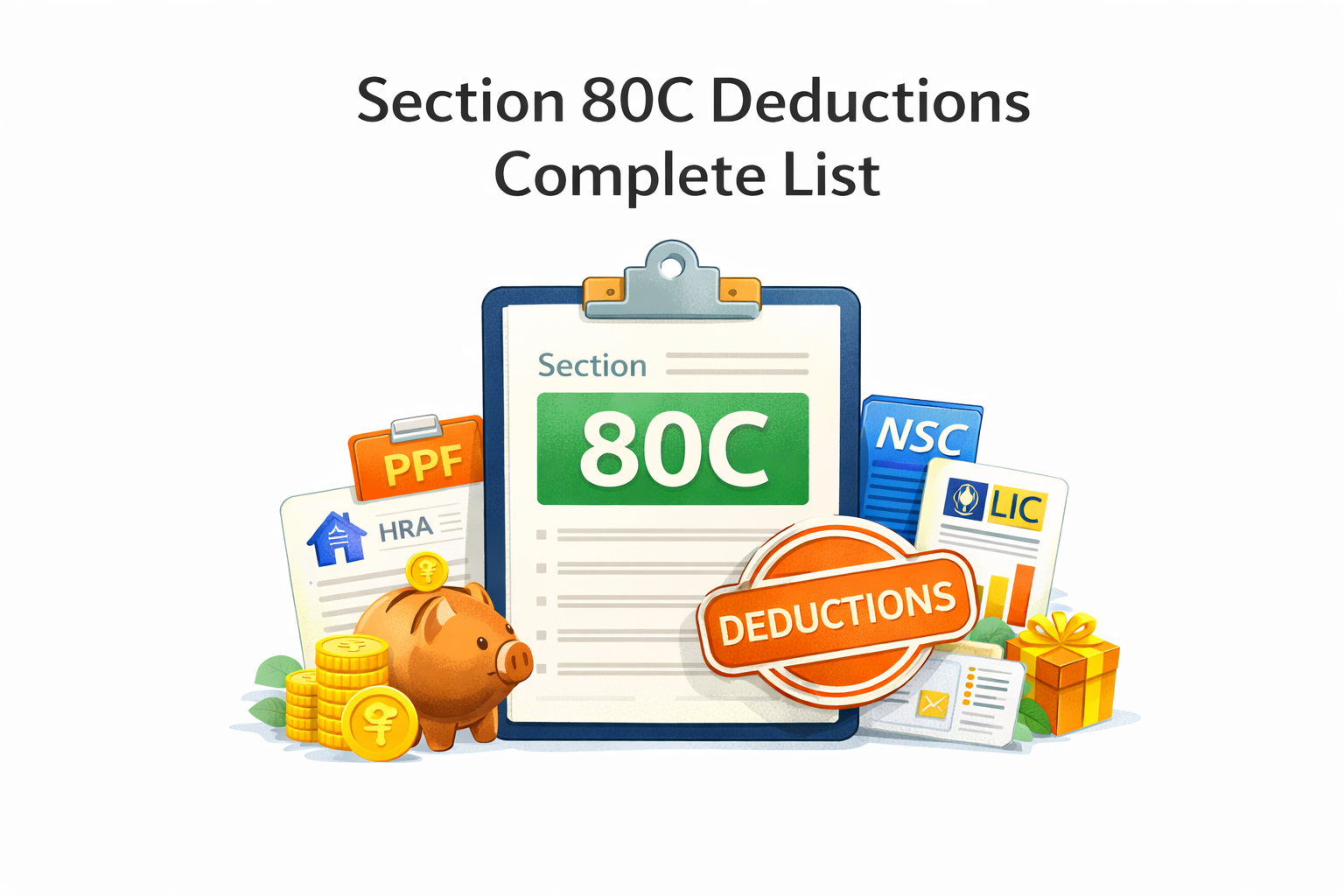
Section 80C Deductions Complete List for FY 2025-26
What Is Section 80C? (And Why Every Salaried Person Must Know This)
In my 6 years of working with salaried professionals across India, Section 80C is the single most misunderstood tax-saving tool I come across. And the reason is simple: it is the most powerful tax-saving tool available to salaried individuals in India.
Yet I am constantly surprised by how many people use it wrong. Most people only know about LIC premiums and EPF. They have no idea about the 15+ other instruments that qualify. That gap in knowledge costs them thousands of rupees in unnecessary tax every year.
In this article, I am giving you the complete Section 80C deductions list for FY 2025-26 and FY 2026-27, with every detail you need: lock-in periods, return rates, who can claim, and which option suits which type of person.
But before we dive in, there is one important update you must know.
Important Update for FY 2026-27: Under the new Income Tax Act, 2025 (effective from 1 April 2026), Section 80C has been renumbered as Section 123. The deduction limit of Rs. 1,50,000 remains exactly the same. All eligible instruments remain the same. Only the section number changes. Returns for FY 2025-26 will still be filed under Section 80C of the old Income Tax Act, 1961. Returns for FY 2026-27 will use Section 123. I will update this article as filing procedures become clearer.
Section 80C at a Glance
| Feature | Details |
|---|---|
| Maximum Deduction | Rs. 1,50,000 per financial year |
| Who Can Claim | Individual taxpayers and HUFs only |
| Tax Regime | Old Tax Regime only (not available in new regime) |
| Combined Limit | Rs. 1,50,000 total across 80C + 80CCC + 80CCD(1) |
| Additional NPS Benefit | Extra Rs. 50,000 under Section 80CCD(1B) over and above the 1.5 lakh limit |
| New Act Section | Section 123 (from 1 April 2026) |
Before you read further, make sure you are actually in the old tax regime. If you are in the new regime, Section 80C deductions are not available to you at all. The new regime offers lower slab rates but removes most deductions including this one.
How Much Can You Actually Save with Section 80C?
Let me give you the real numbers. Real numbers make this clearest, so let me show you exactly what the tax saving looks like at each bracket.
| Your Tax Bracket | 80C Investment | Tax Saved | Effective Cost of Investment |
|---|---|---|---|
| 5% slab | Rs. 1,50,000 | Rs. 7,800 (incl. cess) | Rs. 1,42,200 |
| 20% slab | Rs. 1,50,000 | Rs. 31,200 (incl. cess) | Rs. 1,18,800 |
| 30% slab | Rs. 1,50,000 | Rs. 46,800 (incl. cess) | Rs. 1,03,200 |
If you are in the 30% tax bracket, investing Rs. 1,50,000 under 80C effectively costs you only Rs. 1,03,200 after tax savings. That is a guaranteed 31% return just from the tax benefit, before any actual investment return.
This is why exhausting your 80C limit every single year is non-negotiable for anyone in the old regime.
Complete Section 80C Deductions List (FY 2025-26)
Section 80C covers two types of eligible items: Investments and Expenses. Most people only know the investments. The expenses category is what most people miss entirely.
Part A: Investment-Based 80C Deductions
1. Public Provident Fund (PPF)
- Lock-in period: 15 years (partial withdrawal allowed from year 7)
- Interest rate: 7.1% per annum (government sets this quarterly)
- Tax treatment: EEE (Exempt-Exempt-Exempt): contribution deductible, interest tax-free, maturity tax-free
- Who should invest: Anyone looking for zero-risk, long-term, fully tax-free savings
- Minimum investment: Rs. 500 per year
- Maximum investment: Rs. 1,50,000 per year
- Where to open: Post office or any nationalized bank
PPF is the go-to recommendation for conservative investors. The returns are modest but completely tax-free, and the 15-year structure forces the kind of long-term discipline that actually builds wealth.
2. Employee Provident Fund (EPF)
- Who qualifies: Salaried employees in organisations with 20 or more employees
- Deductible amount: Employee’s contribution only (employer’s share is not deductible under 80C)
- Interest rate: 8.25% for FY 2023-24 (declared annually by EPFO)
- Tax treatment: EEE if withdrawn after 5 continuous years of service
- Important note: If you withdraw EPF before 5 years of continuous service, it becomes taxable
For most salaried employees, EPF contributions alone eat up a significant chunk of the Rs. 1.5 lakh limit. Check your salary slip to know your monthly EPF contribution before planning additional 80C investments.
3. Voluntary Provident Fund (VPF)
- What it is: Voluntary additional contribution to your EPF account over and above the mandatory 12%
- Interest rate: Same as EPF (8.25%)
- Tax treatment: Same as EPF (EEE)
- Best for: Salaried employees who want to top up their 80C limit without opening new accounts
4. ELSS Mutual Funds (Equity Linked Savings Scheme)
- Lock-in period: 3 years (shortest among all 80C options)
- Returns: Market-linked (historically 12-15% over long term, not guaranteed)
- Tax treatment: EET: contribution deductible, gains taxed as LTCG above Rs. 1.25 lakh per year
- Investment mode: SIP or lump sum both qualify. Each SIP instalment has its own 3-year lock-in
- Who should invest: Investors with a 5+ year horizon who can handle market fluctuations
ELSS is the only 80C option that gives you exposure to equity markets. The 3-year lock-in is the lowest of all 80C instruments, and the return potential is the highest. The right SIP approach for ELSS rather than lump sum investment in March.
5. National Savings Certificate (NSC)
- Lock-in period: 5 years
- Interest rate: 7.7% per annum (compounded annually, paid at maturity)
- Tax treatment: Investment deductible; interest is taxable but qualifies as reinvestment under 80C each year
- Where to buy: Post office
- Best for: Conservative investors who want fixed, government-backed returns
6. Life Insurance Premiums (LIC and Other Insurers)
- What qualifies: Premiums paid for life insurance policies for yourself, your spouse, or your children
- Important condition: For policies issued on or after 1 April 2012, the premium must not exceed 10% of the sum assured to qualify for deduction
- Does NOT qualify: Premiums paid for parents or in-laws
- Insurers covered: Any insurer approved by IRDAI, including private companies
- My strong advice: Buy term insurance for life cover and invest separately. Do NOT buy endowment or money-back plans just for 80C. The returns on those plans are very poor.
7. ULIP (Unit Linked Insurance Plans)
- Lock-in period: 5 years
- Premium qualifies under: 80C, and maturity proceeds are tax-free under Section 10(10D) if conditions are met
- ULIPs combine insurance and investment, which usually means poor returns on both. Avoid unless you have very specific needs that no other instrument covers.
8. Sukanya Samriddhi Yojana (SSY)
- Who can invest: Parent or guardian of a girl child below age 10
- Interest rate: 8.2% per annum (highest among all small savings schemes)
- Lock-in: Until girl child turns 21 (partial withdrawal allowed at 18 for education or marriage)
- Tax treatment: EEE: fully tax-free contribution, interest, and maturity
- Minimum investment: Rs. 250 per year
- Maximum investment: Rs. 1,50,000 per year per account
If you have a daughter below age 10, SSY is one of the best investments you can make. The interest rate is the highest among all government-backed schemes, and the entire corpus is tax-free. I have written a detailed article on Sukanya Samriddhi Yojana if you want to understand it fully.
9. Tax Saving Fixed Deposits (Bank FDs)
- Lock-in period: 5 years (cannot be broken prematurely)
- Interest rate: Varies by bank, typically 6.5% to 7.5%
- Tax treatment: Investment deductible under 80C, but interest is fully taxable every year
- Who should consider: Very conservative investors who want complete capital protection
- Important note: TDS is deducted on interest. Submit Form 15G (or 15H for seniors) to avoid TDS if your income is below taxable limit.
10. National Pension System (NPS) under Section 80CCD(1)
- Deductible amount: Up to 10% of salary (basic + DA) under 80CCD(1), within the Rs. 1.5 lakh overall limit
- Additional benefit: An extra Rs. 50,000 deduction is available under Section 80CCD(1B), over and above the Rs. 1.5 lakh cap
- Lock-in: Till age 60 (partial withdrawal allowed for specific purposes)
- Tax at maturity: 60% lump sum at retirement is tax-free, 40% must be used for annuity purchase
NPS is one of the most underutilised tax-saving tools. The extra Rs. 50,000 deduction under 80CCD(1B) is available over and above 80C. That means if you invest Rs. 1,50,000 in 80C and another Rs. 50,000 in NPS under 80CCD(1B), your total deduction can be Rs. 2,00,000.
11. Senior Citizens Savings Scheme (SCSS)
- Who can invest: Indian citizens aged 60 and above (55+ if retired under VRS)
- Interest rate: 8.2% per annum (paid quarterly)
- Lock-in: 5 years
- Maximum investment: Rs. 30,00,000
- Tax treatment: Investment deductible, but interest is taxable
12. Post Office Time Deposit (5-year)
- Lock-in: 5 years
- Interest rate: 7.5% per annum
- Tax treatment: Investment deductible, interest is taxable
- Best for: People who want post office safety with fixed returns
Part B: Expense-Based 80C Deductions (Most People Miss These)
This section is what separates informed taxpayers from the rest. You can claim 80C deduction on certain expenses without investing a single rupee in any new instrument.
13. Children’s Tuition Fees
- What qualifies: Tuition fees paid to any school, college, university, or educational institution in India for full-time education
- Number of children: Up to 2 children per taxpayer
- What does NOT qualify: Donation fees, development fees, hostel fees, coaching class fees, or fees paid for spouse’s education
- Important: Both parents cannot claim the same child’s fees. Only one parent can claim.
Many parents paying school fees of Rs. 50,000 to Rs. 1,00,000 per child per year are sitting on a large 80C deduction they never claim. If you have two children in school or college, your fees alone might exhaust the entire Rs. 1.5 lakh limit.
14. Home Loan Principal Repayment
- What qualifies: The principal component of your home loan EMI (not the interest portion)
- Important condition: The property must not be sold within 5 years of possession. If you sell before 5 years, the deductions claimed will be reversed and added back to your income in the year of sale.
- Also qualifies: Stamp duty and registration charges paid at the time of house purchase (claimable only in the year of purchase)
- Interest deduction: Home loan interest is NOT under 80C. It is claimed separately under Section 24(b), up to Rs. 2,00,000 per year.
Understanding the complete income tax deduction system helps you plan both the principal and interest benefit from your home loan together.
Quick Comparison Table: All 80C Options at a Glance
| Instrument | Lock-in | Returns | Risk | Tax on Returns |
|---|---|---|---|---|
| PPF | 15 years | 7.1% | Zero | Tax-free |
| EPF/VPF | Till retirement | 8.25% | Zero | Tax-free (if 5+ yrs service) |
| ELSS | 3 years | 12-15% (not guaranteed) | High | LTCG above Rs. 1.25L |
| NSC | 5 years | 7.7% | Zero | Taxable (but re-investable) |
| Tax Saving FD | 5 years | 6.5-7.5% | Zero | Taxable |
| SSY | Till age 21 | 8.2% | Zero | Tax-free |
| SCSS | 5 years | 8.2% | Zero | Taxable |
| NPS (80CCD1) | Till age 60 | Market-linked | Moderate | 60% tax-free at maturity |
| LIC Premium | Policy term | 4-6% | Zero | Tax-free under Sec 10(10D) |
| Tuition Fees | None | Not applicable | None | Not applicable |
| Home Loan Principal | 5 years (property) | Not applicable | None | Not applicable |
Which 80C Investment Is Best for You? (Based on Your Profile)
This is the most common question I get, and the answer depends on your age, risk appetite, and financial goals. Here is my framework:
If you are 22 to 35 years old and can take risk:
Prioritise ELSS for the majority of your 80C investment. The 3-year lock-in is short, the return potential is highest over the long term, and the tax on gains is only on LTCG above Rs. 1.25 lakh. Combine with EPF (which is automatic) and top up with PPF for a small portion of guaranteed savings.
If you are 35 to 50 years old:
Start shifting the balance towards PPF and VPF. ELSS can still be part of the mix, but reduce equity exposure gradually. If you have children in school or college, use tuition fees to fill part of the 80C bucket without any lock-in cost.
If you are 50 plus or near retirement:
PPF, VPF, NSC, and SCSS (if 60+) should dominate your 80C allocation. Avoid long lock-in instruments. SCSS at 8.2% with quarterly payouts is excellent for senior citizens.
If you have a daughter below age 10:
SSY at 8.2% tax-free return is unbeatable for this specific purpose. Open an SSY account and contribute the maximum before looking at other 80C options.
If you are buying a house this year:
Stamp duty and registration charges in the year of purchase qualify under 80C. Your principal repayment from the next EMI also qualifies. You may exhaust most of your Rs. 1.5 lakh limit through these expenses alone.
Common Mistakes People Make with 80C
These are the most expensive and most common mistakes salaried professionals make with Section 80C:
Mistake 1: Investing in January-March in a rush
Most people do 80C investments in the last quarter just to save tax. This is the worst approach for ELSS because you lose the averaging benefit of SIP. Start your 80C investments in April itself. An ELSS SIP started in April is far better than a lump sum in March.
Mistake 2: Buying LIC endowment plans for 80C
A traditional endowment or money-back plan gives you 4-5% effective returns after factoring in the premium. That is below inflation. Buy a pure term plan for life insurance. Invest the premium difference in ELSS or PPF. You will end up with much better insurance coverage and much better returns.
Mistake 3: Investing over Rs. 1.5 lakh in a single 80C instrument
If you invest Rs. 2 lakh in PPF, you get deduction only on Rs. 1.5 lakh. The extra Rs. 50,000 gives you no additional tax benefit. Plan your total 80C investments carefully across all instruments combined.
Mistake 4: Forgetting tuition fees and home loan principal
Parents paying school fees and home loan borrowers are often sitting on unused 80C deductions. These expenses count towards your Rs. 1.5 lakh limit even without any separate investment.
Mistake 5: Not submitting proof to employer on time
Missing the employer proof submission deadline (usually December to January) means higher TDS deducted from your monthly salary. You recover it at ITR filing, but it hurts your cash flow for months unnecessarily.
80C vs 80CCC vs 80CCD: What Is the Combined Limit?
Many people confuse these three sections. Here is the clear breakdown:
- Section 80C: Investments in PPF, ELSS, EPF, NSC, LIC, tuition fees, home loan principal, etc.
- Section 80CCC: Contributions to pension funds of insurance companies (like LIC’s pension plans)
- Section 80CCD(1): Your own contribution to NPS or Atal Pension Yojana (APY)
The combined limit across all three sections is Rs. 1,50,000 per year. You cannot claim Rs. 1.5 lakh under 80C and another Rs. 1.5 lakh under 80CCC. The total is capped at Rs. 1.5 lakh.
However, Section 80CCD(1B) gives you an additional Rs. 50,000 deduction for NPS contributions, completely separate from the Rs. 1.5 lakh cap. This is the one way to go beyond Rs. 1.5 lakh in deductions from this cluster.
So the maximum you can claim from this combined cluster is: Rs. 1,50,000 (80C + 80CCC + 80CCD1) + Rs. 50,000 (80CCD1B) = Rs. 2,00,000
Can You Claim 80C If You Did Not Submit Proof to Your Employer?
Yes, absolutely. Even if you missed submitting investment proofs to your employer during the year, you can still claim the 80C deduction when you file your Income Tax Return. The deduction is claimed in the ITR, not just through employer TDS.
What will happen is that your employer would have deducted higher TDS from your salary (because they did not account for your 80C investments). When you file your ITR and declare those investments, the excess TDS will be refunded to you.
Proof Documents Required to Claim 80C Deductions
| Investment | Document Required |
|---|---|
| PPF | PPF passbook or account statement showing deposit |
| ELSS | Statement from mutual fund showing investment during the year |
| LIC/Insurance | Premium payment receipt |
| NSC | NSC certificate issued by post office |
| Tax Saving FD | FD receipt or certificate from bank |
| SSY | SSY passbook showing deposit |
| Home Loan Principal | Certificate from lender showing principal repayment during the year |
| Tuition Fees | Fee receipt from the school or college (institution must be in India) |
| Stamp Duty | Stamp duty payment receipt (claimable only in the year of purchase) |
Section 80C in the New Income Tax Act, 2025
From 1 April 2026, India has moved to the new Income Tax Act, 2025. Section 80C has been renumbered to Section 123 under the new Act. The eligible instruments are now listed in Schedule XV of the new Act.
However, the deduction limit remains Rs. 1,50,000, and all the same instruments continue to qualify. The renumbering is purely administrative.
For FY 2025-26 returns (which you will file between July and December 2026), you will still use Section 80C under the old Act. The new numbering will apply from FY 2026-27 returns onwards.
This is a piece of information most competitors have not covered yet. You are now ahead of most taxpayers in understanding this change.
Frequently Asked Questions on Section 80C
What is the maximum deduction under Section 80C?
The maximum deduction allowed under Section 80C is Rs. 1,50,000 per financial year. This limit has remained unchanged since 2014. The combined limit across Section 80C, 80CCC, and 80CCD(1) is also Rs. 1,50,000. An additional Rs. 50,000 is available under 80CCD(1B) for NPS contributions.
Is Section 80C available in the new tax regime?
No. Section 80C deductions are not available if you choose the new tax regime. You can still invest in PPF, ELSS, or NPS in the new regime, but you will not get a tax deduction on those investments. Section 80C is only beneficial under the old tax regime.
Which is the best investment under Section 80C?
There is no single best option. It depends on your age, risk tolerance, and financial goals. ELSS gives the highest return potential with the shortest lock-in (3 years). PPF gives fully tax-free, guaranteed returns with zero risk. SSY is best if you have a young daughter. For most young salaried employees, a combination of ELSS and PPF works well.
Can I claim 80C for tuition fees of my spouse?
No. Tuition fee deduction under 80C is available only for the education of up to two children. Fees for your own education or your spouse’s education do not qualify.
Can NRIs claim Section 80C deductions?
Yes. NRIs can claim Section 80C deductions for eligible investments such as life insurance premiums, ELSS, and ULIPs. However, NRIs cannot invest in PPF, NSC, or SSY.
Can both husband and wife claim 80C for the same child’s tuition fees?
No. Only one parent can claim the tuition fee deduction for a particular child. Both parents cannot claim the same fee as a deduction.
What happens if I sell my house within 5 years?
If you sell the property within 5 years of possession, all the 80C deductions you claimed on home loan principal repayment will be reversed. The total amount previously deducted will be added back to your income in the year of sale and taxed accordingly.
Is EPF employer contribution deductible under 80C?
No. Only your own (employee’s) contribution to EPF qualifies for deduction under Section 80C. The employer’s contribution to EPF is not deductible under 80C for the employee. However, the employer’s NPS contribution up to 14% of basic salary is deductible under Section 80CCD(2), even in the new tax regime.
How to Plan Your 80C Investment for the Full Year
Here is the practical approach to follow at the start of every financial year:
- Step 1: Check your annual EPF contribution from your salary slip. Multiply monthly EPF deduction by 12. This is your automatic 80C contribution.
- Step 2: Add any school tuition fees you pay for up to 2 children. Add home loan principal component from your lender’s certificate.
- Step 3: Calculate the remaining gap up to Rs. 1,50,000.
- Step 4: Fill the remaining gap with ELSS (via monthly SIP starting April), PPF, or SSY based on your profile.
- Step 5: If you want to go beyond Rs. 1.5 lakh, invest Rs. 50,000 in NPS under 80CCD(1B) for an extra deduction.
- Step 6: Submit all investment proofs to your employer by the deadline (usually December or January) to reduce TDS from salary.
This 6-step process, done once in April, eliminates last-minute tax scrambling and prevents thousands in unnecessary TDS deductions throughout the year.
For a complete picture of all income tax deductions available, not just 80C, read my Complete Income Tax Guide India 2025-26 and 2026-27. And if you are still deciding between the old and new tax regime before planning these investments, read the old vs new tax regime comparison first, because 80C is only relevant if you choose the old regime.
If you have questions about which 80C option fits your specific situation, drop them in the comments. I go through every one and respond.