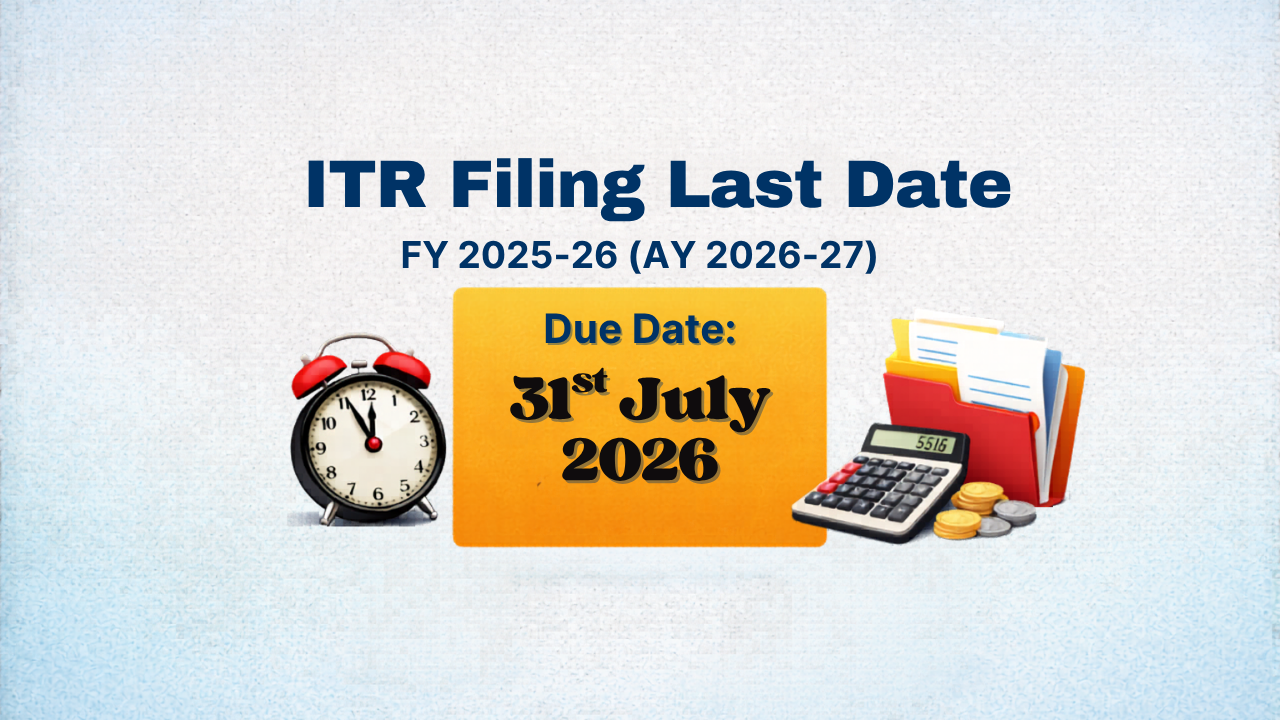
ITR Filing Last Date FY 2025-26 (AY 2026-27)
ITR Filing Last Date 2026: Every Deadline You Need to Know for FY 2025-26
Two financial years. Two different laws. One filing season.
This year’s ITR filing is unlike any before it. For the first time, the income tax portal has two separate tabs: one for FY 2025-26 (governed by the Income Tax Act 1961) and one for Tax Year 2026-27 (governed by the new Income Tax Act 2025). Most people do not know this yet, and many will make mistakes because of it.
With 7 years of experience in income tax and financial education, I have seen the confusion that deadline misunderstandings create every July. This guide gives you every deadline clearly, explains what is new this year, and tells you exactly what to do if you miss a deadline.
Critical Note: When you log in to incometax.gov.in for filing your ITR for FY 2025-26 (the return due July 31, 2026), select Tab 1: Income Tax Act, 1961. Tab 2 is for Tax Year 2026-27 returns that will be filed in 2027. Choosing the wrong tab will invalidate your filing.
ITR Filing Due Dates for FY 2025-26 (AY 2026-27): Complete Table
| Taxpayer Category | ITR Form | Due Date |
|---|---|---|
| Salaried individuals, pensioners, individuals with one house property and interest income | ITR-1 (Sahaj) | July 31, 2026 |
| Individuals with capital gains, two house properties, foreign assets, or directors of companies | ITR-2 | July 31, 2026 |
| Freelancers, consultants, business owners not requiring audit (non-audit) | ITR-3 | August 31, 2026 |
| Presumptive taxation scheme filers (Section 44AD, 44ADA, 44AE) | ITR-4 (Sugam) | August 31, 2026 |
| Businesses and professionals requiring tax audit | ITR-3, ITR-5, ITR-6 | October 31, 2026 |
| Taxpayers with international transactions or transfer pricing (Section 92E) | ITR-3, ITR-6 | November 30, 2026 |
| Trusts, political parties, educational institutions | ITR-7 | October 31, 2026 |
What changed this year: ITR-3 and ITR-4 deadlines have been extended from July 31 to August 31 for non-audit cases. This benefits freelancers and small business owners who previously had to rush alongside salaried employees. Read our complete guide on how to file ITR online for step-by-step instructions.
Important Clarification: Which Law Applies to Your 2026 Filing?
This is the question every taxpayer is asking right now. Here is the clear answer.
| Filing | Income Period | Governing Law | Portal Tab | Due Date |
|---|---|---|---|---|
| ITR for FY 2025-26 | April 1, 2025 to March 31, 2026 | Income Tax Act, 1961 | Tab 1 | July 31, 2026 |
| ITR for Tax Year 2026-27 | April 1, 2026 to March 31, 2027 | Income Tax Act, 2025 | Tab 2 | July 31, 2027 |
For the July 2026 filing season, you are filing for income earned in FY 2025-26. This return uses old forms (Form 16, Form 26AS), old section numbers (Section 80C, Section 192, Section 234A), and Tab 1 on the portal. The new Income Tax Act 2025 does not affect this filing at all.
What Happens If You Miss the ITR Filing Deadline?
Option 1: Belated Return (Section 139(4))
If you miss July 31 or August 31, you can still file a belated return until December 31, 2026.
Consequences of filing a belated return:
- Late filing fee under Section 234F: Rs. 5,000 if total income exceeds Rs. 5 lakh. Rs. 1,000 if total income is below Rs. 5 lakh.
- Interest under Section 234A: 1% per month on unpaid tax from the original due date until you file.
- Loss of carry forward: Capital losses, business losses, and speculative losses cannot be carried forward if ITR is not filed by the original deadline. House property loss can still be carried forward even in a belated return.
Option 2: Revised Return (Section 139(5))
If you filed on time but made a mistake, you can file a revised return until March 31, 2027.
What changed this year: Previously the revised return deadline was December 31. From FY 2025-26 onwards, this has been extended to March 31 of the following year. However, a nominal fee applies if you revise after December 31, 2026.
Common reasons to file a revised return:
- Missed claiming a deduction (Section 80C, 80D, HRA)
- Wrong bank account details entered
- Income from a source accidentally omitted
- Incorrect ITR form selected
Option 3: Updated Return (Section 139(8A))
If you missed both the original and belated return deadlines, or need to add income you did not declare, you can file an updated return within 48 months (4 years) from the end of the assessment year.
For FY 2025-26, the updated return can be filed until March 31, 2031.
Important restrictions on updated returns:
- Additional tax of 25% on tax and interest if filed within 12 months
- Additional tax of 50% on tax and interest if filed between 12 to 24 months
- Additional tax of 60% if filed between 24 to 48 months (new provision from FY 2025-26)
- Cannot claim additional refunds or deductions in an updated return
- Cannot file updated return if assessment proceedings are pending
Interest Penalties: The Exact Cost of Missing Deadlines
Missing a deadline does not just mean a flat fee. Interest accumulates every month until you pay and file. Here is exactly what it costs.
Section 234A: Interest for Late Filing
Rate: 1% per month (or part of a month) on unpaid tax Period: From the due date (July 31 or August 31) until the actual filing date Applicable: Only if there is unpaid tax. If all tax has already been paid (through TDS and advance tax), Section 234A interest is nil.
Section 234B: Interest for Default in Advance Tax
Rate: 1% per month on unpaid tax Period: From April 1 of the assessment year until the date of assessment Applicable: If advance tax paid is less than 90% of total tax liability
Section 234C: Interest for Deferment of Advance Tax Instalments
Rate: 1% per month for 3 months on shortfall at each instalment Applicable: If quarterly advance tax instalments were missed or insufficient
Practical example: Ramesh has a tax liability of Rs. 50,000. TDS covered Rs. 30,000. Balance of Rs. 20,000 was not paid as advance tax. He files his ITR on September 30, 2026 (2 months late).
- Section 234F: Rs. 5,000 (income above Rs. 5 lakh)
- Section 234A: 1% x 2 months x Rs. 20,000 = Rs. 400
- Section 234B: Interest on Rs. 20,000 for the year (approximately Rs. 1,200)
- Total extra cost: Approximately Rs. 6,600
This entire cost is avoidable by filing on July 31 and paying the Rs. 20,000 as self-assessment tax before filing. Use our advance tax payment guide to understand how to calculate and pay tax dues before filing.
What You Lose by Filing Late: Beyond the Penalty
The monetary penalty is only part of the problem. Here is what else is at stake.
1. Loss of Carry Forward Benefits
If you have losses from stocks, mutual funds, F&O trading, or business operations, you can carry them forward to set off against future gains only if you file your ITR by the original deadline. A belated return forfeits this right.
Example: You sold stocks at a loss of Rs. 2 lakh in FY 2025-26. If you file by July 31, you can carry this loss forward and set it off against capital gains in FY 2026-27. If you miss the deadline and file a belated return, this Rs. 2 lakh loss is permanently forfeited.
2. Loan Applications
Banks require the last 2 to 3 years of ITRs for home loans, personal loans, and business loans. A missing or late ITR can delay or reject your loan application.
3. Visa Applications
Foreign embassies, especially for countries like the US, UK, Canada, and Australia, ask for ITR copies as proof of income and financial stability. A gap year in ITR filing raises flags and can affect visa approval.
4. Delayed Refund
If you have excess TDS deducted and are entitled to a refund, filing late means receiving your refund later. Given that refunds are processed faster now (many within weeks of filing), filing early in April itself ensures you get your refund before the July rush.
ITR Filing Calendar: Key Dates at a Glance
| Date | What Happens |
|---|---|
| April 1, 2026 | ITR filing portal opens for FY 2025-26 |
| June 15, 2026 | Employers must issue Form 16 by this date |
| July 31, 2026 | Deadline for ITR-1 and ITR-2 (salaried, capital gains) |
| August 31, 2026 | Deadline for ITR-3 and ITR-4 (freelancers, business, presumptive) |
| October 31, 2026 | Deadline for audit cases (ITR-5, ITR-6, ITR-7) |
| November 30, 2026 | Deadline for transfer pricing cases |
| December 31, 2026 | Last date for belated returns (with penalty) |
| March 31, 2027 | Last date for revised returns (with fee after December 31) |
| March 31, 2031 | Last date for updated returns (ITR-U) for FY 2025-26 |
Why You Should File in April or May, Not July
The deadline is July 31 but filing in April or May has real advantages:
- Faster refund: Refunds for early filers are processed faster. Filing in April means your refund could arrive by May or June.
- Portal not crowded: Every year, the income tax portal slows down dramatically in the last week of July due to crores of simultaneous filings. Early filing avoids this entirely.
- Time to fix errors: Filing early gives you months to spot mistakes and file a revised return if needed, without any fee.
- Verification time: After submitting your ITR, you have 30 days to verify it. An unverified ITR is treated as not filed. Filing early gives you enough time to complete e-verification calmly.
Special Situations: Who Must File Regardless of Income
Even if your income is below the basic exemption limit (Rs. 2.5 lakh for old regime, Rs. 4 lakh for new regime), you must still file an ITR if:
- You deposited more than Rs. 1 crore in bank accounts during the year
- You spent more than Rs. 2 lakh on foreign travel
- Your electricity bill exceeded Rs. 1 lakh during the year
- You have foreign assets or foreign bank accounts
- You are a company or LLP (mandatory regardless of income)
- You have TDS deducted and want to claim a refund
- You want to carry forward losses from the current year
Documents You Need Before Filing
Having these ready will make your filing take 20 minutes instead of 2 hours:
- Form 16 from employer (available after June 15, 2026)
- Form 26AS and Annual Information Statement (AIS) downloaded from income tax portal
- All bank account statements for interest income
- Investment proofs: PPF passbook, ELSS statements, insurance premium receipts, school fee receipts
- Rent receipts and landlord PAN if claiming HRA
- Home loan interest certificate from bank
- Capital gains statements from brokers or mutual fund houses
- Aadhaar linked to PAN (mandatory for e-verification)
- Pre-validated bank account for refund credit
For a complete step-by-step filing process, read our guide on how to file ITR online. And to ensure you are claiming all eligible deductions before filing, read the tax saving tips for salaried employees guide and the complete Section 80C deductions guide.
Frequently Asked Questions on ITR Filing Last Date 2026
What is the ITR filing last date for FY 2025-26?
July 31, 2026 for salaried individuals filing ITR-1 or ITR-2. August 31, 2026 for freelancers and small business owners filing ITR-3 or ITR-4 (non-audit cases). October 31, 2026 for audit cases.
What is the deadline for ITR-4 filers in 2026?
August 31, 2026. This is a new extension from the previous July 31 deadline. ITR-4 filers include those under the presumptive taxation scheme (Section 44AD, 44ADA, 44AE) which covers freelancers, consultants, and small traders.
Can I file ITR after July 31, 2026?
Yes. You can file a belated return until December 31, 2026. A penalty of Rs. 5,000 applies (Rs. 1,000 if income is below Rs. 5 lakh), along with interest under Section 234A on any unpaid tax.
What is the last date for revised ITR for FY 2025-26?
March 31, 2027. This is an extension from the previous December 31 deadline. However, a nominal fee applies if you revise after December 31, 2026. Revised returns can be filed to correct mistakes or add missed deductions.
Which tab should I use on the income tax portal for FY 2025-26 ITR?
Tab 1: Income Tax Act, 1961. Tab 2 is for Tax Year 2026-27 returns that will be filed in 2027. Using Tab 2 for FY 2025-26 returns would be an error.
Does the Income Tax Act 2025 affect my July 2026 ITR filing?
No. The Income Tax Act 2025 applies to income earned from April 1, 2026 onwards (Tax Year 2026-27). Your July 2026 ITR covers income earned in FY 2025-26 (April 2025 to March 2026), which is still governed by the Income Tax Act 1961.
What happens if I do not file ITR at all?
If your income exceeds the basic exemption limit and you do not file, the income tax department can issue a notice, assess your income, and levy interest plus penalties. In cases of significant undeclared income, prosecution provisions can also apply. If you have missed filing for previous years, file an updated return (ITR-U) immediately before the window closes.
Is it mandatory to file ITR if all tax is deducted by employer?
If your total income is below the basic exemption limit after TDS, filing is technically not mandatory. However, filing is strongly recommended because it establishes your income record, helps with loan and visa applications, and allows you to claim any excess TDS as a refund.
What if I have income from freelancing and salary both?
You must file ITR-3. Your deadline would be August 31, 2026 (not July 31), since ITR-3 is used for non-audit professional income. Do not use ITR-1 or ITR-2 if you have freelance income. Read our complete guide on income tax for freelancers for detailed guidance.
The Bottom Line
The ITR filing season for FY 2025-26 runs from April 1, 2026 to July 31, 2026 for most salaried professionals. Filing early, even in April or May, is significantly better than waiting for July. You get your refund faster, avoid portal congestion, and have time to correct any mistakes without penalty.
If you have not already downloaded your Form 26AS and AIS from the income tax portal, do that now. Verify that all TDS credits are correctly reflected before you begin filing. Any mismatch between Form 16 and Form 26AS must be resolved with your employer before filing.
For a complete understanding of your tax obligations including deductions, ITR form selection, and the new Income Tax Act 2025 transition, read the Complete Income Tax Guide India 2025-26 and 2026-27.
Questions about your specific ITR filing situation? Drop them in the comments below.