Belated Return vs Revised Return: Key Differences
You filed your ITR on time but realized you made a mistake. Or you missed the July 31 deadline entirely. Both situations feel equally stressful, but they have completely different solutions and completely different consequences.
Confusing belated return with revised return — or not knowing which one applies to your situation — leads to wrong filings, penalties that could have been avoided, and losing benefits you were entitled to. This guide explains both options clearly, with exact deadlines for FY 2025-26.
The Simple Difference First
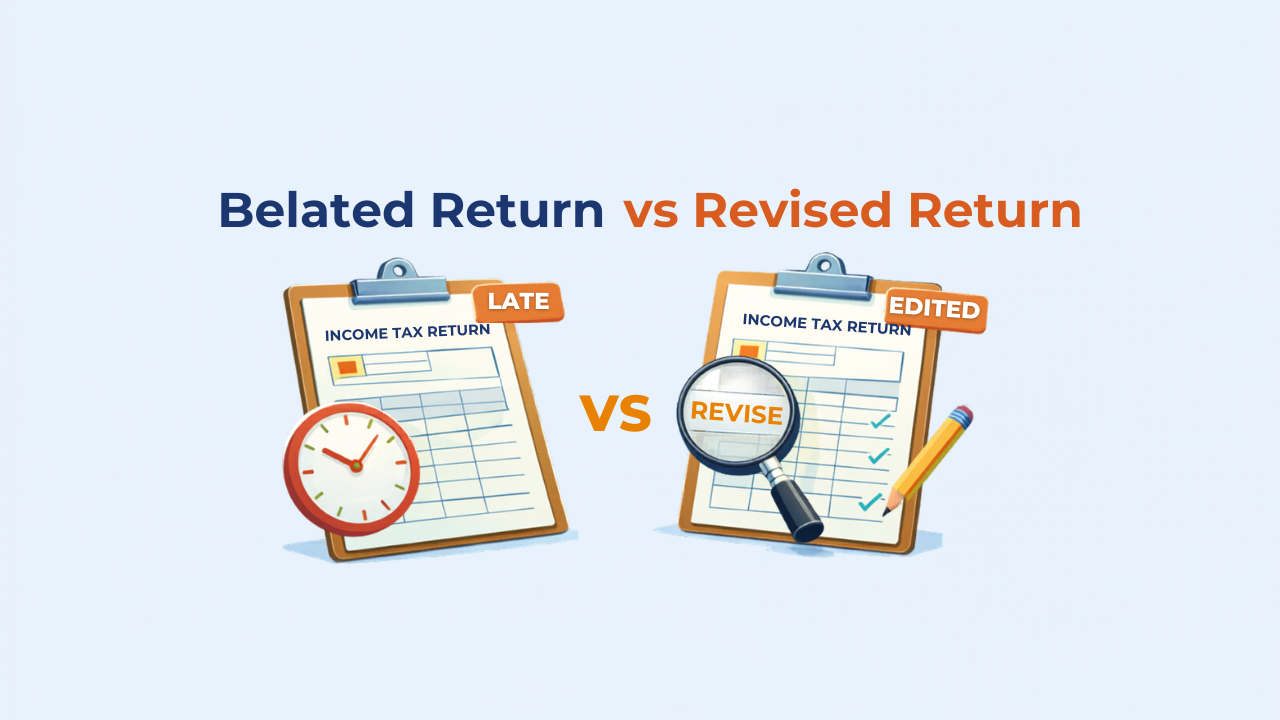
Revised Return: You filed on time but made a mistake. You want to correct it.
Belated Return: You missed the deadline entirely. You are filing late.
These are two different situations governed by two different sections of the Income Tax Act. Revised return falls under Section 139(5). Belated return falls under Section 139(4). Using the wrong one is itself an error that will need to be corrected.
Revised Return Under Section 139(5)
What Is It?
A revised return is a corrected version of a return you already filed within the original deadline. If you filed before July 31, 2026 and then discovered an error, you can file a revised return to fix it.
The revised return completely replaces your original return. It is not an addendum. Whatever you declare in the revised return is what the Income Tax Department processes. Your original return effectively ceases to exist once the revised return is filed.
When to File a Revised Return
You should file a revised return when you discover any of these in your already filed ITR:
Wrong income figures declared. Deduction claimed incorrectly or a deduction missed. Wrong bank account details for refund. Wrong ITR form used (for example, filed ITR-1 but should have filed ITR-2). Income from a source missed — FD interest, dividend, freelance work. TDS mismatch with Form 26AS or AIS. Wrong PAN of landlord for HRA claim. Any typographical error that affects the computation.
Deadline for Revised Return FY 2025-26
Under Budget 2026, the revised return deadline has been extended. For FY 2025-26 (AY 2026-27), you can file a revised return up to March 31, 2027.
Important update: If you file a revised return between January 1, 2027 and March 31, 2027, a late fee applies under the updated Budget 2026 provisions. The fee structure is similar to belated return penalties. To avoid this fee, file your revised return before December 31, 2026.
You can file multiple revised returns within this window. There is no limit on the number of revisions as long as they are within the deadline.
Penalty for Revised Return
Filing a revised return itself attracts no penalty. However, if the revision results in higher taxable income than what you originally declared, interest under Section 234A, 234B, or 234C will apply on the additional tax from the original due date. If you revised because you claimed a wrong deduction and now owe more tax, pay the difference with interest.
What You Cannot Do With a Revised Return
A revised return cannot be used to change your tax regime choice. If you filed under the new tax regime and want to switch to the old regime, a revised return does not allow this change after the original deadline. The tax regime choice for the year is locked once the original return is filed or the deadline passes.
Belated Return Under Section 139(4)
What Is It?
A belated return is an ITR filed after the original due date. If you missed July 31, 2026 (for ITR-1 and ITR-2) or August 31, 2026 (for ITR-3 and ITR-4), you need to file a belated return.
A belated return is still better than not filing at all. It keeps you compliant, allows you to claim refunds, and avoids harsher consequences like prosecution for non-filing in cases of significant tax liability.
Deadline for Belated Return FY 2025-26
You can file a belated return for FY 2025-26 until December 31, 2026. This deadline cannot be extended except in very rare cases with a condonation request approved by the Income Tax Department.
Penalties and Consequences of Belated Return
Late filing fee under Section 234F: Rs. 5,000 if total income exceeds Rs. 5 lakh. Rs. 1,000 if total income is Rs. 5 lakh or below.
Interest under Section 234A: 1% per month or part of month on unpaid tax from the original due date until the date of filing. If you had no tax to pay (all was covered by TDS), Section 234A interest does not apply.
Loss of carry forward benefit: This is the most significant consequence. Business losses and capital losses (short-term and long-term) cannot be carried forward if you file a belated return. You lose the ability to set them off against future gains. The only exception is loss from house property, which can be carried forward even in a belated return.
Forced new tax regime: If you miss the deadline and file a belated return, you cannot opt for the old tax regime. You are compulsorily placed under the new tax regime. This affects people with significant deductions under Section 80C, HRA, home loan interest, and others who benefit from the old regime.
Loss of certain deductions: Some deductions and exemptions cannot be claimed in a belated return. Filing on time preserves all options.
Can a Belated Return Be Revised?
Yes. Since Assessment Year 2017-18, belated returns can be revised. If you file a belated return on October 15, 2026 and then find an error, you can file a revised version of that belated return before December 31, 2026 (the belated return deadline). After December 31, 2026, no further revision of the belated return is possible.
Complete Comparison: Belated vs Revised Return
Who can file: Revised return – only those who filed original return on time. Belated return – those who missed the original deadline.
Governing section: Revised return – Section 139(5). Belated return – Section 139(4).
Last date for FY 2025-26: Revised return – March 31, 2027 (with fee after December 31, 2026). Belated return – December 31, 2026.
Late filing fee: Revised return – No fee if filed before December 31, 2026. Fee applies January to March 2027. Belated return – Rs. 5,000 (or Rs. 1,000 if income below Rs. 5 lakh).
Interest under 234A: Revised return – Only if additional tax is payable. Belated return – Yes, at 1% per month on unpaid tax from original due date.
Loss carry forward: Revised return – Allowed. Belated return – Not allowed for business and capital losses.
Tax regime choice: Revised return – Cannot change regime. Belated return – Forced into new regime.
Refund eligibility: Both revised and belated returns allow refund claims.
Multiple filings: Both can be filed multiple times within their respective deadlines.
Third Option: Updated Return Under Section 139(8A)
If you miss both deadlines — the original July 31 deadline and the December 31 belated return deadline — you still have one option: the Updated Return (ITR-U) under Section 139(8A).
ITR-U can be filed within 48 months (4 years) from the end of the assessment year. For FY 2025-26, this window extends until March 31, 2031.
But ITR-U comes with significant additional tax costs:
If filed within 12 months of the end of assessment year (by March 31, 2027): Additional tax of 25% on tax plus interest payable.
If filed between 12 and 24 months (April 2027 to March 2028): Additional tax of 50%.
If filed between 24 and 36 months (April 2028 to March 2029): Additional tax of 60%.
If filed between 36 and 48 months (April 2029 to March 2031): Additional tax of 70%.
ITR-U cannot be filed if it results in a refund or reduction of tax liability. It is only for declaring missed income or paying additional tax. You cannot use ITR-U to claim deductions you forgot to claim.
Which Option Applies to You: Quick Decision Guide
Filed on time, found an error: File a Revised Return under Section 139(5) before March 31, 2027. No penalty if before December 31, 2026.
Missed July 31 deadline, it is before December 31, 2026: File a Belated Return under Section 139(4) immediately. Pay the penalty and applicable interest.
Missed both deadlines, it is after December 31, 2026: File ITR-U under Section 139(8A) within 4 years. Pay additional tax of 25% to 70% depending on how late.
Filed a belated return but found an error: File a Revised version of the belated return before December 31, 2026.
How to File a Revised Return: Step by Step
Step 1: Log in to incometax.gov.in.
Step 2: Go to e-File then Income Tax Returns then File Income Tax Return.
Step 3: Select Assessment Year 2026-27 and the correct ITR form.
Step 4: Select Filing Type as “Revised Return” (not original).
Step 5: Enter the acknowledgement number of the original return you are revising. This is the 15-digit number from your original ITR-V.
Step 6: Enter the date of filing of the original return.
Step 7: Fill in all details correctly with the corrections. The entire return must be filled again, not just the changed fields.
Step 8: Submit and e-verify within 30 days. For verification methods, read the complete ITR verification guide.
How to File a Belated Return: Step by Step
Step 1: Log in to incometax.gov.in.
Step 2: Go to e-File then Income Tax Returns then File Income Tax Return.
Step 3: Select Assessment Year 2026-27 and the correct ITR form.
Step 4: Select Filing Type as “Belated Return under Section 139(4)”.
Step 5: Fill in all income, deduction, and tax details.
Step 6: Pay the late filing fee of Rs. 5,000 (or Rs. 1,000) through the portal before submitting.
Step 7: Submit and e-verify within 30 days.
Frequently Asked Questions
I filed on time but used the wrong ITR form. Is this a revised return?
Yes. Filing with the correct ITR form using the revised return option under Section 139(5) before December 31, 2026 corrects this without any penalty.
I missed the July 31 deadline but have a refund coming. Should I still file?
Yes, definitely. Filing a belated return is the only way to claim your refund. Refunds are not issued automatically. You must file and e-verify to trigger refund processing. Pay the Section 234F penalty and file before December 31, 2026.
Can I switch from new regime to old regime in a revised return?
No. Tax regime choice is locked once the original return is filed or the deadline passes. A revised return cannot change the regime.
I have capital losses this year. Can I carry them forward if I file a belated return?
No. Business losses and capital losses cannot be carried forward in a belated return. This is one of the most important reasons to file on time. If you have significant capital losses, missing the deadline means losing the carry forward benefit permanently for that year.
Is there any penalty for filing a revised return?
No penalty for the revision itself. However, if the revision results in additional tax liability, interest under Section 234A, 234B, or 234C applies on the extra tax from the original due date. And under Budget 2026, revisions filed between January 1 and March 31, 2027 attract a late fee.
What is the difference between revised return and updated return (ITR-U)?
Revised return is for correcting errors in an already filed return within the December 31 deadline. Updated return (ITR-U) is for disclosing missed income after the December 31 deadline, within 4 years. ITR-U carries heavy additional tax (25% to 70%) and cannot be used to claim missed deductions or generate refunds.
The Bottom Line
The three-tier system for FY 2025-26 ITR filing gives you multiple opportunities to comply: original return by July 31, belated return by December 31, and updated return within 4 years. Each tier comes with progressively higher costs.
File on time if possible. The original deadline preserves all your options — regime choice, loss carry forward, full deduction claims — without any additional cost. Every day after the deadline adds cost and reduces flexibility.
If you have already missed the deadline, file a belated return immediately rather than waiting. The Section 234A interest accumulates every month. And if the December 31 belated return deadline also passes without action, ITR-U is still available but will cost significantly more.
For the complete ITR filing deadline guide including all category-wise due dates, read the ITR filing last date guide. For refund tracking after filing, read the ITR refund status check guide.
Questions about your specific filing situation? Drop them in the comments below.