Income Tax on Trading FY 2026-27: Equity, F&O, Intraday & Crypto Tax Rules
Income from stock trading, futures & options (F&O), and cryptocurrency is taxable in India – and the tax treatment varies based on how you trade. Classifying your trading income correctly as capital gains or business income determines your tax rate, applicable deductions, and which ITR form you must file in FY 2026-27.
⚡ Trading Tax FY 2026-27 – Quick Reference
- STCG (equity held < 12 months): 20% flat (Section 111A)
- LTCG (equity held ≥ 12 months): 12.5% above ₹1.25 lakh per year (Section 112A)
- F&O Trading: Business income – taxed at slab rates
- Intraday Trading: Speculative business income – slab rates, no set-off against non-speculative
- Crypto/VDA: 30% flat tax + 1% TDS (Section 115BBH)
Tax on Equity Share Trading
Short-Term Capital Gains (STCG) – Section 111A
If you sell listed equity shares or equity mutual funds within 12 months of purchase, the gain is Short-Term Capital Gain (STCG) taxed at 20% flat (increased from 15% in Budget 2024, effective from 23 July 2024). No deductions or basic exemption benefit is available against STCG under Section 111A.
Long-Term Capital Gains (LTCG) – Section 112A
Gains from listed equity shares or equity MFs held for more than 12 months are Long-Term Capital Gains. Tax rate: 12.5% (increased from 10% in Budget 2024) on gains exceeding ₹1,25,000 per financial year. LTCG up to ₹1.25 lakh is completely tax-free. No indexation benefit for equity.
Grandfathering Benefit (for pre-January 2018 holdings)
For equity/MF units purchased before 31 January 2018, gains up to 31 January 2018 are grandfathered – cost of acquisition is the higher of actual cost or Fair Market Value on 31 January 2018.
Tax on Futures & Options (F&O) Trading
F&O trading is treated as non-speculative business income under the Income Tax Act. Key implications:
- Taxed at slab rates (not capital gains rates)
- All trading expenses are deductible: brokerage, STT, exchange fees, internet, software, advisory fees
- Losses can be set off against other business income
- F&O losses can be carried forward for 8 years and set off against future F&O profits
- If F&O turnover exceeds ₹1 crore (₹3 crore for 95%+ digital transactions), tax audit required
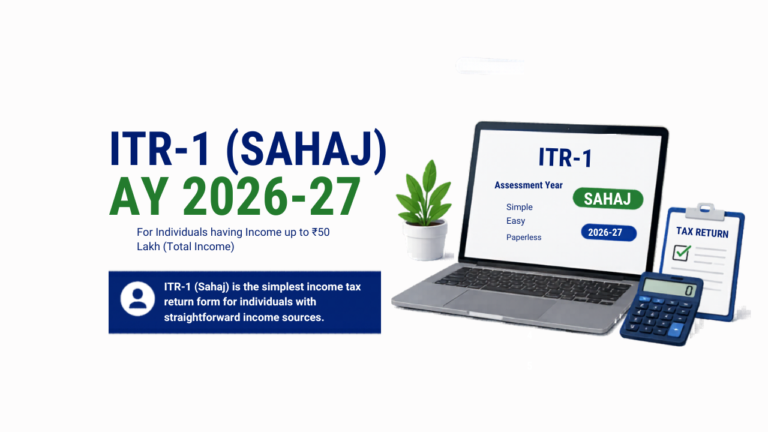
- Must file ITR-3
F&O turnover calculation: Sum of absolute values of all profits and losses (not gross receipts). E.g., +₹5L trade + (−₹2L trade) = ₹7L turnover.
Tax on Intraday Trading
Intraday equity trading (buying and selling the same shares on the same day) is treated as speculative business income:
- Taxed at slab rates
- Speculative losses can only be set off against speculative profits – not against F&O income or salary
- Carry forward for 4 years only (vs 8 years for non-speculative)
Tax on Cryptocurrency and Virtual Digital Assets (VDA)
From FY 2022-23 onwards, all gains from cryptocurrency, NFTs, and virtual digital assets are taxed under Section 115BBH:
- Tax rate: 30% flat on all VDA gains (no deductions except cost of acquisition)
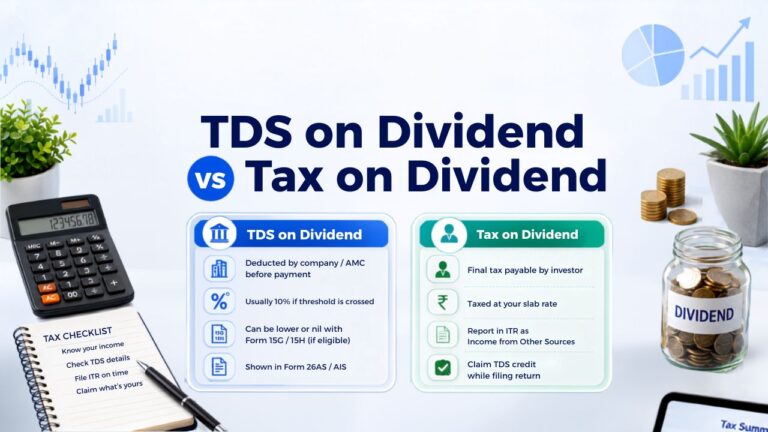
- 1% TDS deducted at source on every transaction above ₹10,000 (₹50,000 for specified persons)
- No set-off of VDA losses against any other income
- VDA losses cannot be carried forward
- Applicable regardless of holding period – no long-term/short-term distinction
Which ITR Form for Traders?
| Trading Type | ITR Form |
|---|---|
| Equity delivery (capital gains only) | ITR-2 |
| F&O trading (with or without salary) | ITR-3 |
| Intraday trading | ITR-3 |
| Crypto/VDA gains | ITR-2 or ITR-3 |
Tax-Loss Harvesting for Equity Investors
Before 31 March each year, review your portfolio for unrealised losses. Selling loss-making positions before year-end allows you to set off those losses against LTCG or STCG, reducing your tax liability. You can repurchase the same stocks after the sale if you want to maintain your portfolio position.
📚 Also Read: