Income tax for women FY 2026-27
Income tax for women FY 2026-27 follows the same slab structure as for men – there is no separate income tax slab for women in India since FY 2012-13. However, women taxpayers benefit from the same zero-tax limit of Rs. 12 lakh under the new regime, an expanded HRA city list from FY 2026-27, and a range of deductions under the old regime that can significantly reduce taxable income. This guide covers everything a woman taxpayer needs to know for FY 2026-27, from slabs and rebates to deductions, real examples, and practical tips.
Is There a Separate Income Tax Slab for Women in India?
No. India discontinued separate income tax slabs for women after FY 2012-13. Before that, women below 65 years of age had a slightly higher basic exemption limit than male taxpayers. Since FY 2013-14, the tax structure has been uniform for all individuals regardless of gender. The same slabs, rebates, and rates apply to women and men under both the new and old tax regimes.
Budget 2026 made no changes to income tax slab rates for FY 2026-27. The slabs announced in Budget 2025 continue unchanged.
Income Tax Slabs for Women FY 2026-27: New Tax Regime
The new tax regime is the default regime from FY 2024-25 onwards. It offers lower tax rates but most deductions and exemptions are not available. Women who do not have significant tax-saving investments or home loans generally benefit more from the new regime.
| Taxable Income | Tax Rate (New Regime) |
|---|---|
| Up to Rs. 4 lakh | Nil |
| Rs. 4 lakh to Rs. 8 lakh | 5% |
| Rs. 8 lakh to Rs. 12 lakh | 10% |
| Rs. 12 lakh to Rs. 16 lakh | 15% |
| Rs. 16 lakh to Rs. 20 lakh | 20% |
| Rs. 20 lakh to Rs. 24 lakh | 25% |
| Above Rs. 24 lakh | 30% |
Key benefit: Under the new regime, resident individuals including women with taxable income up to Rs. 12 lakh pay zero tax due to the Section 87A rebate of Rs. 60,000. For salaried women, the standard deduction of Rs. 75,000 applies additionally, making gross salary up to Rs. 12.75 lakh effectively tax-free. Note that the Section 87A rebate is not available on income taxed at special rates such as capital gains.
An additional 4% health and education cess applies on the tax amount calculated. No separate cess applies to women.
Income Tax for Women FY 2026-27: Old Tax Regime
The old tax regime allows women to claim deductions under Section 80C, 80D, HRA, home loan interest, and many other provisions. It is beneficial for women who have significant investments, pay rent, or have a home loan.
Women Below 60 Years of Age
| Taxable Income | Tax Rate (Old Regime) |
|---|---|
| Up to Rs. 2.5 lakh | Nil |
| Rs. 2.5 lakh to Rs. 5 lakh | 5% |
| Rs. 5 lakh to Rs. 10 lakh | 20% |
| Above Rs. 10 lakh | 30% |
Under the old regime, income up to Rs. 5 lakh is effectively tax-free due to the Section 87A rebate of Rs. 12,500. Standard deduction of Rs. 50,000 also applies for salaried women.
Senior Citizen Women (60 to 80 Years)
| Taxable Income | Tax Rate (Old Regime) |
|---|---|
| Up to Rs. 3 lakh | Nil |
| Rs. 3 lakh to Rs. 5 lakh | 5% |
| Rs. 5 lakh to Rs. 10 lakh | 20% |
| Above Rs. 10 lakh | 30% |
Super Senior Citizen Women (Above 80 Years)
| Taxable Income | Tax Rate (Old Regime) |
|---|---|
| Up to Rs. 5 lakh | Nil |
| Rs. 5 lakh to Rs. 10 lakh | 20% |
| Above Rs. 10 lakh | 30% |
Under the new regime, senior citizen and super senior citizen women do not get a higher basic exemption limit. The Rs. 4 lakh basic exemption applies uniformly to all age groups under the new regime. The higher exemption for senior and super senior citizens is available only under the old regime.
Big Change from FY 2026-27: HRA Expanded to 8 Cities
This is one of the most impactful changes for salaried women living in major Indian cities. From FY 2026-27 onwards, the 50% HRA exemption – previously available only in 4 metro cities — now applies to 8 cities:
- Earlier (up to FY 2025-26): In Delhi, Mumbai, Chennai, Kolkata 50% of basic salary for HRA exemption
- Now (from FY 2026-27): Delhi, Mumbai, Chennai, Kolkata, Bengaluru, Hyderabad, Pune, Ahmedabad — all qualify for 50% HRA exemption
For salaried women in Bengaluru, Hyderabad, Pune, or Ahmedabad, this is a direct tax benefit. Earlier, the HRA exemption for these cities was calculated at 40% of basic salary. From FY 2026-27, it is 50% – a 10 percentage point increase that directly raises the exempt HRA amount and reduces taxable income.
Example: A woman with basic salary of Rs. 60,000 per month in Bengaluru, receiving HRA of Rs. 30,000 per month and paying rent of Rs. 25,000 per month:
- Old rule (40%): HRA exemption capped at Rs. 24,000 per month (40% of Rs. 60,000)
- New rule (50%): HRA exemption capped at Rs. 30,000 per month (50% of Rs. 60,000)
The actual exemption is the lowest of the three HRA conditions. In this case, the 50% city upgrade directly increases the cap and can raise the annual exemption amount. For a complete HRA calculation guide with examples, see our article on HRA exemption calculation.
Note: From FY 2026-27, the landlord relationship must also be disclosed when claiming HRA. This is a new requirement to prevent false HRA claims.
Key Deductions Available for Women Under the Old Tax Regime
| Deduction | Section | Maximum Limit | What It Covers |
|---|---|---|---|
| Standard deduction | Section 16 | Rs. 50,000 | Available to all salaried women automatically |
| Investments (PPF, ELSS, LIC, NSC, EPF, home loan principal, tuition fees) | Section 80C | Rs. 1.5 lakh | Most common tax-saving deduction |
| Additional NPS contribution | Section 80CCD(1B) | Rs. 50,000 | Over and above the Rs. 1.5 lakh 80C limit |
| Health insurance premium (self and family) | Section 80D | Rs. 25,000 (Rs. 50,000 for senior citizens) | Individual and family floater health insurance |
| Health insurance for parents | Section 80D | Additional Rs. 25,000 (Rs. 50,000 if parents are senior citizens) | Parents’ health insurance premium |
| Home loan interest (self-occupied property) | Section 24(b) | Rs. 2 lakh | Interest component of EMI on self-occupied home |
| HRA exemption | Section 10(13A) | Formula-based | For salaried women paying rent |
| Interest on education loan | Section 80E | No limit (for 8 years) | For women who took loans for higher education |
| Interest on savings account | Section 80TTA | Rs. 10,000 | Interest from savings bank account |
| Section 80GG | Section 80GG | Rs. 5,000 per month or actual, whichever is lower | For women who pay rent but do not receive HRA from employer |
| Children education allowance | Section 10(14) | Rs. 3,000 per month per child (up to 2 children) | Raised from Rs. 100 to Rs. 3,000 from FY 2026-27 |
| Hostel expenditure allowance | Section 10(14) | Rs. 9,000 per month per child (up to 2 children) | Raised from Rs. 300 to Rs. 9,000 from FY 2026-27 |
New from FY 2026-27: Children Education and Hostel Allowance Raised
Two allowances that had remained unchanged since 1997 have been significantly revised under the Income Tax Rules 2026:
- Children Education Allowance: Raised from Rs. 100 per month per child to Rs. 3,000 per month per child (for up to 2 children). Annual benefit for two children: Rs. 72,000.
- Hostel Expenditure Allowance: Raised from Rs. 300 per month per child to Rs. 9,000 per month per child (for up to 2 children). Annual benefit for two children in hostel: Rs. 2,16,000.
Combined annual benefit for two children in hostel from FY 2026-27: Rs. 2,88,000 compared to just Rs. 9,600 under the old limits. This is especially relevant for working women with school-going or hostel-staying children. These allowances are available under the old tax regime only.
Deductions Available for Women Under the New Tax Regime
The new regime offers far fewer deductions. The ones available to women under the new regime are:
- Standard deduction: Rs. 75,000 for salaried women (higher than the Rs. 50,000 available under old regime)
- Employer’s NPS contribution: Up to 14% of basic salary under Section 80CCD(2) – no upper rupee cap
- Home loan interest on let-out property: Allowed under Section 24(b) for rented-out properties. Not available for self-occupied property under the new regime.
- Transport allowance for differently-abled persons: Exempt if applicable
HRA exemption, Section 80C investments, Section 80D health insurance, home loan interest on self-occupied property, and LTA are not available under the new regime.
Real Example: Tax Calculation for a Salaried Woman in FY 2026-27
Profile: Priya, salaried software engineer in Bengaluru, age 32. Gross salary Rs. 15 lakh. Pays rent of Rs. 20,000 per month. Basic salary Rs. 7.5 lakh per year. HRA received Rs. 3.75 lakh per year. Investments: PPF Rs. 1 lakh, ELSS Rs. 50,000. Health insurance premium Rs. 20,000.
| Calculation | New Regime | Old Regime |
|---|---|---|
| Gross salary | Rs. 15,00,000 | Rs. 15,00,000 |
| Standard deduction | Rs. 75,000 | Rs. 50,000 |
| HRA exemption | Not available | Rs. 1,92,000 (formula-based, Bengaluru now 50% city) |
| Section 80C | Not available | Rs. 1,50,000 |
| Section 80D | Not available | Rs. 20,000 |
| Total deductions | Rs. 75,000 | Rs. 4,12,000 |
| Taxable income | Rs. 14,25,000 | Rs. 10,88,000 |
| Tax payable (before cess) | Rs. 1,48,750 | Rs. 1,27,600 |
| After 4% cess | Rs. 1,54,700 | Rs. 1,32,704 |
In Priya’s case, the old regime saves approximately Rs. 22,000 in tax. With the Bengaluru HRA now calculated at 50% (previously 40%), her HRA exemption increased compared to FY 2025-26, making the old regime even more attractive for her specifically.
Non-Tax Financial Benefits for Women in India
While the income tax structure itself is gender-neutral, several financial schemes and policies offer additional benefits to women:
- Lower stamp duty on property registration: Several state governments charge lower stamp duty for properties registered in a woman’s name. Maharashtra, Delhi, Punjab, Rajasthan, and UP offer concessions ranging from 1% to 2% lower stamp duty. This is a state-level benefit and varies by location.
- Concessional home loan interest rates: Several banks and housing finance companies offer slightly lower interest rates (typically 0.05% to 0.10% lower) on home loans when the primary applicant is a woman.
- Mahila Samman Savings Certificate: A special small savings scheme for women and girls offering 7.5% interest per annum on deposits up to Rs. 2 lakh for 2 years. Available at post offices. The interest is taxable.
- Sukanya Samriddhi Yojana (SSY): For parents of girl children up to 10 years. Deposits up to Rs. 1.5 lakh per year qualify for Section 80C deduction under old regime. Interest and maturity amount are fully tax-free. Current interest rate is 8.2% per annum.
- Stand-Up India and Mudra Yojana: Government loan schemes for women entrepreneurs. While not a tax benefit directly, lower interest costs reduce business expenses and therefore taxable business income.
- Startup India tax holiday: Women-led startups meeting DPIIT eligibility criteria can claim a 3-year income tax holiday under Section 80-IAC of the old regime.
Which Tax Regime Should Women Choose in FY 2026-27?
| Choose New Regime if | Choose Old Regime if |
|---|---|
| Income is Rs. 12 lakh or below (zero tax under new regime) | You pay rent and claim HRA (especially in 8 expanded cities) |
| You have minimal investments in 80C instruments | You invest Rs. 1.5 lakh or more in PPF, ELSS, LIC etc. |
| You do not have a home loan on self-occupied property | You have a home loan (Rs. 2 lakh interest deduction) |
| You prefer simpler filing with fewer documents | You pay health insurance premiums for self and parents |
| Your income is above Rs. 12.75 lakh with limited deductions | You have children in school or hostel (higher allowances now) |
The break-even point for choosing between regimes depends on the total value of deductions you can genuinely claim. Always calculate tax under both regimes before filing. You can switch between regimes every year if your income is from salary or other non-business sources.
How to File ITR as a Woman Taxpayer in FY 2026-27
- Check your Annual Information Statement (AIS) on the income tax portal before filing. Verify all income, TDS, and transaction entries linked to your PAN.
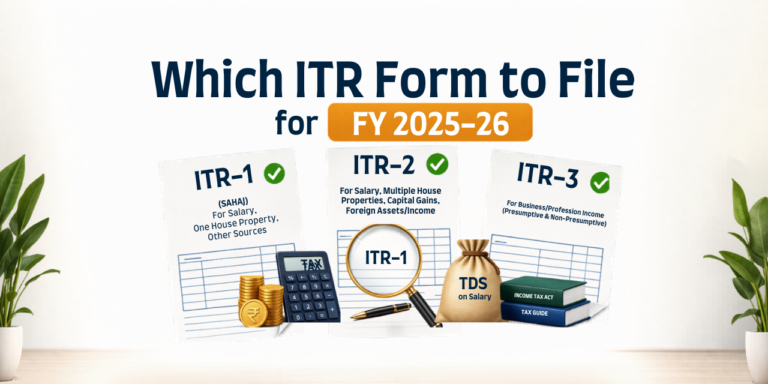
- Choose the correct ITR form based on your income sources. Most salaried women file ITR-1 (if income is from salary, one house property, and other sources up to Rs. 50 lakh) or ITR-2 (if you have capital gains). See our guide on new ITR forms for AY 2026-27.
- Select your tax regime in the ITR form. New regime is default – if you want old regime, explicitly opt out.
- Enter all deductions with actual amounts – do not round up or guess. Keep investment proofs, rent receipts, and insurance certificates ready.
- File before the ITR filing last date 2026. For salaried women, the deadline is July 31, 2026. For a full overview of income tax rules and deductions applicable this year, refer to our complete income tax guide. Filing early gives you time to correct errors before the deadline.
If you have capital gains from stocks, mutual funds, or property, the capital gains tax for FY 2026-27 guide will help you calculate and declare these correctly. Understanding the tax year vs financial year distinction matters especially for the July 2026 filing since it is the first filing season under the new Income Tax Act 2025.
Frequently Asked Questions
Is income tax the same for men and women in India?
Yes. Since FY 2013-14, income tax slabs, rates, and rebates are identical for men and women. There is no gender-based differentiation in the tax structure. The same new regime and old regime apply equally to all individuals regardless of gender.
What is the zero tax income limit for women in FY 2026-27?
Under the new tax regime, taxable income up to Rs. 12 lakh is effectively tax-free due to the Section 87A rebate of Rs. 60,000. For salaried women, the standard deduction of Rs. 75,000 is additionally available, making gross salary up to Rs. 12.75 lakh effectively tax-free. Under the old regime, income up to Rs. 5 lakh is tax-free. These limits apply equally to men and women.
Can a housewife or homemaker file income tax return?
Yes. A housewife must file an ITR if her total income exceeds the basic exemption limit. Income from interest on bank deposits, rental income from property, capital gains from selling investments, or income from freelance work are all taxable. If total income is below the exemption limit but she has received a TDS deduction, filing an ITR allows her to claim a refund. You can file for free on the Income Tax Portal.
What is Sukanya Samriddhi Yojana and is it tax-free?
Sukanya Samriddhi Yojana (SSY) is a government savings scheme for girl children below 10 years. Annual deposits up to Rs. 1.5 lakh qualify for Section 80C deduction under the old tax regime. The interest earned and the maturity amount are fully exempt from tax. The current interest rate is 8.2% per annum. This is one of the most tax-efficient savings instruments available specifically for families with girl children.
I live in Hyderabad. Does the 50% HRA rule apply to me from FY 2026-27?
Yes. From FY 2026-27, Hyderabad is included in the expanded list of cities qualifying for the 50% HRA exemption. Previously, Hyderabad was treated as a non-metro city with a 40% cap. The change applies to salary earned from April 1, 2026 onwards. This benefit is available only under the old tax regime and only if you receive HRA as part of your salary and pay rent. See our detailed guide on HRA exemption calculation for the full formula and examples.
Can a woman change her tax regime every year?
Yes. Women with salary or other non-business income can switch between the old and new tax regimes every financial year. The choice is made when filing the ITR. If you have business income, switching is restricted and you can change only once. Since the new regime is the default, you need to explicitly opt for the old regime each year at the time of filing if you want its deductions.