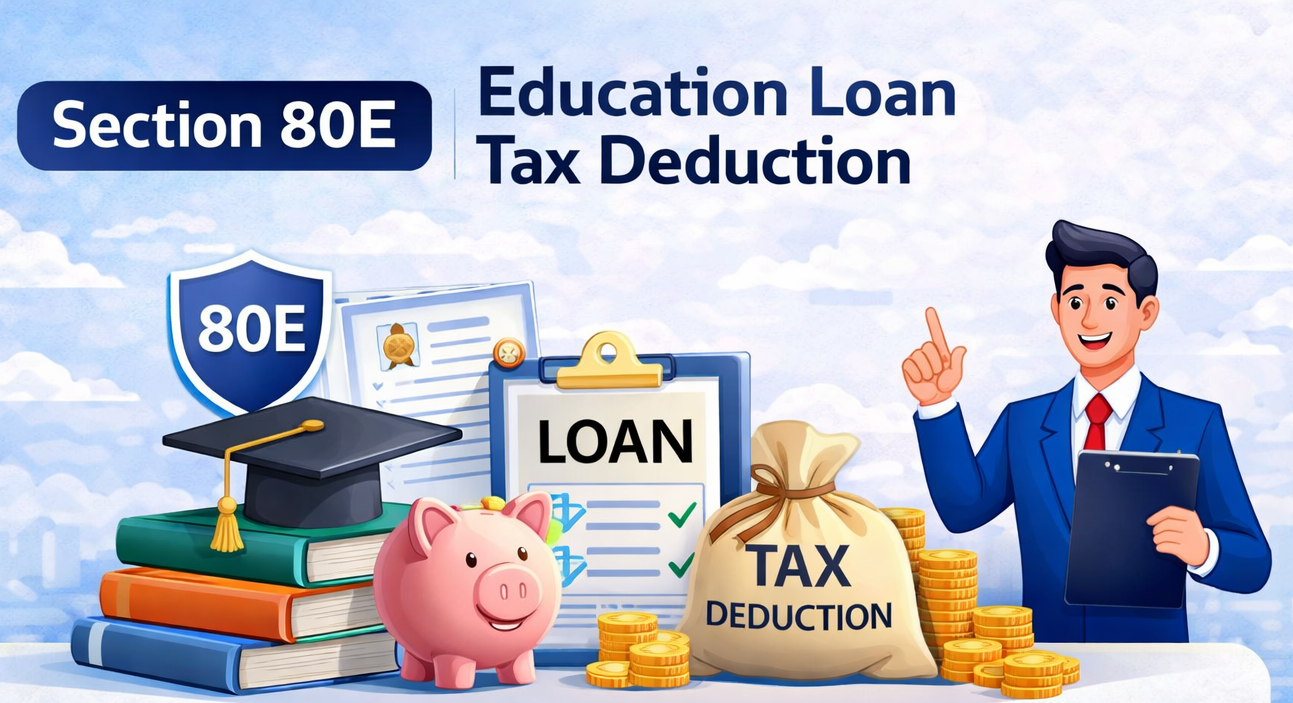
Section 80E: Education Loan Tax Deduction Guide
The One Tax Deduction With No Upper Limit That Most Professionals Overlook
Section 80E education loan deduction is unique among all income tax provisions in India. Almost every other tax-saving deduction has a cap. Section 80C is capped at Rs. 1,50,000. Section 80D is capped at Rs. 1,00,000. HRA exemption depends on your salary and rent.
Section 80E is different. It has no upper limit.
If you paid Rs. 3,00,000 in education loan interest this year, the entire Rs. 3,00,000 is deductible. If you paid Rs. 6,00,000, the entire Rs. 6,00,000 is deductible. There is no ceiling.
Yet this is one of the least-claimed deductions among salaried professionals. Many people repaying education loans either do not know this exists, or assume it only applies to loans taken for their own education. Both assumptions are wrong.
This guide covers everything you need to know about Section 80E: who can claim it, what qualifies, how to calculate the benefit, and the specific situations most people miss.
Important: Section 80E is available only under the old tax regime. If you have chosen the new tax regime, this deduction cannot be claimed. Before reading further, confirm your regime. If you are unsure which regime saves you more, read the old vs new tax regime comparison first.
What Is Section 80E?
Section 80E of the Income Tax Act allows individual taxpayers to claim a deduction on the interest paid on education loans taken for higher education. The deduction applies only to the interest component of your EMI, not the principal repayment.
Under the Income Tax Act 2025 (effective April 1, 2026), Section 80E has been renumbered but the benefit remains identical. The deduction amount, eligibility conditions, and 8-year duration are all unchanged.
Section 80E at a Glance
| Feature | Details |
|---|---|
| Maximum Deduction | No upper limit. Entire interest paid is deductible. |
| What is Deductible | Interest component only, not principal |
| Duration | Maximum 8 years from the year repayment begins |
| Who Can Claim | Individual taxpayers only (not HUF, firms, or companies) |
| Loan Source | Recognized financial institution or approved charitable trust only |
| Education Type | Higher education (after Class 12) in India or abroad |
| Tax Regime | Old tax regime only |
Who Can Claim Section 80E?
You can claim Section 80E if you are repaying an education loan taken for:
- Your own higher education
- Your spouse’s higher education
- Your children’s higher education
- A student for whom you are the legal guardian
This is a point many professionals miss. You do not need to be the student yourself to claim this deduction. If you took a loan for your child’s engineering degree or your spouse’s MBA, and you are the one repaying it, you can claim the deduction.
Who cannot claim Section 80E:
- HUFs (Hindu Undivided Families)
- Companies or firms
- Anyone who borrowed from friends, family, or informal sources
What Qualifies as Higher Education Under Section 80E?
Higher education means any course pursued after completing the Senior Secondary Examination (Class 12) or its equivalent. This includes:
- Graduate and postgraduate degrees (BA, BCom, BSc, MA, MCom, MSc)
- Professional courses (MBBS, LLB, CA, CS, CMA)
- Engineering degrees (BTech, MTech)
- Management courses (MBA, PGDM)
- Vocational and skill-based courses after Class 12
- Diploma courses from recognized institutions
- Courses pursued abroad (from recognized foreign universities)
The definition is broad enough to include most formal education taken after Class 12, whether in India or overseas.
Which Loan Sources Qualify?
Only loans from specific sources qualify for Section 80E deduction:
Eligible sources:
- Scheduled banks (SBI, HDFC Bank, ICICI Bank, etc.)
- NBFCs (Non-Banking Financial Companies) approved for education lending
- Approved charitable trusts and institutions
Not eligible:
- Loans from parents, siblings, relatives, or friends
- Loans from unregistered institutions
- Credit card debt used for education expenses
- Personal loans used for education (unless specifically structured as an education loan by the bank)
This is a critical distinction. Even if you borrowed money from a relative specifically for education and paid interest on it, that interest does not qualify under Section 80E. The loan must be from a formal, recognized source.
How to Calculate Your Section 80E Benefit
The calculation is straightforward because there is no upper limit. Your entire interest payment for the year is deductible.
Example 1: Recent graduate repaying own loan
Rahul took an education loan of Rs. 15,00,000 for his MBA. Annual interest in FY 2026-27: Rs. 1,20,000. He is in the 20% tax bracket.
| Item | Amount |
|---|---|
| Gross Salary | Rs. 9,00,000 |
| Standard Deduction | Rs. 50,000 |
| Section 80C | Rs. 1,50,000 |
| Section 80E (education loan interest) | Rs. 1,20,000 |
| Taxable Income | Rs. 5,80,000 |
| Tax Saved from 80E alone | Rs. 24,960 (Rs. 1,20,000 x 20% + 4% cess) |
Example 2: Parent repaying child’s medical college loan
Priya’s daughter is studying MBBS. Priya took a Rs. 25,00,000 education loan. Annual interest in FY 2026-27: Rs. 2,50,000. Priya is in the 30% tax bracket.
| Item | Amount |
|---|---|
| Section 80E deduction | Rs. 2,50,000 (full interest, no cap) |
| Tax saved at 30% bracket | Rs. 78,000 (Rs. 2,50,000 x 30% + 4% cess) |
Rs. 78,000 saved every year, just by claiming interest that she is already paying anyway. No additional investment required.
The 8-Year Rule: How It Works
Section 80E deduction is available for a maximum of 8 consecutive years, starting from the year you begin repaying the loan. This is calculated from the year interest repayment begins, not from the year the loan was taken.
Example: Loan repayment starts in FY 2024-25.
| Year | 80E Claim Available? |
|---|---|
| FY 2024-25 (Year 1) | Yes |
| FY 2025-26 (Year 2) | Yes |
| FY 2026-27 (Year 3) | Yes |
| FY 2027-28 (Year 4) | Yes |
| FY 2028-29 (Year 5) | Yes |
| FY 2029-30 (Year 6) | Yes |
| FY 2030-31 (Year 7) | Yes |
| FY 2031-32 (Year 8) | Yes |
| FY 2032-33 (Year 9 onwards) | No, benefit ends |
If the loan is fully repaid before 8 years, the benefit stops when repayment ends. For example, if you repay the full loan in 5 years, you can only claim for those 5 years, not 8.
Practical implication: Some borrowers deliberately avoid prepaying education loans quickly specifically to continue claiming this deduction for the full 8 years. Whether this makes financial sense depends on the loan interest rate versus the tax benefit. At a 10% interest rate and 30% tax bracket, the effective post-tax interest rate is only 7%, making the loan cheaper to hold than it appears.
Section 80E vs Section 80C: Key Differences
| Feature | Section 80E | Section 80C |
|---|---|---|
| Maximum deduction | No limit | Rs. 1,50,000 |
| What qualifies | Education loan interest only | Investments and specified expenses |
| Duration | Maximum 8 years | Every year, no time limit |
| New investment required | No (claimed on existing EMI) | Yes (requires investment) |
| Regime | Old only | Old only |
Both can be claimed simultaneously. Claiming Section 80E does not reduce your Section 80C limit. Read the complete Section 80C guide to ensure you are claiming all 14 available options alongside your 80E benefit.
Documents Required to Claim Section 80E
The primary document required is an interest certificate from your lender. This certificate must separately show:
- Total EMI paid during the financial year
- Principal component for the year
- Interest component for the year
You claim only the interest amount shown in this certificate as your Section 80E deduction.
You do not need to attach this certificate to your ITR. However, keep it safely for at least 6 years in case the tax department asks for verification during scrutiny.
Most banks provide this certificate automatically in April or May for the previous financial year. If you have not received it, log in to your bank’s portal or request it from your branch. For the complete guide on how to file ITR online, including where to enter this deduction in the ITR form, refer to the dedicated guide.
File your return directly at the official portal: incometax.gov.in
How to Submit 80E Claim to Your Employer
At the start of the financial year, your employer collects investment declarations via Form 12BB. Declare your expected education loan interest payment for the year in this form.
Your employer will then reduce your monthly TDS accordingly throughout the year.
If you miss the employer declaration deadline, claim the deduction directly in your ITR. Any excess TDS already deducted will come back as a refund.
Special Situations: What Most Guides Do Not Cover
Situation 1: Loan Taken for Studies Abroad
Education loans for courses at foreign universities qualify under Section 80E, provided the loan is taken from an Indian bank or recognized financial institution. The course must be higher education (post Class 12). There is no restriction on the country where you study.
Situation 2: Moratorium Period Interest
Many education loans have a moratorium period during which the student does not repay EMIs (typically the course duration plus 6 to 12 months). During this period, interest accrues and is added to the principal.
The 8-year deduction window starts from the year you begin actual repayment, not from the year the loan was taken. So the moratorium period does not eat into your 8-year benefit window.
Situation 3: Loan Transferred to Another Bank
If you transfer your education loan to another bank for a lower interest rate, the Section 80E benefit continues on the interest paid to the new lender. The 8-year count continues from the original repayment start date, not from the transfer date.
Situation 4: Both Spouses Have Education Loans
Both spouses can claim Section 80E separately for their own education loan interest. Each claim is independent and does not affect the other’s deduction.
Situation 5: Parent Repaying Child’s Loan
If the loan was taken in the child’s name but the parent is the co-borrower and is repaying, the parent can claim the Section 80E deduction. The key condition is that the person repaying the loan is the one claiming the deduction.
Common Mistakes to Avoid
Mistake 1: Not claiming because the loan is in the child’s name
If you are the co-borrower repaying a loan taken in your child’s name, you can still claim the deduction. Do not leave this benefit unclaimed.
Mistake 2: Claiming principal repayment under 80E
Only the interest component qualifies. Principal repayment of an education loan does not qualify under 80E. Principal repayment of home loans qualifies under Section 80C, but education loan principal has no deduction provision.
Mistake 3: Assuming 8 years starts from when the loan was taken
The 8-year window starts from the year repayment begins, not from the loan disbursement date. Loans with a moratorium period effectively give you more time.
Mistake 4: Not claiming in the new tax regime without verifying regime
Section 80E is not available in the new tax regime. However, this should be part of your regime selection decision, not a reason to miss the benefit entirely. If Section 80E gives you a large deduction, it may push the old regime to be more beneficial. Always calculate both regimes including this deduction before choosing.
Mistake 5: Missing the employer declaration
If you do not declare expected education loan interest to your employer in April, your employer will deduct higher TDS throughout the year. You recover the excess at ITR filing, but it hurts your monthly cash flow. Always declare at the start of the year.
Frequently Asked Questions on Section 80E
What is the maximum deduction under Section 80E?
There is no maximum limit. The entire interest paid on a qualifying education loan during the financial year is deductible under Section 80E. This makes it unique among income tax deductions, which typically have a fixed cap.
Can I claim Section 80E for a loan taken for my child’s education?
Yes. If you took the loan for your child’s higher education and you are repaying it, you can claim Section 80E. The deduction is available for loans taken for self, spouse, children, or any student for whom you are the legal guardian.
Is Section 80E available in the new tax regime?
No. Section 80E is available only under the old tax regime. If you have chosen the new regime, you cannot claim this deduction. Consider whether this deduction, combined with others like Section 80C and Section 80D, makes the old regime more beneficial for you.
Can I claim 80E for a personal loan used for education?
Generally no. The loan must be specifically structured and documented as an education loan from a recognized bank or financial institution. A personal loan used for education does not qualify, even if you can demonstrate it was used for education purposes.
Does the 8-year limit apply even if the loan is repaid earlier?
Yes. If the loan is repaid in 5 years, the deduction is available only for those 5 years, not for 8. The 8-year limit is a maximum, not a guarantee. The benefit ends when repayment ends or at 8 years, whichever is earlier.
Can I claim Section 80E for a loan taken for an online course?
It depends on whether the course qualifies as higher education under the Act. The course must be from a recognized institution and must be a full-time or recognized vocational program after Class 12. Informal online courses or certifications from non-recognized platforms typically do not qualify.
What document do I need to claim Section 80E?
You need an interest certificate from your lender showing the interest and principal components separately for the financial year. This is the primary document. Keep it safely even though you do not attach it to the ITR.
Can both husband and wife claim 80E if both have education loans?
Yes. Both can claim Section 80E separately for their respective education loan interest. Each claim is independent.
The Bottom Line
Section 80E is one of the most valuable deductions available to salaried professionals repaying education loans, precisely because it has no upper limit. A professional in the 30% bracket with Rs. 2,00,000 in annual education loan interest saves Rs. 62,400 in taxes every year, simply by claiming what they are already paying.
The deduction requires no additional investment. It applies automatically to interest you are already paying on a qualifying loan. The only requirement is claiming it correctly in your ITR or employer declaration.
If you are repaying an education loan and have not been claiming Section 80E, check whether you are in the old regime and whether your lender qualifies. The tax saved over the 8-year window can be substantial.
For the complete picture of all tax deductions available including Section 80C, Section 80D, and HRA exemption, read the Complete Income Tax Guide India 2025-26 and 2026-27.
Questions about your specific education loan situation? Drop them in the comments below.
📚 Also Read: